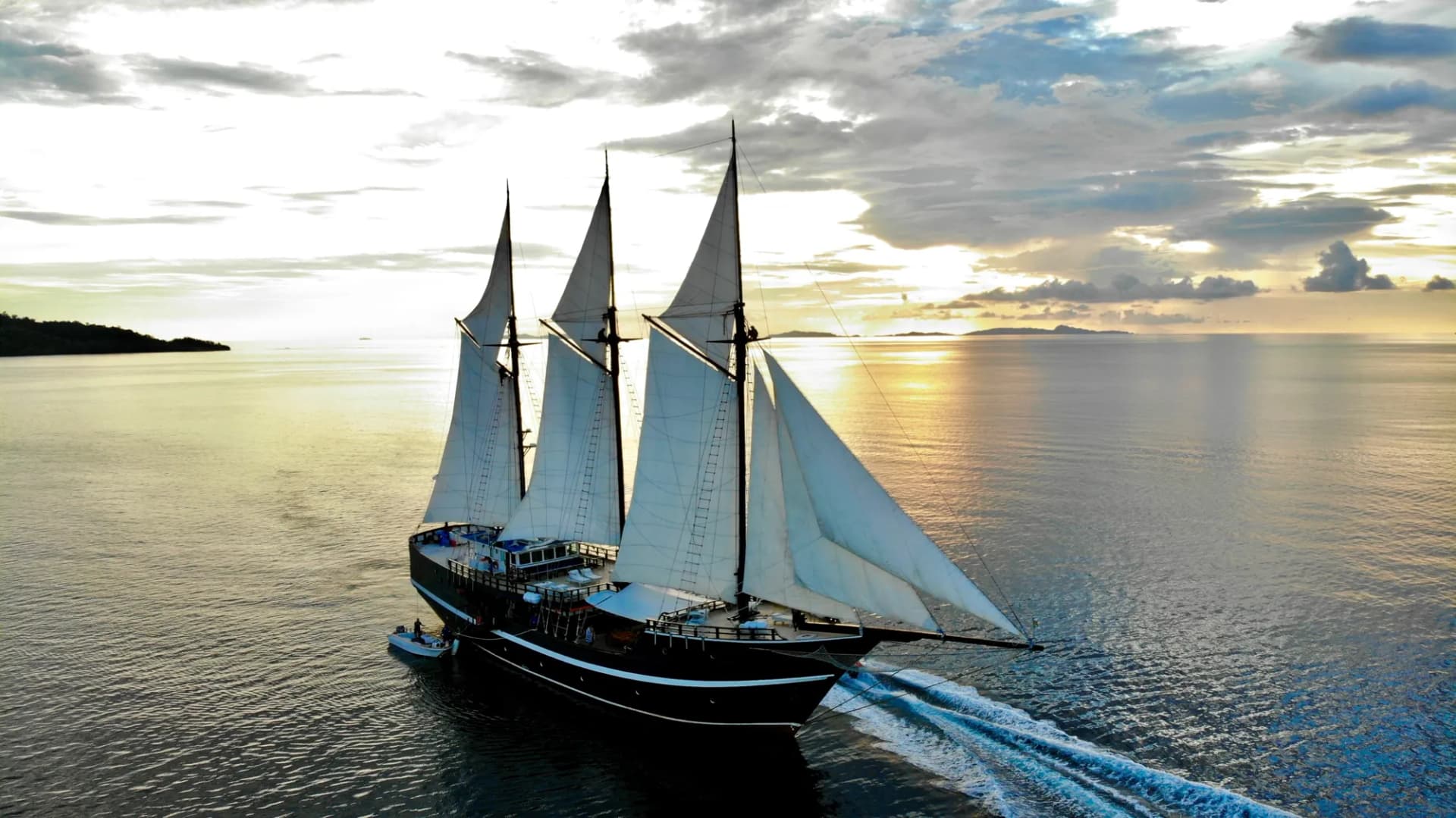
Dewi Nusantara
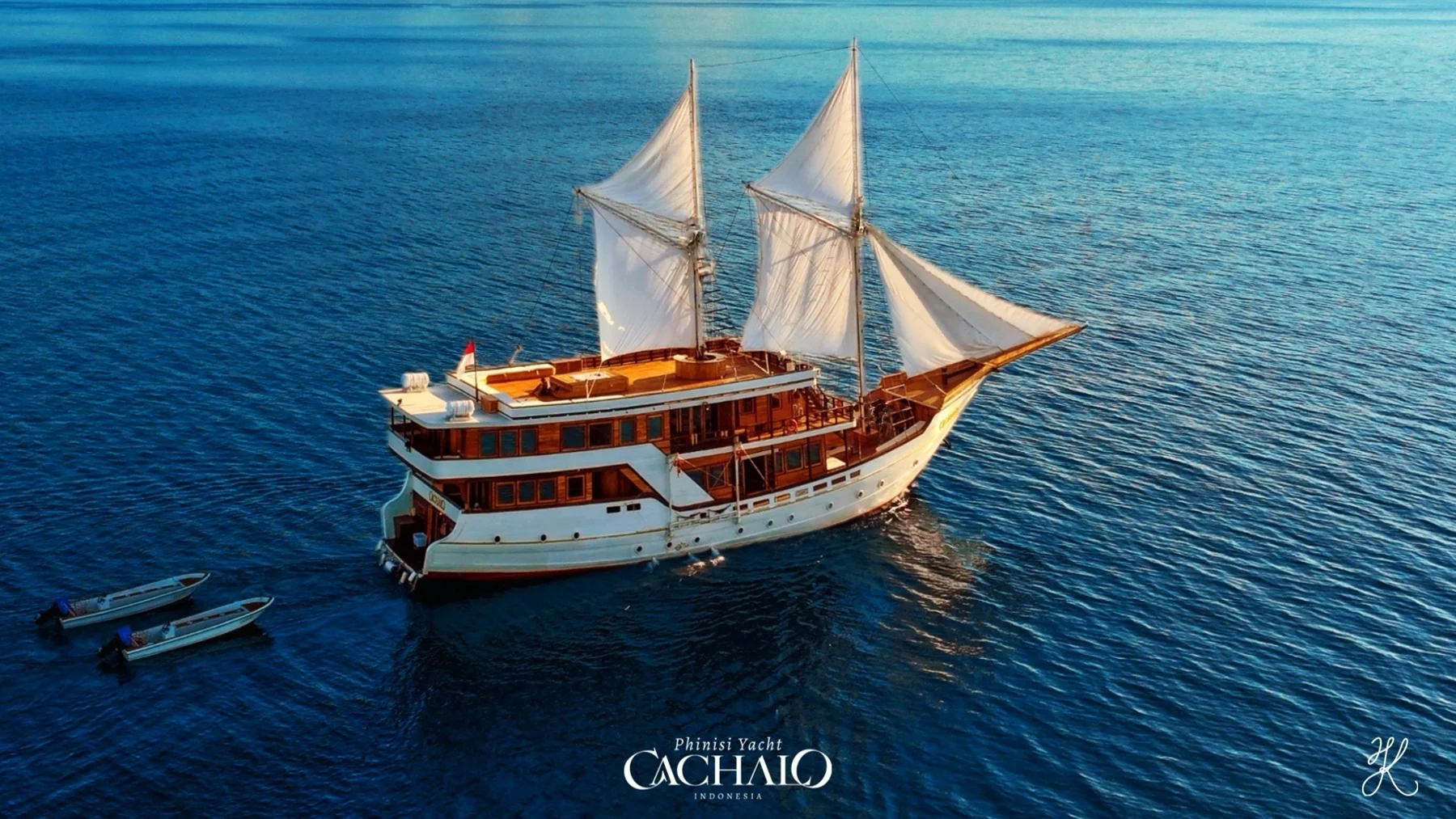
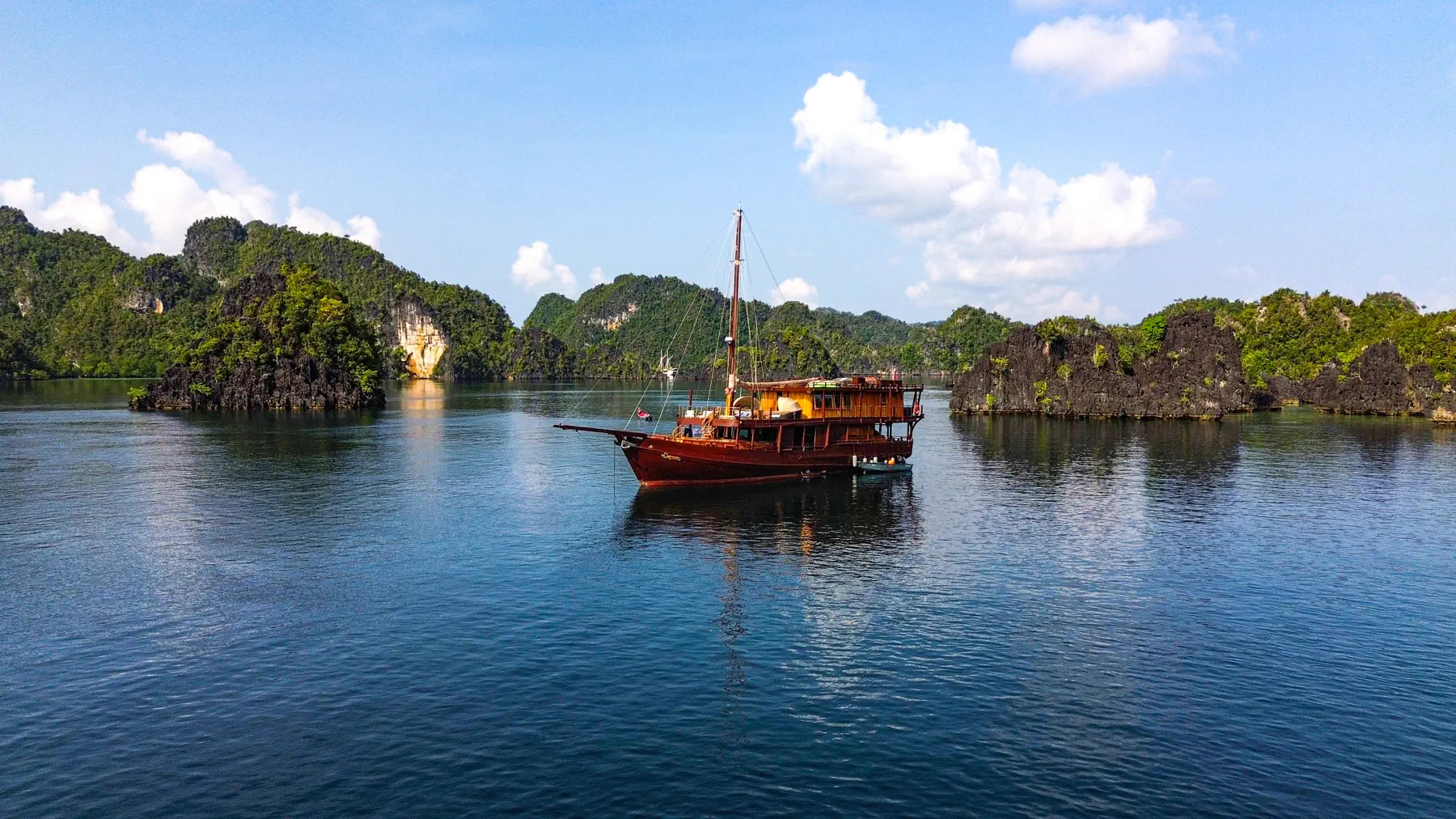
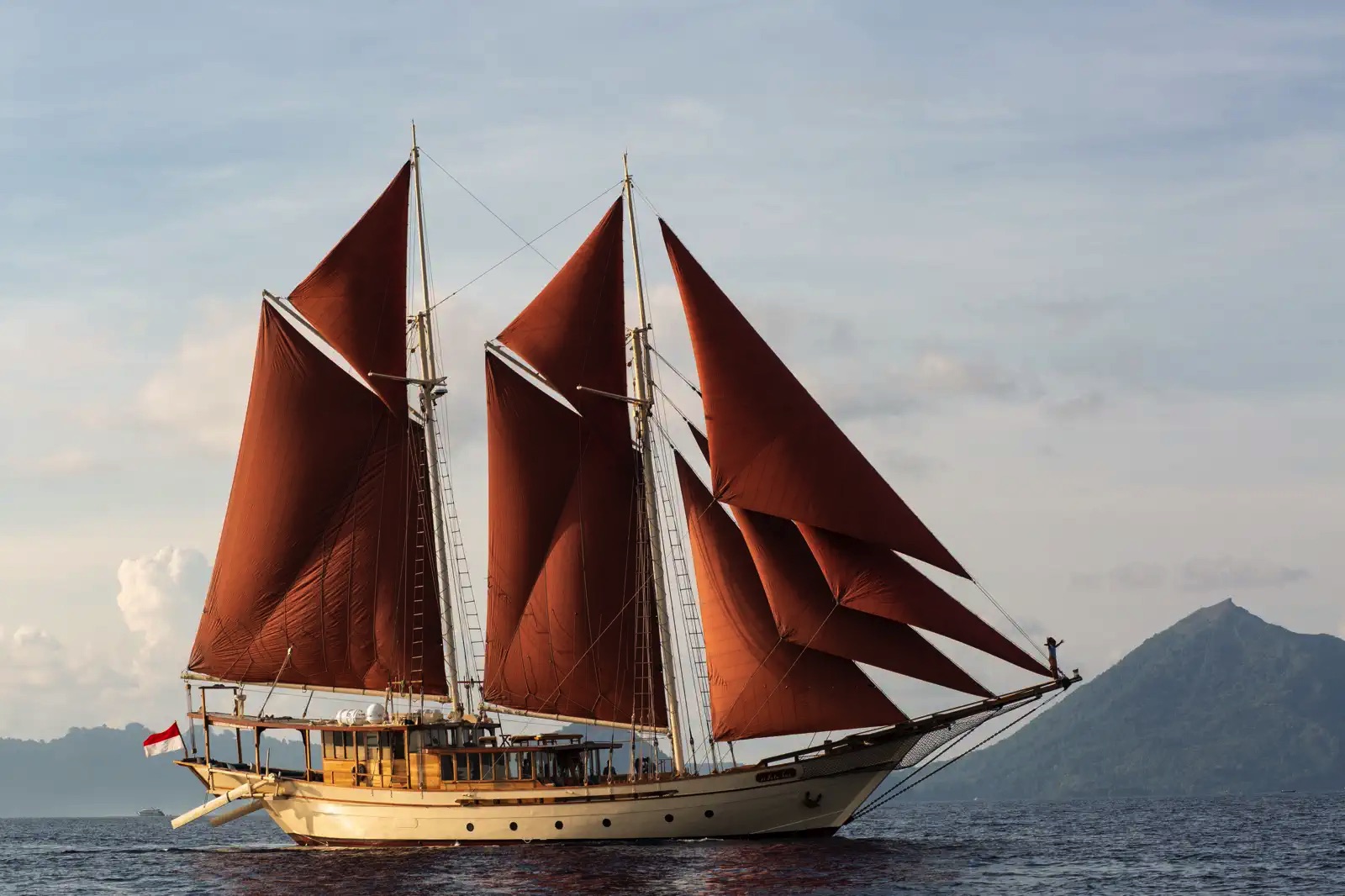
Dewi Nusantara is a 58-metre schooner running dive trips across Indonesia’s remote islands. She carries two 500-horsepower engines and desalination systems producing 5000 litres of fresh water a day. There are eight Deluxe Staterooms, each convertible between a double and twin singles, all with en-suite bathrooms, plus a Master Cabin.
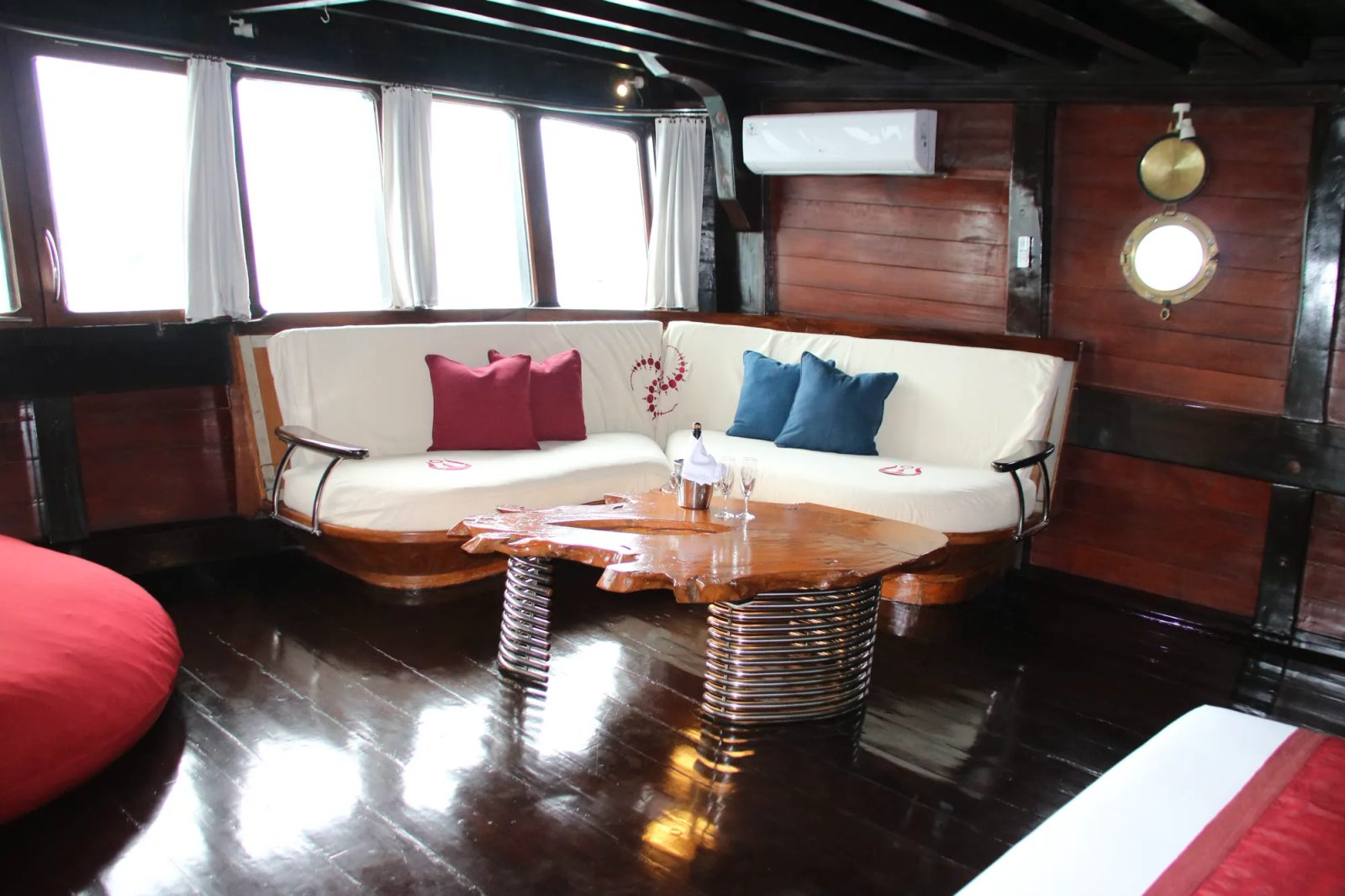
Guests enjoy the charm of a historic vessel with modern amenities such as expansive lounge areas, outdoor relaxation spaces, and two sun decks. Dining onboard is a five-star experience, complemented by a dedicated crew of 19, including a cruise director and four seasoned dive masters. Dewi Nusantara promises an exceptional journey for diving enthusiasts seeking both comfort and adventure at sea.
The Cabins
The cabins are laid out for long trips, with storage and bathroom space to match.
Master Cabin


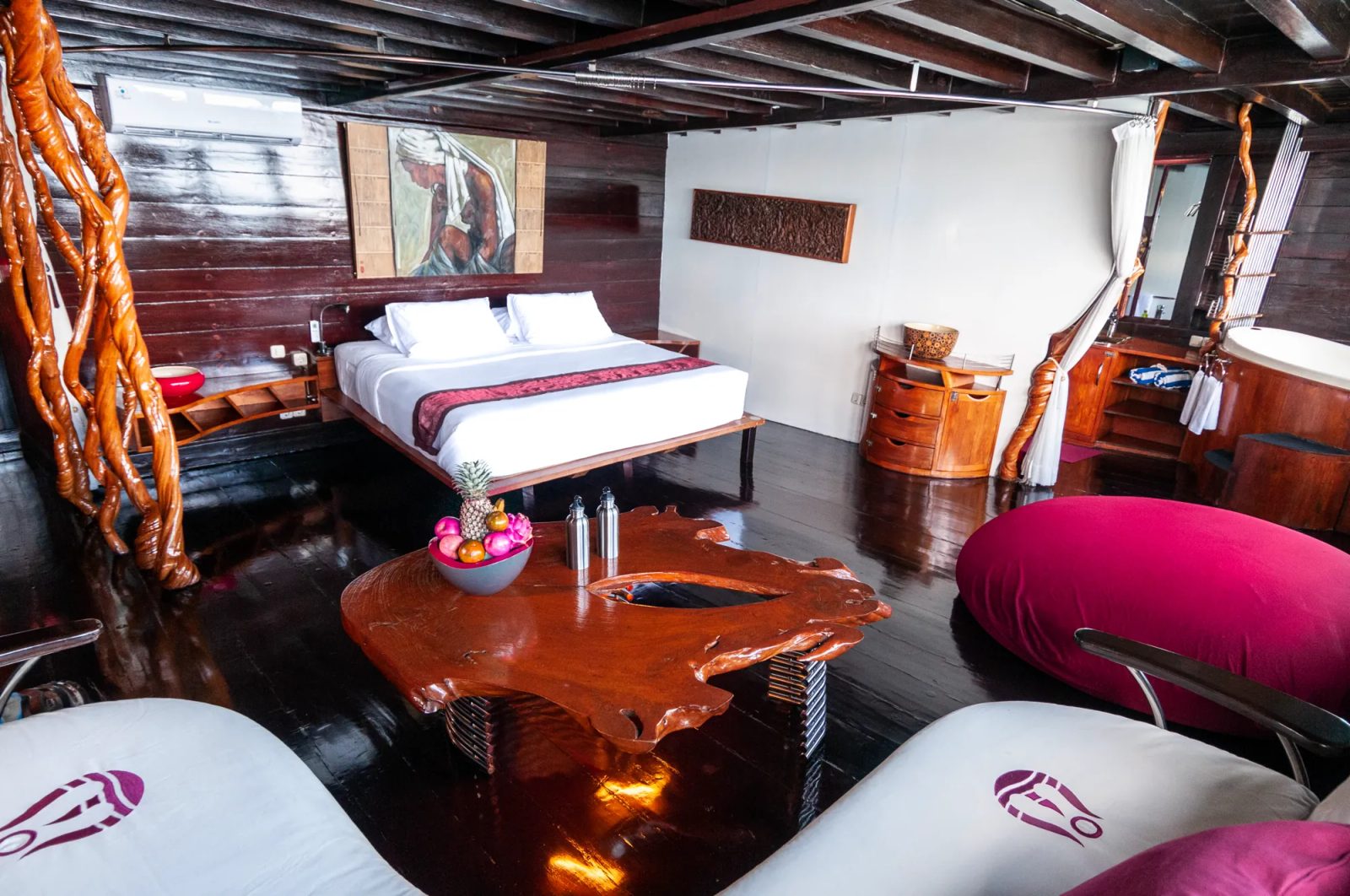
The Master Cabin sits at the aft of the boat and is the largest on board, roughly the size of a hotel suite, with sea views. It has a double bed, plenty of storage and an en-suite bathroom.
Deluxe Staterooms


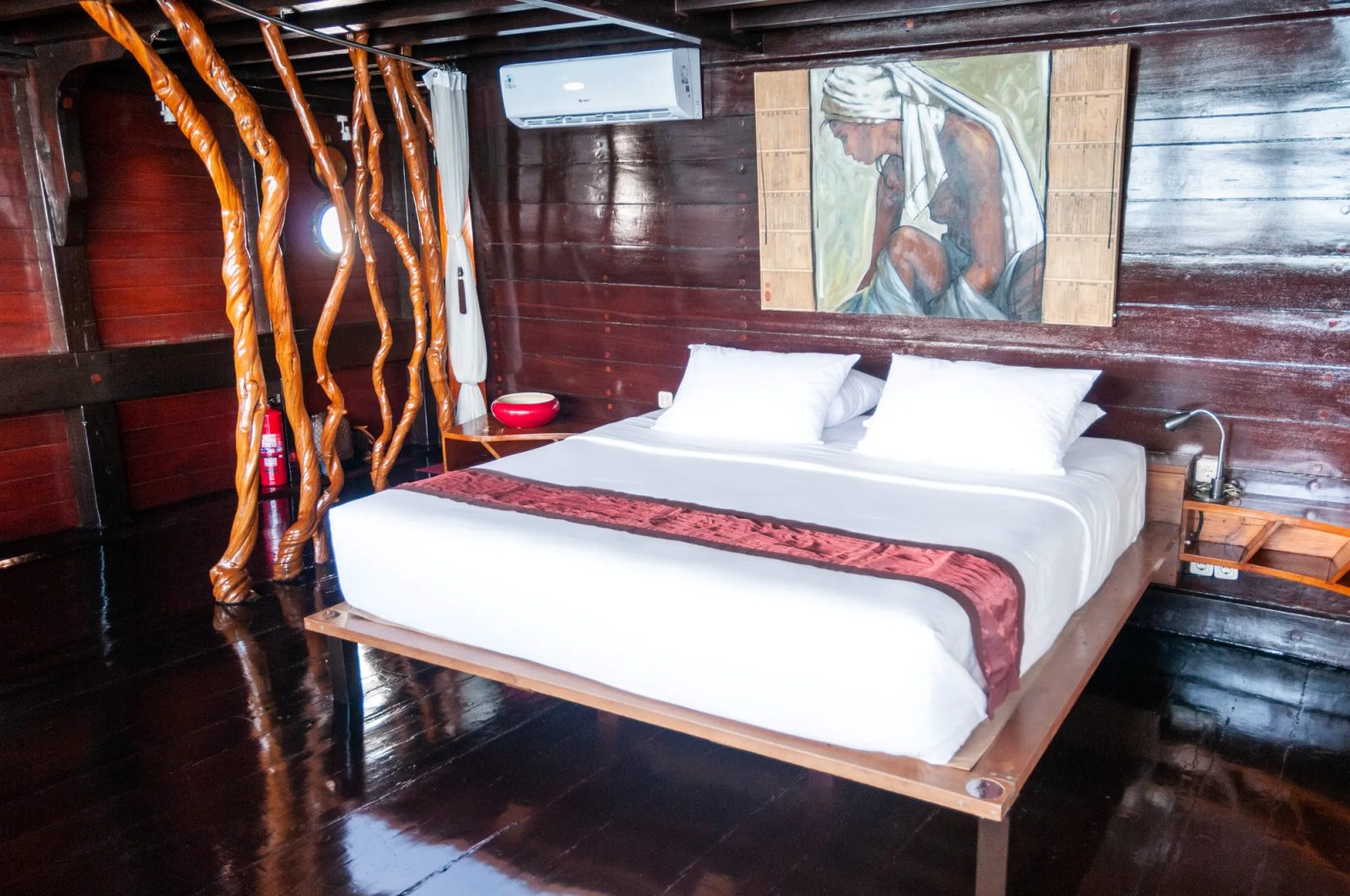
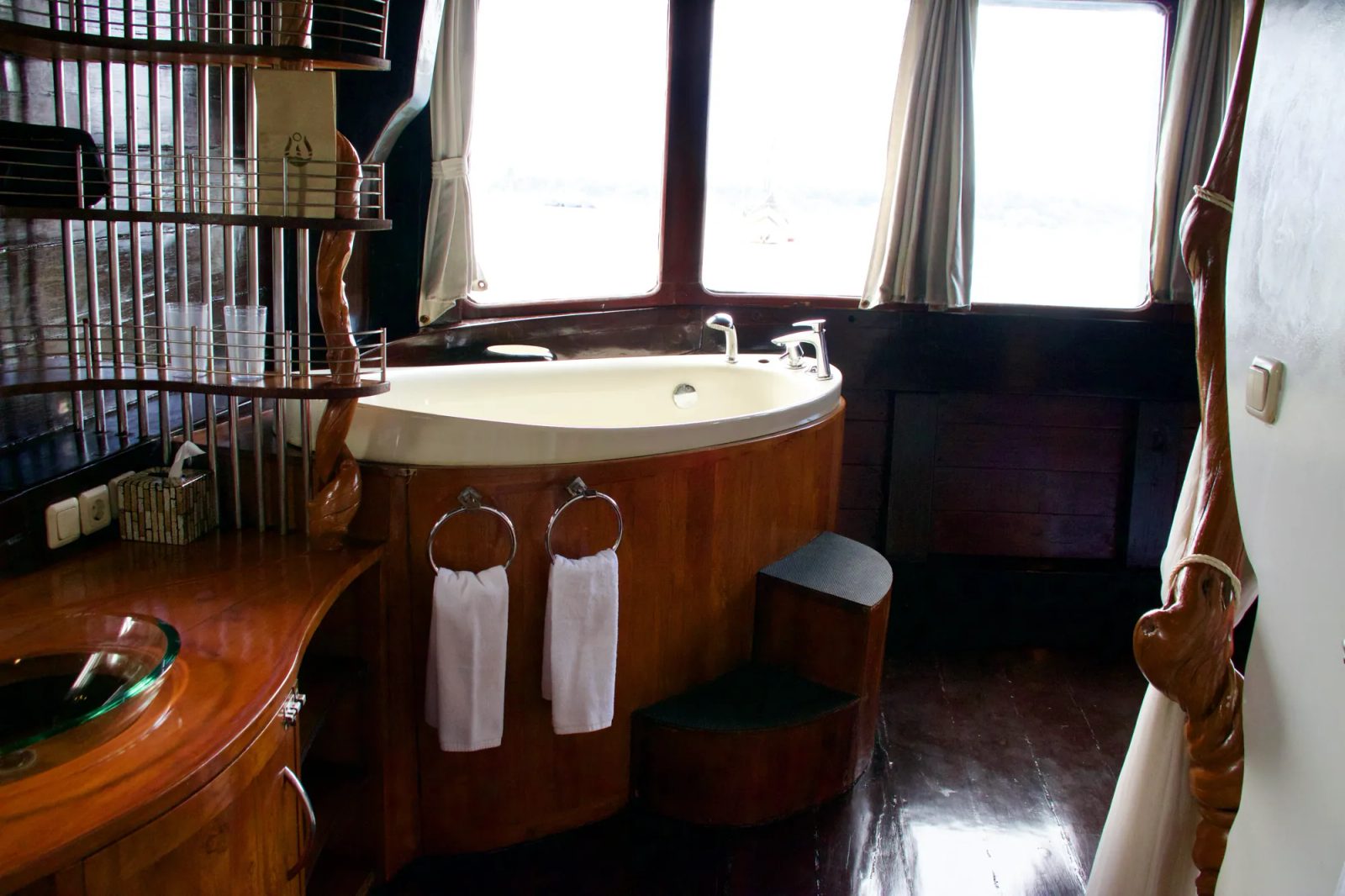
The Dewi Nusantara has eight Deluxe Staterooms, all air-conditioned. Each converts between a double bed and twin singles, which suits couples or friends sharing, and each has a large en-suite bathroom.
Itineraries
- Cendrawasih Bay | 11 days 10 nights | From USD 5.745 per person
- North Raja Ampat | 12 days 11 nights | From USD 6.384 per person
- Raja Ampat North and South | 12 days 11 nights | From USD 7.979 per person
- South Raja Ampat and Triton Bay Combination | 12 days 11 nights | From USD 8.459 per person
- Triton Bay and Maluku Tenggara Combination | 12 days 11 nights | From USD 8.459 per person
- The Forgotten Islands | 12 days 11 nights | From USD 8.459 per person
- Alor crossing the Banda Sea and Ambon Bay | 12 days 11 nights | From USD 8.459 per person
- Ambon Bay crossing the Banda Sea and Tual | 12 days 11 nights | From USD 8.459 per person
- Maluku Tenggara and Triton Bay Combination | 12 days 11 nights | From USD 8.459 per person
- Triton Bay and South Raja Ampat Combination | 12 days 11 nights | From USD 8.459 per person
- Cenderawasih Bay – Sorong – Nabire – Manokwari | 11 days 10 nights | From USD 7.690 per person
- South Raja Ampat and beyond SE Misool – Waterfall – S-Misool – Batanta| 12 days 11 nights | From USD 8.459 per person
Planning a diving trip to Indonesia? Contact us now and let’s explore the wonder of Indonesia with Dewi Nusantara!
Où vous dormirez
Les cabines
Cabines à bord du Dewi Nusantara
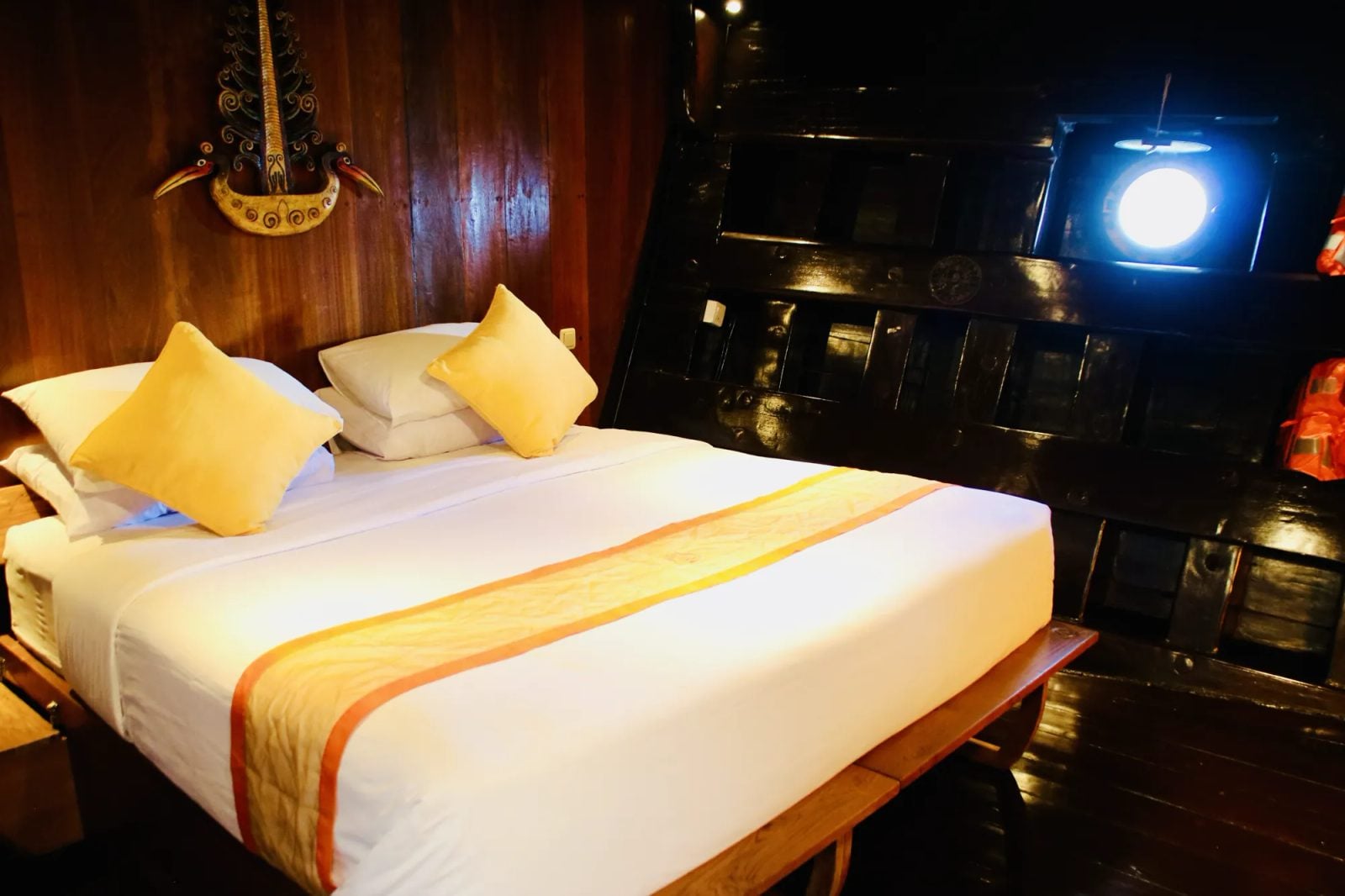
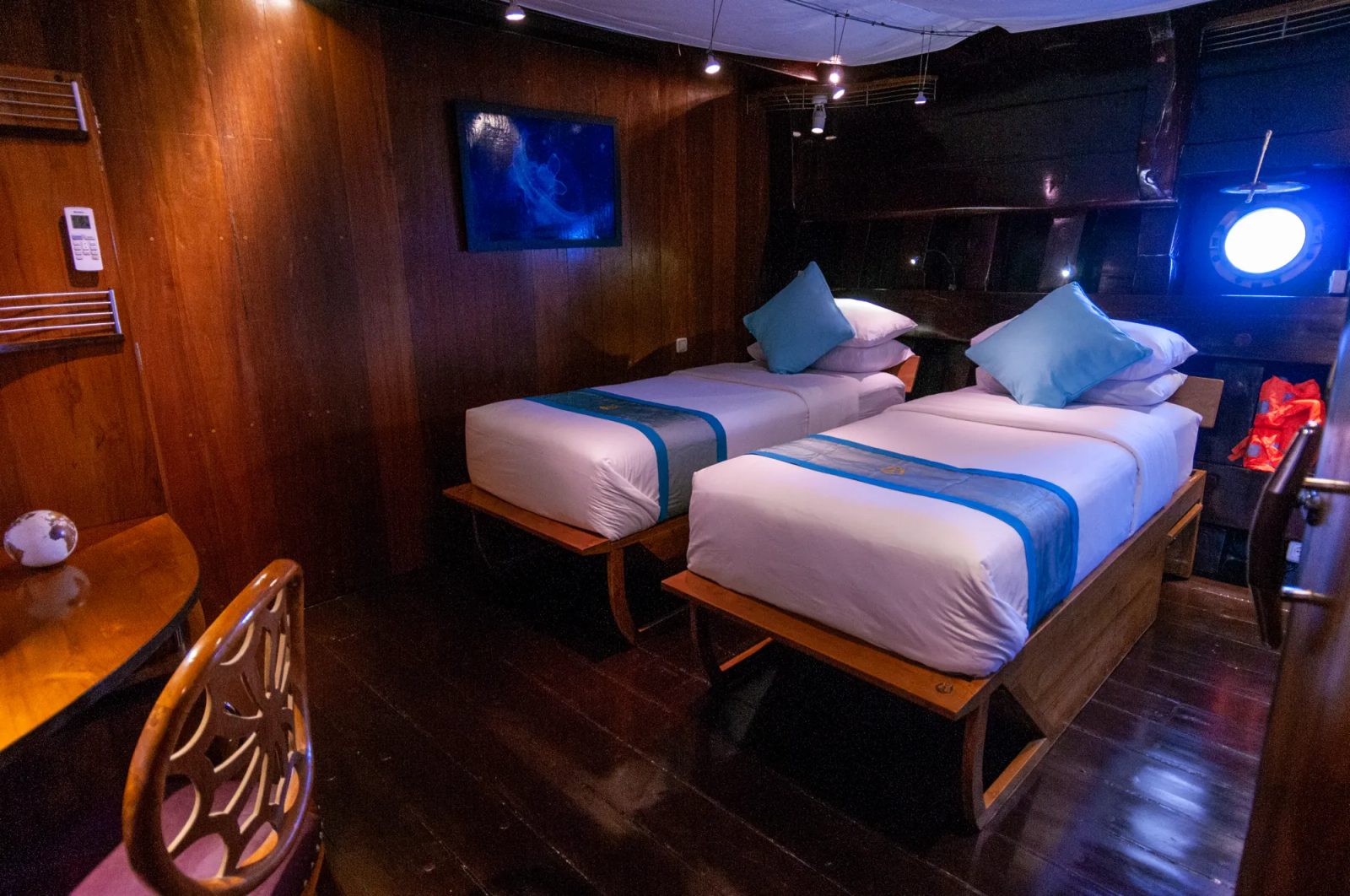
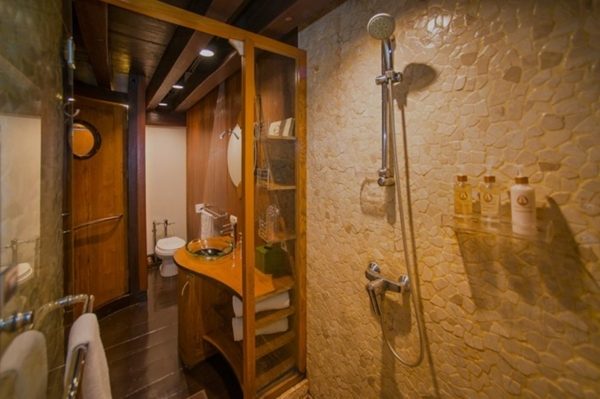
Deluxe Stateroom
2 guests · convertible · 8 cabins of this type
Eight spacious, air-conditioned staterooms configurable with either a double bed or twin single beds, each with a large en-suite bathroom with modern fixtures — ideal for couples or friends.
Master Suite
2 guests · double
The most spacious cabin on board, located at the aft of the vessel and rivalling a luxury hotel suite. Features a double bed, ample storage, breathtaking sea views, and a private en-suite bathroom for an exclusive, serene retreat.
Destination
Itinéraires
Itinéraires à bord du Dewi Nusantara
Flores to Alor: Route II - Maumere Bay, Adonara, Lembata, Pantar, Alor
Day 1 | Flores to Alor: Route II
Over twenty years ago, the team that still pioneers Dewi Nusantara’s dive operations, embarked on a series of custom cruises that ventured beyond Komodo, pushing further east to explore the island chain stretching from Flores to Alor - deep into the heart of East Nusa Tenggara. What we discovered was nothing short of extraordinary: pristine reefs with endless visibility, teeming with vibrant marine life, and an array of rare underwater creatures that marine photographers can only dream of capturing. Our underwater adventures were complemented by breathtaking topside scenery. Towering volcanoes, breaching whales, and playful dolphins provided a dramatic backdrop, while the warmth and hospitality of the local communities added a unique charm. The local people often delighted in diving into the water alongside us, eager to share in our discoveries. And this was just the beginning.
A Distinctive Diving Experience Each diving hotspot in Indonesia offers a distinct experience, both beneath the waves and on the surface. The reef structures, coral compositions, and marine species vary subtly from region to region. Marine life abundant in one area may be a rarity in another, and the Flores-to-Alor corridor is no exception. Along this route, divers encounter a diverse range of underwater environments: towering walls adorned with vibrant sea fans, bustling sea mounts, crystal-clear ledges, kaleidoscopic coral slopes, and sandy seabeds that serve as a haven for elusive macro life. Some dive sites are truly one-of-a-kind. Clown Valley and Big Foot Bay in the Alor-Pantar Strait, for example, are adorned with vast carpets of anemones stretching as far as the eye can see, creating a surreal and mesmerizing underwater landscape.
Encounters with Majestic Marine Life The waterways surrounding these islands are home to an impressive array of large marine species rarely seen in other destinations. Divers have the chance to encounter oceanic sunfish, thresher sharks, hammerheads, and massive dogtooth tuna. Other sites frequently host Napoleon wrasse, whitetip, blacktip, and grey reef sharks, along with colossal stingrays and formations of eagle and mobula rays. Dolphins are a near-constant presence, often racing toward our boat to play in the bow waves. Meanwhile, the deep channels separating the islands serve as migration routes for larger cetaceans. Sightings of surfacing whales - sometimes even the mighty blue or fin species - are not uncommon, adding to the region’s allure.
A Hidden Paradise for Macro Enthusiasts While many underwater macro photography enthusiasts are familiar with the Lembeh Strait in Sulawesi, fewer have explored Kalabahi Inlet, Teluk Lebaleba, Teluk Waihinga, or Beangabang Bay - hidden gems that rival Lembeh in biodiversity. These untouched regions offer encounters with some of the rarest and most cryptic marine species, without the crowds disturbing the delicate ecosystem. Despite our extensive explorations, we have merely scratched the surface - or more accurately, the seabed of these incredible sites. World-class macro diving requires precise environmental conditions: gently sloping sandy or silty substrates, mild tidal currents, and ideally, the presence of freshwater inflows from streams or rivers. When these elements converge, the results are extraordinary, and such environments are abundant in the sheltered coves, bays, and inlets throughout the region.
Day 2 | Day 2
Dramatic Topside Landscapes Beyond the underwater marvels, the topside scenery along this route is equally breathtaking. White sandy beaches, sparkling blue waters, lush green forests, and sun-scorched savannahs set the stage for exploration. However, the most striking features are the region’s numerous active volcanoes. During our early exploratory cruises, we visited one such volcano, isolated in the open sea. As we approached at dusk, we were treated to the awe-inspiring sight of molten rock cascading down its slopes into the ocean, accompanied by thunderous explosions and clouds of ash billowing into the sky. Naturally, we couldn’t resist the urge to dive nearby, where we uncovered even more spectacular underwater sites to add to our essential and ever-growing list.
Cultural Encounters and Local Traditions Despite its remote location, East Nusa Tenggara is home to welcoming and vibrant communities. The people of the Alor-Pantar Strait, for example, are renowned for their intricate Ikat weaving. They skillfully navigate strong currents in small traditional boats to offer their beautifully crafted textiles to visitors. Live entertainment is often an unexpected delight—whether in the form of entire schools of children singing from the shore or paddling out in dugout canoes to greet arriving boats with smiles and laughter. These genuine interactions add depth and warmth to the journey, making every visit truly memorable.
Sustainable Fishing and Pristine Reefs The health of the coral reefs in this region owes much to the sustainable fishing practices of the local communities. Traditional basket traps and selective spearfishing methods are still widely used, ensuring minimal impact on the marine ecosystem. It is not uncommon to encounter a spearfisher gliding effortlessly through the water as you complete a safety stop—many are more than happy to pose for a photo.
Diving along this quiet, untouched island chain is nothing short of spectacular. Crystal-clear visibility, exhilarating drift dives, vibrant coral gardens, and exceptional critter sites all combine to create one of the most biologically diverse and breathtaking marine ecosystems on the planet. Whether drawn by the thrill of big animal encounters, the intrigue of macro photography, or the sheer beauty of this unspoiled paradise, one thing is certain—East Nusa Tenggara is a destination that leaves an indelible mark on all who explore it.
Get On-Board with Dewi Nusantara The team that conceived and constructed Dewi Nusantara in 2007 was among the original group of early pioneers that purpose-built liveaboard yachts to explore the seas of the Indonesian archipelago in the mid-90s. With thousands of miles already under her keel, the Goddess of the Archipelago continues to gracefully glide over the azure water that makes this country so unique. Begin your next scuba adventure on board the Indonesian archipelago’s premier liveaboard and experience the very best that Indonesia has to offer, along with Dewi Nusantara’s outstanding service, exceptional facilities, and her highly experienced crew.
Day 3 | Maumere Bay
Diving in Maumere Bay, located on the north Flores coastline, is a must-see destination for underwater enthusiasts. Known for its rich marine biodiversity, vibrant coral reefs, and magnificent muck dives, Maumere offers a more off-the-beaten-path experience compared to some of Indonesia’s more well-known dive destinations. The bay, which was greatly affected by a massive earthquake and tsunami in 1992, has since seen significant reef recovery, making it a fascinating example of how a marine ecosystem can thrive after such dramatic and damaging cataclysmic events. One of the biggest features of Maumere Bay is its diverse dive sites, catering to all levels of divers. From shallow coral gardens teeming with macro life to deeper walls and slopes where pelagic species roam, the bay has something for everyone. Sites around Pulau Besar, Dambilah, the low-lying sandy island of Pangabatang, and the Flores mainland feature stunning coral formations and a wide range of marine species, including reef sharks, turtles, rays, and a host of macro subjects. The wide open spaces of the bay are also used as a playground and feeding area by a number of whale and dolphin species, too. Maumere’s critter diving scene is also a highlight, making it an excellent spot for macro photographers. The volcanic black sand slopes along the Flores coastline are home to rare critters such as frogfish, flamboyant cuttlefish, and ghost pipefish. Night dives here are particularly rewarding, revealing bioluminescent plankton and nocturnal marine life in action. Close by to some of these wonderful critter sites at Wai Terang is the wreck of a Japanese freighter from World War II, adding a sense of mystery and history to the underwater adventure. Beyond the water, Maumere offers a rich cultural experience. There is the opportunity to include visits to traditional villages at Sikka on the Flores mainland, where travellers can witness local weaving techniques and experience Flores’ warm hospitality. Further afield are the astonishing three coloured volcano crater lakes at Keli Mutu. With its laid-back charm, spectacular diving, and cultural richness, Maumere Bay is a perfect destination for divers looking to explore Indonesia’s lesser-known underwater treasures.
Day 4 | Pomana & Gosong Bone
Located just 15 nautical miles north of Maumere Harbour, this collection of dive sites is among the finest in the region, offering breathtaking underwater landscapes and rich biodiversity. The Pomana Besar and Kecil island group stand in contrast to the nearby Gosong Bone atoll, with distinct topside features. However, beneath the surface, both locations share remarkable similarities, characterized by vibrant, shallow reef tops that give way to dramatic drop-offs into the deep waters of Maumere Bay. Divers can explore stunning wall dives adorned with towering barrel sponges, delicate sea fans, and intricate coral formations. The 1992 earthquake, while causing some damage to the bedrock, also reshaped the reefs and walls, creating an intricate network of cracks and crevices that have since become thriving habitats for a variety of marine life. These natural formations provide shelter for an array of reef fish, crustaceans, and invertebrates, making each dive an exciting exploration of hidden underwater worlds. The interplay between the shallow reefs and the deep ocean creates unique currents that act as natural gathering points for marine species. These nutrient-rich waters attract schools of pelagic fish, including tuna, trevallies, and barracudas, while eagle rays and even reef sharks are occasional visitors. Meanwhile, the coral-covered flats and vertical walls are a macro diver’s paradise, teeming with elusive critters such as pygmy seahorses and nudibranchs - just a few of the treasures that make Indonesia one of the world’s top diving destinations. Whether you’re drawn to the thrill of drifting along dramatic drop-offs or the excitement of spotting rare marine creatures, these dive sites promise an unforgettable underwater adventure.
Day 5 | Tanjung Gedong
Tanjung Gedong is the name given to a massive rocky promontory at the top of what is known as the Scorpions Tail, on the north-west side of the Bunga Peninsula in east Flores. The peninsula comprises the major part of this northeastern section of the island, with Gedong jutting out into the Flores Sea, surrounded by the sea on three sides. One of the highlights of diving at Tanjung Gedong is the chance to explore its dramatic underwater topography, including coral-covered rock formations and gentle slopes that lead to deeper waters. The dive sites are combined around the south-west and north-east corners of the headland, starting at the south end with a particularly dramatic soft coral mini-wall that continues on to a 400-metre-long rubble slope dotted with coral heads. The slope leads to a current trap at the north corner before finishing over the reefs of the northern-facing section of the headland. During a west-to-east rising tide, it is possible to drift all the way around the headland and take in all of the separate sites. At these times, the currents swirling around these two corners attract a mass of marine life. These sites are often visited by some big fish, with sharks, mantas, groupers, Napoleon wrasses, and dogtooth tunas spotted on many dives. Macro photographers will also find plenty to capture, as the area is home to an array of colourful nudibranchs, shrimp, and other small marine creatures. The mini wall on the south-west side is sheer and covered with very colourful and abundant soft coral growth, a good place to find pygmy seahorses, skeleton shrimp, and many other smaller critters. Whether you’re looking to drift along the reef or take a closer look at the intricate marine biodiversity during a dive after dark, Tanjung Gedong offers a variety of different and adventurous diving experiences.
Day 6 | The Ipet Islands
The Ipet anchorage, a collection of pretty low-lying islands, surface-breaking shallow reefs, and white sandbars, lies close to the northern end of the Boling Strait that separates the islands of Adonara and Lembata. The seascape is calm and well protected, making it a big favourite with cruising captains, and there is a lot to do and see around the islands and reefs, and the scenic surroundings are greatly enhanced by the imposing panorama of several active volcanoes dominating the skyline. There are some terrific dive sites around the edges of the islands and waterways, particularly on the north side that faces the open sea. This area features some splendid reefs that shimmer with colourful corals and streams of marine life. The signature site of the area is the Ipet Barrier Ridge. There is a shallow coral ridge that stretches for over 1,000 metres parallel to the shallow fringing reef of Ipet Island. The ridge drops onto a spectacular wall and deep ledge on the seaward side and features a surprisingly high number of different shark species, marble rays, and schools of barracudas that patrol the ledges, edges, and walls. Other sites include a drift through the narrow channel between Konaweh and the larger island of Adonara Island and the spectacular reef slopes of the Boling Strait that showcase all that the underwater world of Nusa Tenggara has to offer here. The mangrove-lined waterways between the island group lend themselves well to excellent kayaking expeditions. The brilliantly colourful coral reefs extend away from the small islands into deeper water at a comfortable snorkelling depth. The entire island group is a great place for surface water-based sports like kayaking, paddleboarding, and snorkelling, due to the expansive shallow reefs, intricate shorelines and waterways, and the protected nature of the islands. Central to the shallow coral reefs and mangrove-lined islands is a long white sandbar that becomes visible before and after high tide, and around the edges of Ipet Island, thousands of huge fruit bats like to spend their days hanging upside down in the trees. In the late afternoon, it is possible to get close to the tree line and hear them screeching and flapping shortly before they make the journey over to the forests and farms of Adonara to begin their nighttime feasting. Ipet has become a popular permanent cruising fixture, offering a wide range of exciting activities under and on the water.
Day 7 | Waihinga & Lewaling
Nestled beneath the commanding presence of the still-active Mt. Lewotolo volcano, the twin bays of Waihinga and Lewaling carve deep into the rugged northern coastline of Lembata, unveiling a spectacular underwater landscape rich in marine biodiversity. These bays are home to an array of renowned dive sites, each offering its own distinct allure - from dramatic wall dives to intricate ledges and sandy alcoves teeming with macro life, ideal for underwater photography enthusiasts. The most celebrated dive sites are found along a striking drop-off that delineates the edge of an expansive shallow reef. Stretching over four kilometres from the northeastern tip of the Bacatan Peninsula on Waihinga’s eastern side, this reef extends along the west-facing coastline into the bay, providing divers with an abundance of entry points. The reef’s sharp boundary descends into a sheer abyss, where coral-encrusted ledges, shadowy caverns, and bustling fish habitats create an exhilarating underwater experience. In these depths, vibrant marine life flourishes, from dense schools of reef fish to elusive pelagic species gliding effortlessly through the deep blue. Deeper into the bays, the winding coastline reveals yet another dimension of its marine treasures. These sheltered waters serve as a haven for macro divers, offering the chance to observe a fascinating array of small marine creatures concealed within the sand and coral crevices. Nearby, a thriving seamount adjacent to a working pearl farm provides an additional, and different, dive site, attracting large schools of fish and the occasional passing predator. Beyond its exceptional diving opportunities, this destination holds an even more extraordinary secret - their waters occasionally play host to the largest creature on Earth, the magnificent blue whale. On rare and awe-inspiring occasions, small groups of these gentle giants can be seen gathering within the bay, a sight that leaves even the most experienced divers in speechless wonder. For those eager to delve deeper into the mysteries of these majestic mammals, the village of Waipukang on the western shore features a beautifully preserved skeleton of a blue whale, displayed in a dedicated exhibit - a poignant reminder of both nature’s grandeur and fragility.
Day 8 | Wai Wowang
Lembata is a breathtaking island, with its administrative and commercial heart in the bustling town of Lewoleba, which sits along the north-facing shores of Leba Leba Bay. Just a short distance down the coast lies Wai Wowang, a quiet anchorage and a hotspot for divers. This haven for macro enthusiasts takes its name from a small sandy bay, a freshwater stream (“Wai”) that feeds into it, and the remnants of a long-abandoned fish processing plant on the mainland. Without a doubt, scuba diving is the favourite activity at this anchorage. The coastline boasts some of the region’s finest critter - or “muck” - diving sites, offering an unparalleled opportunity to encounter rare and mesmerising marine life. A unique blend of freshwater runoff, a sparse reef, a gravel-and-sand seabed, and gentle tidal currents creates the perfect conditions for an extraordinary underwater ecosystem to flourish. Although discovered only recently, the dive sites along this stretch of coastline have quickly gained a reputation as some of the best for spotting elusive marine species. Among the most renowned sites are Sizzler and Ferry Dock, along with the extensive reef systems that flank them. The underwater terrain is literally teeming with marine treasures. For those with a keen eye, the waters here reveal an astonishing array of rare and exotic species. Ghost pipefish in a dazzling variety of forms hide among the corals, while all three species of the elusive Rhinopias scorpionfish lurk around the small coral heads and in the sand, waiting to be discovered. Beyond these stars of the show, an endless parade of extraordinary critters makes every dive an extraordinary exploration. For adventurers looking to stretch their legs after a day beneath the waves, the surrounding landscape offers rolling hills with scenic trekking routes that meander through leafy lanes along the shoreline. Meanwhile, a visit to Lewoleba town promises a warm and lively welcome from the friendly, spirited locals - always eager to share their culture and hospitality with those who pass through.
Day 9 | Rusa, Marissa & Kambing
The strait between Lembata and Pantar is one of Indonesia’s most breathtaking marine thoroughfares. Rising from its depths are the islands of Marissa, Rusa, and the smaller Kambing, reminiscent of the famed Komodo National Park. Tides funnel nutrient-rich waters between the Flores and Banda Seas to the north and the Savu Sea to the south, creating strong currents that sustain thriving coral reefs and an abundance of marine life. These powerful flows have shaped numerous dive sites, where currents attract diverse marine species. The waters around Rusa, Marissa, and Kambing teem with hunting predators, from sharks and rays to schooling tunas, vibrant reef fish, and even elusive mola mola, making for a spectacular underwater display. On Rusa’s southwest side, the tiny islet of Watu Balu rises from the sea, home to hundreds of seabirds and surrounded by a dazzling, steep coral reef - one of the region’s top dive sites. South of Kambing, Batu Bawa offers an exhilarating and largely unexplored dive. This vast site features sheer coral-covered walls, swim-throughs, and canyons teeming with marine life. At its heart lies a massive underwater arch, home to several large nurse sharks. Just over a mile east of Kambing, the larger island of Pantar boasts another dramatic dive site - Big Willi, named after the mountain at the southwest headland. Sheer rock walls, deep crevices, and the promise of large marine visitors make it an unforgettable experience. Further along Pantar’s coast, Alkatrazz offers a dive reminiscent of Komodo’s legendary Horseshoe Bay. What first appears as a small site opens into a sprawling underwater landscape of rocky ledges, black coral bushes, sea fan-adorned walls, and boulders teeming with surgeonfish, sweetlips, and an array of fascinating macro life. For those seeking adventure above the waves, Kambing is the crown jewel of the area. Just two kilometers across at its widest point, it features a rugged coastline and a stunning northeast cove. Though smaller than the beaches on nearby islands, its pristine white sands and easy accessibility make it a perfect starting point for exploring the island’s wild and untracked terrain.
Day 10 | Beangabang Bay
While the outer reefs of Beangabang Bay boast vibrant corals and an array of marine life - from delicate pygmy seahorses to elusive thresher sharks - the real magic lies beneath the sandy, gravel-strewn seabed of the bay’s interior. A legendary hotspot for underwater photographers and macro enthusiasts, Beangabang has long been one of Indonesia’s top destinations for discovering the ocean’s strangest and most fascinating creatures. Constantly shifting with the tides, the dive sites here evolve week by week, revealing new surprises as unusual critters emerge from the sand. As a general rule, great critter diving sites share three essential ingredients:
A dynamic seabed. A mix of sand, gravel, coral rubble, seaweed, and scattered marine habitats provides shelter for an astonishing variety of camouflaged species.
A gentle current. Even a mild flow of water carries nutrients across the bay, sustaining its ecosystem. Beangabang experiences a cyclical current that sweeps around its curving shoreline, creating the perfect conditions for marine life to thrive.
A freshwater source. A trickling stream or hidden spring is often all it takes to enhance biodiversity. Beangabang takes this a step further - its freshwater supply is naturally heated by volcanic activity. While it’s unclear whether the warm water contributes to the bay’s abundance of rare and bizarre species, one thing is certain - Beangabang is a magnet for the extraordinary. Its reputation draws dive boats and yachts carrying eager photographers, many of whom extend their stay for days, mesmerized by the ever-changing spectacle beneath the surface of the Savu Sea.
Day 11 | The Alor-Pantar Strait
The strait between Alor and Pantar, the final two islands along the East Nusa Tenggara chain, is a premier destination for experienced scuba divers seeking unspoiled marine biodiversity. This remote and ecologically rich region is home to some of the most pristine dive sites in the world, featuring vibrant coral reefs, dramatic underwater topography, and an exceptional variety of marine life. The powerful currents that course through the strait carry nutrient-dense waters from the deep, attracting large pelagic species and sustaining a thriving marine ecosystem. Enhancing the region’s dynamic underwater environment, the waterway is interspersed with several smaller islands - Buaya, Ternate, Pura, Kumba, and Treweg further south. These landforms influence tidal movements, creating a complex interplay of currents that give rise to a diverse range of dive conditions, from tranquil coral gardens to exhilarating drift dives. One of the most remarkable aspects of diving in the Alor-Pantar Strait is the extraordinary health and diversity of its coral reefs. These ecosystems host an abundance of marine species, including schools of barracuda, trevallies, and reef sharks. Macro enthusiasts can observe rare and elusive creatures such as frogfish, pygmy seahorses, and rhinopias scorpionfish, all thriving within this biologically rich environment. Beyond its exceptional reef systems, the strait offers unparalleled opportunities for encounters with larger marine species. Divers frequently witness pods of dolphins, while seasonal migrations bring sightings of orcas and even blue whales, further underscoring the region’s significance as a marine biodiversity hotspot. The Alor-Pantar Strait is also home to a number of renowned dive sites. Locations such as The Cathedral, Kelatetek, Crucifixion Point, Babylon, Cave Point, and Tanjung Muna attract oceanic sunfish, eagle rays, hammerhead sharks, and thresher sharks, providing a world-class diving experience. Among the most unique sites is Clown Valley on Pura Island, where divers can observe an expansive seabed entirely covered by swaying anemones - a rare and mesmerising sight. In addition to its ecological wonders, the Alor-Pantar region offers a rich cultural experience. Local communities, particularly those on Pura Island, have maintained traditional fishing and boat-building practices for generations. Visitors may have the opportunity to observe skilled freedivers utilising handcrafted wooden goggles, a testament to the enduring maritime traditions of the region. Combining breathtaking underwater biodiversity with cultural heritage and unspoiled natural beauty, the Alor-Pantar Strait presents an exceptional diving experience. Its remote location and dynamic marine environment make it a truly unparalleled destination for divers seeking adventure beyond conventional dive sites.
Day 12 | The Kalabahi Inlet
Indonesia is home to some of the world’s most extraordinary muck and critter diving destinations, making it a must-visit for enthusiasts of bizarre and fascinating marine life. While the Lembeh Strait is where muck diving first gained fame, this unique style of diving has since spread across Indonesia, the Philippines, and Papua New Guinea. Among the top locations to encounter the weird and wonderful creatures of the seabed, Alor - and more specifically the Kalabahi Inlet - stands out as one of the very best waiting to be explored. Stretching over nine nautical miles from the Alor-Pantar Strait to Kalabahi Town, the Kalabahi Inlet is a long, winding waterway that separates the Alor mainland from the northern headland known as Alor Kecil. Along its shores, divers will find an impressive collection of critter-filled dive sites, each offering incredible biodiversity. While visibility tends to decrease deeper into the inlet, the reward is well worth it, as these nutrient-rich waters are teeming with marine life. The sites here share many of the same characteristics as legendary muck diving spots like Lembeh in Sulawesi and Laha in Ambon - gently sloping gravel or sand bottoms dotted with coral heads, small habitats, a touch of current, and the occasional influx of freshwater from springs, streams, or rivers. These conditions create the perfect environment for an astonishing array of marine life, from the beautiful to the bizarre. Underwater photographers and critter enthusiasts will be thrilled to find an incredible selection of species, and with the help of Dewi’s eagle-eyed dive guides - world renowned for their ability to spot even the most elusive creatures - checking off a wish list of must-see critters can happen in just a few dives. While the well-known sites in Kalabahi Inlet are packed with marine treasures, the adventure doesn’t end there. Many more dive spots remain unexplored, offering endless opportunities for discovery. Whether you’re a seasoned macro photographer or a curious diver eager to encounter nature’s strangest underwater inhabitants, Kalabahi Inlet promises an unforgettable muck diving experience.
Day 13 | Cruise Notes
Flexible Itineraries: Our cruise routes are intentionally adaptable. Throughout the journey, the captain and cruise director continuously assess sea conditions, weather, and tides to ensure the best possible experience. Guest preferences for specific dive sites are always considered whenever feasible.
More Than Is Listed: The locations featured in these itineraries represent only a portion of what’s possible. Numerous additional anchorages and activity options are available along the way, making each voyage truly unique.
Simplified for Clarity: The destinations shown in our presentations are not necessarily listed in the order they will be visited. They are organized for clarity and to help guests visualize the overall routing.
Extended Stays: If a particular anchorage offers exceptional experiences, guests may opt to linger a bit longer. The captain and cruise director have the flexibility to accommodate such preferences, provided they align with the overall cruise schedule.
Overnight Passages: To maximize daylight hours at our most spectacular destinations, longer transits between anchorages are typically conducted overnight.
Escape the Crowds: With the exception of embarkation and disembarkation points, our itineraries are carefully crafted to avoid congested areas and busy commercial ports, allowing for a more tranquil and immersive experience.
Beyond the Dive: Many of our anchorages offer more than just diving and snorkelling. Guests can enjoy kayaking, stand-up paddleboarding, and occasional visits to local villages and cultural sites — adding even more richness to the journey.
Inclus
- 9 nights accommodation on board
- Full-Board Meal Plan (All meals)
- VAT
- Airport Transfer
- Hotel Transfer
- Drinking Water
- Soft drinks
- Tea & Coffee
- Welcome Cocktails
- Wine with Dinner
- Snacks
- Diving Package
- Night Dives
- Kayaks
- Land Excursions
- Stand Up Paddleboard
- Beach Towels
- Cabin Towels
- Complimentary Toiletries
- Deck Towels
Non inclus
- Domestic or international flight
- Dive insurance
- Medical evacuation insurance
- Visa
- Internet Starlink
- Crew gratuities
- Equipment rental
- Park and Port Fees : 390 US$ par personne
- Fuel Surcharge : 330 US$ par personne
Flores to Alor: Route I - Maumere Bay, Adonara, Lembata, Pantar, Alor
Day 1 | Flores to Alor: Route I
Over twenty years ago, the team that still pioneers Dewi Nusantara’s dive operations, embarked on a series of custom cruises that ventured beyond Komodo, pushing further east to explore the island chain stretching from Flores to Alor - deep into the heart of East Nusa Tenggara. What we discovered was nothing short of extraordinary: pristine reefs with endless visibility, teeming with vibrant marine life, and an array of rare underwater creatures that marine photographers can only dream of capturing. Our underwater adventures were complemented by breathtaking topside scenery. Towering volcanoes, breaching whales, and playful dolphins provided a dramatic backdrop, while the warmth and hospitality of the local communities added a unique charm. The local people often delighted in diving into the water alongside us, eager to share in our discoveries. And this was just the beginning.
A Distinctive Diving Experience Each diving hotspot in Indonesia offers a distinct experience, both beneath the waves and on the surface. The reef structures, coral compositions, and marine species vary subtly from region to region. Marine life abundant in one area may be a rarity in another, and the Flores-to-Alor corridor is no exception. Along this route, divers encounter a diverse range of underwater environments: towering walls adorned with vibrant sea fans, bustling sea mounts, crystal-clear ledges, kaleidoscopic coral slopes, and sandy seabeds that serve as a haven for elusive macro life. Some dive sites are truly one-of-a-kind. Clown Valley and Big Foot Bay in the Alor-Pantar Strait, for example, are adorned with vast carpets of anemones stretching as far as the eye can see, creating a surreal and mesmerizing underwater landscape.
Encounters with Majestic Marine Life The waterways surrounding these islands are home to an impressive array of large marine species rarely seen in other destinations. Divers have the chance to encounter oceanic sunfish, thresher sharks, hammerheads, and massive dogtooth tuna. Other sites frequently host Napoleon wrasse, whitetip, blacktip, and grey reef sharks, along with colossal stingrays and formations of eagle and mobula rays. Dolphins are a near-constant presence, often racing toward our boat to play in the bow waves. Meanwhile, the deep channels separating the islands serve as migration routes for larger cetaceans. Sightings of surfacing whales - sometimes even the mighty blue or fin species - are not uncommon, adding to the region’s allure.
A Hidden Paradise for Macro Enthusiasts While many underwater macro photography enthusiasts are familiar with the Lembeh Strait in Sulawesi, fewer have explored Kalabahi Inlet, Teluk Lebaleba, Teluk Waihinga, or Beangabang Bay - hidden gems that rival Lembeh in biodiversity. These untouched regions offer encounters with some of the rarest and most cryptic marine species, without the crowds disturbing the delicate ecosystem. Despite our extensive explorations, we have merely scratched the surface - or more accurately, the seabed of these incredible sites. World-class macro diving requires precise environmental conditions: gently sloping sandy or silty substrates, mild tidal currents, and ideally, the presence of freshwater inflows from streams or rivers. When these elements converge, the results are extraordinary, and such environments are abundant in the sheltered coves, bays, and inlets throughout the region.
Day 2 | Day 2
Dramatic Topside Landscapes Beyond the underwater marvels, the topside scenery along this route is equally breathtaking. White sandy beaches, sparkling blue waters, lush green forests, and sun-scorched savannahs set the stage for exploration. However, the most striking features are the region’s numerous active volcanoes. During our early exploratory cruises, we visited one such volcano, isolated in the open sea. As we approached at dusk, we were treated to the awe-inspiring sight of molten rock cascading down its slopes into the ocean, accompanied by thunderous explosions and clouds of ash billowing into the sky. Naturally, we couldn’t resist the urge to dive nearby, where we uncovered even more spectacular underwater sites to add to our essential and ever-growing list.
Cultural Encounters and Local Traditions Despite its remote location, East Nusa Tenggara is home to welcoming and vibrant communities. The people of the Alor-Pantar Strait, for example, are renowned for their intricate Ikat weaving. They skillfully navigate strong currents in small traditional boats to offer their beautifully crafted textiles to visitors. Live entertainment is often an unexpected delight—whether in the form of entire schools of children singing from the shore or paddling out in dugout canoes to greet arriving boats with smiles and laughter. These genuine interactions add depth and warmth to the journey, making every visit truly memorable.
Sustainable Fishing and Pristine Reefs The health of the coral reefs in this region owes much to the sustainable fishing practices of the local communities. Traditional basket traps and selective spearfishing methods are still widely used, ensuring minimal impact on the marine ecosystem. It is not uncommon to encounter a spearfisher gliding effortlessly through the water as you complete a safety stop—many are more than happy to pose for a photo.
Diving along this quiet, untouched island chain is nothing short of spectacular. Crystal-clear visibility, exhilarating drift dives, vibrant coral gardens, and exceptional critter sites all combine to create one of the most biologically diverse and breathtaking marine ecosystems on the planet. Whether drawn by the thrill of big animal encounters, the intrigue of macro photography, or the sheer beauty of this unspoiled paradise, one thing is certain—East Nusa Tenggara is a destination that leaves an indelible mark on all who explore it.
Get On-Board with Dewi Nusantara The team that conceived and constructed Dewi Nusantara in 2007 was among the original group of early pioneers that purpose-built liveaboard yachts to explore the seas of the Indonesian archipelago in the mid-90s. With thousands of miles already under her keel, the Goddess of the Archipelago continues to gracefully glide over the azure water that makes this country so unique. Begin your next scuba adventure on board the Indonesian archipelago’s premier liveaboard and experience the very best that Indonesia has to offer, along with Dewi Nusantara’s outstanding service, exceptional facilities, and her highly experienced crew.
Day 3 | Maumere Bay
Diving in Maumere Bay, located on the north Flores coastline, is a must-see destination for underwater enthusiasts. Known for its rich marine biodiversity, vibrant coral reefs, and magnificent muck dives, Maumere offers a more off-the-beaten-path experience compared to some of Indonesia’s more well-known dive destinations. The bay, which was greatly affected by a massive earthquake and tsunami in 1992, has since seen significant reef recovery, making it a fascinating example of how a marine ecosystem can thrive after such dramatic and damaging cataclysmic events. One of the biggest features of Maumere Bay is its diverse dive sites, catering to all levels of divers. From shallow coral gardens teeming with macro life to deeper walls and slopes where pelagic species roam, the bay has something for everyone. Sites around Pulau Besar, Dambilah, the low-lying sandy island of Pangabatang, and the Flores mainland feature stunning coral formations and a wide range of marine species, including reef sharks, turtles, rays, and a host of macro subjects. The wide open spaces of the bay are also used as a playground and feeding area by a number of whale and dolphin species, too. Maumere’s critter diving scene is also a highlight, making it an excellent spot for macro photographers. The volcanic black sand slopes along the Flores coastline are home to rare critters such as frogfish, flamboyant cuttlefish, and ghost pipefish. Night dives here are particularly rewarding, revealing bioluminescent plankton and nocturnal marine life in action. Close by to some of these wonderful critter sites at Wai Terang is the wreck of a Japanese freighter from World War II, adding a sense of mystery and history to the underwater adventure. Beyond the water, Maumere offers a rich cultural experience. There is the opportunity to include visits to traditional villages at Sikka on the Flores mainland, where travellers can witness local weaving techniques and experience Flores’ warm hospitality. Further afield are the astonishing three coloured volcano crater lakes at Keli Mutu. With its laid-back charm, spectacular diving, and cultural richness, Maumere Bay is a perfect destination for divers looking to explore Indonesia’s lesser-known underwater treasures.
Day 4 | Tanjung Gedong
Tanjung Gedong is the name given to a massive rocky promontory at the top of what is known as the Scorpions Tail, on the north-west side of the Bunga Peninsula in east Flores. The peninsula comprises the major part of this northeastern section of the island, with Gedong jutting out into the Flores Sea, surrounded by the sea on three sides. One of the highlights of diving at Tanjung Gedong is the chance to explore its dramatic underwater topography, including coral-covered rock formations and gentle slopes that lead to deeper waters. The dive sites are combined around the south-west and north-east corners of the headland, starting at the south end with a particularly dramatic soft coral mini-wall that continues on to a 400-metre-long rubble slope dotted with coral heads. The slope leads to a current trap at the north corner before finishing over the reefs of the northern-facing section of the headland. During a west-to-east rising tide, it is possible to drift all the way around the headland and take in all of the separate sites. At these times, the currents swirling around these two corners attract a mass of marine life. These sites are often visited by some big fish, with sharks, mantas, groupers, Napoleon wrasses, and dogtooth tunas spotted on many dives. Macro photographers will also find plenty to capture, as the area is home to an array of colourful nudibranchs, shrimp, and other small marine creatures. The mini wall on the south-west side is sheer and covered with very colourful and abundant soft coral growth, a good place to find pygmy seahorses, skeleton shrimp, and many other smaller critters. Whether you’re looking to drift along the reef or take a closer look at the intricate marine biodiversity during a dive after dark, Tanjung Gedong offers a variety of different and adventurous diving experiences.
Day 5 | The Ipet Islands
The Ipet anchorage, a collection of pretty low-lying islands, surface-breaking shallow reefs, and white sandbars, lies close to the northern end of the Boling Strait that separates the islands of Adonara and Lembata. The seascape is calm and well protected, making it a big favourite with cruising captains, and there is a lot to do and see around the islands and reefs, and the scenic surroundings are greatly enhanced by the imposing panorama of several active volcanoes dominating the skyline. There are some terrific dive sites around the edges of the islands and waterways, particularly on the north side that faces the open sea. This area features some splendid reefs that shimmer with colourful corals and streams of marine life. The signature site of the area is the Ipet Barrier Ridge. There is a shallow coral ridge that stretches for over 1,000 metres parallel to the shallow fringing reef of Ipet Island. The ridge drops onto a spectacular wall and deep ledge on the seaward side and features a surprisingly high number of different shark species, marble rays, and schools of barracudas that patrol the ledges, edges, and walls. Other sites include a drift through the narrow channel between Konaweh and the larger island of Adonara Island and the spectacular reef slopes of the Boling Strait that showcase all that the underwater world of Nusa Tenggara has to offer here. The mangrove-lined waterways between the island group lend themselves well to excellent kayaking expeditions. The brilliantly colourful coral reefs extend away from the small islands into deeper water at a comfortable snorkelling depth. The entire island group is a great place for surface water-based sports like kayaking, paddleboarding, and snorkelling, due to the expansive shallow reefs, intricate shorelines and waterways, and the protected nature of the islands. Central to the shallow coral reefs and mangrove-lined islands is a long white sandbar that becomes visible before and after high tide, and around the edges of Ipet Island, thousands of huge fruit bats like to spend their days hanging upside down in the trees. In the late afternoon, it is possible to get close to the tree line and hear them screeching and flapping shortly before they make the journey over to the forests and farms of Adonara to begin their nighttime feasting. Ipet has become a popular permanent cruising fixture, offering a wide range of exciting activities under and on the water.
Day 6 | Wai Wowang
Lembata is a breathtaking island, with its administrative and commercial heart in the bustling town of Lewoleba, which sits along the north-facing shores of Leba Leba Bay. Just a short distance down the coast lies Wai Wowang, a quiet anchorage and a hotspot for divers. This haven for macro enthusiasts takes its name from a small sandy bay, a freshwater stream (“Wai”) that feeds into it, and the remnants of a long-abandoned fish processing plant on the mainland. Without a doubt, scuba diving is the favourite activity at this anchorage. The coastline boasts some of the region’s finest critter - or “muck” - diving sites, offering an unparalleled opportunity to encounter rare and mesmerising marine life. A unique blend of freshwater runoff, a sparse reef, a gravel-and-sand seabed, and gentle tidal currents creates the perfect conditions for an extraordinary underwater ecosystem to flourish. Although discovered only recently, the dive sites along this stretch of coastline have quickly gained a reputation as some of the best for spotting elusive marine species. Among the most renowned sites are Sizzler and Ferry Dock, along with the extensive reef systems that flank them. The underwater terrain is literally teeming with marine treasures. For those with a keen eye, the waters here reveal an astonishing array of rare and exotic species. Ghost pipefish in a dazzling variety of forms hide among the corals, while all three species of the elusive Rhinopias scorpionfish lurk around the small coral heads and in the sand, waiting to be discovered. Beyond these stars of the show, an endless parade of extraordinary critters makes every dive an extraordinary exploration. For adventurers looking to stretch their legs after a day beneath the waves, the surrounding landscape offers rolling hills with scenic trekking routes that meander through leafy lanes along the shoreline. Meanwhile, a visit to Lewoleba town promises a warm and lively welcome from the friendly, spirited locals - always eager to share their culture and hospitality with those who pass through.
Day 7 | Rusa, Marissa & Kambing
The strait between Lembata and Pantar is one of Indonesia’s most breathtaking marine thoroughfares. Rising from its depths are the islands of Marissa, Rusa, and the smaller Kambing, reminiscent of the famed Komodo National Park. Tides funnel nutrient-rich waters between the Flores and Banda Seas to the north and the Savu Sea to the south, creating strong currents that sustain thriving coral reefs and an abundance of marine life. These powerful flows have shaped numerous dive sites, where currents attract diverse marine species. The waters around Rusa, Marissa, and Kambing teem with hunting predators, from sharks and rays to schooling tunas, vibrant reef fish, and even elusive mola mola, making for a spectacular underwater display. On Rusa’s southwest side, the tiny islet of Watu Balu rises from the sea, home to hundreds of seabirds and surrounded by a dazzling, steep coral reef - one of the region’s top dive sites. South of Kambing, Batu Bawa offers an exhilarating and largely unexplored dive. This vast site features sheer coral-covered walls, swim-throughs, and canyons teeming with marine life. At its heart lies a massive underwater arch, home to several large nurse sharks. Just over a mile east of Kambing, the larger island of Pantar boasts another dramatic dive site - Big Willi, named after the mountain at the southwest headland. Sheer rock walls, deep crevices, and the promise of large marine visitors make it an unforgettable experience. Further along Pantar’s coast, Alkatrazz offers a dive reminiscent of Komodo’s legendary Horseshoe Bay. What first appears as a small site opens into a sprawling underwater landscape of rocky ledges, black coral bushes, sea fan-adorned walls, and boulders teeming with surgeonfish, sweetlips, and an array of fascinating macro life. For those seeking adventure above the waves, Kambing is the crown jewel of the area. Just two kilometers across at its widest point, it features a rugged coastline and a stunning northeast cove. Though smaller than the beaches on nearby islands, its pristine white sands and easy accessibility make it a perfect starting point for exploring the island’s wild and untracked terrain.
Day 8 | Beangabang Bay
While the outer reefs of Beangabang Bay boast vibrant corals and an array of marine life - from delicate pygmy seahorses to elusive thresher sharks - the real magic lies beneath the sandy, gravel-strewn seabed of the bay’s interior. A legendary hotspot for underwater photographers and macro enthusiasts, Beangabang has long been one of Indonesia’s top destinations for discovering the ocean’s strangest and most fascinating creatures. Constantly shifting with the tides, the dive sites here evolve week by week, revealing new surprises as unusual critters emerge from the sand. As a general rule, great critter diving sites share three essential ingredients:
A dynamic seabed. A mix of sand, gravel, coral rubble, seaweed, and scattered marine habitats provides shelter for an astonishing variety of camouflaged species.
A gentle current. Even a mild flow of water carries nutrients across the bay, sustaining its ecosystem. Beangabang experiences a cyclical current that sweeps around its curving shoreline, creating the perfect conditions for marine life to thrive.
A freshwater source. A trickling stream or hidden spring is often all it takes to enhance biodiversity. Beangabang takes this a step further - its freshwater supply is naturally heated by volcanic activity. While it’s unclear whether the warm water contributes to the bay’s abundance of rare and bizarre species, one thing is certain - Beangabang is a magnet for the extraordinary. Its reputation draws dive boats and yachts carrying eager photographers, many of whom extend their stay for days, mesmerized by the ever-changing spectacle beneath the surface of the Savu Sea.
Day 9 | The Alor-Pantar Strait
The strait between Alor and Pantar, the final two islands along the East Nusa Tenggara chain, is a premier destination for experienced scuba divers seeking unspoiled marine biodiversity. This remote and ecologically rich region is home to some of the most pristine dive sites in the world, featuring vibrant coral reefs, dramatic underwater topography, and an exceptional variety of marine life. The powerful currents that course through the strait carry nutrient-dense waters from the deep, attracting large pelagic species and sustaining a thriving marine ecosystem. Enhancing the region’s dynamic underwater environment, the waterway is interspersed with several smaller islands - Buaya, Ternate, Pura, Kumba, and Treweg further south. These landforms influence tidal movements, creating a complex interplay of currents that give rise to a diverse range of dive conditions, from tranquil coral gardens to exhilarating drift dives. One of the most remarkable aspects of diving in the Alor-Pantar Strait is the extraordinary health and diversity of its coral reefs. These ecosystems host an abundance of marine species, including schools of barracuda, trevallies, and reef sharks. Macro enthusiasts can observe rare and elusive creatures such as frogfish, pygmy seahorses, and rhinopias scorpionfish, all thriving within this biologically rich environment. Beyond its exceptional reef systems, the strait offers unparalleled opportunities for encounters with larger marine species. Divers frequently witness pods of dolphins, while seasonal migrations bring sightings of orcas and even blue whales, further underscoring the region’s significance as a marine biodiversity hotspot. The Alor-Pantar Strait is also home to a number of renowned dive sites. Locations such as The Cathedral, Kelatetek, Crucifixion Point, Babylon, Cave Point, and Tanjung Muna attract oceanic sunfish, eagle rays, hammerhead sharks, and thresher sharks, providing a world-class diving experience. Among the most unique sites is Clown Valley on Pura Island, where divers can observe an expansive seabed entirely covered by swaying anemones - a rare and mesmerising sight. In addition to its ecological wonders, the Alor-Pantar region offers a rich cultural experience. Local communities, particularly those on Pura Island, have maintained traditional fishing and boat-building practices for generations. Visitors may have the opportunity to observe skilled freedivers utilising handcrafted wooden goggles, a testament to the enduring maritime traditions of the region. Combining breathtaking underwater biodiversity with cultural heritage and unspoiled natural beauty, the Alor-Pantar Strait presents an exceptional diving experience. Its remote location and dynamic marine environment make it a truly unparalleled destination for divers seeking adventure beyond conventional dive sites.
Day 10 | The Kalabahi Inlet
Indonesia is home to some of the world’s most extraordinary muck and critter diving destinations, making it a must-visit for enthusiasts of bizarre and fascinating marine life. While the Lembeh Strait is where muck diving first gained fame, this unique style of diving has since spread across Indonesia, the Philippines, and Papua New Guinea. Among the top locations to encounter the weird and wonderful creatures of the seabed, Alor - and more specifically the Kalabahi Inlet - stands out as one of the very best waiting to be explored. Stretching over nine nautical miles from the Alor-Pantar Strait to Kalabahi Town, the Kalabahi Inlet is a long, winding waterway that separates the Alor mainland from the northern headland known as Alor Kecil. Along its shores, divers will find an impressive collection of critter-filled dive sites, each offering incredible biodiversity. While visibility tends to decrease deeper into the inlet, the reward is well worth it, as these nutrient-rich waters are teeming with marine life. The sites here share many of the same characteristics as legendary muck diving spots like Lembeh in Sulawesi and Laha in Ambon - gently sloping gravel or sand bottoms dotted with coral heads, small habitats, a touch of current, and the occasional influx of freshwater from springs, streams, or rivers. These conditions create the perfect environment for an astonishing array of marine life, from the beautiful to the bizarre. Underwater photographers and critter enthusiasts will be thrilled to find an incredible selection of species, and with the help of Dewi’s eagle-eyed dive guides - world renowned for their ability to spot even the most elusive creatures - checking off a wish list of must-see critters can happen in just a few dives. While the well-known sites in Kalabahi Inlet are packed with marine treasures, the adventure doesn’t end there. Many more dive spots remain unexplored, offering endless opportunities for discovery. Whether you’re a seasoned macro photographer or a curious diver eager to encounter nature’s strangest underwater inhabitants, Kalabahi Inlet promises an unforgettable muck diving experience.
Day 11 | Waihinga & Lewaling
Nestled beneath the commanding presence of the still-active Mt. Lewotolo volcano, the twin bays of Waihinga and Lewaling carve deep into the rugged northern coastline of Lembata, unveiling a spectacular underwater landscape rich in marine biodiversity. These bays are home to an array of renowned dive sites, each offering its own distinct allure - from dramatic wall dives to intricate ledges and sandy alcoves teeming with macro life, ideal for underwater photography enthusiasts. The most celebrated dive sites are found along a striking drop-off that delineates the edge of an expansive shallow reef. Stretching over four kilometres from the northeastern tip of the Bacatan Peninsula on Waihinga’s eastern side, this reef extends along the west-facing coastline into the bay, providing divers with an abundance of entry points. The reef’s sharp boundary descends into a sheer abyss, where coral-encrusted ledges, shadowy caverns, and bustling fish habitats create an exhilarating underwater experience. In these depths, vibrant marine life flourishes, from dense schools of reef fish to elusive pelagic species gliding effortlessly through the deep blue. Deeper into the bays, the winding coastline reveals yet another dimension of its marine treasures. These sheltered waters serve as a haven for macro divers, offering the chance to observe a fascinating array of small marine creatures concealed within the sand and coral crevices. Nearby, a thriving seamount adjacent to a working pearl farm provides an additional, and different, dive site, attracting large schools of fish and the occasional passing predator. Beyond its exceptional diving opportunities, this destination holds an even more extraordinary secret - their waters occasionally play host to the largest creature on Earth, the magnificent blue whale. On rare and awe-inspiring occasions, small groups of these gentle giants can be seen gathering within the bay, a sight that leaves even the most experienced divers in speechless wonder. For those eager to delve deeper into the mysteries of these majestic mammals, the village of Waipukang on the western shore features a beautifully preserved skeleton of a blue whale, displayed in a dedicated exhibit - a poignant reminder of both nature’s grandeur and fragility.
Day 12 | Pomana & Gosong Bone
Located just 15 nautical miles north of Maumere Harbour, this collection of dive sites is among the finest in the region, offering breathtaking underwater landscapes and rich biodiversity. The Pomana Besar and Kecil island group stand in contrast to the nearby Gosong Bone atoll, with distinct topside features. However, beneath the surface, both locations share remarkable similarities, characterized by vibrant, shallow reef tops that give way to dramatic drop-offs into the deep waters of Maumere Bay. Divers can explore stunning wall dives adorned with towering barrel sponges, delicate sea fans, and intricate coral formations. The 1992 earthquake, while causing some damage to the bedrock, also reshaped the reefs and walls, creating an intricate network of cracks and crevices that have since become thriving habitats for a variety of marine life. These natural formations provide shelter for an array of reef fish, crustaceans, and invertebrates, making each dive an exciting exploration of hidden underwater worlds. The interplay between the shallow reefs and the deep ocean creates unique currents that act as natural gathering points for marine species. These nutrient-rich waters attract schools of pelagic fish, including tuna, trevallies, and barracudas, while eagle rays and even reef sharks are occasional visitors. Meanwhile, the coral-covered flats and vertical walls are a macro diver’s paradise, teeming with elusive critters such as pygmy seahorses and nudibranchs - just a few of the treasures that make Indonesia one of the world’s top diving destinations. Whether you’re drawn to the thrill of drifting along dramatic drop-offs or the excitement of spotting rare marine creatures, these dive sites promise an unforgettable underwater adventure.
Day 13 | Cruise Notes
Flexible Itineraries: Our cruise routes are intentionally adaptable. Throughout the journey, the captain and cruise director continuously assess sea conditions, weather, and tides to ensure the best possible experience. Guest preferences for specific dive sites are always considered whenever feasible.
More Than Is Listed: The locations featured in these itineraries represent only a portion of what’s possible. Numerous additional anchorages and activity options are available along the way, making each voyage truly unique.
Simplified for Clarity: The destinations shown in our presentations are not necessarily listed in the order they will be visited. They are organized for clarity and to help guests visualize the overall routing.
Extended Stays: If a particular anchorage offers exceptional experiences, guests may opt to linger a bit longer. The captain and cruise director have the flexibility to accommodate such preferences, provided they align with the overall cruise schedule.
Overnight Passages: To maximize daylight hours at our most spectacular destinations, longer transits between anchorages are typically conducted overnight.
Escape the Crowds: With the exception of embarkation and disembarkation points, our itineraries are carefully crafted to avoid congested areas and busy commercial ports, allowing for a more tranquil and immersive experience.
Beyond the Dive: Many of our anchorages offer more than just diving and snorkelling. Guests can enjoy kayaking, stand-up paddleboarding, and occasional visits to local villages and cultural sites — adding even more richness to the journey.
Inclus
- 9 nights accommodation on board
- Full-Board Meal Plan (All meals)
- VAT
- Airport Transfer
- Hotel Transfer
- Drinking Water
- Soft drinks
- Tea & Coffee
- Welcome Cocktails
- Wine with Dinner
- Snacks
- Diving Package
- Night Dives
- Kayaks
- Land Excursions
- Stand Up Paddleboard
- Beach Towels
- Cabin Towels
- Complimentary Toiletries
- Deck Towels
Non inclus
- Domestic or international flight
- Dive insurance
- Medical evacuation insurance
- Visa
- Internet Starlink
- Crew gratuities
- Equipment rental
- Park and Port Fees : 390 US$ par personne
- Fuel Surcharge : 330 US$ par personne
- Long Distance Fee : 360 US$ par personne
Dragons, Volcanoes & Whale Sharks - Saleh Bay - Sumbawa & Komodo
Day 1 | Dragons, Volcanoes & Whale Sharks
Above and below the surface, Komodo National Park and the surrounding Nusa Tenggara region stand as one of Indonesia’s most celebrated destinations for scuba divers. This spectacular archipelago offers an unparalleled diversity of underwater experiences - ranging from exhilarating drift dives and dramatic walls to fish-covered seamounts, pristine coral gardens, and hidden critter havens. Whether your passion lies in watching schooling pelagics sweep past in the blue, searching for rare macro life, or simply drifting along reefs alive with colour, this region delivers it all. Our journey begins in the heart of Komodo, where nutrient-rich currents bring encounters with reef sharks, manta rays, and vast clouds of fish. From here, we head west to the volcanic island of Sangeang, a stark yet breathtaking landscape above water and a macro photographer’s dream below. Its black sand slopes and bubbling vents provide the perfect backdrop for an astonishing array of rare and unusual critters. The voyage continues to central Sumbawa, where Saleh Bay offers the unforgettable chance to dive alongside the gentle giants of the sea - whale sharks. These remarkable encounters, combined with the region’s rich biodiversity, make for a truly once-in-a-lifetime diving adventure. Beyond the underwater wonders, the region’s topside beauty is no less dramatic: rugged volcanic peaks, remote island landscapes, and of course, the legendary Komodo dragons - the world’s largest living lizards - roaming their natural habitat. Join us aboard Dewi Nusantara and discover Indonesia from a new perspective. With world-class diving, breathtaking scenery, and encounters that will stay with you long after the journey ends, these voyages are designed for divers seeking both adventure and inspiration.
Get On-Board with Dewi Nusantara The team that conceived Dewi Nusantara in 2007 was among the original group of pioneers that purpose-built liveaboard yachts to explore Komodo and beyond in the mid-90s. For selected trips during our season, the Goddess of the Archipelago will be exploring this outstanding region of Indonesia. Begin your next scuba adventure on board the Indonesian archipelago’s premier liveaboard and experience the best that Indonesia has to offer, along with Dewi Nusantara’s outstanding service, exceptional facilities, and her highly experienced crew.
Day 2 | Saleh Bay
Covering almost two thousand square kilometres, Saleh Bay is a vast inland sea that carves deep into the heart of Sumbawa. Its entrance is guarded by the nature reserve island of Moyo, which blockades the north-western corner and leaves only two narrow, yet easily navigable, passages into this impressive body of water. To the north, the skyline is dominated by the awe-inspiring Mount Tambora, infamous as the site of the most powerful volcanic eruption ever recorded in human history. In contrast, the southern shoreline is lower and more populated, fringed by villages and dotted with small islands rising just offshore. While its landscapes are striking, the true highlight of Saleh Bay lies beneath the surface: its thriving whale shark population. Indonesia is home to several regions where these gentle giants gather to feed, and Saleh Bay has become one of the most accessible and reliable. The secret lies in the bagans - traditional fishing platforms built around 15 to 20-metre wooden hulls, extended with walkways and braced by intricate networks of ropes and wires. At night, these platforms glow with powerful lamps that attract swarms of baitfish into the fishermen’s nets. Whale sharks have learnt to linger around the bagans, feeding on scraps that escape, and over time, a unique symbiotic relationship has developed. Fishermen welcome the sharks as symbols of good fortune, while the animals enjoy a steady and predictable source of food. For visitors, Saleh Bay offers the rare opportunity to swim alongside these extraordinary filter feeders. Encounters are arranged directly with the fishermen, who often supplement their catch by feeding the sharks to encourage them to stay close. To ensure ethical experiences, Dewi Nusantara books with local operators who coordinate with local conservation programmes, helping to balance tourism, tradition, and marine protection. Timing is also important: trips are best planned outside of the full moon, when natural moonlight diminishes the effectiveness of the bagans’ lights and reduces the concentration of baitfish - and, in turn, whale sharks.
Day 3 | Moyo
The waters surrounding Moyo Island offer some of the most rewarding diving in the north Sumbawa region. From vibrant coral gardens to dramatic walls and fascinating critter sites, this area is a treasure trove for divers of all levels. The crown jewel of Moyo’s dive sites, Angel Reef, is both the most famous and conveniently located near the favourite anchorage spots. This spectacular site features walls and reefs covered with healthy corals, alive with schools of reef fish, macro critters, and the occasional pelagic species cruising by. Just offshore from the friendly village of Labuan Haji, Long Reef stretches out as a shallow-topped formation that begs to be explored. Long Reef’s mix of hard and soft corals, along with its good visibility and approachable depths, make it an ideal site for extended dives. For history enthusiasts, a small Japanese shipwreck lies further south near the Sumbawa mainland. Resting on a sandy bottom, the wreck is scattered with unusual relics - including the remains of small bulldozers that went down with the vessel. This dive offers a unique and atmospheric experience. The east coast of Moyo is a paradise for macro lovers. Freshwater streams flow into the sea here, creating sandy and coral-strewn habitats that attract an astonishing range of critters. From nudibranchs and pipefish to rare crustaceans, making it a dream spot for underwater photographers. Across the strait that separates Moyo from the Sumbawa coastline, White Light is an extraordinary critter dive. Renowned for “the weird and the wonderful”, this is a site where divers can expect unusual encounters and unexpected marine life. Further north-east of Moyo, Madang Island offers an entirely different underwater landscape. The west side is dominated by an extensive reef system that drops dramatically into the depths. Around the rocky point at roughly 10 metres, divers can explore stunning reef structures before descending further. Beyond lies a series of deep seamounts at over 40 metres, a hotspot for big marine encounters. Regular sightings include grey reef, blacktip, and whitetip sharks, along with the majestic manta rays that sometimes glide across the point.
Day 4 | Satonda Island
Satonda Island is an intriguing stop for divers travelling between Sumbawa and Komodo, offering a variety of underwater experiences. The island’s sites range from steep coral slopes teeming with reef life to wide sandy expanses that serve as havens for curious critters. On the southern side, Batu Gerandong is the most popular dive, conveniently close to the favourite anchorage spots. Here, a colourful reef drops steeply onto deeper seamounts where soft corals sway in the current and reef fish dart in every direction. Look closely and you’ll find a host of smaller creatures tucked among the corals, making this dive as rich in detail as it is in sweeping scenery. Nearby, the Sand Pit dominates much of the southern bay. By day it offers solid critter hunting, with unusual macro life scattered across the sand. But after dark, the site changes entirely. Octopuses, crabs, shrimps, and other nocturnal hunters emerge from the seabed, creating a fascinating night dive for those drawn to the “weird and wonderful”. The island’s north and west coasts provide more conventional reef diving, with gardens of hard and soft corals sheltering clouds of reef fish. On the south-eastern side, flatter sandy and coral-strewn areas offer another dimension, particularly appealing to macro enthusiasts and underwater photographers in search of the unusual. Across the channel, the Sumbawa mainland site of Tanjung Brenti delivers a rewarding mix of reef and critter diving. Inside the bay, scattered coral heads provide a home to smaller marine life, perfect for patient exploration. Out at the rocky point, a sloping reef and mini wall come alive with swirling fusiliers, surgeonfish, and other schooling species. Venturing further into the blue, divers may encounter the bigger visitors - manta rays gliding effortlessly in the current, eagle rays sweeping past, and the occasional whitetip reef shark patrolling the edge of the reef-making this site an interesting all-rounder.
Day 5 | Sangeang Volcano
Scuba diving at the imposing Sangeang Volcano has a completely different vibe when compared to the sites at Komodo and the surrounding area. As the whole island is an active volcano, the sandy substrate that surrounds it is dark; some call it black. This dark colouration, combined with the geothermal activity that is constantly going on beneath the island, forms another of Indonesia’s unique diving locations. The black sand and bubbles that dominate the Sangeang marinescape provide the perfect backdrop for the intensely colourful reefs that thrive around the island, making it a magnet for underwater photographers and critter spotters alike. Looking at a chart, the island appears almost circular; however, there are numerous geophysical irregularities around the coastline. Rocky points act as current-catching or disruption points, as well as forming calm bays. Think of the shape as more of a sprocket for a motorcycle chain rather than a circle. These formations act as nutrient traps, diverting the sometimes strong currents every which way, and are one of the main reasons that Sangeang has such prolific corals and interesting marine life. Although the island is famous for its sublime critter dives and corals, don’t be surprised if you come across some of the ocean’s larger animals here too. Manta, mobula, and eagle rays, and even whale sharks and zebra sharks are spotted here fairly regularly. On a good day with good conditions, Sangeang is one of the very best dive locations in the Komodo region and a great favourite with divers from all over the world.
Day 6 | Gili Banta
Gili Banta’s major dive sites are situated in and around the island’s huge north-facing bay. This expansive seascape stretches almost two and a half nautical miles from west to east and is located under the shadow of what is almost certainly the caldera of a massive but long extinct volcano. There are two points on the eastern and western extremities of the bay, and both feature two excellent dive sites; one of them, a picturesque coral reef teeming with life that lies below the rocky Oiungke peninsula, is known as Starwars; the other, centred around the western tip, a current-blasted rock promontory with breathtaking marine architecture, is the deep and mysterious Rollercoaster, also known as Tandokrasa. For divers wanting a less energetic experience, Gili Banta features some pretty sand and coral reef sites such as K2 and The Circus. These two dives are found inside the bay and regularly come up with cryptic and unusual marine critters. Their sheltered position and calm conditions make them ideal for novice divers and underwater photographers. They also provide two of the island’s best night diving sites. The Circus at night is a particularly good place to seek out the grumpy looking stargazer fish. The main attraction at Gili Banta, however, is the infamous GPS Point, a high-voltage, coral-covered underwater mountain, probably an extension of the island’s caldera, and one of the most unpredictable and demanding dives in the Komodo region, if not Indonesia. A pelagic playground subject to strong currents, GPS Point is located close to one nautical mile offshore and can be difficult to plan; however, when current and weather conditions are right, there are not many dives that beat the adrenaline rush of this electrifying site.
Day 7 | Batu Moncho
The picturesque anchorage at Batu Moncho boasts an impressive variety of dive sites, each offering its own unique underwater experience. From dramatic vertical walls and massive coral-encrusted boulders to gently sloping sandy bottoms and vibrant coral gardens, the area supports an extraordinary abundance of marine life. Divers can encounter everything from graceful manta rays gliding effortlessly through the water to the elusive and delicate pygmy seahorses hidden among the corals. The dive sites within and around the bay are generally easy to access and navigate, with calm conditions prevailing for most of the year thanks to the bay’s sheltered geography. This makes Batu Moncho an ideal anchorage for beginners and novice divers looking for a safe and scenic underwater adventure. While the majority of dives are relaxed, occasional currents and thermoclines - particularly around the outer reefs - can add a touch of excitement. One of Batu Moncho’s most captivating sights is the frequent appearance of manta rays within the bay itself. Acting as a natural food trap, the bay often sees a morning bloom of plankton drifting across the surface of the shallow reefs. It’s during these calm early hours that manta rays glide in, mouths agape, sweeping through the water in search of their plankton-rich breakfast - a mesmerising spectacle for divers and snorkellers alike. Yet, Batu Moncho still holds secrets waiting to be discovered. Scattered beyond the more commonly visited sites are hidden reefs and submerged seamounts teeming with life. One such spot is famously patrolled by giant Napoleon wrasses and regularly visited by squadrons of mobula rays making graceful flybys, offering rare and unforgettable encounters for those who venture a little farther afield.
Day 8 | Gili Lawa Laut
Scuba diving at Gili Lawa Laut, just north of Komodo Island, offers some of the most exciting and diverse underwater experiences in the region. The waters here are remarkably clear and full of colour, with healthy reefs that thrive under the influence of nutrient-rich currents. These currents, while sometimes challenging, bring with them an incredible abundance of marine life, making every dive both rewarding and unpredictable. Sites like Crystal Rock and Castle Rock are among the area’s most celebrated. Both feature dramatic seamounts rising from the depths, surrounded by swirls of schooling fusiliers, surgeonfish, and jacks. Grey reef and white-tip sharks are regularly seen patrolling the blue, while giant trevallies, tuna, and the occasional manta ray sweep gracefully through the moving water. In calmer spots, the coral gardens shine—layered plate corals, scattered bommies, and soft corals in vivid shades provide shelter for turtles, reef fish of every size, and smaller creatures such as nudibranchs, shrimps, and pygmy seahorses. One of the true highlights of Gili Lawa Laut is Shotgun, a thrilling drift dive that funnels divers through the narrow channel separating Gili Lawa Laut and Gili Lawa Darat. The current can be powerful here, propelling divers at speed past walls of sweetlips, snappers, and batfish. It’s also one of the best places in Komodo to encounter manta rays, as the plankton-rich water attracts these graceful giants to feed and sometimes circle above in mesmerizing loops. Diving at Gili Lawa Laut blends the beauty of Komodo’s coral reefs with the exhilaration of fast-moving water. In a single dive you might drift alongside mantas, watch sharks glide by in the blue, and then finish by spotting tiny macro life hidden among the corals. This combination of scale, variety, and energy makes Gili Lawa Laut a must-visit for anyone exploring Komodo National Park.
Day 9 | Langkoi & Lehoksera
Langkoi and Lehoksera are close neighbours located around the wild and wonderful coastline of south Komodo. Langkoi Bay features several stunning dives, with an impressive list of several of the ocean’s larger marine species. However, the major attraction is undoubtedly the semi-resident group of manta rays. Whether these majestic creatures are feeding in the current-swept channels, getting a wash and brush-up at the numerous cleaning stations, or just flapping around on the surface in the late afternoon sun, they are always one of the most exciting sights a diver can see in the ocean. The mantas, however, are not the only stars of the show. Oceanic sunfish (mola mola) and marlin have been reported in the area; blacktip, whitetip, and nurse sharks are fairly common; and on one occasion, an hour was spent in the company of two orcas that were splashing around close to Tala. Other sea monsters that dwell in the deep and sometimes cold water down here include huge potato cod and Queensland groupers, which are often sighted at dive sites around Tala Island. All in all, Langkoi Bay can be one of the best diving experiences you will ever have; on its day, its marine wonderland is very hard to beat. Just around the corner from Langkoi, there is more diving around the pretty and well sheltered anchorage at Lehoksera. Currents don’t much affect the sites inside the bay, and there is a small shipwreck that is a great favourite, especially as a night dive due to the nocturnal marine life that it attracts. There are also some good coral reefs running along the north side of the Lehoksera peninsula before it reaches its eastern point.
Day 10 | Nusa Kode
Featured in dive magazines, books, and journals all over the world, Nusa Kode, or Horseshoe Bay, as it is also known, features its own microcosm of dive site variety and is one of the most popular destinations for visiting dive yachts and other adventurous vessels. This is down to the sheer quality of the underwater experience inside and outside the bay and the fact that the formation of the waterway and topside topography make it easy to operate here. Under the surface, temperatures are sometimes cold, caused by upwellings from the depths of the Savu Sea. This can make visibility in the plankton-rich water fairly murky at times. However, what awaits divers is nothing short of astonishing: vibrant rocky reefs, sheer walls, and dramatic seamounts pulsate with marine life. There is even a site over the shallow sand, deep inside the bay, to match any of the stellar list of Indonesian critter dives that put the country at the top of the list for marine photographers and explorers. One of the dives here, Cannibal Rock, has been described as being one of the finest on the planet, and on a good day, it is hard to argue with that. That said, Cannibal Rock is certainly not Nusa Kode’s only marine attraction. All the sites inside and outside the bay feature a jaw-dropping array of colourful corals inhabited by an endless list of marine species. The topography of these sites is interrupted by plenty of holes, cracks, ledges, and current-catching points, providing a perfect environment for the breathtaking underwater scenery and impressive marine life to thrive. Although Horseshoe Bay is known primarily for its impressive array of smaller animals, there is no shortage of larger species on show. Outside the bay, sites such as the current-blasted Rodeo Rock attract huge groups of schooling fish, which in turn pull in some of the ocean’s larger predators. There is still, even today, a lot of scope for exploration too, especially on and around the rarely visited surface-breaking rocks underneath the south-facing cliffs of Nusa Kode Island. A visit to Horseshoe Bay for a couple of days of very special diving is an experience not to be missed during a Komodo cruise.
Day 11 | The Linta Strait
The Linta Strait - often nicknamed Current City - is the pulsing heart of Komodo National Park, dividing the region in two and serving as home to some of its most exhilarating and legendary dive sites. This dynamic stretch of water is where powerful ocean currents collide, creating world-class conditions that both challenge and reward divers with unforgettable underwater experiences. One of the highlights here is Tatawa Besar, a site celebrated for its exhilarating drift dives. Carried by fast-moving currents, divers glide effortlessly above vibrant coral gardens where schools of reef fish flash in unison, and graceful turtles often join the ride as if acting as seasoned guides. Beyond Tatawa, a number of dramatic rock islands, like Batu Bolong and Tatawa Kecil, and submerged seamounts rise from the depths of the central channel. These sites are consistently ranked among the very best in the world, thanks to their dramatic underwater topography of slopes, walls, ledges, pinnacles, and caverns, all cloaked in vivid coral and alive with a dazzling array of marine species. Adding to the thrill, the Linta Strait also boasts some of the park’s most reliable manta ray encounters. Shallow feeding grounds and cleaning stations provide divers with extraordinary, up-close moments with these gentle ocean giants. Watching a squadron of mantas glide in formation, sometimes looping within arm’s reach, is a truly humbling experience that lingers long after the dive ends. That said, the Strait’s reputation as Current City is well-earned. Conditions here are among the most demanding in the national park, and many of the sites are recommended only for advanced divers with experience handling strong, shifting currents. For those ready to rise to the challenge, however, the Linta Strait offers some of the most rewarding and unforgettable diving anywhere on the planet.
Day 12 | Sebayur
The two Sebayur islands - Besar and Kecil, literally “big” and “small” - are a favourite first stop for liveaboards departing from Labuan Bajo. Conveniently located just outside Komodo National Park, they offer the nearest reliable anchorage, making them a natural place to pause, settle in, and begin exploring the islands. The sheltered bay provides calm waters and easy access, while their reefs and beaches offer a first taste of the region’s remarkable marine life. Divers typically ease into their journey with a check dive on the north side of Sebayur Kecil. This sheltered site is renowned for its bright coral garden, where hard and soft corals form a lively patchwork of colour in a current-free environment. It is an ideal setting to adjust buoyancy and equipment while enjoying the scenery. While small reef critters delight macro enthusiasts, the site often surprises with bigger visitors - mobula and eagle rays sometimes glide past in the blue, and a resident school of bumphead parrotfish regularly storms noisily across the reef, chomping through corals in their wake. These dramatic bursts of life give the dive far more character than a simple check dive site might suggest. For snorkellers, the house reef in front of the Komodo Resort & Diving Club on Sebayur Besar has long been protected as a no-dive marine reserve. Here, a shallow coral plateau hosts clouds of reef fish, anemones swaying in the shallows, and the occasional turtle cruising through, making it a rewarding spot to explore with just mask and fins. By contrast, divers looking for more variety can head to the Red Rocks Reef, located on the south side of Sebayur Kecil. With its striking rock formations draped in corals, schools of fusiliers darting through the water, and a good chance of spotting larger pelagics, it offers an exciting next step after the gentler introduction dives.
Day 13 | Cruise Notes
Flexible Itineraries: Our cruise routes are intentionally adaptable. Throughout the journey, the captain and cruise director continuously assess sea conditions, weather, and tides to ensure the best possible experience. Guest preferences for specific dive sites are always considered whenever feasible.
More Than Is Listed: The locations featured in these itineraries represent only a portion of what’s possible. Numerous additional anchorages and activity options are available along the way, making each voyage truly unique.
Simplified for Clarity: The destinations shown in our presentations are not necessarily listed in the order they will be visited. They are organized for clarity and to help guests visualize the overall routing.
Extended Stays: If a particular anchorage offers exceptional experiences, guests may opt to linger a bit longer. The captain and cruise director have the flexibility to accommodate such preferences, provided they align with the overall cruise schedule.
Overnight Passages: To maximize daylight hours at our most spectacular destinations, longer transits between anchorages are typically conducted overnight.
Escape the Crowds: With the exception of embarkation and disembarkation points, our itineraries are carefully crafted to avoid congested areas and busy commercial ports, allowing for a more tranquil and immersive experience.
Beyond the Dive: Many of our anchorages offer more than just diving and snorkelling. Guests can enjoy kayaking, stand-up paddleboarding, and occasional visits to local villages and cultural sites — adding even more richness to the journey.
Inclus
- 9 nights accommodation on board
- Full-Board Meal Plan (All meals)
- VAT
- Airport Transfer
- Hotel Transfer
- Drinking Water
- Soft drinks
- Tea & Coffee
- Welcome Cocktails
- Wine with Dinner
- Snacks
- Diving Package
- Night Dives
- Kayaks
- Land Excursions
- Stand Up Paddleboard
- Beach Towels
- Cabin Towels
- Complimentary Toiletries
- Deck Towels
Non inclus
- Domestic or international flight
- Dive insurance
- Medical evacuation insurance
- Visa
- Internet Starlink
- Crew gratuities
- Equipment rental
- Park and Port Fees : 390 US$ par personne
- Fuel Surcharge : 330 US$ par personne
Dragons, Volcanoes & Whale Sharks - Komodo & Sumbawa - Saleh Bay
Day 1 | Dragons, Volcanoes & Whale Sharks
Above and below the surface, Komodo National Park and the surrounding Nusa Tenggara region stand as one of Indonesia’s most celebrated destinations for scuba divers. This spectacular archipelago offers an unparalleled diversity of underwater experiences - ranging from exhilarating drift dives and dramatic walls to fish-covered seamounts, pristine coral gardens, and hidden critter havens. Whether your passion lies in watching schooling pelagics sweep past in the blue, searching for rare macro life, or simply drifting along reefs alive with colour, this region delivers it all. Our journey begins in the heart of Komodo, where nutrient-rich currents bring encounters with reef sharks, manta rays, and vast clouds of fish. From here, we head west to the volcanic island of Sangeang, a stark yet breathtaking landscape above water and a macro photographer’s dream below. Its black sand slopes and bubbling vents provide the perfect backdrop for an astonishing array of rare and unusual critters. The voyage continues to central Sumbawa, where Saleh Bay offers the unforgettable chance to dive alongside the gentle giants of the sea - whale sharks. These remarkable encounters, combined with the region’s rich biodiversity, make for a truly once-in-a-lifetime diving adventure. Beyond the underwater wonders, the region’s topside beauty is no less dramatic: rugged volcanic peaks, remote island landscapes, and of course, the legendary Komodo dragons - the world’s largest living lizards - roaming their natural habitat. Join us aboard Dewi Nusantara and discover Indonesia from a new perspective. With world-class diving, breathtaking scenery, and encounters that will stay with you long after the journey ends, these voyages are designed for divers seeking both adventure and inspiration.
Get On-Board with Dewi Nusantara The team that conceived Dewi Nusantara in 2007 was among the original group of pioneers that purpose-built liveaboard yachts to explore Komodo and beyond in the mid-90s. For selected trips during our season, the Goddess of the Archipelago will be exploring this outstanding region of Indonesia. Begin your next scuba adventure on board the Indonesian archipelago’s premier liveaboard and experience the best that Indonesia has to offer, along with Dewi Nusantara’s outstanding service, exceptional facilities, and her highly experienced crew.
Day 2 | Sebayur
The two Sebayur islands - Besar and Kecil, literally “big” and “small” - are a favourite first stop for liveaboards departing from Labuan Bajo. Conveniently located just outside Komodo National Park, they offer the nearest reliable anchorage, making them a natural place to pause, settle in, and begin exploring the islands. The sheltered bay provides calm waters and easy access, while their reefs and beaches offer a first taste of the region’s remarkable marine life. Divers typically ease into their journey with a check dive on the north side of Sebayur Kecil. This sheltered site is renowned for its bright coral garden, where hard and soft corals form a lively patchwork of colour in a current-free environment. It is an ideal setting to adjust buoyancy and equipment while enjoying the scenery. While small reef critters delight macro enthusiasts, the site often surprises with bigger visitors - mobula and eagle rays sometimes glide past in the blue, and a resident school of bumphead parrotfish regularly storms noisily across the reef, chomping through corals in their wake. These dramatic bursts of life give the dive far more character than a simple check dive site might suggest. For snorkellers, the house reef in front of the Komodo Resort & Diving Club on Sebayur Besar has long been protected as a no-dive marine reserve. Here, a shallow coral plateau hosts clouds of reef fish, anemones swaying in the shallows, and the occasional turtle cruising through, making it a rewarding spot to explore with just mask and fins. By contrast, divers looking for more variety can head to the Red Rocks Reef, located on the south side of Sebayur Kecil. With its striking rock formations draped in corals, schools of fusiliers darting through the water, and a good chance of spotting larger pelagics, it offers an exciting next step after the gentler introduction dives.
Day 3 | Loh Buaya
Much like Loh Liang on Komodo, the Ranger Station at Loh Buaya serves as the gateway to Rinca Island, a place where our guests come face-to-face with the legendary Komodo dragons and an impressive array of terrestrial wildlife. Yet for many divers, the magic of Loh Buaya lies just below the waterline. This anchorage is the starting point for some of Komodo’s most rewarding dive sites, making it an essential stop on any liveaboard or cruising itinerary in Komodo. Just a short ride away, Wainilu reveals a very different side of the Komodo underwater world. At first glance, its sandy slopes and rubble patches may appear unassuming, but seasoned divers know better. This site is a haven for the weird and wonderful - frogfish, ghost pipefish, flamboyant cuttlefish, and countless other elusive critters lurk in the nooks and crannies. For lovers of muck diving and marine macro photography, Wainilu is a playground where hours can pass unnoticed while searching for rare, camouflaged treasures. In contrast, the nearby Tengah Kecil offers the thrill of a more traditional reef dive. Here, dramatic rocky formations and vibrant coral gardens come alive in the pulse of the currents. Larger pelagic species cruise by, schools of snapper and fusilier swirl overhead, and the reef itself glows with colour. The energy of the site is unmistakable, delivering that exhilarating “big ocean” feel that makes divers want to return again and again. For those eager to venture a little further, Police Point at the southern end of Siaba Besar and Bonsai (One Tree Island) are increasingly sought-after stops. Though slightly more remote, both are easily accessible from the Wainilu anchorage with well-equipped tenders. Police Point rewards divers with impressive rock formations and vibrant fish life, while Bonsai - named for its solitary tree - is known for its distinctive topography and lively underwater scenes. Together, these sites showcase the extraordinary range Komodo diving has to offer: from intimate encounters with tiny, rare creatures to sweeping reefscapes alive with movement and colour. Whether you’re a seasoned photographer, a critter hunter, or simply looking for that unforgettable Komodo dive, Loh Buaya and its surrounding waters deliver experiences to match every passion.
Day 4 | The Linta Strait
The Linta Strait - often nicknamed Current City - is the pulsing heart of Komodo National Park, dividing the region in two and serving as home to some of its most exhilarating and legendary dive sites. This dynamic stretch of water is where powerful ocean currents collide, creating world-class conditions that both challenge and reward divers with unforgettable underwater experiences. One of the highlights here is Tatawa Besar, a site celebrated for its exhilarating drift dives. Carried by fast-moving currents, divers glide effortlessly above vibrant coral gardens where schools of reef fish flash in unison, and graceful turtles often join the ride as if acting as seasoned guides. Beyond Tatawa, a number of dramatic rock islands, like Batu Bolong and Tatawa Kecil, and submerged seamounts rise from the depths of the central channel. These sites are consistently ranked among the very best in the world, thanks to their dramatic underwater topography of slopes, walls, ledges, pinnacles, and caverns, all cloaked in vivid coral and alive with a dazzling array of marine species. Adding to the thrill, the Linta Strait also boasts some of the park’s most reliable manta ray encounters. Shallow feeding grounds and cleaning stations provide divers with extraordinary, up-close moments with these gentle ocean giants. Watching a squadron of mantas glide in formation, sometimes looping within arm’s reach, is a truly humbling experience that lingers long after the dive ends. That said, the Strait’s reputation as Current City is well-earned. Conditions here are among the most demanding in the national park, and many of the sites are recommended only for advanced divers with experience handling strong, shifting currents. For those ready to rise to the challenge, however, the Linta Strait offers some of the most rewarding and unforgettable diving anywhere on the planet.
Day 5 | Nusa Kode
Featured in dive magazines, books, and journals all over the world, Nusa Kode, or Horseshoe Bay, as it is also known, features its own microcosm of dive site variety and is one of the most popular destinations for visiting dive yachts and other adventurous vessels. This is down to the sheer quality of the underwater experience inside and outside the bay and the fact that the formation of the waterway and topside topography make it easy to operate here. Under the surface, temperatures are sometimes cold, caused by upwellings from the depths of the Savu Sea. This can make visibility in the plankton-rich water fairly murky at times. However, what awaits divers is nothing short of astonishing: vibrant rocky reefs, sheer walls, and dramatic seamounts pulsate with marine life. There is even a site over the shallow sand, deep inside the bay, to match any of the stellar list of Indonesian critter dives that put the country at the top of the list for marine photographers and explorers. One of the dives here, Cannibal Rock, has been described as being one of the finest on the planet, and on a good day, it is hard to argue with that. That said, Cannibal Rock is certainly not Nusa Kode’s only marine attraction. All the sites inside and outside the bay feature a jaw-dropping array of colourful corals inhabited by an endless list of marine species. The topography of these sites is interrupted by plenty of holes, cracks, ledges, and current-catching points, providing a perfect environment for the breathtaking underwater scenery and impressive marine life to thrive. Although Horseshoe Bay is known primarily for its impressive array of smaller animals, there is no shortage of larger species on show. Outside the bay, sites such as the current-blasted Rodeo Rock attract huge groups of schooling fish, which in turn pull in some of the ocean’s larger predators. There is still, even today, a lot of scope for exploration too, especially on and around the rarely visited surface-breaking rocks underneath the south-facing cliffs of Nusa Kode Island. A visit to Horseshoe Bay for a couple of days of very special diving is an experience not to be missed during a Komodo cruise.
Day 6 | Langkoi & Lehoksera
Langkoi and Lehoksera are close neighbours located around the wild and wonderful coastline of south Komodo. Langkoi Bay features several stunning dives, with an impressive list of several of the ocean’s larger marine species. However, the major attraction is undoubtedly the semi-resident group of manta rays. Whether these majestic creatures are feeding in the current-swept channels, getting a wash and brush-up at the numerous cleaning stations, or just flapping around on the surface in the late afternoon sun, they are always one of the most exciting sights a diver can see in the ocean. The mantas, however, are not the only stars of the show. Oceanic sunfish (mola mola) and marlin have been reported in the area; blacktip, whitetip, and nurse sharks are fairly common; and on one occasion, an hour was spent in the company of two orcas that were splashing around close to Tala. Other sea monsters that dwell in the deep and sometimes cold water down here include huge potato cod and Queensland groupers, which are often sighted at dive sites around Tala Island. All in all, Langkoi Bay can be one of the best diving experiences you will ever have; on its day, its marine wonderland is very hard to beat. Just around the corner from Langkoi, there is more diving around the pretty and well sheltered anchorage at Lehoksera. Currents don’t much affect the sites inside the bay, and there is a small shipwreck that is a great favourite, especially as a night dive due to the nocturnal marine life that it attracts. There are also some good coral reefs running along the north side of the Lehoksera peninsula before it reaches its eastern point.
Day 7 | Gili Lawa Laut
Scuba diving at Gili Lawa Laut, just north of Komodo Island, offers some of the most exciting and diverse underwater experiences in the region. The waters here are remarkably clear and full of colour, with healthy reefs that thrive under the influence of nutrient-rich currents. These currents, while sometimes challenging, bring with them an incredible abundance of marine life, making every dive both rewarding and unpredictable. Sites like Crystal Rock and Castle Rock are among the area’s most celebrated. Both feature dramatic seamounts rising from the depths, surrounded by swirls of schooling fusiliers, surgeonfish, and jacks. Grey reef and white-tip sharks are regularly seen patrolling the blue, while giant trevallies, tuna, and the occasional manta ray sweep gracefully through the moving water. In calmer spots, the coral gardens shine—layered plate corals, scattered bommies, and soft corals in vivid shades provide shelter for turtles, reef fish of every size, and smaller creatures such as nudibranchs, shrimps, and pygmy seahorses. One of the true highlights of Gili Lawa Laut is Shotgun, a thrilling drift dive that funnels divers through the narrow channel separating Gili Lawa Laut and Gili Lawa Darat. The current can be powerful here, propelling divers at speed past walls of sweetlips, snappers, and batfish. It’s also one of the best places in Komodo to encounter manta rays, as the plankton-rich water attracts these graceful giants to feed and sometimes circle above in mesmerizing loops. Diving at Gili Lawa Laut blends the beauty of Komodo’s coral reefs with the exhilaration of fast-moving water. In a single dive you might drift alongside mantas, watch sharks glide by in the blue, and then finish by spotting tiny macro life hidden among the corals. This combination of scale, variety, and energy makes Gili Lawa Laut a must-visit for anyone exploring Komodo National Park.
Day 8 | Batu Moncho
The picturesque anchorage at Batu Moncho boasts an impressive variety of dive sites, each offering its own unique underwater experience. From dramatic vertical walls and massive coral-encrusted boulders to gently sloping sandy bottoms and vibrant coral gardens, the area supports an extraordinary abundance of marine life. Divers can encounter everything from graceful manta rays gliding effortlessly through the water to the elusive and delicate pygmy seahorses hidden among the corals. The dive sites within and around the bay are generally easy to access and navigate, with calm conditions prevailing for most of the year thanks to the bay’s sheltered geography. This makes Batu Moncho an ideal anchorage for beginners and novice divers looking for a safe and scenic underwater adventure. While the majority of dives are relaxed, occasional currents and thermoclines - particularly around the outer reefs - can add a touch of excitement. One of Batu Moncho’s most captivating sights is the frequent appearance of manta rays within the bay itself. Acting as a natural food trap, the bay often sees a morning bloom of plankton drifting across the surface of the shallow reefs. It’s during these calm early hours that manta rays glide in, mouths agape, sweeping through the water in search of their plankton-rich breakfast - a mesmerising spectacle for divers and snorkellers alike. Yet, Batu Moncho still holds secrets waiting to be discovered. Scattered beyond the more commonly visited sites are hidden reefs and submerged seamounts teeming with life. One such spot is famously patrolled by giant Napoleon wrasses and regularly visited by squadrons of mobula rays making graceful flybys, offering rare and unforgettable encounters for those who venture a little farther afield.
Day 9 | Gili Banta
Gili Banta’s major dive sites are situated in and around the island’s huge north-facing bay. This expansive seascape stretches almost two and a half nautical miles from west to east and is located under the shadow of what is almost certainly the caldera of a massive but long extinct volcano. There are two points on the eastern and western extremities of the bay, and both feature two excellent dive sites; one of them, a picturesque coral reef teeming with life that lies below the rocky Oiungke peninsula, is known as Starwars; the other, centred around the western tip, a current-blasted rock promontory with breathtaking marine architecture, is the deep and mysterious Rollercoaster, also known as Tandokrasa. For divers wanting a less energetic experience, Gili Banta features some pretty sand and coral reef sites such as K2 and The Circus. These two dives are found inside the bay and regularly come up with cryptic and unusual marine critters. Their sheltered position and calm conditions make them ideal for novice divers and underwater photographers. They also provide two of the island’s best night diving sites. The Circus at night is a particularly good place to seek out the grumpy looking stargazer fish. The main attraction at Gili Banta, however, is the infamous GPS Point, a high-voltage, coral-covered underwater mountain, probably an extension of the island’s caldera, and one of the most unpredictable and demanding dives in the Komodo region, if not Indonesia. A pelagic playground subject to strong currents, GPS Point is located close to one nautical mile offshore and can be difficult to plan; however, when current and weather conditions are right, there are not many dives that beat the adrenaline rush of this electrifying site.
Day 10 | Satonda Island
Satonda Island is an intriguing stop for divers travelling between Sumbawa and Komodo, offering a variety of underwater experiences. The island’s sites range from steep coral slopes teeming with reef life to wide sandy expanses that serve as havens for curious critters. On the southern side, Batu Gerandong is the most popular dive, conveniently close to the favourite anchorage spots. Here, a colourful reef drops steeply onto deeper seamounts where soft corals sway in the current and reef fish dart in every direction. Look closely and you’ll find a host of smaller creatures tucked among the corals, making this dive as rich in detail as it is in sweeping scenery. Nearby, the Sand Pit dominates much of the southern bay. By day it offers solid critter hunting, with unusual macro life scattered across the sand. But after dark, the site changes entirely. Octopuses, crabs, shrimps, and other nocturnal hunters emerge from the seabed, creating a fascinating night dive for those drawn to the “weird and wonderful”. The island’s north and west coasts provide more conventional reef diving, with gardens of hard and soft corals sheltering clouds of reef fish. On the south-eastern side, flatter sandy and coral-strewn areas offer another dimension, particularly appealing to macro enthusiasts and underwater photographers in search of the unusual. Across the channel, the Sumbawa mainland site of Tanjung Brenti delivers a rewarding mix of reef and critter diving. Inside the bay, scattered coral heads provide a home to smaller marine life, perfect for patient exploration. Out at the rocky point, a sloping reef and mini wall come alive with swirling fusiliers, surgeonfish, and other schooling species. Venturing further into the blue, divers may encounter the bigger visitors - manta rays gliding effortlessly in the current, eagle rays sweeping past, and the occasional whitetip reef shark patrolling the edge of the reef-making this site an interesting all-rounder.
Day 11 | Moyo
The waters surrounding Moyo Island offer some of the most rewarding diving in the north Sumbawa region. From vibrant coral gardens to dramatic walls and fascinating critter sites, this area is a treasure trove for divers of all levels. The crown jewel of Moyo’s dive sites, Angel Reef, is both the most famous and conveniently located near the favourite anchorage spots. This spectacular site features walls and reefs covered with healthy corals, alive with schools of reef fish, macro critters, and the occasional pelagic species cruising by. Just offshore from the friendly village of Labuan Haji, Long Reef stretches out as a shallow-topped formation that begs to be explored. Long Reef’s mix of hard and soft corals, along with its good visibility and approachable depths, make it an ideal site for extended dives. For history enthusiasts, a small Japanese shipwreck lies further south near the Sumbawa mainland. Resting on a sandy bottom, the wreck is scattered with unusual relics - including the remains of small bulldozers that went down with the vessel. This dive offers a unique and atmospheric experience. The east coast of Moyo is a paradise for macro lovers. Freshwater streams flow into the sea here, creating sandy and coral-strewn habitats that attract an astonishing range of critters. From nudibranchs and pipefish to rare crustaceans, making it a dream spot for underwater photographers. Across the strait that separates Moyo from the Sumbawa coastline, White Light is an extraordinary critter dive. Renowned for “the weird and the wonderful”, this is a site where divers can expect unusual encounters and unexpected marine life. Further north-east of Moyo, Madang Island offers an entirely different underwater landscape. The west side is dominated by an extensive reef system that drops dramatically into the depths. Around the rocky point at roughly 10 metres, divers can explore stunning reef structures before descending further. Beyond lies a series of deep seamounts at over 40 metres, a hotspot for big marine encounters. Regular sightings include grey reef, blacktip, and whitetip sharks, along with the majestic manta rays that sometimes glide across the point.
Day 12 | Saleh Bay
Covering almost two thousand square kilometres, Saleh Bay is a vast inland sea that carves deep into the heart of Sumbawa. Its entrance is guarded by the nature reserve island of Moyo, which blockades the north-western corner and leaves only two narrow, yet easily navigable, passages into this impressive body of water. To the north, the skyline is dominated by the awe-inspiring Mount Tambora, infamous as the site of the most powerful volcanic eruption ever recorded in human history. In contrast, the southern shoreline is lower and more populated, fringed by villages and dotted with small islands rising just offshore. While its landscapes are striking, the true highlight of Saleh Bay lies beneath the surface: its thriving whale shark population. Indonesia is home to several regions where these gentle giants gather to feed, and Saleh Bay has become one of the most accessible and reliable. The secret lies in the bagans - traditional fishing platforms built around 15 to 20-metre wooden hulls, extended with walkways and braced by intricate networks of ropes and wires. At night, these platforms glow with powerful lamps that attract swarms of baitfish into the fishermen’s nets. Whale sharks have learnt to linger around the bagans, feeding on scraps that escape, and over time, a unique symbiotic relationship has developed. Fishermen welcome the sharks as symbols of good fortune, while the animals enjoy a steady and predictable source of food. For visitors, Saleh Bay offers the rare opportunity to swim alongside these extraordinary filter feeders. Encounters are arranged directly with the fishermen, who often supplement their catch by feeding the sharks to encourage them to stay close. To ensure ethical experiences, Dewi Nusantara books with local operators who coordinate with local conservation programmes, helping to balance tourism, tradition, and marine protection. Timing is also important: trips are best planned outside of the full moon, when natural moonlight diminishes the effectiveness of the bagans’ lights and reduces the concentration of baitfish - and, in turn, whale sharks.
Day 13 | Sangeang Volcano
Scuba diving at the imposing Sangeang Volcano has a completely different vibe when compared to the sites at Komodo and the surrounding area. As the whole island is an active volcano, the sandy substrate that surrounds it is dark; some call it black. This dark colouration, combined with the geothermal activity that is constantly going on beneath the island, forms another of Indonesia’s unique diving locations. The black sand and bubbles that dominate the Sangeang marinescape provide the perfect backdrop for the intensely colourful reefs that thrive around the island, making it a magnet for underwater photographers and critter spotters alike. Looking at a chart, the island appears almost circular; however, there are numerous geophysical irregularities around the coastline. Rocky points act as current-catching or disruption points, as well as forming calm bays. Think of the shape as more of a sprocket for a motorcycle chain rather than a circle. These formations act as nutrient traps, diverting the sometimes strong currents every which way, and are one of the main reasons that Sangeang has such prolific corals and interesting marine life. Although the island is famous for its sublime critter dives and corals, don’t be surprised if you come across some of the ocean’s larger animals here too. Manta, mobula, and eagle rays, and even whale sharks and zebra sharks are spotted here fairly regularly. On a good day with good conditions, Sangeang is one of the very best dive locations in the Komodo region and a great favourite with divers from all over the world.
Day 14 | Cruise Notes
Flexible Itineraries: Our cruise routes are intentionally adaptable. Throughout the journey, the captain and cruise director continuously assess sea conditions, weather, and tides to ensure the best possible experience. Guest preferences for specific dive sites are always considered whenever feasible.
More Than Is Listed: The locations featured in these itineraries represent only a portion of what’s possible. Numerous additional anchorages and activity options are available along the way, making each voyage truly unique.
Simplified for Clarity: The destinations shown in our presentations are not necessarily listed in the order they will be visited. They are organized for clarity and to help guests visualize the overall routing.
Extended Stays: If a particular anchorage offers exceptional experiences, guests may opt to linger a bit longer. The captain and cruise director have the flexibility to accommodate such preferences, provided they align with the overall cruise schedule.
Overnight Passages: To maximize daylight hours at our most spectacular destinations, longer transits between anchorages are typically conducted overnight.
Escape the Crowds: With the exception of embarkation and disembarkation points, our itineraries are carefully crafted to avoid congested areas and busy commercial ports, allowing for a more tranquil and immersive experience.
Beyond the Dive: Many of our anchorages offer more than just diving and snorkelling. Guests can enjoy kayaking, stand-up paddleboarding, and occasional visits to local villages and cultural sites — adding even more richness to the journey.
Inclus
- 9 nights accommodation on board
- Full-Board Meal Plan (All meals)
- VAT
- Airport Transfer
- Hotel Transfer
- Drinking Water
- Soft drinks
- Tea & Coffee
- Welcome Cocktails
- Wine with Dinner
- Snacks
- Diving Package
- Night Dives
- Kayaks
- Land Excursions
- Stand Up Paddleboard
- Beach Towels
- Cabin Towels
- Complimentary Toiletries
- Deck Towels
Non inclus
- Domestic or international flight
- Dive insurance
- Medical evacuation insurance
- Visa
- Internet Starlink
- Crew gratuities
- Equipment rental
- Park and Port Fees : 390 US$ par personne
- Fuel Surcharge : 330 US$ par personne
The Forgotten Islands - Historic Banda & Ambon
Day 1 | He Forgotten Islands, Historic Banda & Ambon
For selected expeditions during her busy cruising season, Dewi Nusantara embarks on an extraordinary voyage of discovery, navigating the breathtaking seascapes of the southern Banda Sea. This journey takes adventurers to the fabled dive sites of the Forgotten Islands through the historic Banda Islands before culminating in Ambon, the vibrant heart of the Lease Islands. Setting sail from Saumlaki, the commercial and administrative hub of the Tanimbar Islands, we chart a course northward toward Ambon, the capital of the Central Maluku region. Along the way, we dive into the astonishing underwater realms of the Damar Ridge’s awe-inspiring volcanic seascapes, explore the rich marine biodiversity and storied past of the legendary Banda Islands, and finally, experience the natural wonders of the remarkable Lease Islands. This unforgettable odyssey concludes in the tranquil waters of Ambon Bay, marking the end of an adventure unlike any other.
The Forgotten Islands After departing Saumlaki, Dewi Nusantara navigates towards our first destinations in the Forgotten Islands. Spreading across the southern borders of the deep blue Banda Sea, the Forgotten Islands form an extensive chain stretching over 1,000 kilometres between Timor and West Papua. Officially known as Maluku Tenggara (the south-east Maluku), this remote and largely uncharted region remains one of the country’s most pristine natural frontiers. Isolated from major settlements and untouched by mainstream tourism, these islands offer a rare glimpse into a world where nature and tradition thrive undisturbed. The geography of this vast archipelago is strikingly diverse. Towering volcanic peaks, dense rainforests, and rugged limestone terraces define the Inner and Outer Banda Arcs, while the distant Aru and Kei islands feature sprawling savannah, mangrove forests, and flat, open landscapes. The interplay of land and sea has shaped a breathtaking environment where each island tells its own geological story. As part of the Wallacea biogeographical region, this area serves as a bridge between Asia and Australia-New Guinea, fostering an extraordinary mix of wildlife. The easternmost islands, in particular, share remarkable ecological similarities with New Guinea, making them a haven for unique species found nowhere else on Earth. Culturally, the people of Maluku Tenggara are deeply connected to their Austronesian heritage. Across the islands, ancient traditions endure through masterful wood carvings, striking ikat textiles, and woven bamboo crafts. Mythology, ancestral worship, and storytelling remain integral to local communities, preserving a rich and enduring legacy. Beneath the waves, the Forgotten Islands boast some of the most spectacular diving in the Indonesian archipelago. The marine environment is a paradise for explorers, featuring sheer coral walls, vibrant reef systems, and deep ocean drop-offs teeming with life. Divers have encountered vast schools of bumphead parrotfish, swirling clouds of big-eye trevallies, powerful giant trevallies, sleek Spanish mackerel, and formidable barracudas. In these waters, even hammerhead and whale sharks make their ghostly appearances, adding to the sense of unspoiled wonder. For divers seeking adventure in its purest form, the Forgotten Islands offer an unparalleled journey into Indonesia’s last great wilderness - where land, sea, and culture remain as they have for centuries.
Historic Banda Rising majestically from the depths of the Banda Sea, the legendary Banda Islands exude an irresistible allure, unmatched by any other destination in the Indonesian archipelago. While their rich and tumultuous history as the epicentre of the global spice trade is well known, it is their extraordinary marine environment that is now taking centre stage. The Banda Sea plunges to staggering depths, and within this vast expanse lies a secluded chain of islands perched atop an underwater mountain range. At the heart of this cluster are Banda Neira, Lontar, and the awe-inspiring Gunung Api volcano. These three islands form the core of the Bandas, offering world-class critter diving, particularly for those eager to spot the elusive and dazzling Mandarin fish. Venturing beyond lie the islands of Run, Ai, Hatta, and the stunning Skaru Reef. Further still, the remote outcrop of Suangi stands as a beacon for marine life. Here, dramatic drop-offs, sheer walls, and vibrant coral gardens flourish in crystal-clear waters, teeming with a kaleidoscope of reef fish and frequented by larger pelagic species, including majestic hammerhead sharks. Diving in the Banda Islands is nothing short of spectacular, offering a rare blend of macro and pelagic encounters. Beneath the waves, every dive promises a discovery - whether it’s the intricate beauty of a tiny nudibranch or the exhilarating presence of schooling barracuda. Above the surface, the islands’ historical charm adds yet another layer of magic to the experience, making every moment in this remote paradise truly unforgettable.
Day 2 | Day 2
Ambon & The Lease Islands Sitting below the vast landmass of Ceram, in the deep waters of the Banda Sea, the Lease Islands - Haruku, Saparua, Nusa Laut, and Molana - offer a spectacular and diverse scuba diving experience. Located in Indonesia’s Central Maluku province, these islands are known for their stunning coral gardens, dramatic underwater topography, and thriving marine ecosystems, making them a top destination for divers seeking adventure and beauty beneath the waves. These islands feature an array of dive sites with breathtaking coral gardens, steep drop-offs, and vibrant marine biodiversity. Schools of colourful reef fish, turtles, and even reef sharks can often be spotted gliding through the crystal-clear waters. The reefs here are adorned with impressive steep slopes lined with cup corals, soft corals, giant sea fans, and towering sponges. The sheer diversity of coral formations creates a dazzling marine seascape. One favourite site is the reef at Ameth, on the north-east tip of Nusa Laut, considered one of the finest dive spots in the area. Its pristine condition and extraordinary biodiversity make it a must-visit for serious divers. When combined with the stellar critter or muck diving at Laha, diving in the Lease Islands promises an exciting array of marine life encounters. Divers can expect to see reef sharks patrolling the depths, graceful sea turtles drifting through the currents, and a whole host of smaller critters hiding among the corals and rubble. The nutrient-rich waters also support an incredible variety of reef fish, adding to the vibrancy of this underwater paradise.
Get On-Board with Dewi Nusantara The team that conceived and constructed Dewi Nusantara in 2007 was among the original group of early pioneers that purpose-built liveaboard yachts to explore the seas of the Indonesian archipelago in the mid-90s. With thousands of miles already under her keel, the Goddess of the Archipelago continues to gracefully glide over the azure water that makes this country so unique. Begin your next scuba adventure on board the Indonesian archipelago’s premier liveaboard and experience the very best that Indonesia has to offer, along with Dewi Nusantara’s outstanding service, exceptional facilities, and her highly experienced crew.
Day 3 | Dawera & Daweloor
Located in Indonesia’s remote South Maluku province, just 78 nautical miles north-west of Saumlaki - the regional capital of the Tanimbar Islands - the twin islands of Dawera and Daweloor are two of the most pristine and awe-inspiring dive destinations on Dewi Nusantara’s Forgotten Islands itineraries. Each island spans just over three nautical miles in length and showcases the dramatic limestone topography characteristic of the southern Forgotten Islands, with rugged terraces rising over 500 meters. Small traditional villages dot both islands, including an elevated settlement on Daweloor perched atop one of its striking limestone terraces. Far from the well-trodden tourist routes, Dawera and Daweloor offer divers an unparalleled opportunity to explore thriving coral reefs, teeming marine life, and crystal-clear waters. Their isolation has preserved their underwater ecosystems in near-perfect condition, allowing vibrant coral gardens to flourish and a remarkable array of marine species to thrive. Divers can experience breathtaking wall dives, sprawling reef plateaus, and fish-laden seamounts nestled in the channel between the islands. While many sites feature gentle currents and easy diving conditions, they remain exceptionally colourful and full of life - making them ideal for divers of all experience levels. The islands underwater landscapes are sculpted by ancient volcanic activity, forming dramatic coral-covered walls, sweeping reef slopes, and hidden macro havens. One of the region’s biggest draws is its sheer biodiversity. Divers can expect to encounter a dazzling array of marine life, from vivid reef fish to a wide range of elusive macro critters. For those seeking larger marine encounters, seasonal sightings of pelagic species such as reef sharks, eagle rays, and even hammerhead sharks add to the thrill of diving in these waters. With water temperatures ranging from a comfortable 26-29°C (79-84°F) and visibility often exceeding 30 metres (100 feet), conditions around Dawera and Daweloor are nothing short of spectacular. Currents vary by site, offering everything from serene drift dives along coral-encrusted walls to more dynamic challenges that attract seasoned divers eager for exhilarating encounters with schooling fish and apex predators. Due to their remote location, Dawera and Daweloor remain free from large-scale dive resorts or commercial operations, enhancing the sense of adventure. Every dive here feels like an expedition into an untouched underwater paradise. For those in search of extraordinary biodiversity, pristine coral ecosystems, and an exclusive, off-the-grid diving experience, these twin islands stand out as two of Indonesia’s best-kept secrets.
Day 4 | Dai Island
One of the smaller islands in the Forgotten Islands archipelago, Dai Island lies in the open sea, approximately 13 nautical miles north of Babar Island. It shares a similar geology with the twin islands of Dawera and Dawloor to the southeast, featuring high limestone cliffs, ledges, and terraces. This contrasts sharply with the volcanic rock islands of the Damar Ridge further north, giving Dai a distinct and rugged landscape. The reefs surrounding Dai Island offer some of the most pristine and exhilarating scuba diving experiences in the region. Known for its untouched coral ecosystems, thriving marine biodiversity, and dramatic underwater topography, this remote island is a remote treasure for divers. Due to its isolation and the lack of human activity, the waters here remain remarkably clear, often boasting visibility beyond 30 meters. Drift diving is a major highlight, as the nutrient-rich currents not only support flourishing coral reefs but also attract an abundance of pelagic life. Divers can expect an incredible mix of steep walls, sloping reefs, pinnacles, and vibrant coral gardens teeming with marine life. The reefs are alive with giant trevallies, schooling barracudas, enormous groupers, eagle rays, and massive Napoleon wrasses, along with swirling clouds of fusiliers and surgeonfish. Sharks are also a common sight, with blacktip, whitetip, and grey reef sharks frequently patrolling the waters. Hammerhead sharks occasionally visit, adding to the thrill of diving in these waters. Dai Island’s location along a major migration route means that divers may even encounter dolphins and whales passing through. Past expeditions have uncovered several spectacular dive sites, particularly around the northeast and southeast points of the island. A long, prominent ridge extending from the south-eastern corner is especially rich in marine life, with enormous schools of fish and a variety of pelagic species congregating around the site. Due to the island’s remoteness, liveaboards are the only practical way to access its waters. This exclusivity ensures that the dive sites remain uncrowded and in near-perfect condition. For those seeking an adventurous, world-class underwater experience in one of the most remote corners of the Indonesian archipelago, Dai Island is a sensational diving destination.
Day 5 | Nila Island & Offshore Reefs
Nila is a breathtaking volcanic island perched majestically atop the Damar Ridge in the heart of the Forgotten Islands. Its rugged picturesque coastline is a haven for adventure-seekers, offering pristine shallow coral reefs perfect for snorkelling and diving. These vibrant reefs teem with marine life, providing an underwater spectacle of dazzling corals and tropical fish. On the island’s southern side, an inviting lagoon awaits, ideal for exploration by kayak or paddleboard, allowing visitors to immerse themselves in the island’s tranquil beauty. Just a short journey to the north-west of Nila, the stunning Dusborgh Reef emerges from the depths - a vast, surface-breaking atoll ringed by an explosion of colourful corals, dramatic walls, and sloping reefs. This remote reef boasts multiple dive sites, each offering unique encounters with the region’s diverse marine life. Known as a hotspot for big fish action, Dusborgh is one of those rare places in the Forgotten Islands where anything can appear at any moment - from large pelagic species to elusive deep-sea dwellers. Further to the northeast, the legendary Griffin Reef rises from the depths of the Banda Sea, mirroring the striking features of Dusborgh. At its heart lies the intriguingly named Nil Desperandum - Latin for Do Not Despair - a site that captivates even the most seasoned divers. Here, the north-western drop-off and sloping reef showcase some of Indonesia’s most spectacular coral growth, forming a thriving marine metropolis. Swirling schools of pelagic fish roam the blue, and, for those with patience and a keen eye, hammerhead sharks frequently grace the site, making it one of Indonesia’s premier locations for encounters with these awe-inspiring predators. Exploring these remote reefs is the very definition of frontier diving - venturing into uncharted waters where few have ever descended. Each dive promises thrill, mystery, and discovery, set against the backdrop of one of the world’s last true underwater wildernesses.
Day 6 | Serua & Kekeh
Serua Island, sometimes marked as Legatala on maritime charts, rises dramatically from the depths of the Banda Sea near the eastern tip of the Damar Ridge. This remote volcanic island, standing over 600 meters tall, is a captivating fusion of rugged terrain, verdant forests, and deep sapphire waters. With its steep slopes cloaked in lush greenery and its shores kissed by the waves of the open sea, Serua exudes an air of both mystery and raw, untamed beauty. A scattering of small villages and seasonal fishing camps dot the island’s coastline, where the rhythms of life remain deeply intertwined with nature. Dominated by its towering active volcano, Serua’s dramatic landscape tells a story of fire and water, past eruptions having shaped its jagged cliffs and black-sand shores. Steam vents and hot springs dot the island, hinting at the geothermal forces simmering beneath its surface. Just off Serua’s north-western coast, the satellite islands of Kekeh and Kekeh Kecil rise from the ocean like emerald jewels set in a sea of blue. These secluded isles, blanketed in dense tropical foliage, are surrounded by coral reefs bursting with life. Beneath the waves, an astonishing underwater world awaits - where sprawling coral gardens, steep drop-offs, and intricate reef systems create an aquatic paradise. The Kekeh Islands offer a blank canvas for marine explorers, promising a kaleidoscope of colours and an ecosystem teeming with biodiversity. For those who venture deeper into the sea, Serua’s waters unveil a realm of extraordinary beauty. Pristine coral formations slope to the ocean floor, while towering underwater cliffs plummet into the abyss, providing shelter for an astonishing array of marine life. The island’s nutrient-rich currents attract huge schools of barracuda and jackfish and, for the fortunate few, the awe-inspiring spectacle of hammerhead sharks moving in synchronised formation. Renowned among divers for its untouched reefs and thrilling encounters, Serua’s submerged landscapes are a marine explorer’s dream. Remote, untouched, and brimming with natural wonders, Serua Island remains a destination for those who seek the extraordinary, a place where adventure and discovery go hand in hand. For those willing to journey beyond the familiar, this isolated paradise offers a rare and unforgettable escape into the wild.
Day 7 | Manuk Volcano
The BBC wildlife documentary “Island of the Snakes” brought global attention to Manuk’s mysterious volcanic island, a place as captivating as it is remote. As dawn breaks and a yacht approaches its rugged shores, the air grows thick with the unmistakable scent of sulphur, a tell-tale sign of the island’s ongoing geothermal activity. Though modest in height - rising just under 300 meters - Manuk plays host to an extraordinary array of seabirds. Frigates and boobies dominate the skies, creating a breathtaking spectacle of avian life. Encircled by a jagged, rocky coastline devoid of beaches, Manuk presents a strikingly raw and untamed landscape. The sparse vegetation struggles to cling to life above the short tree line, leaving much of the terrain exposed in its stark volcanic glory. Scattered across the island, sulphur-encrusted fumaroles vent wisps of steam, adding an ethereal quality to the scenery. For those with an adventurous spirit, a handful of rugged entry points may offer the chance to step ashore for an exploratory trek, though the island remains largely untouched and inhospitable. Beneath the waves, Manuk offers one of the most unique diving experiences in the region. Its geothermal activity is believed to attract a thriving population of sea snakes, with the olive sea snake being the most prevalent. Divers exploring the island’s waters are often treated to close encounters with these sleek, enigmatic creatures. Manuk Ridge, the island’s signature dive site on the southeastern corner, is a favourite among underwater explorers - and, on occasion, schooling hammerhead sharks. Meanwhile, the island’s western side features gently sloping reefs adorned with vibrant coral gardens, creating a haven for marine life. Here, sea snakes gather in such remarkable numbers that even the most seasoned divers may find the experience both exhilarating and somewhat unnerving. From its dramatic volcanic landscapes to its teeming underwater world, Manuk is a destination that few will ever visit - but those who do will never forget.
Day 8 | The Historic Banda Islands: A Timeless Treasure
Far out in the remote, shimmering expanse of the Banda Sea - nestled to the south of the great island of Ceram - lies a small but remarkable cluster of islands: the Banda Islands. Scattered like emeralds across the deep blue waters, this archipelago once stood at the very heart of the global spice trade, fiercely contested by empires for its precious nutmeg and mace. Today, the Banda Islands resonate with echoes of their extraordinary past, where crumbling colonial fortresses and ancient plantations reveal stories of ambition, exploration, and cultural exchange. Set against a dramatic backdrop of a soaring volcanic peak, vibrant coral reefs, and lush tropical forests, the Banda Islands offer a rare and captivating blend of history and breathtaking natural beauty - a destination as unforgettable as it is remote.
A Window into a Distant Past The principal island, Banda Neira, transports visitors back in time to an era when these islands were among the most significant in the world. European remnants of this bygone age still grace the streets - quaint churches, a charming post office, a rustic museum, and street lamps (though no longer in operation) stand as echoes of colonial influence. Towering above it all is Fort Belgica, an imposing 17th-century stronghold that offers panoramic views and a fascinating glimpse into the region’s tumultuous history. Wandering through Banda Neira’s narrow streets and alleyways is nothing short of spellbinding.
A Land of Contrasts Just across from Banda Neira’s bustling harbour, the striking 600-metre-high volcano island, Banda Api, looms over the seascape. Though its last eruption was in May 1988, the rugged terrain continues to captivate adventurers who take on the demanding trek to its summit, guided by seasoned locals. For those seeking a more leisurely experience, a tranquil stroll through the fragrant nutmeg groves of Lontar Island offers a peaceful alternative.
Adventures on Land and Sea While the inner islands boast pleasant snorkelling spots, the real thrill for visiting yachts comes in the form of a friendly yet fierce rowing competition between islanders and crew members. Racing in traditional kora-kora longboats, the islanders almost always claim victory, leaving visitors with an unforgettable experience and their rowing crews exhausted. Beneath the waves, the Banda Sea reveals its true magic. These islands, the peaks of an immense underwater mountain range, are surrounded by deep, pristine blue waters teeming with marine life. From vibrant coral walls to rare critter dives, the Banda Islands offer some of the most exhilarating scuba diving experiences in the world, making them a dream destination for underwater explorers.
Safe Haven in a Remote Paradise For visiting yachts, the most favoured anchorage lies in the sheltered waterway between Banda Neira harbour and the towering Banda Api volcano. Here, amidst the serene beauty of the islands, sailors find a perfect haven to rest, explore, and immerse themselves in the extraordinary blend of history, adventure, and natural splendour that defines the Banda Islands. Whether you’re a history enthusiast, an adventurer, or a diver seeking untouched underwater realms, the Banda Islands promise an experience unlike any other - an enchanting journey through time and nature in one of the world’s most remote and captivating destinations.
Day 9 | Hatta & Skaru Reef
Located just over 10 nautical miles south-east of the central harbour of the Banda Islands at Banda Neira, Hatta Island offers scuba divers an unparalleled underwater adventure. With its crystal-clear waters and an abundance of marine life, the island is a haven for divers seeking both beauty and biodiversity beneath the surface. From dramatic drop-offs and thriving coral gardens to arches and mysterious underwater caves, Hatta Island’s seascape is as diverse as it is stunning. The vibrant ecosystem teems with colourful tropical fish, graceful turtles, reef sharks, and even occasional encounters with majestic manta rays and playful dolphins. For those seeking a truly exhilarating experience, the deeper waters around the island are known to attract schools of hammerhead sharks, offering an unforgettable and rare diving spectacle. Just two nautical miles south, the awe-inspiring Skaru Reef (Karang Hatta) awaits. This towering marine mountain, that barely breaks the ocean’s surface at low tide, features a network of shimmering shallows that plunge into the deep, creating thrilling big fish dive sites. The reef’s unique topography and nutrient-rich waters attract pelagic species, making it a must-visit for those hoping to encounter sharks, barracudas, and other ocean giants in their natural habitat. Whether you’re an adventurous diver chasing adrenaline-fuelled drift dives or a nature enthusiast eager to witness marine life in its pristine habitat, Hatta Island promises an extraordinary diving experience like no other.
Day 10 | Banda Neira
During our time in the Banda Islands, Dewi Nusantara has explored the outer island of Hatta and the magnificent reef plateau of Skaru. Now, it’s time to venture into the heart of this stunning archipelago. A variety of diverse dive sites await, beginning with the remarkable critter dive at Mandarin Hotel. At first glance, this stretch of rocks and sand - nestled along the border of the colonial Molana Hotel’s picturesque gardens - may seem unassuming. However, beneath the surface, it reveals an extraordinary spectacle. In the shallow waters, a vibrant population of mandarin fish, some impressively large, engage in their intricate mating displays at dusk. Unlike in coral-rich environments, these mesmerising creatures must perform their ritual in the open, making them exceptionally photogenic for underwater photographers. Towering 600 meters above the surrounding waters, the volcanic Gunung Api dominates the skyline of Banda Neira, the principal island. Its most recent eruption in 1988 sent a dramatic lava flow cascading into the sea on the mountain’s northeast side. In the years since, this once-barren expanse has transformed into a thriving coral garden, a breathtaking testament to nature’s resilience and the rapid regrowth of marine ecosystems. This dive site is a must-visit, offering a rare opportunity to witness the astonishing speed at which coral reefs can recover after a volcanic eruption. Beyond the protective embrace of Banda’s natural harbour, even more exhilarating dive sites beckon. One standout is Batu Kapal, an offshore seamount teeming with marine life. Here, honeycomb moray eels weave through the reef, while immense schools of fish move in perfect synchronicity - a truly unforgettable underwater experience.
Day 11 | Run & Suanggi
Diving around the breathtaking island of Run and its smaller, remote neighbour, Suanggi, offers an extraordinary underwater adventure that seamlessly blends history, natural beauty, and exhilarating marine encounters. Located in the northern reaches of the Banda Sea over 100 nautical miles south-east of Ambon, Suanggi is a rugged, rocky outpost that stands as a gateway to the Banda Islands. Despite its small size and isolated position, this hidden gem is rapidly making a name for itself as one of the Indonesian archipelago’s top diving destinations. It is one of the few places where divers have the thrilling opportunity to witness the awe-inspiring spectacle of schooling hammerhead sharks - a bucket-list experience for any underwater enthusiast. Meanwhile, the dive sites surrounding Run Island boast an astonishing variety of marine life and topographical wonders. Vibrant coral gardens flourish alongside sheer, dramatic drop-offs, creating an awe-inspiring seascape teeming with biodiversity. Schools of brilliantly coloured reef fish dart through the reefs, while graceful pelagic species glide effortlessly through the crystal-clear waters. And, just like Suanggi, Run offers divers the exhilarating chance to encounter the elusive hammerhead sharks in their natural habitat. With visibility often exceeding 40 metres, the waters surrounding Run and Suanggi provide an exceptional environment for underwater photography, allowing divers to capture the rich marine life in stunning detail. Adding to the allure of this extraordinary diving destination is Run Island’s fascinating history. Once a crucial hub in the global spice trade, the island’s past is intertwined with tales of explorers, merchants, and colonial powers, lending an intriguing cultural dimension to every dive. Whether you are a seasoned diver seeking new thrills or a beginner eager to explore an untouched marine paradise, the waters of Run and Suanggi promise an unforgettable experience - one where history, adventure, and the wonders of the deep come together in perfect harmony.
Day 12 | Nusa Laut
Nusa Laut, the easternmost jewel in the Lease Islands archipelago - which also includes Saparua, Haruku, and Ambon - offers an unspoiled paradise both above and below the sea’s surface. The island’s landscape is lush with a high-rising interior, fringed by picturesque bays and dotted with small fishing villages that exude charm and tranquillity. The northern bays, in particular, provide a sanctuary for dugongs - the elusive Southeast Asian relatives of the manatee - adding to the island’s natural allure. A testament to the power of community-led conservation, the villages of Ameth and Akon on Nusa Laut’s northeast coast stand as shining examples of grassroots environmental stewardship. Captains of visiting yachts are required to report to the village head in Ameth, a minor formality in exchange for experiencing one of the region’s most well-protected marine environments. The vigilant efforts of the local community in safeguarding their coastline from illegal fishing have resulted in thriving fish populations and pristine coral reefs, making the waters of Nusa Laut a paradise for visiting divers. Beneath the surface, the island boasts spectacular wall and reef dives, but the true highlight lies in the vibrant reef on its northwestern coast. Here, stunning coral formations and abundant marine life create a mesmerising underwater landscape. Adding to the thrill, divers sometimes encounter schools of majestic hammerhead sharks in the deep blue beyond the reef - an unforgettable sight for any underwater explorer. For those seeking even more adventure, a breathtaking underwater arch at Akon on the island’s eastern side awaits, just beneath the surface, offering a glimpse into the raw beauty of Nusa Laut’s marine wonders. With its thriving ecosystems, dedicated local guardians, and world-class diving opportunities, Nusa Laut is a hidden treasure in the heart of Indonesia’s Maluku region, inviting travellers to experience nature at its most pristine.
Day 13 | Laha (Ambon)
Not far from Ambon airport, along the northern shore of the Ambon Inlet, the village of Laha is renowned for hosting some of the most extraordinary muck diving sites in the world. Most of the dive points are clustered fairly close together, with names such as Middle Point, Mandarin City, Rhino City, and the one that started it all, the aptly named Twilight Zone. This legendary dive site, located close to as well as underneath the fishing boat piers, is a haven for macro photographers and critter enthusiasts seeking rare and unusual marine life. What makes The Twilight Zone so exceptional is the unique interplay of natural and human elements. Over time, local fishing activities have contributed organic debris to the sandy, silty, and gravel-strewn seabed, inadvertently creating an ideal microhabitat for an astonishing variety of marine species. Divers venturing into these waters are rewarded with encounters with some of the ocean’s most bizarre and captivating creatures, making every expedition a true treasure hunt for the weird and wonderful. In recent years, the discovery of additional dive sites a little further afield along this thriving stretch of shoreline has further cemented Ambon’s reputation as a world-class muck diving destination. Notably, it was here that the psychedelic frogfish, one of the rarest and most visually striking marine species, was first documented - an extraordinary testament to the area’s biodiversity. With ongoing exploration, there is no doubt that more ground breaking discoveries await. For those seeking a contrasting yet equally thrilling dive experience, the Duke of Sparta shipwreck offers an entirely different underwater adventure. Resting in deeper waters further into the bay, closer to the city, this massive and remarkably intact wreck invites divers to explore its hauntingly beautiful remains - a striking juxtaposition to the critter-filled world of The Twilight Zone.
Day 14 | Cruise Notes
Flexible Itineraries: Our cruise routes are intentionally adaptable. Throughout the journey, the captain and cruise director continuously assess sea conditions, weather, and tides to ensure the best possible experience. Guest preferences for specific dive sites are always considered whenever feasible.
More Than Is Listed: The locations featured in these itineraries represent only a portion of what’s possible. Numerous additional anchorages and activity options are available along the way, making each voyage truly unique.
Simplified for Clarity: The destinations shown in our presentations are not necessarily listed in the order they will be visited. They are organized for clarity and to help guests visualize the overall routing.
Extended Stays: If a particular anchorage offers exceptional experiences, guests may opt to linger a bit longer. The captain and cruise director have the flexibility to accommodate such preferences, provided they align with the overall cruise schedule.
Overnight Passages: To maximize daylight hours at our most spectacular destinations, longer transits between anchorages are typically conducted overnight.
Escape the Crowds: With the exception of embarkation and disembarkation points, our itineraries are carefully crafted to avoid congested areas and busy commercial ports, allowing for a more tranquil and immersive experience.
Beyond the Dive: Many of our anchorages offer more than just diving and snorkelling. Guests can enjoy kayaking, stand-up paddleboarding, and occasional visits to local villages and cultural sites — adding even more richness to the journey.
Inclus
- 10 nights accommodation on board
- Full-Board Meal Plan (All meals)
- VAT
- Airport Transfer
- Hotel Transfer
- Drinking Water
- Soft drinks
- Tea & Coffee
- Welcome Cocktails
- Wine with Dinner
- Snacks
- Diving Package
- Night Dives
- Kayaks
- Land Excursions
- Stand Up Paddleboard
- Beach Towels
- Cabin Towels
- Complimentary Toiletries
- Deck Towels
Non inclus
- Domestic or international flight
- Dive insurance
- Medical evacuation insurance
- Visa
- Internet Starlink
- Crew gratuities
- Equipment rental
- Park and Port Fees : 390 US$ par personne
- Fuel Surcharge : 330 US$ par personne
- Long Distance Fee : 360 US$ par personne
Flores to Alor: Route I - Maumere Bay, Adonara, Lembata, Pantar, Alor
Day 1 | The route map
Kindly note that minor variations may occur during the cruise.
Day 2 | Flores to Alor: Route I
Over twenty years ago, the team that still pioneers Dewi Nusantara’s dive operations, embarked on a series of custom cruises that ventured beyond Komodo, pushing further east to explore the island chain stretching from Flores to Alor - deep into the heart of East Nusa Tenggara. What we discovered was nothing short of extraordinary: pristine reefs with endless visibility, teeming with vibrant marine life, and an array of rare underwater creatures that marine photographers can only dream of capturing. Our underwater adventures were complemented by breathtaking topside scenery. Towering volcanoes, breaching whales, and playful dolphins provided a dramatic backdrop, while the warmth and hospitality of the local communities added a unique charm. The local people often delighted in diving into the water alongside us, eager to share in our discoveries. And this was just the beginning.
A Distinctive Diving Experience Each diving hotspot in Indonesia offers a distinct experience, both beneath the waves and on the surface. The reef structures, coral compositions, and marine species vary subtly from region to region. Marine life abundant in one area may be a rarity in another, and the Flores-to-Alor corridor is no exception. Along this route, divers encounter a diverse range of underwater environments: towering walls adorned with vibrant sea fans, bustling sea mounts, crystal-clear ledges, kaleidoscopic coral slopes, and sandy seabeds that serve as a haven for elusive macro life. Some dive sites are truly one-of-a-kind. Clown Valley and Big Foot Bay in the Alor-Pantar Strait, for example, are adorned with vast carpets of anemones stretching as far as the eye can see, creating a surreal and mesmerizing underwater landscape.
Encounters with Majestic Marine Life The waterways surrounding these islands are home to an impressive array of large marine species rarely seen in other destinations. Divers have the chance to encounter oceanic sunfish, thresher sharks, hammerheads, and massive dogtooth tuna. Other sites frequently host Napoleon wrasse, whitetip, blacktip, and grey reef sharks, along with colossal stingrays and formations of eagle and mobula rays. Dolphins are a near-constant presence, often racing toward our boat to play in the bow waves. Meanwhile, the deep channels separating the islands serve as migration routes for larger cetaceans. Sightings of surfacing whales - sometimes even the mighty blue or fin species - are not uncommon, adding to the region’s allure.
A Hidden Paradise for Macro Enthusiasts While many underwater macro photography enthusiasts are familiar with the Lembeh Strait in Sulawesi, fewer have explored Kalabahi Inlet, Teluk Lebaleba, Teluk Waihinga, or Beangabang Bay - hidden gems that rival Lembeh in biodiversity. These untouched regions offer encounters with some of the rarest and most cryptic marine species, without the crowds disturbing the delicate ecosystem. Despite our extensive explorations, we have merely scratched the surface - or more accurately, the seabed of these incredible sites. World-class macro diving requires precise environmental conditions: gently sloping sandy or silty substrates, mild tidal currents, and ideally, the presence of freshwater inflows from streams or rivers. When these elements converge, the results are extraordinary, and such environments are abundant in the sheltered coves, bays, and inlets throughout the region.
Day 3 | Day 3
Dramatic Topside Landscapes Beyond the underwater marvels, the topside scenery along this route is equally breathtaking. White sandy beaches, sparkling blue waters, lush green forests, and sun-scorched savannahs set the stage for exploration. However, the most striking features are the region’s numerous active volcanoes. During our early exploratory cruises, we visited one such volcano, isolated in the open sea. As we approached at dusk, we were treated to the awe-inspiring sight of molten rock cascading down its slopes into the ocean, accompanied by thunderous explosions and clouds of ash billowing into the sky. Naturally, we couldn’t resist the urge to dive nearby, where we uncovered even more spectacular underwater sites to add to our essential and ever-growing list.
Cultural Encounters and Local Traditions Despite its remote location, East Nusa Tenggara is home to welcoming and vibrant communities. The people of the Alor-Pantar Strait, for example, are renowned for their intricate Ikat weaving. They skillfully navigate strong currents in small traditional boats to offer their beautifully crafted textiles to visitors. Live entertainment is often an unexpected delight—whether in the form of entire schools of children singing from the shore or paddling out in dugout canoes to greet arriving boats with smiles and laughter. These genuine interactions add depth and warmth to the journey, making every visit truly memorable.
Sustainable Fishing and Pristine Reefs The health of the coral reefs in this region owes much to the sustainable fishing practices of the local communities. Traditional basket traps and selective spearfishing methods are still widely used, ensuring minimal impact on the marine ecosystem. It is not uncommon to encounter a spearfisher gliding effortlessly through the water as you complete a safety stop—many are more than happy to pose for a photo.
Diving along this quiet, untouched island chain is nothing short of spectacular. Crystal-clear visibility, exhilarating drift dives, vibrant coral gardens, and exceptional critter sites all combine to create one of the most biologically diverse and breathtaking marine ecosystems on the planet. Whether drawn by the thrill of big animal encounters, the intrigue of macro photography, or the sheer beauty of this unspoiled paradise, one thing is certain—East Nusa Tenggara is a destination that leaves an indelible mark on all who explore it.
Get On-Board with Dewi Nusantara The team that conceived and constructed Dewi Nusantara in 2007 was among the original group of early pioneers that purpose-built liveaboard yachts to explore the seas of the Indonesian archipelago in the mid-90s. With thousands of miles already under her keel, the Goddess of the Archipelago continues to gracefully glide over the azure water that makes this country so unique. Begin your next scuba adventure on board the Indonesian archipelago’s premier liveaboard and experience the very best that Indonesia has to offer, along with Dewi Nusantara’s outstanding service, exceptional facilities, and her highly experienced crew.
Day 4 | Maumere Bay
Diving in Maumere Bay, located on the north Flores coastline, is a must-see destination for underwater enthusiasts. Known for its rich marine biodiversity, vibrant coral reefs, and magnificent muck dives, Maumere offers a more off-the-beaten-path experience compared to some of Indonesia’s more well-known dive destinations. The bay, which was greatly affected by a massive earthquake and tsunami in 1992, has since seen significant reef recovery, making it a fascinating example of how a marine ecosystem can thrive after such dramatic and damaging cataclysmic events. One of the biggest features of Maumere Bay is its diverse dive sites, catering to all levels of divers. From shallow coral gardens teeming with macro life to deeper walls and slopes where pelagic species roam, the bay has something for everyone. Sites around Pulau Besar, Dambilah, the low-lying sandy island of Pangabatang, and the Flores mainland feature stunning coral formations and a wide range of marine species, including reef sharks, turtles, rays, and a host of macro subjects. The wide open spaces of the bay are also used as a playground and feeding area by a number of whale and dolphin species, too. Maumere’s critter diving scene is also a highlight, making it an excellent spot for macro photographers. The volcanic black sand slopes along the Flores coastline are home to rare critters such as frogfish, flamboyant cuttlefish, and ghost pipefish. Night dives here are particularly rewarding, revealing bioluminescent plankton and nocturnal marine life in action. Close by to some of these wonderful critter sites at Wai Terang is the wreck of a Japanese freighter from World War II, adding a sense of mystery and history to the underwater adventure. Beyond the water, Maumere offers a rich cultural experience. There is the opportunity to include visits to traditional villages at Sikka on the Flores mainland, where travellers can witness local weaving techniques and experience Flores’ warm hospitality. Further afield are the astonishing three coloured volcano crater lakes at Keli Mutu. With its laid-back charm, spectacular diving, and cultural richness, Maumere Bay is a perfect destination for divers looking to explore Indonesia’s lesser-known underwater treasures.
Day 5 | Tanjung Gedong
Tanjung Gedong is the name given to a massive rocky promontory at the top of what is known as the Scorpions Tail, on the north-west side of the Bunga Peninsula in east Flores. The peninsula comprises the major part of this northeastern section of the island, with Gedong jutting out into the Flores Sea, surrounded by the sea on three sides. One of the highlights of diving at Tanjung Gedong is the chance to explore its dramatic underwater topography, including coral-covered rock formations and gentle slopes that lead to deeper waters. The dive sites are combined around the south-west and north-east corners of the headland, starting at the south end with a particularly dramatic soft coral mini-wall that continues on to a 400-metre-long rubble slope dotted with coral heads. The slope leads to a current trap at the north corner before finishing over the reefs of the northern-facing section of the headland. During a west-to-east rising tide, it is possible to drift all the way around the headland and take in all of the separate sites. At these times, the currents swirling around these two corners attract a mass of marine life. These sites are often visited by some big fish, with sharks, mantas, groupers, Napoleon wrasses, and dogtooth tunas spotted on many dives. Macro photographers will also find plenty to capture, as the area is home to an array of colourful nudibranchs, shrimp, and other small marine creatures. The mini wall on the south-west side is sheer and covered with very colourful and abundant soft coral growth, a good place to find pygmy seahorses, skeleton shrimp, and many other smaller critters. Whether you’re looking to drift along the reef or take a closer look at the intricate marine biodiversity during a dive after dark, Tanjung Gedong offers a variety of different and adventurous diving experiences.
Day 6 | The Ipet Islands
The Ipet anchorage, a collection of pretty low-lying islands, surface-breaking shallow reefs, and white sandbars, lies close to the northern end of the Boling Strait that separates the islands of Adonara and Lembata. The seascape is calm and well protected, making it a big favourite with cruising captains, and there is a lot to do and see around the islands and reefs, and the scenic surroundings are greatly enhanced by the imposing panorama of several active volcanoes dominating the skyline. There are some terrific dive sites around the edges of the islands and waterways, particularly on the north side that faces the open sea. This area features some splendid reefs that shimmer with colourful corals and streams of marine life. The signature site of the area is the Ipet Barrier Ridge. There is a shallow coral ridge that stretches for over 1,000 metres parallel to the shallow fringing reef of Ipet Island. The ridge drops onto a spectacular wall and deep ledge on the seaward side and features a surprisingly high number of different shark species, marble rays, and schools of barracudas that patrol the ledges, edges, and walls. Other sites include a drift through the narrow channel between Konaweh and the larger island of Adonara Island and the spectacular reef slopes of the Boling Strait that showcase all that the underwater world of Nusa Tenggara has to offer here. The mangrove-lined waterways between the island group lend themselves well to excellent kayaking expeditions. The brilliantly colourful coral reefs extend away from the small islands into deeper water at a comfortable snorkelling depth. The entire island group is a great place for surface water-based sports like kayaking, paddleboarding, and snorkelling, due to the expansive shallow reefs, intricate shorelines and waterways, and the protected nature of the islands. Central to the shallow coral reefs and mangrove-lined islands is a long white sandbar that becomes visible before and after high tide, and around the edges of Ipet Island, thousands of huge fruit bats like to spend their days hanging upside down in the trees. In the late afternoon, it is possible to get close to the tree line and hear them screeching and flapping shortly before they make the journey over to the forests and farms of Adonara to begin their nighttime feasting. Ipet has become a popular permanent cruising fixture, offering a wide range of exciting activities under and on the water.
Day 7 | Wai Wowang
Lembata is a breathtaking island, with its administrative and commercial heart in the bustling town of Lewoleba, which sits along the north-facing shores of Leba Leba Bay. Just a short distance down the coast lies Wai Wowang, a quiet anchorage and a hotspot for divers. This haven for macro enthusiasts takes its name from a small sandy bay, a freshwater stream (“Wai”) that feeds into it, and the remnants of a long-abandoned fish processing plant on the mainland. Without a doubt, scuba diving is the favourite activity at this anchorage. The coastline boasts some of the region’s finest critter - or “muck” - diving sites, offering an unparalleled opportunity to encounter rare and mesmerising marine life. A unique blend of freshwater runoff, a sparse reef, a gravel-and-sand seabed, and gentle tidal currents creates the perfect conditions for an extraordinary underwater ecosystem to flourish. Although discovered only recently, the dive sites along this stretch of coastline have quickly gained a reputation as some of the best for spotting elusive marine species. Among the most renowned sites are Sizzler and Ferry Dock, along with the extensive reef systems that flank them. The underwater terrain is literally teeming with marine treasures. For those with a keen eye, the waters here reveal an astonishing array of rare and exotic species. Ghost pipefish in a dazzling variety of forms hide among the corals, while all three species of the elusive Rhinopias scorpionfish lurk around the small coral heads and in the sand, waiting to be discovered. Beyond these stars of the show, an endless parade of extraordinary critters makes every dive an extraordinary exploration. For adventurers looking to stretch their legs after a day beneath the waves, the surrounding landscape offers rolling hills with scenic trekking routes that meander through leafy lanes along the shoreline. Meanwhile, a visit to Lewoleba town promises a warm and lively welcome from the friendly, spirited locals - always eager to share their culture and hospitality with those who pass through.
Day 8 | Rusa, Marissa & Kambing
The strait between Lembata and Pantar is one of Indonesia’s most breathtaking marine thoroughfares. Rising from its depths are the islands of Marissa, Rusa, and the smaller Kambing, reminiscent of the famed Komodo National Park. Tides funnel nutrient-rich waters between the Flores and Banda Seas to the north and the Savu Sea to the south, creating strong currents that sustain thriving coral reefs and an abundance of marine life. These powerful flows have shaped numerous dive sites, where currents attract diverse marine species. The waters around Rusa, Marissa, and Kambing teem with hunting predators, from sharks and rays to schooling tunas, vibrant reef fish, and even elusive mola mola, making for a spectacular underwater display. On Rusa’s southwest side, the tiny islet of Watu Balu rises from the sea, home to hundreds of seabirds and surrounded by a dazzling, steep coral reef - one of the region’s top dive sites. South of Kambing, Batu Bawa offers an exhilarating and largely unexplored dive. This vast site features sheer coral-covered walls, swim-throughs, and canyons teeming with marine life. At its heart lies a massive underwater arch, home to several large nurse sharks. Just over a mile east of Kambing, the larger island of Pantar boasts another dramatic dive site - Big Willi, named after the mountain at the southwest headland. Sheer rock walls, deep crevices, and the promise of large marine visitors make it an unforgettable experience. Further along Pantar’s coast, Alkatrazz offers a dive reminiscent of Komodo’s legendary Horseshoe Bay. What first appears as a small site opens into a sprawling underwater landscape of rocky ledges, black coral bushes, sea fan-adorned walls, and boulders teeming with surgeonfish, sweetlips, and an array of fascinating macro life. For those seeking adventure above the waves, Kambing is the crown jewel of the area. Just two kilometers across at its widest point, it features a rugged coastline and a stunning northeast cove. Though smaller than the beaches on nearby islands, its pristine white sands and easy accessibility make it a perfect starting point for exploring the island’s wild and untracked terrain.
Day 9 | Beangabang Bay
While the outer reefs of Beangabang Bay boast vibrant corals and an array of marine life - from delicate pygmy seahorses to elusive thresher sharks - the real magic lies beneath the sandy, gravel-strewn seabed of the bay’s interior. A legendary hotspot for underwater photographers and macro enthusiasts, Beangabang has long been one of Indonesia’s top destinations for discovering the ocean’s strangest and most fascinating creatures. Constantly shifting with the tides, the dive sites here evolve week by week, revealing new surprises as unusual critters emerge from the sand. As a general rule, great critter diving sites share three essential ingredients:
A dynamic seabed. A mix of sand, gravel, coral rubble, seaweed, and scattered marine habitats provides shelter for an astonishing variety of camouflaged species.
A gentle current. Even a mild flow of water carries nutrients across the bay, sustaining its ecosystem. Beangabang experiences a cyclical current that sweeps around its curving shoreline, creating the perfect conditions for marine life to thrive.
A freshwater source. A trickling stream or hidden spring is often all it takes to enhance biodiversity. Beangabang takes this a step further - its freshwater supply is naturally heated by volcanic activity. While it’s unclear whether the warm water contributes to the bay’s abundance of rare and bizarre species, one thing is certain - Beangabang is a magnet for the extraordinary. Its reputation draws dive boats and yachts carrying eager photographers, many of whom extend their stay for days, mesmerized by the ever-changing spectacle beneath the surface of the Savu Sea.
Day 10 | The Alor-Pantar Strait
The strait between Alor and Pantar, the final two islands along the East Nusa Tenggara chain, is a premier destination for experienced scuba divers seeking unspoiled marine biodiversity. This remote and ecologically rich region is home to some of the most pristine dive sites in the world, featuring vibrant coral reefs, dramatic underwater topography, and an exceptional variety of marine life. The powerful currents that course through the strait carry nutrient-dense waters from the deep, attracting large pelagic species and sustaining a thriving marine ecosystem. Enhancing the region’s dynamic underwater environment, the waterway is interspersed with several smaller islands - Buaya, Ternate, Pura, Kumba, and Treweg further south. These landforms influence tidal movements, creating a complex interplay of currents that give rise to a diverse range of dive conditions, from tranquil coral gardens to exhilarating drift dives. One of the most remarkable aspects of diving in the Alor-Pantar Strait is the extraordinary health and diversity of its coral reefs. These ecosystems host an abundance of marine species, including schools of barracuda, trevallies, and reef sharks. Macro enthusiasts can observe rare and elusive creatures such as frogfish, pygmy seahorses, and rhinopias scorpionfish, all thriving within this biologically rich environment. Beyond its exceptional reef systems, the strait offers unparalleled opportunities for encounters with larger marine species. Divers frequently witness pods of dolphins, while seasonal migrations bring sightings of orcas and even blue whales, further underscoring the region’s significance as a marine biodiversity hotspot. The Alor-Pantar Strait is also home to a number of renowned dive sites. Locations such as The Cathedral, Kelatetek, Crucifixion Point, Babylon, Cave Point, and Tanjung Muna attract oceanic sunfish, eagle rays, hammerhead sharks, and thresher sharks, providing a world-class diving experience. Among the most unique sites is Clown Valley on Pura Island, where divers can observe an expansive seabed entirely covered by swaying anemones - a rare and mesmerising sight. In addition to its ecological wonders, the Alor-Pantar region offers a rich cultural experience. Local communities, particularly those on Pura Island, have maintained traditional fishing and boat-building practices for generations. Visitors may have the opportunity to observe skilled freedivers utilising handcrafted wooden goggles, a testament to the enduring maritime traditions of the region. Combining breathtaking underwater biodiversity with cultural heritage and unspoiled natural beauty, the Alor-Pantar Strait presents an exceptional diving experience. Its remote location and dynamic marine environment make it a truly unparalleled destination for divers seeking adventure beyond conventional dive sites.
Day 11 | The Kalabahi Inlet
Indonesia is home to some of the world’s most extraordinary muck and critter diving destinations, making it a must-visit for enthusiasts of bizarre and fascinating marine life. While the Lembeh Strait is where muck diving first gained fame, this unique style of diving has since spread across Indonesia, the Philippines, and Papua New Guinea. Among the top locations to encounter the weird and wonderful creatures of the seabed, Alor - and more specifically the Kalabahi Inlet - stands out as one of the very best waiting to be explored. Stretching over nine nautical miles from the Alor-Pantar Strait to Kalabahi Town, the Kalabahi Inlet is a long, winding waterway that separates the Alor mainland from the northern headland known as Alor Kecil. Along its shores, divers will find an impressive collection of critter-filled dive sites, each offering incredible biodiversity. While visibility tends to decrease deeper into the inlet, the reward is well worth it, as these nutrient-rich waters are teeming with marine life. The sites here share many of the same characteristics as legendary muck diving spots like Lembeh in Sulawesi and Laha in Ambon - gently sloping gravel or sand bottoms dotted with coral heads, small habitats, a touch of current, and the occasional influx of freshwater from springs, streams, or rivers. These conditions create the perfect environment for an astonishing array of marine life, from the beautiful to the bizarre. Underwater photographers and critter enthusiasts will be thrilled to find an incredible selection of species, and with the help of Dewi’s eagle-eyed dive guides - world renowned for their ability to spot even the most elusive creatures - checking off a wish list of must-see critters can happen in just a few dives. While the well-known sites in Kalabahi Inlet are packed with marine treasures, the adventure doesn’t end there. Many more dive spots remain unexplored, offering endless opportunities for discovery. Whether you’re a seasoned macro photographer or a curious diver eager to encounter nature’s strangest underwater inhabitants, Kalabahi Inlet promises an unforgettable muck diving experience.
Day 12 | Waihinga & Lewaling
Nestled beneath the commanding presence of the still-active Mt. Lewotolo volcano, the twin bays of Waihinga and Lewaling carve deep into the rugged northern coastline of Lembata, unveiling a spectacular underwater landscape rich in marine biodiversity. These bays are home to an array of renowned dive sites, each offering its own distinct allure - from dramatic wall dives to intricate ledges and sandy alcoves teeming with macro life, ideal for underwater photography enthusiasts. The most celebrated dive sites are found along a striking drop-off that delineates the edge of an expansive shallow reef. Stretching over four kilometres from the northeastern tip of the Bacatan Peninsula on Waihinga’s eastern side, this reef extends along the west-facing coastline into the bay, providing divers with an abundance of entry points. The reef’s sharp boundary descends into a sheer abyss, where coral-encrusted ledges, shadowy caverns, and bustling fish habitats create an exhilarating underwater experience. In these depths, vibrant marine life flourishes, from dense schools of reef fish to elusive pelagic species gliding effortlessly through the deep blue. Deeper into the bays, the winding coastline reveals yet another dimension of its marine treasures. These sheltered waters serve as a haven for macro divers, offering the chance to observe a fascinating array of small marine creatures concealed within the sand and coral crevices. Nearby, a thriving seamount adjacent to a working pearl farm provides an additional, and different, dive site, attracting large schools of fish and the occasional passing predator. Beyond its exceptional diving opportunities, this destination holds an even more extraordinary secret - their waters occasionally play host to the largest creature on Earth, the magnificent blue whale. On rare and awe-inspiring occasions, small groups of these gentle giants can be seen gathering within the bay, a sight that leaves even the most experienced divers in speechless wonder. For those eager to delve deeper into the mysteries of these majestic mammals, the village of Waipukang on the western shore features a beautifully preserved skeleton of a blue whale, displayed in a dedicated exhibit - a poignant reminder of both nature’s grandeur and fragility.
Day 13 | Pomana & Gosong Bone
Located just 15 nautical miles north of Maumere Harbour, this collection of dive sites is among the finest in the region, offering breathtaking underwater landscapes and rich biodiversity. The Pomana Besar and Kecil island group stand in contrast to the nearby Gosong Bone atoll, with distinct topside features. However, beneath the surface, both locations share remarkable similarities, characterized by vibrant, shallow reef tops that give way to dramatic drop-offs into the deep waters of Maumere Bay. Divers can explore stunning wall dives adorned with towering barrel sponges, delicate sea fans, and intricate coral formations. The 1992 earthquake, while causing some damage to the bedrock, also reshaped the reefs and walls, creating an intricate network of cracks and crevices that have since become thriving habitats for a variety of marine life. These natural formations provide shelter for an array of reef fish, crustaceans, and invertebrates, making each dive an exciting exploration of hidden underwater worlds. The interplay between the shallow reefs and the deep ocean creates unique currents that act as natural gathering points for marine species. These nutrient-rich waters attract schools of pelagic fish, including tuna, trevallies, and barracudas, while eagle rays and even reef sharks are occasional visitors. Meanwhile, the coral-covered flats and vertical walls are a macro diver’s paradise, teeming with elusive critters such as pygmy seahorses and nudibranchs - just a few of the treasures that make Indonesia one of the world’s top diving destinations. Whether you’re drawn to the thrill of drifting along dramatic drop-offs or the excitement of spotting rare marine creatures, these dive sites promise an unforgettable underwater adventure.
Day 14 | Cruise Notes
Flexible Itineraries: Our cruise routes are intentionally adaptable. Throughout the journey, the captain and cruise director continuously assess sea conditions, weather, and tides to ensure the best possible experience. Guest preferences for specific dive sites are always considered whenever feasible.
More Than Is Listed: The locations featured in these itineraries represent only a portion of what’s possible. Numerous additional anchorages and activity options are available along the way, making each voyage truly unique.
Simplified for Clarity: The destinations shown in our presentations are not necessarily listed in the order they will be visited. They are organized for clarity and to help guests visualize the overall routing.
Extended Stays: If a particular anchorage offers exceptional experiences, guests may opt to linger a bit longer. The captain and cruise director have the flexibility to accommodate such preferences, provided they align with the overall cruise schedule.
Overnight Passages: To maximize daylight hours at our most spectacular destinations, longer transits between anchorages are typically conducted overnight.
Escape the Crowds: With the exception of embarkation and disembarkation points, our itineraries are carefully crafted to avoid congested areas and busy commercial ports, allowing for a more tranquil and immersive experience.
Beyond the Dive: Many of our anchorages offer more than just diving and snorkelling. Guests can enjoy kayaking, stand-up paddleboarding, and occasional visits to local villages and cultural sites — adding even more richness to the journey.
Inclus
- 10 nights accommodation on board
- Full-Board Meal Plan (All meals)
- VAT
- Airport Transfer
- Hotel Transfer
- Drinking Water
- Soft drinks
- Tea & Coffee
- Welcome Cocktails
- Wine with Dinner
- Snacks
- Diving Package
- Night Dives
- Kayaks
- Land Excursions
- Stand Up Paddleboard
- Beach Towels
- Cabin Towels
- Complimentary Toiletries
- Deck Towels
Non inclus
- Domestic or international flight
- Dive insurance
- Medical evacuation insurance
- Visa
- Internet Starlink
- Crew gratuities
- Equipment rental
- Park and Port Fees : 390 US$ par personne
- Fuel Surcharge : 330 US$ par personne
- Long Distance Fee : 360 US$ par personne
Flores to Alor: Route II - Maumere Bay, Adonara, Lembata, Pantar, Alor
Day 1 | The route map
Kindly note that minor variations may occur during the cruise.
Day 2 | Flores to Alor: Route II
Over twenty years ago, the team that still pioneers Dewi Nusantara’s dive operations, embarked on a series of custom cruises that ventured beyond Komodo, pushing further east to explore the island chain stretching from Flores to Alor - deep into the heart of East Nusa Tenggara. What we discovered was nothing short of extraordinary: pristine reefs with endless visibility, teeming with vibrant marine life, and an array of rare underwater creatures that marine photographers can only dream of capturing. Our underwater adventures were complemented by breathtaking topside scenery. Towering volcanoes, breaching whales, and playful dolphins provided a dramatic backdrop, while the warmth and hospitality of the local communities added a unique charm. The local people often delighted in diving into the water alongside us, eager to share in our discoveries. And this was just the beginning.
A Distinctive Diving Experience Each diving hotspot in Indonesia offers a distinct experience, both beneath the waves and on the surface. The reef structures, coral compositions, and marine species vary subtly from region to region. Marine life abundant in one area may be a rarity in another, and the Flores-to-Alor corridor is no exception. Along this route, divers encounter a diverse range of underwater environments: towering walls adorned with vibrant sea fans, bustling sea mounts, crystal-clear ledges, kaleidoscopic coral slopes, and sandy seabeds that serve as a haven for elusive macro life. Some dive sites are truly one-of-a-kind. Clown Valley and Big Foot Bay in the Alor-Pantar Strait, for example, are adorned with vast carpets of anemones stretching as far as the eye can see, creating a surreal and mesmerizing underwater landscape.
Encounters with Majestic Marine Life The waterways surrounding these islands are home to an impressive array of large marine species rarely seen in other destinations. Divers have the chance to encounter oceanic sunfish, thresher sharks, hammerheads, and massive dogtooth tuna. Other sites frequently host Napoleon wrasse, whitetip, blacktip, and grey reef sharks, along with colossal stingrays and formations of eagle and mobula rays. Dolphins are a near-constant presence, often racing toward our boat to play in the bow waves. Meanwhile, the deep channels separating the islands serve as migration routes for larger cetaceans. Sightings of surfacing whales - sometimes even the mighty blue or fin species - are not uncommon, adding to the region’s allure.
A Hidden Paradise for Macro Enthusiasts While many underwater macro photography enthusiasts are familiar with the Lembeh Strait in Sulawesi, fewer have explored Kalabahi Inlet, Teluk Lebaleba, Teluk Waihinga, or Beangabang Bay - hidden gems that rival Lembeh in biodiversity. These untouched regions offer encounters with some of the rarest and most cryptic marine species, without the crowds disturbing the delicate ecosystem. Despite our extensive explorations, we have merely scratched the surface - or more accurately, the seabed of these incredible sites. World-class macro diving requires precise environmental conditions: gently sloping sandy or silty substrates, mild tidal currents, and ideally, the presence of freshwater inflows from streams or rivers. When these elements converge, the results are extraordinary, and such environments are abundant in the sheltered coves, bays, and inlets throughout the region.
Day 3 | Day 3
Dramatic Topside Landscapes Beyond the underwater marvels, the topside scenery along this route is equally breathtaking. White sandy beaches, sparkling blue waters, lush green forests, and sun-scorched savannahs set the stage for exploration. However, the most striking features are the region’s numerous active volcanoes. During our early exploratory cruises, we visited one such volcano, isolated in the open sea. As we approached at dusk, we were treated to the awe-inspiring sight of molten rock cascading down its slopes into the ocean, accompanied by thunderous explosions and clouds of ash billowing into the sky. Naturally, we couldn’t resist the urge to dive nearby, where we uncovered even more spectacular underwater sites to add to our essential and ever-growing list.
Cultural Encounters and Local Traditions Despite its remote location, East Nusa Tenggara is home to welcoming and vibrant communities. The people of the Alor-Pantar Strait, for example, are renowned for their intricate Ikat weaving. They skillfully navigate strong currents in small traditional boats to offer their beautifully crafted textiles to visitors. Live entertainment is often an unexpected delight—whether in the form of entire schools of children singing from the shore or paddling out in dugout canoes to greet arriving boats with smiles and laughter. These genuine interactions add depth and warmth to the journey, making every visit truly memorable.
Sustainable Fishing and Pristine Reefs The health of the coral reefs in this region owes much to the sustainable fishing practices of the local communities. Traditional basket traps and selective spearfishing methods are still widely used, ensuring minimal impact on the marine ecosystem. It is not uncommon to encounter a spearfisher gliding effortlessly through the water as you complete a safety stop—many are more than happy to pose for a photo.
Diving along this quiet, untouched island chain is nothing short of spectacular. Crystal-clear visibility, exhilarating drift dives, vibrant coral gardens, and exceptional critter sites all combine to create one of the most biologically diverse and breathtaking marine ecosystems on the planet. Whether drawn by the thrill of big animal encounters, the intrigue of macro photography, or the sheer beauty of this unspoiled paradise, one thing is certain—East Nusa Tenggara is a destination that leaves an indelible mark on all who explore it.
Get On-Board with Dewi Nusantara The team that conceived and constructed Dewi Nusantara in 2007 was among the original group of early pioneers that purpose-built liveaboard yachts to explore the seas of the Indonesian archipelago in the mid-90s. With thousands of miles already under her keel, the Goddess of the Archipelago continues to gracefully glide over the azure water that makes this country so unique. Begin your next scuba adventure on board the Indonesian archipelago’s premier liveaboard and experience the very best that Indonesia has to offer, along with Dewi Nusantara’s outstanding service, exceptional facilities, and her highly experienced crew.
Day 4 | Maumere Bay
Diving in Maumere Bay, located on the north Flores coastline, is a must-see destination for underwater enthusiasts. Known for its rich marine biodiversity, vibrant coral reefs, and magnificent muck dives, Maumere offers a more off-the-beaten-path experience compared to some of Indonesia’s more well-known dive destinations. The bay, which was greatly affected by a massive earthquake and tsunami in 1992, has since seen significant reef recovery, making it a fascinating example of how a marine ecosystem can thrive after such dramatic and damaging cataclysmic events. One of the biggest features of Maumere Bay is its diverse dive sites, catering to all levels of divers. From shallow coral gardens teeming with macro life to deeper walls and slopes where pelagic species roam, the bay has something for everyone. Sites around Pulau Besar, Dambilah, the low-lying sandy island of Pangabatang, and the Flores mainland feature stunning coral formations and a wide range of marine species, including reef sharks, turtles, rays, and a host of macro subjects. The wide open spaces of the bay are also used as a playground and feeding area by a number of whale and dolphin species, too. Maumere’s critter diving scene is also a highlight, making it an excellent spot for macro photographers. The volcanic black sand slopes along the Flores coastline are home to rare critters such as frogfish, flamboyant cuttlefish, and ghost pipefish. Night dives here are particularly rewarding, revealing bioluminescent plankton and nocturnal marine life in action. Close by to some of these wonderful critter sites at Wai Terang is the wreck of a Japanese freighter from World War II, adding a sense of mystery and history to the underwater adventure. Beyond the water, Maumere offers a rich cultural experience. There is the opportunity to include visits to traditional villages at Sikka on the Flores mainland, where travellers can witness local weaving techniques and experience Flores’ warm hospitality. Further afield are the astonishing three coloured volcano crater lakes at Keli Mutu. With its laid-back charm, spectacular diving, and cultural richness, Maumere Bay is a perfect destination for divers looking to explore Indonesia’s lesser-known underwater treasures.
Day 5 | Pomana & Gosong Bone
Located just 15 nautical miles north of Maumere Harbour, this collection of dive sites is among the finest in the region, offering breathtaking underwater landscapes and rich biodiversity. The Pomana Besar and Kecil island group stand in contrast to the nearby Gosong Bone atoll, with distinct topside features. However, beneath the surface, both locations share remarkable similarities, characterized by vibrant, shallow reef tops that give way to dramatic drop-offs into the deep waters of Maumere Bay. Divers can explore stunning wall dives adorned with towering barrel sponges, delicate sea fans, and intricate coral formations. The 1992 earthquake, while causing some damage to the bedrock, also reshaped the reefs and walls, creating an intricate network of cracks and crevices that have since become thriving habitats for a variety of marine life. These natural formations provide shelter for an array of reef fish, crustaceans, and invertebrates, making each dive an exciting exploration of hidden underwater worlds. The interplay between the shallow reefs and the deep ocean creates unique currents that act as natural gathering points for marine species. These nutrient-rich waters attract schools of pelagic fish, including tuna, trevallies, and barracudas, while eagle rays and even reef sharks are occasional visitors. Meanwhile, the coral-covered flats and vertical walls are a macro diver’s paradise, teeming with elusive critters such as pygmy seahorses and nudibranchs - just a few of the treasures that make Indonesia one of the world’s top diving destinations. Whether you’re drawn to the thrill of drifting along dramatic drop-offs or the excitement of spotting rare marine creatures, these dive sites promise an unforgettable underwater adventure.
Day 6 | Tanjung Gedong
Tanjung Gedong is the name given to a massive rocky promontory at the top of what is known as the Scorpions Tail, on the north-west side of the Bunga Peninsula in east Flores. The peninsula comprises the major part of this northeastern section of the island, with Gedong jutting out into the Flores Sea, surrounded by the sea on three sides. One of the highlights of diving at Tanjung Gedong is the chance to explore its dramatic underwater topography, including coral-covered rock formations and gentle slopes that lead to deeper waters. The dive sites are combined around the south-west and north-east corners of the headland, starting at the south end with a particularly dramatic soft coral mini-wall that continues on to a 400-metre-long rubble slope dotted with coral heads. The slope leads to a current trap at the north corner before finishing over the reefs of the northern-facing section of the headland. During a west-to-east rising tide, it is possible to drift all the way around the headland and take in all of the separate sites. At these times, the currents swirling around these two corners attract a mass of marine life. These sites are often visited by some big fish, with sharks, mantas, groupers, Napoleon wrasses, and dogtooth tunas spotted on many dives. Macro photographers will also find plenty to capture, as the area is home to an array of colourful nudibranchs, shrimp, and other small marine creatures. The mini wall on the south-west side is sheer and covered with very colourful and abundant soft coral growth, a good place to find pygmy seahorses, skeleton shrimp, and many other smaller critters. Whether you’re looking to drift along the reef or take a closer look at the intricate marine biodiversity during a dive after dark, Tanjung Gedong offers a variety of different and adventurous diving experiences.
Day 7 | The Ipet Islands
The Ipet anchorage, a collection of pretty low-lying islands, surface-breaking shallow reefs, and white sandbars, lies close to the northern end of the Boling Strait that separates the islands of Adonara and Lembata. The seascape is calm and well protected, making it a big favourite with cruising captains, and there is a lot to do and see around the islands and reefs, and the scenic surroundings are greatly enhanced by the imposing panorama of several active volcanoes dominating the skyline. There are some terrific dive sites around the edges of the islands and waterways, particularly on the north side that faces the open sea. This area features some splendid reefs that shimmer with colourful corals and streams of marine life. The signature site of the area is the Ipet Barrier Ridge. There is a shallow coral ridge that stretches for over 1,000 metres parallel to the shallow fringing reef of Ipet Island. The ridge drops onto a spectacular wall and deep ledge on the seaward side and features a surprisingly high number of different shark species, marble rays, and schools of barracudas that patrol the ledges, edges, and walls. Other sites include a drift through the narrow channel between Konaweh and the larger island of Adonara Island and the spectacular reef slopes of the Boling Strait that showcase all that the underwater world of Nusa Tenggara has to offer here. The mangrove-lined waterways between the island group lend themselves well to excellent kayaking expeditions. The brilliantly colourful coral reefs extend away from the small islands into deeper water at a comfortable snorkelling depth. The entire island group is a great place for surface water-based sports like kayaking, paddleboarding, and snorkelling, due to the expansive shallow reefs, intricate shorelines and waterways, and the protected nature of the islands. Central to the shallow coral reefs and mangrove-lined islands is a long white sandbar that becomes visible before and after high tide, and around the edges of Ipet Island, thousands of huge fruit bats like to spend their days hanging upside down in the trees. In the late afternoon, it is possible to get close to the tree line and hear them screeching and flapping shortly before they make the journey over to the forests and farms of Adonara to begin their nighttime feasting. Ipet has become a popular permanent cruising fixture, offering a wide range of exciting activities under and on the water.
Day 8 | Waihinga & Lewaling
Nestled beneath the commanding presence of the still-active Mt. Lewotolo volcano, the twin bays of Waihinga and Lewaling carve deep into the rugged northern coastline of Lembata, unveiling a spectacular underwater landscape rich in marine biodiversity. These bays are home to an array of renowned dive sites, each offering its own distinct allure - from dramatic wall dives to intricate ledges and sandy alcoves teeming with macro life, ideal for underwater photography enthusiasts. The most celebrated dive sites are found along a striking drop-off that delineates the edge of an expansive shallow reef. Stretching over four kilometres from the northeastern tip of the Bacatan Peninsula on Waihinga’s eastern side, this reef extends along the west-facing coastline into the bay, providing divers with an abundance of entry points. The reef’s sharp boundary descends into a sheer abyss, where coral-encrusted ledges, shadowy caverns, and bustling fish habitats create an exhilarating underwater experience. In these depths, vibrant marine life flourishes, from dense schools of reef fish to elusive pelagic species gliding effortlessly through the deep blue. Deeper into the bays, the winding coastline reveals yet another dimension of its marine treasures. These sheltered waters serve as a haven for macro divers, offering the chance to observe a fascinating array of small marine creatures concealed within the sand and coral crevices. Nearby, a thriving seamount adjacent to a working pearl farm provides an additional, and different, dive site, attracting large schools of fish and the occasional passing predator. Beyond its exceptional diving opportunities, this destination holds an even more extraordinary secret - their waters occasionally play host to the largest creature on Earth, the magnificent blue whale. On rare and awe-inspiring occasions, small groups of these gentle giants can be seen gathering within the bay, a sight that leaves even the most experienced divers in speechless wonder. For those eager to delve deeper into the mysteries of these majestic mammals, the village of Waipukang on the western shore features a beautifully preserved skeleton of a blue whale, displayed in a dedicated exhibit - a poignant reminder of both nature’s grandeur and fragility.
Day 9 | Wai Wowang
Lembata is a breathtaking island, with its administrative and commercial heart in the bustling town of Lewoleba, which sits along the north-facing shores of Leba Leba Bay. Just a short distance down the coast lies Wai Wowang, a quiet anchorage and a hotspot for divers. This haven for macro enthusiasts takes its name from a small sandy bay, a freshwater stream (“Wai”) that feeds into it, and the remnants of a long-abandoned fish processing plant on the mainland. Without a doubt, scuba diving is the favourite activity at this anchorage. The coastline boasts some of the region’s finest critter - or “muck” - diving sites, offering an unparalleled opportunity to encounter rare and mesmerising marine life. A unique blend of freshwater runoff, a sparse reef, a gravel-and-sand seabed, and gentle tidal currents creates the perfect conditions for an extraordinary underwater ecosystem to flourish. Although discovered only recently, the dive sites along this stretch of coastline have quickly gained a reputation as some of the best for spotting elusive marine species. Among the most renowned sites are Sizzler and Ferry Dock, along with the extensive reef systems that flank them. The underwater terrain is literally teeming with marine treasures. For those with a keen eye, the waters here reveal an astonishing array of rare and exotic species. Ghost pipefish in a dazzling variety of forms hide among the corals, while all three species of the elusive Rhinopias scorpionfish lurk around the small coral heads and in the sand, waiting to be discovered. Beyond these stars of the show, an endless parade of extraordinary critters makes every dive an extraordinary exploration. For adventurers looking to stretch their legs after a day beneath the waves, the surrounding landscape offers rolling hills with scenic trekking routes that meander through leafy lanes along the shoreline. Meanwhile, a visit to Lewoleba town promises a warm and lively welcome from the friendly, spirited locals - always eager to share their culture and hospitality with those who pass through.
Day 10 | Rusa, Marissa & Kambing
The strait between Lembata and Pantar is one of Indonesia’s most breathtaking marine thoroughfares. Rising from its depths are the islands of Marissa, Rusa, and the smaller Kambing, reminiscent of the famed Komodo National Park. Tides funnel nutrient-rich waters between the Flores and Banda Seas to the north and the Savu Sea to the south, creating strong currents that sustain thriving coral reefs and an abundance of marine life. These powerful flows have shaped numerous dive sites, where currents attract diverse marine species. The waters around Rusa, Marissa, and Kambing teem with hunting predators, from sharks and rays to schooling tunas, vibrant reef fish, and even elusive mola mola, making for a spectacular underwater display. On Rusa’s southwest side, the tiny islet of Watu Balu rises from the sea, home to hundreds of seabirds and surrounded by a dazzling, steep coral reef - one of the region’s top dive sites. South of Kambing, Batu Bawa offers an exhilarating and largely unexplored dive. This vast site features sheer coral-covered walls, swim-throughs, and canyons teeming with marine life. At its heart lies a massive underwater arch, home to several large nurse sharks. Just over a mile east of Kambing, the larger island of Pantar boasts another dramatic dive site - Big Willi, named after the mountain at the southwest headland. Sheer rock walls, deep crevices, and the promise of large marine visitors make it an unforgettable experience. Further along Pantar’s coast, Alkatrazz offers a dive reminiscent of Komodo’s legendary Horseshoe Bay. What first appears as a small site opens into a sprawling underwater landscape of rocky ledges, black coral bushes, sea fan-adorned walls, and boulders teeming with surgeonfish, sweetlips, and an array of fascinating macro life. For those seeking adventure above the waves, Kambing is the crown jewel of the area. Just two kilometers across at its widest point, it features a rugged coastline and a stunning northeast cove. Though smaller than the beaches on nearby islands, its pristine white sands and easy accessibility make it a perfect starting point for exploring the island’s wild and untracked terrain.
Day 11 | Beangabang Bay
While the outer reefs of Beangabang Bay boast vibrant corals and an array of marine life - from delicate pygmy seahorses to elusive thresher sharks - the real magic lies beneath the sandy, gravel-strewn seabed of the bay’s interior. A legendary hotspot for underwater photographers and macro enthusiasts, Beangabang has long been one of Indonesia’s top destinations for discovering the ocean’s strangest and most fascinating creatures. Constantly shifting with the tides, the dive sites here evolve week by week, revealing new surprises as unusual critters emerge from the sand. As a general rule, great critter diving sites share three essential ingredients:
A dynamic seabed. A mix of sand, gravel, coral rubble, seaweed, and scattered marine habitats provides shelter for an astonishing variety of camouflaged species.
A gentle current. Even a mild flow of water carries nutrients across the bay, sustaining its ecosystem. Beangabang experiences a cyclical current that sweeps around its curving shoreline, creating the perfect conditions for marine life to thrive.
A freshwater source. A trickling stream or hidden spring is often all it takes to enhance biodiversity. Beangabang takes this a step further - its freshwater supply is naturally heated by volcanic activity. While it’s unclear whether the warm water contributes to the bay’s abundance of rare and bizarre species, one thing is certain - Beangabang is a magnet for the extraordinary. Its reputation draws dive boats and yachts carrying eager photographers, many of whom extend their stay for days, mesmerized by the ever-changing spectacle beneath the surface of the Savu Sea.
Day 12 | The Alor-Pantar Strait
The strait between Alor and Pantar, the final two islands along the East Nusa Tenggara chain, is a premier destination for experienced scuba divers seeking unspoiled marine biodiversity. This remote and ecologically rich region is home to some of the most pristine dive sites in the world, featuring vibrant coral reefs, dramatic underwater topography, and an exceptional variety of marine life. The powerful currents that course through the strait carry nutrient-dense waters from the deep, attracting large pelagic species and sustaining a thriving marine ecosystem. Enhancing the region’s dynamic underwater environment, the waterway is interspersed with several smaller islands - Buaya, Ternate, Pura, Kumba, and Treweg further south. These landforms influence tidal movements, creating a complex interplay of currents that give rise to a diverse range of dive conditions, from tranquil coral gardens to exhilarating drift dives. One of the most remarkable aspects of diving in the Alor-Pantar Strait is the extraordinary health and diversity of its coral reefs. These ecosystems host an abundance of marine species, including schools of barracuda, trevallies, and reef sharks. Macro enthusiasts can observe rare and elusive creatures such as frogfish, pygmy seahorses, and rhinopias scorpionfish, all thriving within this biologically rich environment. Beyond its exceptional reef systems, the strait offers unparalleled opportunities for encounters with larger marine species. Divers frequently witness pods of dolphins, while seasonal migrations bring sightings of orcas and even blue whales, further underscoring the region’s significance as a marine biodiversity hotspot. The Alor-Pantar Strait is also home to a number of renowned dive sites. Locations such as The Cathedral, Kelatetek, Crucifixion Point, Babylon, Cave Point, and Tanjung Muna attract oceanic sunfish, eagle rays, hammerhead sharks, and thresher sharks, providing a world-class diving experience. Among the most unique sites is Clown Valley on Pura Island, where divers can observe an expansive seabed entirely covered by swaying anemones - a rare and mesmerising sight. In addition to its ecological wonders, the Alor-Pantar region offers a rich cultural experience. Local communities, particularly those on Pura Island, have maintained traditional fishing and boat-building practices for generations. Visitors may have the opportunity to observe skilled freedivers utilising handcrafted wooden goggles, a testament to the enduring maritime traditions of the region. Combining breathtaking underwater biodiversity with cultural heritage and unspoiled natural beauty, the Alor-Pantar Strait presents an exceptional diving experience. Its remote location and dynamic marine environment make it a truly unparalleled destination for divers seeking adventure beyond conventional dive sites.
Day 13 | The Kalabahi Inlet
Indonesia is home to some of the world’s most extraordinary muck and critter diving destinations, making it a must-visit for enthusiasts of bizarre and fascinating marine life. While the Lembeh Strait is where muck diving first gained fame, this unique style of diving has since spread across Indonesia, the Philippines, and Papua New Guinea. Among the top locations to encounter the weird and wonderful creatures of the seabed, Alor - and more specifically the Kalabahi Inlet - stands out as one of the very best waiting to be explored. Stretching over nine nautical miles from the Alor-Pantar Strait to Kalabahi Town, the Kalabahi Inlet is a long, winding waterway that separates the Alor mainland from the northern headland known as Alor Kecil. Along its shores, divers will find an impressive collection of critter-filled dive sites, each offering incredible biodiversity. While visibility tends to decrease deeper into the inlet, the reward is well worth it, as these nutrient-rich waters are teeming with marine life. The sites here share many of the same characteristics as legendary muck diving spots like Lembeh in Sulawesi and Laha in Ambon - gently sloping gravel or sand bottoms dotted with coral heads, small habitats, a touch of current, and the occasional influx of freshwater from springs, streams, or rivers. These conditions create the perfect environment for an astonishing array of marine life, from the beautiful to the bizarre. Underwater photographers and critter enthusiasts will be thrilled to find an incredible selection of species, and with the help of Dewi’s eagle-eyed dive guides - world renowned for their ability to spot even the most elusive creatures - checking off a wish list of must-see critters can happen in just a few dives. While the well-known sites in Kalabahi Inlet are packed with marine treasures, the adventure doesn’t end there. Many more dive spots remain unexplored, offering endless opportunities for discovery. Whether you’re a seasoned macro photographer or a curious diver eager to encounter nature’s strangest underwater inhabitants, Kalabahi Inlet promises an unforgettable muck diving experience.
Day 14 | Cruise Notes
Flexible Itineraries: Our cruise routes are intentionally adaptable. Throughout the journey, the captain and cruise director continuously assess sea conditions, weather, and tides to ensure the best possible experience. Guest preferences for specific dive sites are always considered whenever feasible.
More Than Is Listed: The locations featured in these itineraries represent only a portion of what’s possible. Numerous additional anchorages and activity options are available along the way, making each voyage truly unique.
Simplified for Clarity: The destinations shown in our presentations are not necessarily listed in the order they will be visited. They are organized for clarity and to help guests visualize the overall routing.
Extended Stays: If a particular anchorage offers exceptional experiences, guests may opt to linger a bit longer. The captain and cruise director have the flexibility to accommodate such preferences, provided they align with the overall cruise schedule.
Overnight Passages: To maximize daylight hours at our most spectacular destinations, longer transits between anchorages are typically conducted overnight.
Escape the Crowds: With the exception of embarkation and disembarkation points, our itineraries are carefully crafted to avoid congested areas and busy commercial ports, allowing for a more tranquil and immersive experience.
Beyond the Dive: Many of our anchorages offer more than just diving and snorkelling. Guests can enjoy kayaking, stand-up paddleboarding, and occasional visits to local villages and cultural sites — adding even more richness to the journey.
Inclus
- 10 nights accommodation on board
- Full-Board Meal Plan (All meals)
- VAT
- Airport Transfer
- Hotel Transfer
- Drinking Water
- Soft drinks
- Local beer
- Tea & Coffee
- Welcome Cocktails
- 1 glass of wine with Dinner
- Snacks
- Diving Package
- Night Dives
- Kayaks (weather and sea conditions permitted)
- Land Excursions (if applicable)
- Stand Up Paddleboard (weather and sea conditions permitted)
- Beach Towels
- Cabin Towels
- Complimentary Toiletries
- Deck Towels
Non inclus
- Domestic or international flight
- Dive insurance
- Medical evacuation insurance
- Visa
- Internet Starlink
- Crew gratuities
- Equipment rental
- Park and Port Fees : 390 US$ par personne
- Fuel Surcharge : 330 US$ par personne
- Long Distance Fee : 360 US$ par personne
South Raja Ampat, Misool, The Bomberai Peninsula & Central Raja Ampat
Day 1 | South Raja Ampat, Misool, The Bomberai Peninsula & Central Raja Ampat
This intriguing new cruise route takes Dewi Nusantara from Sorong, the principal departure port for the Raja Ampat islands, all the way down south to explore the seldom dived sites of the Bomberai Peninsula. Along the way, we will be able to explore some of the very best scuba diving regions that eastern Indonesia has to offer.
Misool Our first port of call is Misool, the most southerly of the famed Raja Ampat islands. As many of our guests already know, Misool is overflowing with some of the world’s most iconic and well-known dive sites.
The Bomberai Peninsula Sailing further south, we come to the sprawling Bomberai Peninsula, where a wealth of brand new marine adventures await. Offshore, there are numerous newly discovered seamounts literally buzzing with marine life. Closer to the peninsula’s dramatic coastline, there is plenty more to see, along with some very intriguing surprises.
The Pisang Islands The Pisang Island group is now much more than just a waypoint between Raja Ampat and Triton Bay. Dewi Nusantara’s personnel have had the fortunate opportunity to extensively explore the area’s scuba diving potential and discover a whole host of exciting new sites.
The Sagewin Strait, South-West Batanta And now for something completely different. The critter diving sites on the south side of Batanta Island, facing the Sagewin Strait, are fast gaining mythical status. The sand and gravel slopes are the perfect habitat for the weird and wonderful small creatures that make Indonesian scuba diving so special.
Get On-Board with Dewi Nusantara We have crafted this exceptional new itinerary to offer our guests an unparalleled opportunity to explore the diverse marine environments of eastern Indonesia while admiring some of the world’s most breathtaking landscapes. Aboard Dewi Nusantara, guests will embark on an extraordinary expedition, visiting iconic dive sites and discovering exciting new adventures along the journey. Begin your next scuba adventure on board the Indonesian archipelago’s premier liveaboard and experience the best that Indonesia has to offer, along with Dewi Nusantara’s outstanding service, exceptional facilities, and her highly experienced crew.
Day 2 | Fiabacet & Boo
The dive sites in and around Fiabacet and Boo are, without exaggeration, among the most exceptional not only in Raja Ampat and Indonesia, but arguably across the entire planet. This remote corner of the Coral Triangle offers a truly world-class underwater experience that continues to captivate even the most seasoned divers. Beneath the surface, the southern region’s deep ocean floor rises dramatically into a stunning marine landscape - an intricate maze of ridges, seamounts, and channels. This unique topography acts as a natural funnel for the nutrient-rich currents flowing in from the open ocean. As these currents surge over and around the rock and reef formations, they feed the vibrant coral ecosystems, igniting an explosion of life and colour that is nothing short of breathtaking. Each dive site here offers its own distinct wonders, but they all share an extraordinary level of biodiversity. Divers are treated to scenes of immense beauty: clouds of schooling fish so thick they can obscure the reef behind them, kaleidoscopic coral gardens teeming with life, and an ever-present sense of awe. It’s not uncommon to spot grey, whitetip, and black-tip reef sharks weaving through the masses, accompanied by formidable pelagic predators like dogtooth tuna, Spanish mackerel, giant trevally, and the graceful, sweeping forms of mobula rays as they hunt amid the chaos of baitfish. Many of the most celebrated sites cluster around striking karst limestone outcrops and along the rugged shores of Boo and Kalig Islands. Here, the dynamic currents and nutrient-rich upwellings from the Ceram Sea to the south nourish the reefs, sustaining an ecosystem of remarkable abundance and resilience, as well as a magnet for marine life.
Day 3 | Batu Putih
The Batu Putih dive sites are all clustered around the south side of the north-western corner of the Bomberai Peninsula. This is a well-protected area with numerous bays and inlets around the anchorage which are perfect for kayak exploration. For Dewi’s adventurous divers the reefs that border the complex coastline are literally buzzing with colourful marine life and feature dazzling coral beds. During a recent reconnaissance mission by Dewi Nusantara’s exploration team a number of dive sites were discovered around the islands and shores. These consist of mostly level and sloping reefs, however, there were some good critter spots and a fairly lively seamount. Batu Putih is seldom visited by any yachts at the time of writing, but it is only a matter of time before it becomes a dive hotspot, along with the rest of the Bomberai Peninsula.
Day 4 | Teluk Sebakor
Teluk Sebakor extends deep into the western coastline of the Bomberai Peninsula, framed by Tanjung Turkanggur to the north and Tanjung Tongerai to the south. This vast bay is a stunning mosaic of shallow reefs, winding waterways, and dense mangrove forests that transition into the untamed interior of Papua. Scattered within its waters, the islands of Karas, Taburuasa, and Faur hold immense potential for new dive site discoveries. However, the standout sites at Sebakor lie offshore - its spectacular seamounts. Recently discovered, these underwater mountains rival Indonesia’s most renowned dive sites. West of Karas Island, which acts as a natural barrier for the bay, two remarkable seamounts - Great Expectations and Lucky Thirteen - have quickly gained recognition. Towering from the depths, they attract massive schools of fish and frequent visits from larger pelagic species, offering breathtaking encounters for divers. Closer to Karas Island’s shoreline, Knucklehead delivers equally thrilling underwater experiences, featuring swirling columns of barracuda, impressive Napoleon wrasses, and an abundance of macro life for critter enthusiasts. Further south, the Tongerai headland reveals an uncharted diving frontier where oceanic manta rays, whale sharks, and even the elusive Omura whale have been spotted gliding above vibrant reefs. The surrounding karst islands create a maze of narrow waterways, concealing secluded sandy coves backed by lush rainforest - an unspoiled paradise both above and below the surface. Back up in the northern reaches of the bay, inside the Turkanggur headland, a true topside highlight is the shoreline bat cave. Bordered by two fine white and beaches, this magnificent rocky cathedral offers easy access for tenders to glide over its shallow blue waters. Inside, a colony of screeching bats clings to the walls and ceiling, while at the cave’s mouth, a striking blue hole plunges 50 metres into the rocky sea floor - a mesmerising sight for explorers above and below the surface. With its pristine reefs, diverse marine life, unexplored dive sites, and exciting topside excursions, Teluk Sebakor stands as one of Indonesia’s most exciting new frontiers for scuba divers seeking adventure in truly untouched waters.
Day 5 | The Momon Headland
Scuba diving along the rarely travelled coastline of the Bomberai Peninsula is legendary, and the sites at Momon are no exception. The reefs surrounding the small islands around the headland are proving to hide some prolific dive sites, as well as some very unusual marine life sightings. One such site, the spectacular Batu Cantik, is centred around a set of small rocky islands that run parallel with the mainland shore. As well as being a great site for critter spotters, Batu Cantik has also produced some wonderful, and rare, marine life sightings, such as guitar sharks and absolutely huge groupers. For open water excitement, six nautical miles directly to the west, lies a vast marine mountain that rises up to within 10 metres of the ocean’s surface. Stretching for hundreds of metres before sloping off into the depths, it is possible to encounter several different species of shark, manta rays, and huge schools of fish over the dense, undulating coral fields that cover the northern edges of the seamount. When it comes to scenic topside attractions, Momon is hard to beat. The star of the show is the spectacular Kiti Kiti waterfall that thunders directly into the sea from the high forest above. This natural wonder stems from a fast-flowing river that originates up in the Bomberai highlands before terminating in glorious fashion amongst towering trees and primordial rocks at the shoreline. Easily spotted from miles offshore, the falls can be approached with a tender. Explorers who are feeling adventurous can then jump into the ocean and swim to the plunge pool for a refreshing cold shower. The water pouring over the edge creates a transparent curtain of fresh water. Tucked in behind is a small, protected rock ledge; swimmers can enter this space and take photographs through the screen of rushing water for an unusual image of the ocean beyond. Swimming out from behind the waterfall is like swimming down a white-water river. A word of warning, though: the water plunging down from the falls is significantly cooler than the ocean it flows into. The forest above the falls can be a little tricky to explore upriver as there are no trails to follow, but there are some spooky caves and tree-shrouded lakes. It is also possible to spot some unusual wildlife, such as endemic tree kangaroos and flightless cassowary birds.
Day 6 | The Pisang Islands
The Pisang Islands are situated on their own in the Ceram Sea, only 62 nautical miles from the southeast Misool archipelago and 24 nautical miles from the north-western corner of the Bomberai Peninsula. The healthy reefs and abundant marine life make these anchorages much more than just a waypoint for dive yachts transiting between Raja Ampat and Triton Bay. The dive sites here include large schools of reef fish, occasional manta ray flypasts, wonderful macrolife, and some magnificent marine topography, all of which combine to make the Pisang Islands a remote underwater paradise. Sabuda, the largest island in the group, divides the dive environment into two sections: the north side is home to numerous newly explored seamounts, while the south side boasts spectacularly colourful coral reefs teeming with critters.
Day 7 | Wayil
The Wayil dive sites are mostly clustered around the western end of Wayilbatan Island. Comprising multi-peaked seamounts, karst island ridges, and exciting passages, they all feature abundant coral growth and a wealth of both pelagic and reef-dwelling marine life. At Wayil, there is something for every level of diver. These include easy and pretty reef sites, majestic open-water seamounts, and gentle drift dives that flow down some of the most otherworldly marine seascapes imaginable. One of the most popular sites is “The Four Kings.” This incredible underwater experience takes place in open water, west of the anchorages, where an astonishing four-peaked seamount rises from the deep sea floor. This massive rocky marine structure acts as a magnet for all manner of marine life, large and small.
Day 8 | Jef Pele, Lili & Kepotsol
The large island of Jef Pele, as well as the nearby Lili and Kepotsol groups, do not suffer from the concentration of divers and yachts that now visit the anchorages and marine attractions further east. However, they do feature some excellent diving opportunities. The north-western edge of Jef Pele is home to Kaleidoscope Ridge, the anchorage’s signature site. This is a fine example of Raja Ampat’s underwater world, with a dizzying array of corals and marine life, both large and small. This impressive coral-covered ridge’s incredible underwater architecture combines with a deeper seamount, attracting some of the larger animals that inhabit the abundant reefs and seas of the Misool region. Jef Pele’s complex coastline, as well as the numerous offshore islands further south, allow for more dive site exploration. The sites at Lili and Kepotsol, just under two nautical miles north of the Jef Pele shoreline, share the same amazing marine life and coral characteristics as those around the more well-known anchorages. The scope for new discoveries is considerable, especially in the Kofani group, situated between Lili and Kepotsol.
Day 9 | Daram
The large island of Daram marks the easternmost boundary of the Misool region. The vast majority of the dive sites are not located around the island itself, but rather a short distance to the north-west. They are undoubtedly some of the most astonishing and colourful in the entire area. Small collections of karst islets, located along the eastern end of a long island line that extends away from the east side of Misool, are the focal point for most of the site. Many of them boast incredibly abundant coral reefs and jaw-dropping topography. They are also home to so much marine life that, at times, it defies description. The anchorages and sites are vulnerable to adverse sea and weather conditions due to their remote location. However, if the weather and sea conditions are favourable, the diving here is some of the very best that Raja Ampat has to offer. In addition, there are numerous opportunities to find many more new sites around these iconic rocky islands and ridges.
Day 10 | The Sagewin Strait, Batanta
The southern side of Batanta may lack the postcard-perfect vistas that are often synonymous with Raja Ampat, but it more than makes up for it beneath the surface. This area is renowned among seasoned divers and underwater photographers as one of the region’s premier destinations for discovering bizarre, elusive, and utterly fascinating marine critters. Most diving activity in this part of Raja Ampat has traditionally focused along the south-western coastline of Batanta Island, rather than further up the strait or along Salawati’s opposing shoreline. This focus has yielded some of the most rewarding critter-hunting dive sites in the archipelago. Yet, this stretch of coastline continues to surprise - new dive sites and previously undocumented marine species are still being discovered, often in the most unassuming locations. These dive sites are typically found around a series of sheltered bays and the vibrant coral reefs that extend from their edges. Beneath the surface, the seabed is composed of a mix of sand, gravel, and rubble, interspersed with isolated coral bommies that serve as havens for macro life. Above water, narrow strips of dark sand beaches line the coast, giving way to steep forested slopes that rise dramatically into the tropical canopy. The surrounding highlands of both Batanta and Salawati receive substantial rainfall, much of which flows down through streams and rivers, eventually draining into the Sagewin Strait. This steady influx of freshwater mixes with the nutrient-rich saltwater currents moving through the channel, creating the perfect environment for unique marine life to thrive. It’s this interplay of freshwater outflow and oceanic movement that cultivates the ideal conditions for critter diving. Thanks to these naturally rich habitats, the south-western shores of Batanta - particularly those within the Sagewin Strait - have earned a special place in the hearts of macro enthusiasts and underwater photographers. With each dive, this enigmatic stretch of coastline continues to reveal new secrets, cementing its reputation as a must-visit site for those in search of Raja Ampat’s more mysterious and unusual marine residents.
Day 11 | Cruise Notes
Flexible Itineraries: Our cruise routes are intentionally adaptable. Throughout the journey, the captain and cruise director continuously assess sea conditions, weather, and tides to ensure the best possible experience. Guest preferences for specific dive sites are always considered whenever feasible.
More Than Is Listed: The locations featured in these itineraries represent only a portion of what’s possible. Numerous additional anchorages and activity options are available along the way, making each voyage truly unique.
Simplified for Clarity: The destinations shown in our presentations are not necessarily listed in the order they will be visited. They are organized for clarity and to help guests visualize the overall routing.
Extended Stays: If a particular anchorage offers exceptional experiences, guests may opt to linger a bit longer. The captain and cruise director have the flexibility to accommodate such preferences, provided they align with the overall cruise schedule.
Overnight Passages: To maximize daylight hours at our most spectacular destinations, longer transits between anchorages are typically conducted overnight.
Escape the Crowds: With the exception of embarkation and disembarkation points, our itineraries are carefully crafted to avoid congested areas and busy commercial ports, allowing for a more tranquil and immersive experience.
Beyond the Dive: Many of our anchorages offer more than just diving and snorkelling. Guests can enjoy kayaking, stand-up paddleboarding, and occasional visits to local villages and cultural sites — adding even more richness to the journey.
Inclus
- 11 nights accommodation on board
- Full-Board Meal Plan (All meals)
- VAT
- Airport Transfer
- Hotel Transfer
- Drinking Water
- Soft drinks
- Tea & Coffee
- Welcome Cocktails
- Wine with Dinner
- Snacks
- Diving Package
- Night Dives
- Kayaks
- Land Excursions
- Stand Up Paddleboard
- Beach Towels
- Cabin Towels
- Complimentary Toiletries
- Deck Towels
Non inclus
- Domestic or international flight
- Dive insurance
- Medical evacuation insurance
- Visa
- Internet Starlink
- Crew gratuities
- Equipment rental
The Flores Sea: Route I - Maumere Bay, Taka Bonerate, Selayar & South Sulawesi
Day 1 | The Flores Sea: Route I
Dewi Nusantara embarks on an unforgettable journey of exploration to unveil the breathtaking wonders of the Flores Sea. This expedition takes us from the vibrant port of Maumere, on the northern coast of Flores, to the dynamic city of Makassar in South Sulawesi. Along the way, we will dive into some of the region’s most remote and pristine underwater realms, immersing ourselves in the rich marine biodiversity of these unspoiled waters. Our adventure begins the moment we set sail, with immediate access to the stunning dive sites of Maumere Bay. Here, steep underwater walls and flourishing coral reefs lie just an hour from port, offering a spectacular introduction to the voyage ahead. From Maumere, we journey to the secluded waters of Kalaotoa Island and the nearby Karompa Atoll for exploratory dives, followed by a visit to the remote outpost of Kakabia Island - an untouched gem in the open sea. Sailing westward, we arrive at the renowned Taka Bonerate National Park, home to the world’s third-largest atoll. Its name, meaning “coral islands over sand,” perfectly captures its unique geological formation. Spanning more than 5,300 square kilometers, this marine sanctuary is a diver’s paradise, teeming with vibrant coral reefs, large groups of black tip reef sharks, turtles, and an astonishing variety of fish species. Its extraordinary biodiversity makes it both a vital conservation area and a dream destination for marine enthusiasts. Next, we explore Selayar Island, a hidden treasure where dramatic coral reefs, sheer underwater cliffs, and unspoiled landscapes converge. Azure waters lap against white sandy beaches, while lush coconut groves stretch along the coastline. Inland, rolling hills and dense forests shelter traditional villages, where local communities proudly uphold time-honoured customs and craftsmanship. As our voyage nears its conclusion, an overnight journey along Selayar’s eastern coastline brings us to the Selayar Strait and the Bira Peninsula, where we discover secluded reefs and islands seldom visited by divers. Finally, we complete the adventure with our final dives at Dayan Dayang before reaching our destination in the bustling port of Makassar. This journey through the Flores Sea is more than an expedition - it is an invitation to explore remote frontiers, witness extraordinary marine ecosystems, and immerse yourself in the beauty and culture of Indonesia’s island heritage.
Get On-Board with Dewi Nusantara The team that conceived and constructed Dewi Nusantara in 2007 was among the original group of early pioneers that purpose-built liveaboard yachts to explore the seas of the Indonesian archipelago in the mid-90s. With thousands of miles already under her keel, the Goddess of the Archipelago continues to gracefully glide over the azure water that makes this country so unique. Begin your next scuba adventure on board the Indonesian archipelago’s premier liveaboard and experience the very best that Indonesia has to offer, along with Dewi Nusantara’s outstanding service, exceptional facilities, and her highly experienced crew.
Day 2 | About this Itinerary
Our journey takes us from Maumere, the largest town on the north Flores coastline, up to Makassar, the principal city of South Sulawesi. Along the way we will visit the remote outpost of Kakabia, Taka Bonerate, the planet’s third largest atoll, and the island of Selayar. This route covers a total distance of over 500 nautical miles and navigates a large amount of open sea. This is further than we would usually cover during a cruise. We may lose some dives if sea and weather conditions become difficult, and as a consequence, our transits take longer than expected.
Exploration Diving There are a huge number of reefs, walls, and pinnacles at these destinations. Some of them are well known, while others are off the beaten track with a good deal of potential. It is our aim on this trip to experience some of the more popular sites and mix them with some exploration of exciting undiscovered locations to add to our growing list of underwater adventures. While we always endeavour to make every dive a special experience, the very nature of exploration diving means that sometimes dive sites can be a hit or a miss.
Weather & Sea Conditions On any trip out at sea, whether it is close or far, captains and crews always have to take into consideration the prevailing weather and sea conditions. We will try and keep to this published itinerary; however, should this not be possible, it may be necessary to modify this routing.
Day 3 | Maumere Bay
Diving in Maumere Bay, located on the north Flores coastline, is a must-see destination for underwater enthusiasts. Known for its rich marine biodiversity, vibrant coral reefs, and magnificent muck dives, Maumere offers a more off-the-beaten-path experience compared to some of Indonesia’s more well-known dive destinations. The bay, which was greatly affected by a massive earthquake and tsunami in 1992, has since seen significant reef recovery, making it a fascinating example of how a marine ecosystem can thrive after such dramatic and damaging cataclysmic events. One of the biggest features of Maumere Bay is its diverse dive sites, catering to all levels of divers. From shallow coral gardens teeming with macro life to deeper walls and slopes where pelagic species roam, the bay has something for everyone. Sites around Pulau Besar, Dambilah, the low-lying sandy island of Pangabatang, and the Flores mainland feature stunning coral formations and a wide range of marine species, including reef sharks, turtles, rays, and a host of macro subjects. The wide open spaces of the bay are also used as a playground and feeding area by a number of whale and dolphin species, too. Maumere’s critter diving scene is also a highlight, making it an excellent spot for macro photographers. The volcanic black sand slopes along the Flores coastline are home to rare critters such as frogfish, flamboyant cuttlefish, and ghost pipefish. Night dives here are particularly rewarding, revealing bioluminescent plankton and nocturnal marine life in action. Close by to some of these wonderful critter sites at Wai Terang is the wreck of a Japanese freighter from World War II, adding a sense of mystery and history to the underwater adventure. Beyond the water, Maumere offers a rich cultural experience. There is the opportunity to include visits to traditional villages at Sikka on the Flores mainland, where travellers can witness local weaving techniques and experience Flores’ warm hospitality. Further afield are the astonishing three coloured volcano crater lakes at Keli Mutu. With its laid-back charm, spectacular diving, and cultural richness, Maumere Bay is a perfect destination for divers looking to explore Indonesia’s lesser-known underwater treasures.
Day 4 | Pomana & Gosong Bone
Located just 15 nautical miles north of Maumere Harbour, this collection of dive sites is among the finest in the region, offering breathtaking underwater landscapes and rich biodiversity. The Pomana Besar and Kecil island group stand in contrast to the nearby Gosong Bone atoll, with distinct topside features. However, beneath the surface, both locations share remarkable similarities, characterized by vibrant, shallow reef tops that give way to dramatic drop-offs into the deep waters of Maumere Bay. Divers can explore stunning wall dives adorned with towering barrel sponges, delicate sea fans, and intricate coral formations. The 1992 earthquake, while causing some damage to the bedrock, also reshaped the reefs and walls, creating an intricate network of cracks and crevices that have since become thriving habitats for a variety of marine life. These natural formations provide shelter for an array of reef fish, crustaceans, and invertebrates, making each dive an exciting exploration of hidden underwater worlds. The interplay between the shallow reefs and the deep ocean creates unique currents that act as natural gathering points for marine species. These nutrient-rich waters attract schools of pelagic fish, including tuna, trevallies, and barracudas, while eagle rays and even reef sharks are occasional visitors. Meanwhile, the coral-covered flats and vertical walls are a macro diver’s paradise, teeming with elusive critters such as pygmy seahorses and nudibranchs - just a few of the treasures that make Indonesia one of the world’s top diving destinations. Whether you’re drawn to the thrill of drifting along dramatic drop-offs or the excitement of spotting rare marine creatures, these dive sites promise an unforgettable underwater adventure.
Day 5 | Kalaotoa & Karompa Atoll
Located 80 nautical miles north of Maumere, across the Flores Sea, Kalaotoa Island, the expansive Karompa Atoll complex, and their smaller neighbouring islands mark the next destination on our itinerary - dedicated to exploration and discovery. This remote region offers an abundance of exciting new dive site opportunities, featuring a diverse underwater landscape of dramatic walls, gentle slopes, vibrant coral gardens, atoll passes, barrier ridges, and tranquil lagoons. Divers can expect an extraordinary array of marine life, from reef sharks, manta rays, and sea turtles to vast schools of barracuda and fusiliers. For macro enthusiasts, the reefs conceal pygmy seahorses, nudibranchs, and expertly camouflaged octopuses among their intricate coral formations. Adding to the area’s intrigue, this region is also believed to be the final resting place of a British East India Company vessel that sank in 1797. Scuba diving in the Karompa Atoll and around Kalaotoa Island provides a truly remarkable experience, offering pristine coral reefs, exceptional biodiversity, and crystal-clear waters. The warm, tropical waters of Karompa Atoll boast outstanding visibility - often exceeding 30 meters - making it an ideal destination for divers of all skill levels. The currents flowing through the atoll’s pass create exhilarating drift dives, allowing divers to glide effortlessly past spectacular coral walls teeming with marine life. Meanwhile, Kalaotoa Island impresses with its dramatic underwater topography and thriving reef ecosystems, home to a stunning variety of hard and soft corals that shelter countless marine species. With their untouched beauty, sense of seclusion, and opportunities for both daytime exploration and mysterious night dives, Karompa Atoll, Kalaotoa, and their surrounding islands promise an unforgettable diving adventure in one of the ocean’s true frontiers.
Day 6 | Kakabia
Kakabia Island, a remote and unspoiled paradise in South Sulawesi, Indonesia, is a hidden treasure for scuba diving enthusiasts. Surrounded by crystal-clear waters and thriving coral reefs, the island offers an extraordinary underwater experience for those seeking adventure and serenity. The dive sites around Kakabia are teeming with marine life, from vibrant reef fish such as damselfish and fusiliers to larger species like barracudas, reef sharks, and manta rays. The island’s rich biodiversity and exceptional water clarity make it a favorite destination for underwater photographers and marine life enthusiasts alike. The underwater terrain at Kakabia Island is as diverse as it is stunning. Divers can explore colourful coral gardens, steep walls, and sandy slopes that serve as habitats for unique critters like nudibranchs, frogfish, and pygmy seahorses. The remote location ensures minimal human interference, preserving the pristine condition of the marine ecosystem. With its tranquil atmosphere, breathtaking underwater scenery, and the feeling of exploring an untouched paradise, scuba diving at Kakabia Island is an unforgettable experience for divers looking to immerse themselves in Indonesia’s unparalleled marine wonders.
Day 7 | South Taka Bonerate
Taka Bonerate, a UNESCO Biosphere Reserve located in South Sulawesi, Indonesia, is a diver’s dream come true. Known for hosting the third-largest atoll system in the world, Taka Bonerate boasts an underwater paradise that remains largely untouched by mass tourism. The crystal-clear waters and extensive coral reefs are home to over 500 species of coral and more than 300 species of fish, making it a hotspot for biodiversity. Divers are treated to a kaleidoscope of colours as they swim alongside vibrant reef fish, graceful sea turtles, and even majestic manta rays. The atoll’s shallow lagoons and abundant marine life make it a prime destination for divers of all levels. The underwater landscape of Taka Bonerate is nothing short of spectacular. It features a variety of dive sites, including coral gardens, vertical walls, and underwater caves. Advanced divers can explore the deeper drop-offs, where encounters with larger pelagic species like reef sharks, barracudas, and occasionally whale sharks add an extra thrill. The visibility often exceeds 30 meters, providing crystal-clear views of the reefs and their inhabitants. Macro enthusiasts will also find plenty to admire, from tiny nudibranchs to elusive pygmy seahorses hiding in the coral. With such diversity, every dive at Taka Bonerate feels like a unique adventure. What sets Taka Bonerate apart is not only its natural beauty but also its sense of serenity. The remote location and limited access ensure that dive sites are uncrowded, offering a tranquil environment for exploration. Local communities play an active role in conserving the marine park, adding a sense of stewardship to the experience. Whether you’re an experienced diver seeking an off-the-beaten-path destination or a beginner eager to explore one of the world’s most extraordinary marine environments, Taka Bonerate promises an unforgettable underwater journey.
Day 8 | Nambolaki
Nambolaki Island, a hidden gem in the heart of tropical paradise, is a dream destination for scuba diving enthusiasts. Its crystal-clear waters and vibrant marine ecosystem provide an unforgettable underwater experience. Divers are greeted by colourful coral reefs teeming with life, from schools of playful clownfish darting through anemones to majestic sea turtles gliding gracefully through the currents. The island’s diverse underwater terrain, including dramatic drop-offs, intricate caves, and gentle sandy slopes, caters to divers of all skill levels. With visibility often exceeding 30 meters, exploring Nambolaki’s underwater wonders feels like swimming through a living aquarium. For those seeking adventure, Nambolaki Island offers more than just serene coral gardens. Advanced divers can explore shipwrecks encrusted with marine life or encounter thrilling pelagic species like reef sharks and manta rays. Night diving is also a highlight, revealing a completely different world where bioluminescent plankton light up the dark waters and nocturnal creatures like octopuses and lobsters emerge from their hiding spots. With its pristine environment, welcoming dive operators, and a sense of untouched beauty, scuba diving at Nambolaki Island is a must for anyone eager to connect with the ocean’s wonders.
Day 9 | Belang Belang
Belang Belang, situated on the north side of the Taka Bonerate National Park in Indonesia, is a haven for scuba divers seeking pristine marine ecosystems and unparalleled biodiversity. This UNESCO Biosphere Reserve boasts the third-largest atoll in the world, making it a magnet for marine life and an unforgettable diving destination. The waters around Belang Belang are crystal-clear, offering exceptional visibility that reveals vibrant coral gardens, intricate underwater structures, and a kaleidoscope of tropical fish. From the gentle sway of soft corals to the darting movements of butterflyfish, parrotfish, and even the occasional sea turtle, the area’s rich biodiversity enchants every diver. For those who crave a touch of adventure, Belang-Belang’s underwater seascapes include dramatic walls, steep drop-offs, and hidden caves that promise thrilling explorations. The region is also known for its seasonal appearances of larger marine creatures such as reef sharks, manta rays, and even whale sharks. Night dives here unveil a mesmerizing world of glowing bioluminescence and rare nocturnal species. With the combination of a vibrant ecosystem, the warmth of local hospitality, and the sense of diving in one of the most unspoiled marine environments on Earth, Belang Belang along with the rest of Taka Bonerate atoll delivers an extraordinary experience for both novice and seasoned divers.
Day 10 | South-East Selayar
Located off the southwestern tip of Sulawesi, Selayar Island our next point of call on our journey. With its crystal-clear waters, thriving coral reefs, and breathtaking underwater topography, the sites of the Batulaia Peninsula are one of the regions scuba diving hotspots. One of Selayar’s most striking features is the mountain range that runs along its eastern side, towering 600 meters above sea level before plunging over 2,500 meters into the abyss. This dramatic underwater landscape creates ideal conditions for wall diving, with stunning visibility and an abundance of marine life. The vibrant coral reefs surrounding the island host a dazzling array of marine species, from vast schools of fish to larger pelagic creatures like sharks and rays. Drift diving is a popular activity in these waters, with strong currents sweeping divers past lush coral formations and teeming schools of fish. The diversity of marine life is astounding, with encounters ranging from graceful sea turtles and eagle rays to smaller critters such as nudibranchs, shrimp, and exotic crabs. The reefs are alive with activity, making each dive an ever-changing experience filled with new discoveries. Beyond its stunning walls and coral gardens, Selayar’s waters also provide an excellent opportunity to observe predators in action. Various species of reef sharks, along with large barracudas and hunting trevallies, can often be seen patrolling the depths. Meanwhile, the sandy slopes and reef ledges offer shelter to a wide range of critters, such as camouflaged leaf fish, vibrant anemones, and delicate sea fans. The island’s diverse dive environments cater to all levels of divers, from beginners marvelling at shallow coral gardens to advanced explorers descending into the blue in search of rare marine encounters. Whether drifting along a wall, navigating intricate reef formations, or simply enjoying the mesmerising movements of a bustling underwater ecosystem, Selayar offers an unforgettable experience beneath the waves.
Day 11 | The Bira Peninsula
Well known as a thriving hotspot for traditional Indonesian pinisi boatbuilding, the Bira Peninsula and the offshore islands of Liungkalu and Sarontang in the Selayar Strait also have quite a reputation as a hotspot for scuba diving, offering a wide variety of excellent sites. Known for its crystal-clear waters, vibrant coral reefs, and diverse marine life, Bira offers some of the best diving experiences in the region. With warm water and excellent visibility, divers can explore everything from gentle coral gardens to dramatic underwater walls teeming with life. One of the main highlights of diving in Bira is the incredible biodiversity. The region is home to a variety of marine species, including reef sharks, turtles, barracudas, and even the elusive hammerhead shark, which can sometimes be spotted in deeper waters. The reefs are filled with colourful soft and hard corals, creating a thriving habitat for macro critters. Some of the most popular dive sites include Shark Point, where divers have the chance to see blacktip and whitetip reef sharks, and Cape Bira, which offers strong currents and exciting drift dives. The Bira Peninsula and Selayar Strait are also known for their dramatic underwater topography, which includes steep walls, caves, and pinnacles. Experienced divers can enjoy thrilling wall dives, while beginners can explore shallower sites with abundant coral and marine life. Additionally, the laid-back atmosphere of Bira, with its beautiful white-sand beaches and friendly local community, makes it an excellent destination for topside adventures.
Day 12 | Dayan Dayang
Located at the southern end of South Sulawesi’s Spermonde Archipelago, Dayan Dayang is a captivating destination for scuba divers seeking untouched beauty and tranquil waters. Just a short cruise from Makassar, and known for its rich marine biodiversity, the island offers an array of underwater experiences, from vibrant coral gardens to encounters with unique species. The dive sites surrounding the island are known for their healthy coral reefs, which flourish in the warm, nutrient-rich waters. Hard and soft corals create an intricate underwater landscape, providing shelter to schools of reef fish, sea turtles, and an assortment of macro critters. Divers can spot everything from clownfish darting in and out of anemones to nudibranchs, shrimp, and pygmy seahorses hiding among the coral branches. The island’s waters are also frequented by larger pelagic species such as eagle rays and, on lucky days, reef sharks. One of the highlights of diving at here is its excellent visibility, often reaching 20–30 metres, and calm currents that make it accessible to divers of all experience levels. The island’s underwater topography includes sandy patches, coral bommies, and sloping reefs, offering diverse habitats to explore. For macro photography enthusiasts, the shallow reefs are a treasure trove of small, fascinating creatures, while those who prefer a more dynamic dive can explore deeper waters teeming with life. Beyond its underwater attractions, Dayan Dayang Island itself is a picturesque haven, with white sandy beaches and crystal-clear waters perfect for relaxing between dives. Its remote location ensures a peaceful, crowd-free experience, allowing divers to immerse themselves fully in the natural beauty of South Sulawesi.
Day 13 | Cruise Notes
Flexible Itineraries: Our cruise routes are intentionally adaptable. Throughout the journey, the captain and cruise director continuously assess sea conditions, weather, and tides to ensure the best possible experience. Guest preferences for specific dive sites are always considered whenever feasible.
More Than Is Listed: The locations featured in these itineraries represent only a portion of what’s possible. Numerous additional anchorages and activity options are available along the way, making each voyage truly unique.
Simplified for Clarity: The destinations shown in our presentations are not necessarily listed in the order they will be visited. They are organized for clarity and to help guests visualize the overall routing.
Extended Stays: If a particular anchorage offers exceptional experiences, guests may opt to linger a bit longer. The captain and cruise director have the flexibility to accommodate such preferences, provided they align with the overall cruise schedule.
Overnight Passages: To maximize daylight hours at our most spectacular destinations, longer transits between anchorages are typically conducted overnight.
Escape the Crowds: With the exception of embarkation and disembarkation points, our itineraries are carefully crafted to avoid congested areas and busy commercial ports, allowing for a more tranquil and immersive experience.
Beyond the Dive: Many of our anchorages offer more than just diving and snorkelling. Guests can enjoy kayaking, stand-up paddleboarding, and occasional visits to local villages and cultural sites — adding even more richness to the journey.
Inclus
- 11 nights accommodation on board
- Full-Board Meal Plan (All meals)
- VAT
- Airport Transfer
- Hotel Transfer
- Drinking Water
- Soft drinks
- Tea & Coffee
- Welcome Cocktails
- Wine with Dinner
- Snacks
- Diving Package
- Night Dives
- Kayaks
- Land Excursions
- Stand Up Paddleboard
- Beach Towels
- Cabin Towels
- Complimentary Toiletries
- Deck Towels
Non inclus
- Domestic or international flight
- Dive insurance
- Medical evacuation insurance
- Visa
- Internet Starlink
- Crew gratuities
- Equipment rental
- Park and Port Fees : 390 US$ par personne
- Fuel Surcharge : 330 US$ par personne
- Long Distance Fee : 360 US$ par personne
Raja Ampat, Misool & South - West Halmahera
Day 1 | Misool & South - West Halmahera
Dewi Nusantara will embark on three consecutive cruises that will explore two exceptional regions of the Indonesian archipelago: Misool and Halmahera. These itineraries are totally different from each another, and follow completely different routes. This presentation covers the first trip, Part I, which visits the Misool region of Raja Ampat before making a crossing to explore and dive the sites of south-west Halmahera.
Misool Misool is the most southerly of the Four Kings. The islands that stretch out into the Ceram Sea from Misool’s south-east shoreline form a location that avid scuba divers dream about and feature some of the most iconic dive sites to be found anywhere on the planet. This unbelievably scenic area covers close to 2,500 square kilometres and features eye-popping dive sites at every turn. There are spectacular underwater experiences here for every level of diver. These include caves and walls along the northern line and numerous small rocky islets connected by marine ridges in the south. Everywhere, colourful corals combine with an astounding array of marine life to make diving here an unmissable experience.
South-West Halmahera The marine biodiversity of Halmahera is also exceptional, and its pristine coral reefs offer exceptional scuba diving and snorkelling; it is a secret gem with so much still to be discovered. Visitors will have the chance to experience some of the best coral gardens that Indonesia has to offer. Dive sites range from ridges, pinnacles, caverns, swim-throughs, muck, and ancient volcanoes, creating a multitude of diverse marine experiences.
Get On-Board with Dewi Nusantara The team that conceived and constructed Dewi Nusantara in 2007 was among the original group of early pioneers that purpose-built liveaboard yachts to explore the seas of the Indonesian archipelago in the mid-90s. With thousands of miles already under her keel, the Goddess of the Archipelago continues to gracefully glide over the azure water that makes this country so unique. Begin your next scuba adventure on board the Indonesian archipelago’s premier liveaboard and experience the very best that Indonesia has to offer, along with Dewi Nusantara’s outstanding service, exceptional facilities, and her highly experienced crew.
Day 2 | Balbulol
There are some fantastic dive sites both inside and outside the Balbulol Island Group, as well as around the Sagof Islands, a short distance further east. The sites offer multi-peaked seamounts, karst islands with undercuts, deep caves, ledges, spectacular reefs, and walls. At times, thick swarms of baitfish collect around this stunning marine architecture. With a little luck, it’s frequently possible to see pelagics on the hunt, chasing these tiny fish in spectacular acrobatic fashion. The north-east corner of Balbulol and two small islets on the east side of the Sagof Group are home to the majority of the popular sites. However, there is plenty of scope for exploration. Seamounts and reefs that rise close to the surface are spread across the seascape. In addition, there are several lesser-known but excellent sites around the Epfian Group. This is another collection of small islands located only two and a half nautical miles east of the Sagof Group.
Day 3 | Daram
The large island of Daram marks the easternmost boundary of the Misool region. The vast majority of the dive sites are not located around the island itself, but rather a short distance to the north-west. They are undoubtedly some of the most astonishing and colourful in the entire area. Small collections of karst islets, located along the eastern end of a long island line that extends away from the east side of Misool, are the focal point for most of the site. Many of them boast incredibly abundant coral reefs and jaw-dropping topography. They are also home to so much marine life that, at times, it defies description. The anchorages and sites are vulnerable to adverse sea and weather conditions due to their remote location. However, if the weather and sea conditions are favourable, the diving here is some of the very best that Raja Ampat has to offer. In addition, there are numerous opportunities to find many more new sites around these iconic rocky islands and ridges.
Day 4 | Fiabacet & Boo
The dive sites in and around Fiabacet and Boo are, without exaggeration, among the most exceptional not only in Raja Ampat and Indonesia, but arguably across the entire planet. This remote corner of the Coral Triangle offers a truly world-class underwater experience that continues to captivate even the most seasoned divers. Beneath the surface, the southern region’s deep ocean floor rises dramatically into a stunning marine landscape - an intricate maze of ridges, seamounts, and channels. This unique topography acts as a natural funnel for the nutrient-rich currents flowing in from the open ocean. As these currents surge over and around the rock and reef formations, they feed the vibrant coral ecosystems, igniting an explosion of life and colour that is nothing short of breathtaking. Each dive site here offers its own distinct wonders, but they all share an extraordinary level of biodiversity. Divers are treated to scenes of immense beauty: clouds of schooling fish so thick they can obscure the reef behind them, kaleidoscopic coral gardens teeming with life, and an ever-present sense of awe. It’s not uncommon to spot grey, whitetip, and black-tip reef sharks weaving through the masses, accompanied by formidable pelagic predators like dogtooth tuna, Spanish mackerel, giant trevally, and the graceful, sweeping forms of mobula rays as they hunt amid the chaos of baitfish. Many of the most celebrated sites cluster around striking karst limestone outcrops and along the rugged shores of Boo and Kalig Islands. Here, the dynamic currents and nutrient-rich upwellings from the Ceram Sea to the south nourish the reefs, sustaining an ecosystem of remarkable abundance and resilience, as well as a magnet for marine life.
Day 5 | Wayil
The Wayil dive sites are mostly clustered around the western end of Wayilbatan Island. Comprising multi-peaked seamounts, karst island ridges, and exciting passages, they all feature abundant coral growth and a wealth of both pelagic and reef-dwelling marine life. At Wayil, there is something for every level of diver. These include easy and pretty reef sites, majestic open-water seamounts, and gentle drift dives that flow down some of the most otherworldly marine seascapes imaginable. One of the most popular sites is “The Four Kings.” This incredible underwater experience takes place in open water, west of the anchorages, where an astonishing four-peaked seamount rises from the deep sea floor. This massive rocky marine structure acts as a magnet for all manner of marine life, large and small.
Day 6 | Jef Pele, Lili & Kepotsol
The large island of Jef Pele, as well as the nearby Lili and Kepotsol groups, do not suffer from the concentration of divers and yachts that now visit the anchorages and marine attractions further east. However, they do feature some excellent diving opportunities. The north-western edge of Jef Pele is home to Kaleidoscope Ridge, the anchorage’s signature site. This is a fine example of Raja Ampat’s underwater world, with a dizzying array of corals and marine life, both large and small. This impressive coral-covered ridge’s incredible underwater architecture combines with a deeper seamount, attracting some of the larger animals that inhabit the abundant reefs and seas of the Misool region. Jef Pele’s complex coastline, as well as the numerous offshore islands further south, allow for more dive site exploration. The sites at Lili and Kepotsol, just under two nautical miles north of the Jef Pele shoreline, share the same amazing marine life and coral characteristics as those around the more well-known anchorages. The scope for new discoveries is considerable, especially in the Kofani group, situated between Lili and Kepotsol.
Day 7 | Nampale
The Nampale Blue Water Mangroves are the main focus for visitors that venture up to this remote corner of north-west Misool. The clear water channels that cut through the mangrove forests hide a wealth of marine life as well as provide a very special underwater experience. Not unlike diving in a very colourful and clear river, the coral reefs meet the mangroves to produce a unique marine environment. Undocumented islands and reefs further northeast offer ample opportunity for the discovery of new dive sites in this underexplored region. The Senyu and Masmas Ulit seamounts, which have been on the radar for some time, are two that have undergone some exploration. Both are sprawling coral-topped deep reefs covering large areas that literally buzz with marine life.
Day 8 | Pisang
Surrounded by crystal-clear waters teeming with marine life, Pisang Island is located out in the Halmahera Sea midway between Misool and Orang Kaya. The island has a circumference of nearly five nautical miles and rises steeply from deep water to an elevation of nearly 400 metres. It is richly coated in dense forest, uninhabited, and features a few small, isolated sandy coves. This remote and pristine location is a hidden gem for scuba diving enthusiasts and renowned for its vibrant marine biodiversity and unspoiled coral reefs. The underwater world around Pisang Island offers a kaleidoscope of colours, with healthy coral reefs forming the backbone of its ecosystem. The island’s dive sites are home to an impressive array of marine species, including reef sharks, turtles, barracudas, dogtooth tunas, Spanish mackerel, humphead parrotfish, Napoleon wrasse, rainbow runners, and schools of vibrant fish such as butterflyfish, angelfish, and anthias. However, it is the sites around the smaller offshore islands that are the main points of interest for scuba divers. On the south-east side, there is Small Banana, also known as Pisang Kecil. Marked with a lighthouse, this site comprises a very fishy reef that runs to a current-swept point that attracts a lot of schooling fish and some bigger visitors too. The islands of Ayu Intan and Lampu Mata, on the north-west side and also known as Bananarama, are a great favourite with divers. Underwater, these two are connected by a deep ridge reef that is covered with extremely vibrant hard and soft corals. Lampu Mata features a deep wall on the east side that leads to a stunning underwater rock feature and a pretty hard coral garden. In between are two shallow canyon swim-throughs, and extending to the west is a rocky shallow reef that attracts a lot of schooling fish. Over on the big island, macro enthusiasts will also find plenty to marvel at. The fringing reefs and points provide habitats for nudibranchs, pygmy seahorses, and other fascinating animals. On the north-facing shoreline there is a large bay that is certainly worth exploring. This has a watercourse flowing into it from the island’s high peaks, one of the essential criteria for a stellar critter dive site.
Day 9 | Orang Kaya
Scuba diving at the Orang Kaya island collection is a rare and exhilarating experience for divers looking to explore untouched waters filled with vibrant marine life. Located close to the southeastern corner of Halmahera, this group of islands and reefs remain largely undiscovered, making it an ideal destination for those seeking pristine underwater environments. The island’s surrounding waters boast excellent visibility, healthy coral reefs, and a diverse range of marine species, making it a dream destination for underwater adventurers. The dive sites around Orang Kaya feature a mix of dramatic drop-offs, coral-covered slopes, and sandy seabeds rich with macro life. The thriving reefs are home to an abundance of tropical fish, including schools of fusiliers, sweetlips, and angelfish. Larger pelagic species such as reef sharks, barracudas, and eagle rays are also commonly sighted, while macro enthusiasts can find nudibranchs, seahorses, and cuttlefish hiding among the corals. The island’s nutrient-rich currents attract migratory species, offering divers a chance to encounter rare marine life in its natural habitat. For divers interested in adventure and exploration, a short distance to the south-east of Orang Kaya is Karang Batu Anyer. At first glance this looks much like any other remote offshore reef in the seas of Indonesia. However, on closer inspection of satellite imagery, it becomes quite apparent that the elongated, surface-breaking, curved reef is in fact part of the caldera of a long-extinct volcano. Completely circular, and with a diameter of 600 metres, this looks to be a location that definitely warrants further attention. The Orang Kaya region’s isolation means fewer divers and a more exclusive experience, allowing for uninterrupted exploration of its underwater treasures. Whether you are a seasoned diver looking for thrilling drift dives or a photographer in search of stunning reefscapes, Orang Kaya offers an unparalleled diving adventure in one of Indonesia’s most untouched marine environments.
Day 10 | Ganone
Ganone, tucked away on the north-western edge of the Orang Kaya island group near the southeastern tip of Halmahera, is a tiny but captivating island surrounded by deep, pristine waters. Despite its small size, it delivers some of the region’s most memorable diving experiences. The island’s dive sites offer a stunning variety of underwater scenery—from lush coral gardens and dramatic walls that plunge into the blue to sandy slopes alive with hidden treasures. Schools of fusiliers, snapper, and batfish create dazzling displays as they swirl around the reefs, while closer inspection reveals a vibrant world of moray eels, cuttlefish, and brilliantly patterned nudibranchs. For those seeking bigger encounters, Ganone does not disappoint: reef sharks and eagle rays are frequent visitors, and with a little luck, divers may even spot a majestic manta ray gliding gracefully through the currents. Submerged pinnacles rise steeply from the depths, cloaked in soft corals and gorgonian fans, providing refuge for pygmy seahorses and an abundance of reef fish. Beyond these, sandy slopes dotted with bommies reveal countless macro subjects—from ornate ghost pipefish to flamboyant cuttlefish—rewarding divers with endless surprises. Venturing a little further from Ganone, divers will find an equally captivating collection of sites. Tuna and trevally patrol the sweeping coral plateaus of the offshore islands and reefs, their silver flanks flashing in the sunlight. At certain points, currents sweep through narrow channels, drawing in pelagic species and creating thrilling drift dives. This diversity of marine life, paired with the island’s varied underwater terrain and the richness of the surrounding region, makes Ganone and its neighbouring sites an ideal destination for photographers of every style. Whether capturing intricate macro details, dramatic wide-angle seascapes, or the fleeting shadow of a passing pelagic, the area offers endless opportunities to frame the beauty of the marine world.
Day 11 | The Pantinti Strait
Diving in the Pantinti Strait, Indonesia, is an extraordinary experience for those seeking vibrant marine biodiversity, strong currents, and dramatic underwater landscapes. Located in North Maluku, the strait separates the islands of Halmahera and Bacan, creating a dynamic marine environment shaped by the powerful flow of nutrient-rich waters. These currents bring an abundance of marine life, making the Pantinti Strait an exciting destination for divers who enjoy high-voltage dives and pelagic encounters. With a collection of islands blocking and confusing the currents in the middle, the strait is always going to produce absolutely stellar dive sites, much like a mini Komodo or Alor. The underwater topography at Pantinti is incredible, featuring steep walls, coral-covered pinnacles, canyons, passages, and sloping reefs teeming with marine life. Divers can expect to see large schools of barracuda, tuna, and trevallies patrolling the deep blue, while reef sharks and rays glide effortlessly through the currents. There are also quiet coves and corners around the complex coastline of the islands featuring healthy and vibrant coral formations. These support an array of smaller creatures such as nudibranchs, ghost pipefish, and pygmy seahorses. The remoteness of the region means fewer divers, providing an exclusive and pristine underwater experience. Whether you are seeking adrenaline-filled drift dives or mesmerising marine encounters, the Pantinti Strait offers some of the best diving in Indonesia.
Day 12 | Makian Volcano
Critter diving at Makian Island, located on the western seaboard of Halmahera Island, offers an incredible experience for macro photography enthusiasts and underwater explorers. Unlike traditional coral reef diving, critter (or muck) diving focuses on the sandy, silty, or rubble-strewn seabed, where bizarre and cryptic marine creatures thrive. The island is actually a volcano, and along with its nutrient-rich waters, a little current, and some patchy habitat, it creates an ideal environment for rare critters to flourish. Divers exploring Makian’s muck sites can expect to encounter a stunning variety of macro life, including flamboyant cuttlefish, mimic octopuses, hairy frogfish, and an array of colourful nudibranchs. The island’s dark volcanic sand provides the perfect backdrop for spotting these elusive creatures, many of which rely on camouflage to blend into their surroundings. Pipefish, mantis shrimp, and ghost pipefish are also commonly sighted, making every dive a treasure hunt for marine oddities. What makes muck diving at Makian Island even more special is its relatively untouched and less-visited dive sites. Unlike more famous muck diving destinations such as the Lembeh Strait and Ambon, Makian remains under the radar. With the keen eyes of Dewi Nusantara’s expert critter spotters, divers can uncover some of the ocean’s most fascinating and peculiar inhabitants, making every dive an adventure filled with unexpected discoveries.
Day 13 | Cruise Notes
Flexible Itineraries: Our cruise routes are intentionally adaptable. Throughout the journey, the captain and cruise director continuously assess sea conditions, weather, and tides to ensure the best possible experience. Guest preferences for specific dive sites are always considered whenever feasible.
More Than Is Listed: The locations featured in these itineraries represent only a portion of what’s possible. Numerous additional anchorages and activity options are available along the way, making each voyage truly unique.
Simplified for Clarity: The destinations shown in our presentations are not necessarily listed in the order they will be visited. They are organized for clarity and to help guests visualize the overall routing.
Extended Stays: If a particular anchorage offers exceptional experiences, guests may opt to linger a bit longer. The captain and cruise director have the flexibility to accommodate such preferences, provided they align with the overall cruise schedule.
Overnight Passages: To maximize daylight hours at our most spectacular destinations, longer transits between anchorages are typically conducted overnight.
Escape the Crowds: With the exception of embarkation and disembarkation points, our itineraries are carefully crafted to avoid congested areas and busy commercial ports, allowing for a more tranquil and immersive experience.
Beyond the Dive: Many of our anchorages offer more than just diving and snorkelling. Guests can enjoy kayaking, stand-up paddleboarding, and occasional visits to local villages and cultural sites — adding even more richness to the journey.
Inclus
- 11 nights accommodation on board
- Full-Board Meal Plan (All meals)
- VAT
- Airport Transfer
- Hotel Transfer
- Drinking Water
- Soft drinks
- Tea & Coffee
- Welcome Cocktails
- Wine with Dinner
- Snacks
- Diving Package
- Night Dives
- Kayaks
- Land Excursions
- Stand Up Paddleboard
- Beach Towels
- Cabin Towels
- Complimentary Toiletries
- Deck Towels
Non inclus
- Domestic or international flight
- Dive insurance
- Medical evacuation insurance
- Visa
- Internet Starlink
- Crew gratuities
- Equipment rental
- Park and Port Fees : 390 US$ par personne
- Fuel Surcharge : 330 US$ par personne
- Long Distance Fee : 360 US$ par personne
Ambon, Historic Banda, The Forgotten Islands & Alor
Day 1 | Ambon, Historic Banda, The Forgotten Islands & Alor
Embark on an exclusive, one-of-a-kind expedition during Dewi Nusantara’s cruising year - an odyssey through some of Indonesia’s most breathtaking and storied destinations, all within a single unforgettable journey. This once-in-a-lifetime adventure takes you deep into the heart of the Coral Triangle, where natural beauty and rich history collide. Begin in Ambon and the enchanting Lease Islands, a gateway to vibrant marine life and cultural heritage. Then, journey to the legendary Banda Islands, where the echoes of the historical spice trade blend with the remarkable topside scenery, dazzling coral reefs, and outstanding marine life. Venture further into the remote and enigmatic Forgotten Islands, a vast and untouched archipelago that few have had the privilege to explore. Finally, your voyage culminates in the eastern reaches of the Nusa Tenggara island chain, where Alor’s pristine dive sites offer unparalleled visibility and access to some of the world’s most extraordinary macro marine life. This is more than a diving trip - it’s an expedition into the unknown, a chance to witness Indonesia’s most iconic and hidden treasures in one seamless voyage.
Ambon & The Lease Islands Sitting below the vast landmass of Ceram, in the deep waters of the Banda Sea, the Lease Islands - Haruku, Saparua, Nusa Laut, and Molana - offer a spectacular and diverse scuba diving experience. Located in Indonesia’s Central Maluku province, these islands are known for their stunning coral gardens, dramatic underwater topography, and thriving marine ecosystems, making them a top destination for divers seeking adventure and beauty beneath the waves. These islands feature an array of dive sites with breathtaking coral gardens, steep drop-offs, and vibrant marine biodiversity. Schools of colourful reef fish, turtles, and even reef sharks can often be spotted gliding through the crystal-clear waters. The reefs here are adorned with impressive steep slopes lined with cup corals, soft corals, giant sea fans, and towering sponges. The sheer diversity of coral formations creates a dazzling marine seascape. One favourite site is the reef at Ameth, on the north-east tip of Nusa Laut, considered one of the finest dive spots in the area. Its pristine condition and extraordinary biodiversity make it a must-visit for serious divers. When combined with the stellar critter or muck diving at Laha, diving in the Lease Islands promises an exciting array of marine life encounters. Divers can expect to see reef sharks patrolling the depths, graceful sea turtles drifting through the currents, and a whole host of smaller critters hiding among the corals and rubble. The nutrient-rich waters also support an incredible variety of reef fish, adding to the vibrancy of this underwater paradise.
Historic Banda Rising majestically from the depths of the Banda Sea, the legendary Banda Islands exude an irresistible allure, unmatched by any other destination in the Indonesian archipelago. While their rich and tumultuous history as the epicentre of the global spice trade is well known, it is their extraordinary marine environment that is now taking centre stage. The Banda Sea plunges to staggering depths, and within this vast expanse lies a secluded chain of islands perched atop an underwater mountain range. At the heart of this cluster are Banda Neira, Lontar, and the awe-inspiring Gunung Api volcano. These three islands form the core of the Bandas, offering world-class critter diving, particularly for those eager to spot the elusive and dazzling mandarin fish. Venturing beyond lie the islands of Run, Ai, Hatta, and the stunning Skaru Reef. Further still, the remote outcrop of Suangi stands as a beacon for marine life. Here, dramatic drop-offs, sheer walls, and vibrant coral gardens flourish in crystal-clear waters, teeming with a kaleidoscope of reef fish and frequented by larger pelagic species, including majestic hammerhead sharks. Diving in the Banda Islands is nothing short of spectacular, offering a rare blend of macro and pelagic encounters. Beneath the waves, every dive promises a discovery — whether it’s the intricate beauty of a tiny nudibranch or the exhilarating presence of schooling barracuda. Above the surface, the islands’ historical charm adds yet another layer of magic to the experience, making every moment in this remote paradise truly unforgettable.
Day 2 | Day 2
The Forgotten Islands After departing Saumlaki, Dewi Nusantara navigates towards our first destinations in the Forgotten Islands. Spreading across the southern borders of the deep blue Banda Sea, the Forgotten Islands form an extensive chain stretching over 1,000 kilometres between Timor and West Papua. Officially known as Maluku Tenggara (the south-east Maluku), this remote and largely uncharted region remains one of the country’s most pristine natural frontiers. Isolated from major settlements and untouched by mainstream tourism, these islands offer a rare glimpse into a world where nature and tradition thrive undisturbed. The geography of this vast archipelago is strikingly diverse. Towering volcanic peaks, dense rainforests, and rugged limestone terraces define the Inner and Outer Banda Arcs, while the distant Aru and Kei islands feature sprawling savannah, mangrove forests, and flat, open landscapes. The interplay of land and sea has shaped a breathtaking environment where each island tells its own geological story. As part of the Wallacea biogeographical region, this area serves as a bridge between Asia and Australia-New Guinea, fostering an extraordinary mix of wildlife. The easternmost islands, in particular, share remarkable ecological similarities with New Guinea, making them a haven for unique species found nowhere else on Earth. Culturally, the people of Maluku Tenggara are deeply connected to their Austronesian heritage. Across the islands, ancient traditions endure through masterful wood carvings, striking ikat textiles, and woven bamboo crafts. Mythology, ancestral worship, and storytelling remain integral to local communities, preserving a rich and enduring legacy. Beneath the waves, the Forgotten Islands boast some of the most spectacular diving in the Indonesian archipelago. The marine environment is a paradise for explorers, featuring sheer coral walls, vibrant reef systems, and deep ocean drop-offs teeming with life. Divers have encountered vast schools of bumphead parrotfish, swirling clouds of big-eye trevallies, powerful giant trevallies, sleek Spanish mackerel, and formidable barracudas. In these waters, even hammerhead and whale sharks make their ghostly appearances, adding to the sense of unspoiled wonder. For divers seeking adventure in its purest form, the Forgotten Islands offer an unparalleled journey into Indonesia’s last great wilderness - where land, sea, and culture remain as they have for centuries.
Alor Sitting at the far eastern end of the Nusa Tenggara archipelago, Alor is a land of striking contrasts and raw natural beauty. Towering peaks rise from the deep blue sea, their rugged slopes draped in lush forests surrounded by wild and wonderful current-swept waterways. This breathtaking destination offers an untamed paradise for explorers and nature enthusiasts alike. For avid divers, Alor is an underwater sanctuary unlike any other. This secluded corner of Indonesia remains refreshingly untouched compared to more famous diving destinations, offering an exclusive and exhilarating experience. The crystal-clear waters boast extraordinary visibility - sometimes exceeding 40 meters - providing a window into a vibrant marine world teeming with life. From delicate macro critters to awe-inspiring pelagics such as thresher sharks, mola mola (sunfish), and even migrating blue whales, Alor’s biodiversity is truly exceptional. One of Alor’s defining underwater features is its powerful currents, which channel nutrient-rich waters through the region, sustaining thriving coral reefs and vast schools of fish. Dive sites like “The Dream” and “Cathedral” offer dramatic underwater topography and heart-pounding drift dives. The famed Alor-Pantar Strait is a diver’s playground, home to vibrant coral gardens, mesmerising walls, and world-class muck diving, where elusive creatures like frogfish, rhinopias, and mimic octopuses await discovery. Beyond its world-class diving, Alor is a living tapestry of cultures and traditions, shaped by centuries of seafaring trade and ancestral heritage. The island is home to a diverse mix of ethnic groups, each with its own distinct language, customs, and rituals. Visitors can immerse themselves in this rich cultural landscape - witnessing time-honoured ceremonies, tasting authentic local cuisine, and engaging with the island’s warm, welcoming communities. Traditional fishing villages dot the coastline, offering glimpses into a way of life that has remained largely unchanged for generations. Whether you’re plunging into the depths of Alor’s pristine waters, trekking through verdant rainforests, or simply savouring the island’s tranquil beauty, this hidden paradise promises an experience unlike any other. Alor is more than just a destination - it’s a journey into the heart of Indonesia’s most spectacular natural and cultural wonders.
Get On-Board with Dewi Nusantara The team that conceived and constructed Dewi Nusantara in 2007 was among the original group of early pioneers that purpose-built liveaboard yachts to explore the seas of the Indonesian archipelago in the mid-90s. With thousands of miles already under her keel, the Goddess of the Archipelago continues to gracefully glide over the azure water that makes this country so unique. Begin your next scuba adventure on board the Indonesian archipelago’s premier liveaboard and experience the very best that Indonesia has to offer, along with Dewi Nusantara’s outstanding service, exceptional facilities, and her highly experienced crew.
Day 3 | About this Itinerary
Our journey takes us from the city of Ambon, the capital of the Central Maluku region, all the way to Kalabahi, the principal town of the Alor Regency. Along the way, we will visit the Banda Islands, the Forgotten Islands of the Damar Ridge on the south side of the Banda Sea, before finishing at Alor, at the eastern end of the Nusa Tenggara archipelago. The total distance is over 650 nautical miles, covering a large amount of open sea. This is further than we would usually cover during a cruise. We may lose some dives if sea and weather conditions become difficult, and as a consequence, our transits take longer than expected.
Weather & Sea Conditions On any trip out at sea, whether it is close or far, captains and crews always have to take into consideration the prevailing weather and sea conditions. We will try and keep to this published itinerary; however, should this not be possible, it may be necessary to modify this routing.
Day 4 | Laha (Ambon)
Not far from Ambon airport, along the northern shore of the Ambon Inlet, the village of Laha is renowned for hosting some of the most extraordinary muck diving sites in the world. Most of the dive points are clustered fairly close together, with names such as Middle Point, Mandarin City, Rhino City, and the one that started it all, the aptly named Twilight Zone. This legendary dive site, located close to as well as underneath the fishing boat piers, is a haven for macro photographers and critter enthusiasts seeking rare and unusual marine life. What makes The Twilight Zone so exceptional is the unique interplay of natural and human elements. Over time, local fishing activities have contributed organic debris to the sandy, silty, and gravel-strewn seabed, inadvertently creating an ideal microhabitat for an astonishing variety of marine species. Divers venturing into these waters are rewarded with encounters with some of the ocean’s most bizarre and captivating creatures, making every expedition a true treasure hunt for the weird and wonderful. In recent years, the discovery of additional dive sites a little further afield along this thriving stretch of shoreline has further cemented Ambon’s reputation as a world-class muck diving destination. Notably, it was here that the psychedelic frogfish, one of the rarest and most visually striking marine species, was first documented - an extraordinary testament to the area’s biodiversity. With ongoing exploration, there is no doubt that more ground breaking discoveries await. For those seeking a contrasting yet equally thrilling dive experience, the Duke of Sparta shipwreck offers an entirely different underwater adventure. Resting in deeper waters further into the bay, closer to the city, this massive and remarkably intact wreck invites divers to explore its hauntingly beautiful remains - a striking juxtaposition to the critter-filled world of The Twilight Zone.
Day 5 | Nusa Laut
Nusa Laut, the easternmost jewel in the Lease Islands archipelago - which also includes Saparua, Haruku, and Ambon - offers an unspoiled paradise both above and below the sea’s surface. The island’s landscape is lush with a high-rising interior, fringed by picturesque bays and dotted with small fishing villages that exude charm and tranquillity. The northern bays, in particular, provide a sanctuary for dugongs - the elusive Southeast Asian relatives of the manatee - adding to the island’s natural allure. A testament to the power of community-led conservation, the villages of Ameth and Akon on Nusa Laut’s northeast coast stand as shining examples of grassroots environmental stewardship. Captains of visiting yachts are required to report to the village head in Ameth, a minor formality in exchange for experiencing one of the region’s most well-protected marine environments. The vigilant efforts of the local community in safeguarding their coastline from illegal fishing have resulted in thriving fish populations and pristine coral reefs, making the waters of Nusa Laut a paradise for visiting divers. Beneath the surface, the island boasts spectacular wall and reef dives, but the true highlight lies in the vibrant reef on its northwestern coast. Here, stunning coral formations and abundant marine life create a mesmerising underwater landscape. Adding to the thrill, divers sometimes encounter schools of majestic hammerhead sharks in the deep blue beyond the reef - an unforgettable sight for any underwater explorer. For those seeking even more adventure, a breathtaking underwater arch at Akon on the island’s eastern side awaits, just beneath the surface, offering a glimpse into the raw beauty of Nusa Laut’s marine wonders. With its thriving ecosystems, dedicated local guardians, and world-class diving opportunities, Nusa Laut is a hidden treasure in the heart of Indonesia’s Maluku region, inviting travellers to experience nature at its most pristine.
Day 6 | The Historic Banda Islands: A Timeless Treasure
Far out in the remote, shimmering expanse of the Banda Sea - nestled to the south of the great island of Ceram - lies a small but remarkable cluster of islands: the Banda Islands. Scattered like emeralds across the deep blue waters, this archipelago once stood at the very heart of the global spice trade, fiercely contested by empires for its precious nutmeg and mace. Today, the Banda Islands resonate with echoes of their extraordinary past, where crumbling colonial fortresses and ancient plantations reveal stories of ambition, exploration, and cultural exchange. Set against a dramatic backdrop of a soaring volcanic peak, vibrant coral reefs, and lush tropical forests, the Banda Islands offer a rare and captivating blend of history and breathtaking natural beauty - a destination as unforgettable as it is remote.
A Window into a Distant Past The principal island, Banda Neira, transports visitors back in time to an era when these islands were among the most significant in the world. European remnants of this bygone age still grace the streets - quaint churches, a charming post office, a rustic museum, and street lamps (though no longer in operation) stand as echoes of colonial influence. Towering above it all is Fort Belgica, an imposing 17th-century stronghold that offers panoramic views and a fascinating glimpse into the region’s tumultuous history. Wandering through Banda Neira’s narrow streets and alleyways is nothing short of spellbinding.
A Land of Contrasts Just across from Banda Neira’s bustling harbour, the striking 600-metre-high volcano island, Banda Api, looms over the seascape. Though its last eruption was in May 1988, the rugged terrain continues to captivate adventurers who take on the demanding trek to its summit, guided by seasoned locals. For those seeking a more leisurely experience, a tranquil stroll through the fragrant nutmeg groves of Lontar Island offers a peaceful alternative.
Adventures on Land and Sea While the inner islands boast pleasant snorkelling spots, the real thrill for visiting yachts comes in the form of a friendly yet fierce rowing competition between islanders and crew members. Racing in traditional kora-kora longboats, the islanders almost always claim victory, leaving visitors with an unforgettable experience and their rowing crews exhausted. Beneath the waves, the Banda Sea reveals its true magic. These islands, the peaks of an immense underwater mountain range, are surrounded by deep, pristine blue waters teeming with marine life. From vibrant coral walls to rare critter dives, the Banda Islands offer some of the most exhilarating scuba diving experiences in the world, making them a dream destination for underwater explorers.
Safe Haven in a Remote Paradise For visiting yachts, the most favoured anchorage lies in the sheltered waterway between Banda Neira harbour and the towering Banda Api volcano. Here, amidst the serene beauty of the islands, sailors find a perfect haven to rest, explore, and immerse themselves in the extraordinary blend of history, adventure, and natural splendour that defines the Banda Islands. Whether you’re a history enthusiast, an adventurer, or a diver seeking untouched underwater realms, the Banda Islands promise an experience unlike any other - an enchanting journey through time and nature in one of the world’s most remote and captivating destinations.
Day 7 | Run & Suanggi
Diving around the breathtaking island of Run and its smaller, remote neighbour, Suanggi, offers an extraordinary underwater adventure that seamlessly blends history, natural beauty, and exhilarating marine encounters. Located in the northern reaches of the Banda Sea over 100 nautical miles south-east of Ambon, Suanggi is a rugged, rocky outpost that stands as a gateway to the Banda Islands. Despite its small size and isolated position, this hidden gem is rapidly making a name for itself as one of the Indonesian archipelago’s top diving destinations. It is one of the few places where divers have the thrilling opportunity to witness the awe-inspiring spectacle of schooling hammerhead sharks - a bucket-list experience for any underwater enthusiast. Meanwhile, the dive sites surrounding Run Island boast an astonishing variety of marine life and topographical wonders. Vibrant coral gardens flourish alongside sheer, dramatic drop-offs, creating an awe-inspiring seascape teeming with biodiversity. Schools of brilliantly coloured reef fish dart through the reefs, while graceful pelagic species glide effortlessly through the crystal-clear waters. And, just like Suanggi, Run offers divers the exhilarating chance to encounter the elusive hammerhead sharks in their natural habitat. With visibility often exceeding 40 metres, the waters surrounding Run and Suanggi provide an exceptional environment for underwater photography, allowing divers to capture the rich marine life in stunning detail. Adding to the allure of this extraordinary diving destination is Run Island’s fascinating history. Once a crucial hub in the global spice trade, the island’s past is intertwined with tales of explorers, merchants, and colonial powers, lending an intriguing cultural dimension to every dive. Whether you are a seasoned diver seeking new thrills or a beginner eager to explore an untouched marine paradise, the waters of Run and Suanggi promise an unforgettable experience - one where history, adventure, and the wonders of the deep come together in perfect harmony.
Day 8 | Banda Neira
During our time in the Banda Islands, Dewi Nusantara has explored the outer island of Hatta and the magnificent reef plateau of Skaru. Now, it’s time to venture into the heart of this stunning archipelago. A variety of diverse dive sites await, beginning with the remarkable critter dive at Mandarin Hotel. At first glance, this stretch of rocks and sand - nestled along the border of the colonial Molana Hotel’s picturesque gardens - may seem unassuming. However, beneath the surface, it reveals an extraordinary spectacle. In the shallow waters, a vibrant population of mandarin fish, some impressively large, engage in their intricate mating displays at dusk. Unlike in coral-rich environments, these mesmerising creatures must perform their ritual in the open, making them exceptionally photogenic for underwater photographers. Towering 600 meters above the surrounding waters, the volcanic Gunung Api dominates the skyline of Banda Neira, the principal island. Its most recent eruption in 1988 sent a dramatic lava flow cascading into the sea on the mountain’s northeast side. In the years since, this once-barren expanse has transformed into a thriving coral garden, a breathtaking testament to nature’s resilience and the rapid regrowth of marine ecosystems. This dive site is a must-visit, offering a rare opportunity to witness the astonishing speed at which coral reefs can recover after a volcanic eruption. Beyond the protective embrace of Banda’s natural harbour, even more exhilarating dive sites beckon. One standout is Batu Kapal, an offshore seamount teeming with marine life. Here, honeycomb moray eels weave through the reef, while immense schools of fish move in perfect synchronicity - a truly unforgettable underwater experience.
Day 9 | Hatta & Skaru Reef
Located just over 10 nautical miles south-east of the central harbour of the Banda Islands at Banda Neira, Hatta Island offers scuba divers an unparalleled underwater adventure. With its crystal-clear waters and an abundance of marine life, the island is a haven for divers seeking both beauty and biodiversity beneath the surface. From dramatic drop-offs and thriving coral gardens to arches and mysterious underwater caves, Hatta Island’s seascape is as diverse as it is stunning. The vibrant ecosystem teems with colourful tropical fish, graceful turtles, reef sharks, and even occasional encounters with majestic manta rays and playful dolphins. For those seeking a truly exhilarating experience, the deeper waters around the island are known to attract schools of hammerhead sharks, offering an unforgettable and rare diving spectacle. Just two nautical miles south, the awe-inspiring Skaru Reef (Karang Hatta) awaits. This towering marine mountain, that barely breaks the ocean’s surface at low tide, features a network of shimmering shallows that plunge into the deep, creating thrilling big fish dive sites. The reef’s unique topography and nutrient-rich waters attract pelagic species, making it a must-visit for those hoping to encounter sharks, barracudas, and other ocean giants in their natural habitat. Whether you’re an adventurous diver chasing adrenaline-fuelled drift dives or a nature enthusiast eager to witness marine life in its pristine habitat, Hatta Island promises an extraordinary diving experience like no other.
Day 10 | Manuk Volcano
The BBC wildlife documentary “Island of the Snakes” brought global attention to Manuk’s mysterious volcanic island, a place as captivating as it is remote. As dawn breaks and a yacht approaches its rugged shores, the air grows thick with the unmistakable scent of sulphur, a tell-tale sign of the island’s ongoing geothermal activity. Though modest in height - rising just under 300 meters - Manuk plays host to an extraordinary array of seabirds. Frigates and boobies dominate the skies, creating a breathtaking spectacle of avian life. Encircled by a jagged, rocky coastline devoid of beaches, Manuk presents a strikingly raw and untamed landscape. The sparse vegetation struggles to cling to life above the short tree line, leaving much of the terrain exposed in its stark volcanic glory. Scattered across the island, sulphur-encrusted fumaroles vent wisps of steam, adding an ethereal quality to the scenery. For those with an adventurous spirit, a handful of rugged entry points may offer the chance to step ashore for an exploratory trek, though the island remains largely untouched and inhospitable. Beneath the waves, Manuk offers one of the most unique diving experiences in the region. Its geothermal activity is believed to attract a thriving population of sea snakes, with the olive sea snake being the most prevalent. Divers exploring the island’s waters are often treated to close encounters with these sleek, enigmatic creatures. Manuk Ridge, the island’s signature dive site on the southeastern corner, is a favourite among underwater explorers - and, on occasion, schooling hammerhead sharks. Meanwhile, the island’s western side features gently sloping reefs adorned with vibrant coral gardens, creating a haven for marine life. Here, sea snakes gather in such remarkable numbers that even the most seasoned divers may find the experience both exhilarating and somewhat unnerving. From its dramatic volcanic landscapes to its teeming underwater world, Manuk is a destination that few will ever visit - but those who do will never forget.
Day 11 | Serua & Kekeh
Serua Island, sometimes marked as Legatala on maritime charts, rises dramatically from the depths of the Banda Sea near the eastern tip of the Damar Ridge. This remote volcanic island, standing over 600 meters tall, is a captivating fusion of rugged terrain, verdant forests, and deep sapphire waters. With its steep slopes cloaked in lush greenery and its shores kissed by the waves of the open sea, Serua exudes an air of both mystery and raw, untamed beauty. A scattering of small villages and seasonal fishing camps dot the island’s coastline, where the rhythms of life remain deeply intertwined with nature. Dominated by its towering active volcano, Serua’s dramatic landscape tells a story of fire and water, past eruptions having shaped its jagged cliffs and black-sand shores. Steam vents and hot springs dot the island, hinting at the geothermal forces simmering beneath its surface. Just off Serua’s north-western coast, the satellite islands of Kekeh and Kekeh Kecil rise from the ocean like emerald jewels set in a sea of blue. These secluded isles, blanketed in dense tropical foliage, are surrounded by coral reefs bursting with life. Beneath the waves, an astonishing underwater world awaits - where sprawling coral gardens, steep drop-offs, and intricate reef systems create an aquatic paradise. The Kekeh Islands offer a blank canvas for marine explorers, promising a kaleidoscope of colours and an ecosystem teeming with biodiversity. For those who venture deeper into the sea, Serua’s waters unveil a realm of extraordinary beauty. Pristine coral formations slope to the ocean floor, while towering underwater cliffs plummet into the abyss, providing shelter for an astonishing array of marine life. The island’s nutrient-rich currents attract huge schools of barracuda and jackfish and, for the fortunate few, the awe-inspiring spectacle of hammerhead sharks moving in synchronised formation. Renowned among divers for its untouched reefs and thrilling encounters, Serua’s submerged landscapes are a marine explorer’s dream. Remote, untouched, and brimming with natural wonders, Serua Island remains a destination for those who seek the extraordinary, a place where adventure and discovery go hand in hand. For those willing to journey beyond the familiar, this isolated paradise offers a rare and unforgettable escape into the wild.
Day 12 | Nila Island & Offshore Reefs
Nila is a breathtaking volcanic island perched majestically atop the Damar Ridge in the heart of the Forgotten Islands. Its rugged picturesque coastline is a haven for adventure-seekers, offering pristine shallow coral reefs perfect for snorkelling and diving. These vibrant reefs teem with marine life, providing an underwater spectacle of dazzling corals and tropical fish. On the island’s southern side, an inviting lagoon awaits, ideal for exploration by kayak or paddleboard, allowing visitors to immerse themselves in the island’s tranquil beauty. Just a short journey to the north-west of Nila, the stunning Dusborgh Reef emerges from the depths - a vast, surface-breaking atoll ringed by an explosion of colourful corals, dramatic walls, and sloping reefs. This remote reef boasts multiple dive sites, each offering unique encounters with the region’s diverse marine life. Known as a hotspot for big fish action, Dusborgh is one of those rare places in the Forgotten Islands where anything can appear at any moment - from large pelagic species to elusive deep-sea dwellers. Further to the northeast, the legendary Griffin Reef rises from the depths of the Banda Sea, mirroring the striking features of Dusborgh. At its heart lies the intriguingly named Nil Desperandum - Latin for Do Not Despair - a site that captivates even the most seasoned divers. Here, the north-western drop-off and sloping reef showcase some of Indonesia’s most spectacular coral growth, forming a thriving marine metropolis. Swirling schools of pelagic fish roam the blue, and, for those with patience and a keen eye, hammerhead sharks frequently grace the site, making it one of Indonesia’s premier locations for encounters with these awe-inspiring predators. Exploring these remote reefs is the very definition of frontier diving - venturing into uncharted waters where few have ever descended. Each dive promises thrill, mystery, and discovery, set against the backdrop of one of the world’s last true underwater wildernesses.
Day 13 | The Damar Group
The Damar Island Group, the next stop on Dewi Nusantara’s exploration of the remote Forgotten Islands, offers scuba divers an unparalleled opportunity to explore some of the world’s most pristine marine ecosystems. Its isolation has preserved vast, thriving coral formations, creating an underwater paradise teeming with marine life. Divers can encounter vibrant butterflyfish, parrotfish, and surgeonfish, alongside vast, undulating schools of barracudas, tunas, and mackerels. Beyond its breathtaking underwater scenery, this collection of islands is a fascinating geographical wonder. It consists of three distinct areas: the expansive Nusleur reef system, the twin islands of Terbang Utara and Terbang Seletan, and the dominant volcanic island of Damar. Spanning approximately 17 kilometres from north to south and 19 kilometres from west to east, Damar rises to an average elevation of 400 meters, with its active volcano soaring beyond 700 meters on the eastern side. While much of the island remains wild and untouched, settlements are concentrated along its eastern half, with the largest village, Kenili, tucked within a sheltered inlet on the eastern shore. The surrounding islands of Nusleur, Terbang Utara, and Terbang Seletan are premier locations for underwater exploration, each offering distinct underwater landscapes and exceptional biodiversity. Due to the region’s remoteness and limited diving activity, marine species here tend to be more curious and less accustomed to human presence, allowing for closer, more intimate encounters. Located about eight nautical miles west of Damar, Nusleur is an atoll surrounded by coral reefs, while the Terbang Islands, positioned to the south, are nearly identical in size, fringed by vibrant reefs and dramatic drop-offs. Terbang Seletan also features a secluded inner lagoon, which can be explored by kayak when tidal conditions allow. These dive sites are characterised by sprawling hard coral reefs that extend from the shoreline before plunging into the depths. Towering sea fans cling to the reef walls, offering shelter to an extraordinary array of marine life, including elusive pygmy seahorses and the rare leopard anemone shrimp—both prized discoveries for macro enthusiasts. Beyond the intricate coral formations, these remote islands also attract an abundance of pelagic species. Schools of fish swirl in the open water, while powerful dogtooth tunas patrol the depths. Nusleur, in particular, is renowned for its exhilarating encounters with hammerhead sharks, making it a must-visit destination for divers seeking awe-inspiring marine life.
Day 14 | The Telang Island Group
The Telang Group, just east of Romang, is a stunning cluster of islands and a wonderfully scenic stop along Dewi Nusantara’s navigation of the Forgotten Islands. This picturesque archipelago—comprising Telang, Pulau Laut, Limtutu, and Kital—encircles a serene anchorage seascape, offering a perfect blend of watersports, astonishing white-sand beaches, and world-class scuba diving. The diverse marine landscapes here cater to divers of all skill levels, from gentle reef explorations to exhilarating drift dives through current-swept channels. The coral reefs surrounding Kital and Telang Islands are a diver’s paradise, boasting vibrant, unspoiled marine ecosystems teeming with life. These sites provide a first-class diving experience, where explorers can immerse themselves in dazzling coral gardens and discover an abundance of marine species. For those seeking more dynamic encounters, the channels weaving between the islands present an entirely different spectacle. Stronger currents here attract a wide range of pelagic life, adding an element of excitement to the dives. One particular site close to the sandbanks on the south side of Pulau Laut has become a hotspot for shark enthusiasts. On several occasions, divers drifting along its sandy slopes have encountered juvenile silver-tip sharks—an exceptionally rare sight in most parts of Indonesia. These agile young predators exhibit playful, acrobatic movements, curiously buzzing past divers before vanishing into the vast blue as they mature into open-ocean hunters. Shark sightings don’t end there. The reefs and channels around Telang are also a favoured resting ground for nurse sharks, with some truly impressive specimens spotted nestled beneath massive coral formations or resting on the sandy seabed of the breathtaking Kital Beach Reef. This pristine marine environment, rich in biodiversity and dramatic underwater topography, makes the Telang Group a must-visit destination for adventurous divers looking to experience Indonesia’s wild and untouched underwater world.
Day 15 | Nyata
The relatively small island of Nyata, situated just under four nautical miles from the north-west coastline of the much larger Romang Island, is one of the most exhilarating diving destinations in the region. Offering some spectacular scuba diving experiences, this hidden gem rises nearly 300 metres above sea level. Its coastline is a striking blend of rocky points and pristine white sand beaches that give way to thriving coral reefs teeming with marine life. Beyond the reefs, the true adventure begins - sheer, current-washed walls, swimthroughs, and ledges terrace down into the deep blue depths of the Banda Sea, providing an unforgettable underwater playground for divers. Nyata’s dive sites feature an extraordinary mix of vibrant coral gardens, dramatic drop-offs, and intriguing caves. The crystal-clear waters, with visibility often exceeding 30 meters, offer breathtaking views of the island’s diverse marine ecosystem. Towering barrel sponges and enormous, vividly coloured gorgonian sea fans cling to the island’s dramatic underwater landscape, creating a visually stunning backdrop. Larger marine species are frequently spotted patrolling these waters, including Napoleon wrasses, huge groupers, and numerous tuna species. Occasionally, the unmistakable silhouette of a hammerhead shark gliding through the blue injects an extra dose of excitement into the dive. One of Nyata Island’s greatest draws is its incredible biodiversity. Schools of brightly coloured reef fish dart among the corals, while turtles and graceful rays move effortlessly through the currents. The island’s surrounding waters also support healthy populations of blacktip and whitetip reef sharks, adding to the thrill of every dive. The nutrient-rich currents attract various pelagic species, making Nyata a premier location for drift diving. As night falls, the underwater world transforms - bioluminescent plankton twinkle like underwater stars, octopuses emerge to hunt, and an array of nocturnal marine life creates a mesmerising spectacle. Due to its remote location, Nyata Island remains relatively unknown among diving enthusiasts. Its untouched beauty and abundant marine life offer an unparalleled sense of adventure, making it a popular and exciting stop during Dewi Nusantara’s cruises in the region.
Day 16 | Reong
The majestic island of Reong rises dramatically from the sea, positioned just across a currentswept channel off the north-west corner of Wetar Island. Enveloped by breathtaking coral reefs that plunge into deep waters mere meters from the shoreline, its northern cliffs soar over 200 meters, creating a striking natural spectacle. Reong’s dive sites are defined by spectacular wall and reef formations, offering everything from serene drift dives to exhilarating currentswept descents. With an abundance of vibrant coral gardens and thriving sponge formations, the island presents exceptional opportunities for wide-angle underwater photography, capturing its rich and diverse marine landscapes. Reong’s most iconic dive site, Crack Cove, wraps around the island’s northern tip, unveiling an awe-inspiring underwater topography. The dive begins along a sheer wall adorned with enormous sea fans before transitioning to a dynamic, current-washed ridge. When the tide flows south, currents split at the ridge’s peak, surging along the island’s eastern and western flanks. This natural pressure point attracts astonishing congregations of schooling fish, creating a mesmerising underwater spectacle. As with many sites in the Forgotten Islands, divers may encounter an array of pelagic species, from sleek sharks and powerful dogtooth tunas to vast schools of bumphead parrotfish and barracuda, ensuring each dive is both unpredictable and unforgettable. Beyond this adrenaline-fuelled experience, Reong offers many more varied dive opportunities, including exhilarating drift dives along its northeast-facing shores and tranquil reef and wall dives that showcase the island’s pristine underwater beauty. Macro enthusiasts will find Reong particularly rewarding, as its thriving reefs are home to a dazzling array of marine life, including elusive pygmy seahorses and other rare critters, making it a paradise for underwater photographers and macro lovers alike. Thanks to its remote location and untouched marine ecosystem, divers can explore these exceptional sites in solitude, free from the crowds of more frequented destinations. This unparalleled combination of biodiversity, unspoiled environments, and world-class diving makes Reong Island an essential stop on any Forgotten Islands itinerary.
Day 17 | The Alor-Pantar Strait
The strait between Alor and Pantar, the final two islands along the East Nusa Tenggara chain, is a premier destination for experienced scuba divers seeking unspoiled marine biodiversity. This remote and ecologically rich region is home to some of the most pristine dive sites in the world, featuring vibrant coral reefs, dramatic underwater topography, and an exceptional variety of marine life. The powerful currents that course through the strait carry nutrient-dense waters from the deep, attracting large pelagic species and sustaining a thriving marine ecosystem. Enhancing the region’s dynamic underwater environment, the waterway is interspersed with several smaller islands - Buaya, Ternate, Pura, Kumba, and Treweg further south. These landforms influence tidal movements, creating a complex interplay of currents that give rise to a diverse range of dive conditions, from tranquil coral gardens to exhilarating drift dives. One of the most remarkable aspects of diving in the Alor-Pantar Strait is the extraordinary health and diversity of its coral reefs. These ecosystems host an abundance of marine species, including schools of barracuda, trevallies, and reef sharks. Macro enthusiasts can observe rare and elusive creatures such as frogfish, pygmy seahorses, and rhinopias scorpionfish, all thriving within this biologically rich environment. Beyond its exceptional reef systems, the strait offers unparalleled opportunities for encounters with larger marine species. Divers frequently witness pods of dolphins, while seasonal migrations bring sightings of orcas and even blue whales, further underscoring the region’s significance as a marine biodiversity hotspot. The Alor-Pantar Strait is also home to a number of renowned dive sites. Locations such as The Cathedral, Kelatetek, Crucifixion Point, Babylon, Cave Point, and Tanjung Muna attract oceanic sunfish, eagle rays, hammerhead sharks, and thresher sharks, providing a world-class diving experience. Among the most unique sites is Clown Valley on Pura Island, where divers can observe an expansive seabed entirely covered by swaying anemones - a rare and mesmerising sight. In addition to its ecological wonders, the Alor-Pantar region offers a rich cultural experience. Local communities, particularly those on Pura Island, have maintained traditional fishing and boat-building practices for generations. Visitors may have the opportunity to observe skilled freedivers utilising handcrafted wooden goggles, a testament to the enduring maritime traditions of the region. Combining breathtaking underwater biodiversity with cultural heritage and unspoiled natural beauty, the Alor-Pantar Strait presents an exceptional diving experience. Its remote location and dynamic marine environment make it a truly unparalleled destination for divers seeking adventure beyond conventional dive sites.
Day 18 | The Kalabahi Inlet
Indonesia is home to some of the world’s most extraordinary muck and critter diving destinations, making it a must-visit for enthusiasts of bizarre and fascinating marine life. While the Lembeh Strait is where muck diving first gained fame, this unique style of diving has since spread across Indonesia, the Philippines, and Papua New Guinea. Among the top locations to encounter the weird and wonderful creatures of the seabed, Alor - and more specifically the Kalabahi Inlet - stands out as one of the very best waiting to be explored. Stretching over nine nautical miles from the Alor-Pantar Strait to Kalabahi Town, the Kalabahi Inlet is a long, winding waterway that separates the Alor mainland from the northern headland known as Alor Kecil. Along its shores, divers will find an impressive collection of critter-filled dive sites, each offering incredible biodiversity. While visibility tends to decrease deeper into the inlet, the reward is well worth it, as these nutrient-rich waters are teeming with marine life. The sites here share many of the same characteristics as legendary muck diving spots like Lembeh in Sulawesi and Laha in Ambon - gently sloping gravel or sand bottoms dotted with coral heads, small habitats, a touch of current, and the occasional influx of freshwater from springs, streams, or rivers. These conditions create the perfect environment for an astonishing array of marine life, from the beautiful to the bizarre. Underwater photographers and critter enthusiasts will be thrilled to find an incredible selection of species, and with the help of Dewi’s eagle-eyed dive guides - world renowned for their ability to spot even the most elusive creatures - checking off a wish list of must-see critters can happen in just a few dives. While the well-known sites in Kalabahi Inlet are packed with marine treasures, the adventure doesn’t end there. Many more dive spots remain unexplored, offering endless opportunities for discovery. Whether you’re a seasoned macro photographer or a curious diver eager to encounter nature’s strangest underwater inhabitants, Kalabahi Inlet promises an unforgettable muck diving experience.
Day 19 | Cruise Notes
Flexible Itineraries: Our cruise routes are intentionally adaptable. Throughout the journey, the captain and cruise director continuously assess sea conditions, weather, and tides to ensure the best possible experience. Guest preferences for specific dive sites are always considered whenever feasible.
More Than Is Listed: The locations featured in these itineraries represent only a portion of what’s possible. Numerous additional anchorages and activity options are available along the way, making each voyage truly unique.
Simplified for Clarity: The destinations shown in our presentations are not necessarily listed in the order they will be visited. They are organized for clarity and to help guests visualize the overall routing.
Extended Stays: If a particular anchorage offers exceptional experiences, guests may opt to linger a bit longer. The captain and cruise director have the flexibility to accommodate such preferences, provided they align with the overall cruise schedule.
Overnight Passages: To maximize daylight hours at our most spectacular destinations, longer transits between anchorages are typically conducted overnight.
Escape the Crowds: With the exception of embarkation and disembarkation points, our itineraries are carefully crafted to avoid congested areas and busy commercial ports, allowing for a more tranquil and immersive experience.
Beyond the Dive: Many of our anchorages offer more than just diving and snorkelling. Guests can enjoy kayaking, stand-up paddleboarding, and occasional visits to local villages and cultural sites — adding even more richness to the journey.
Inclus
- 11 nights accommodation on board
- Full-Board Meal Plan (All meals)
- VAT
- Airport Transfer
- Hotel Transfer
- Drinking Water
- Soft drinks
- Tea & Coffee
- Welcome Cocktails
- Wine with Dinner
- Snacks
- Diving Package
- Night Dives
- Kayaks
- Land Excursions
- Stand Up Paddleboard
- Beach Towels
- Cabin Towels
- Complimentary Toiletries
- Deck Towels
Non inclus
- Domestic or international flight
- Dive insurance
- Medical evacuation insurance
- Visa
- Internet Starlink
- Crew gratuities
- Equipment rental
- Park and Port Fees : 390 US$ par personne
- Fuel Surcharge : 330 US$ par personne
- Long Distance Fee : 360 US$ par personne
Alor to Flores - Alor, Pantar, Lembata, Adonara, Maumere Bay
Day 1 | Alor to Flores
Over twenty years ago, the team that still pioneers Dewi Nusantara’s dive operations, embarked on a series of custom cruises that ventured beyond Komodo, pushing further east to explore the island chain stretching from Flores to Alor - deep into the heart of East Nusa Tenggara. What we discovered was nothing short of extraordinary: pristine reefs with endless visibility, teeming with vibrant marine life, and an array of rare underwater creatures that marine photographers can only dream of capturing. Our underwater adventures were complemented by breathtaking topside scenery. Towering volcanoes, breaching whales, and playful dolphins provided a dramatic backdrop, while the warmth and hospitality of the local communities added a unique charm. The local people often delighted in diving into the water alongside us, eager to share in our discoveries. And this was just the beginning.
A Distinctive Diving Experience Each diving hotspot in Indonesia offers a distinct experience, both beneath the waves and on the surface. The reef structures, coral compositions, and marine species vary subtly from region to region. Marine life abundant in one area may be a rarity in another, and the Flores-to-Alor corridor is no exception. Along this route, divers encounter a diverse range of underwater environments: towering walls adorned with vibrant sea fans, bustling sea mounts, crystal-clear ledges, kaleidoscopic coral slopes, and sandy seabeds that serve as a haven for elusive macro life. Some dive sites are truly one-of-a-kind. Clown Valley and Big Foot Bay in the Alor-Pantar Strait, for example, are adorned with vast carpets of anemones stretching as far as the eye can see, creating a surreal and mesmerizing underwater landscape.
Encounters with Majestic Marine Life The waterways surrounding these islands are home to an impressive array of large marine species rarely seen in other destinations. Divers have the chance to encounter oceanic sunfish, thresher sharks, hammerheads, and massive dogtooth tuna. Other sites frequently host Napoleon wrasse, whitetip, blacktip, and grey reef sharks, along with colossal stingrays and formations of eagle and mobula rays. Dolphins are a near-constant presence, often racing toward our boat to play in the bow waves. Meanwhile, the deep channels separating the islands serve as migration routes for larger cetaceans. Sightings of surfacing whales - sometimes even the mighty blue or fin species - are not uncommon, adding to the region’s allure.
A Hidden Paradise for Macro Enthusiasts While many underwater macro photography enthusiasts are familiar with the Lembeh Strait in Sulawesi, fewer have explored Kalabahi Inlet, Teluk Lebaleba, Teluk Waihinga, or Beangabang Bay - hidden gems that rival Lembeh in biodiversity. These untouched regions offer encounters with some of the rarest and most cryptic marine species, without the crowds disturbing the delicate ecosystem. Despite our extensive explorations, we have merely scratched the surface - or more accurately, the seabed - of these incredible sites. World-class macro diving requires precise environmental conditions: gently sloping sandy or silty substrates, mild tidal currents, and ideally, the presence of freshwater inflows from streams or rivers. When these elements converge, the results are extraordinary, and such environments are abundant in the sheltered coves, bays, and inlets throughout the region.
Day 2 | Day 2
Dramatic Topside Landscapes Beyond the underwater marvels, the topside scenery along this route is equally breathtaking. White sandy beaches, sparkling blue waters, lush green forests, and sun-scorched savannahs set the stage for exploration. However, the most striking features are the region’s numerous active volcanoes. During our early exploratory cruises, we visited one such volcano, isolated in the open sea. As we approached at dusk, we were treated to the awe-inspiring sight of molten rock cascading down its slopes into the ocean, accompanied by thunderous explosions and clouds of ash billowing into the sky. Naturally, we couldn’t resist the urge to dive nearby, where we uncovered even more spectacular underwater sites to add to our essential and ever-growing list.
Cultural Encounters and Local Traditions Despite its remote location, East Nusa Tenggara is home to welcoming and vibrant communities. The people of the Alor-Pantar Strait, for example, are renowned for their intricate Ikat weaving. They skillfully navigate strong currents in small traditional boats to offer their beautifully crafted textiles to visitors. Live entertainment is often an unexpected delight—whether in the form of entire schools of children singing from the shore or paddling out in dugout canoes to greet arriving boats with smiles and laughter. These genuine interactions add depth and warmth to the journey, making every visit truly memorable.
Sustainable Fishing and Pristine Reefs The health of the coral reefs in this region owes much to the sustainable fishing practices of the local communities. Traditional basket traps and selective spearfishing methods are still widely used, ensuring minimal impact on the marine ecosystem. It is not uncommon to encounter a spearfisher gliding effortlessly through the water as you complete a safety stop - many are more than happy to pose for a photo. Diving along this quiet, untouched island chain is nothing short of spectacular. Crystal-clear visibility, exhilarating drift dives, vibrant coral gardens, and exceptional critter sites all combine to create one of the most biologically diverse and breathtaking marine ecosystems on the planet. Whether drawn by the thrill of big animal encounters, the intrigue of macro photography, or the sheer beauty of this unspoiled paradise, one thing is certain - East Nusa Tenggara is a destination that leaves an indelible mark on all who explore it.
Get On-Board with Dewi Nusantara The team that conceived and constructed Dewi Nusantara in 2007 was among the original group of early pioneers that purpose-built liveaboard yachts to explore the seas of the Indonesian archipelago in the mid-90s. With thousands of miles already under her keel, the Goddess of the Archipelago continues to gracefully glide over the azure water that makes this country so unique. Begin your next scuba adventure on board the Indonesian archipelago’s premier liveaboard and experience the very best that Indonesia has to offer, along with Dewi Nusantara’s outstanding service, exceptional facilities, and her highly experienced crew.
Day 3 | The Kalabahi Inlet
Indonesia is home to some of the world’s most extraordinary muck and critter diving destinations, making it a must-visit for enthusiasts of bizarre and fascinating marine life. While the Lembeh Strait is where muck diving first gained fame, this unique style of diving has since spread across Indonesia, the Philippines, and Papua New Guinea. Among the top locations to encounter the weird and wonderful creatures of the seabed, Alor - and more specifically the Kalabahi Inlet - stands out as one of the very best waiting to be explored. Stretching over nine nautical miles from the Alor-Pantar Strait to Kalabahi Town, the Kalabahi Inlet is a long, winding waterway that separates the Alor mainland from the northern headland known as Alor Kecil. Along its shores, divers will find an impressive collection of critter-filled dive sites, each offering incredible biodiversity. While visibility tends to decrease deeper into the inlet, the reward is well worth it, as these nutrient-rich waters are teeming with marine life. The sites here share many of the same characteristics as legendary muck diving spots like Lembeh in Sulawesi and Laha in Ambon - gently sloping gravel or sand bottoms dotted with coral heads, small habitats, a touch of current, and the occasional influx of freshwater from springs, streams, or rivers. These conditions create the perfect environment for an astonishing array of marine life, from the beautiful to the bizarre. Underwater photographers and critter enthusiasts will be thrilled to find an incredible selection of species, and with the help of Dewi’s eagle-eyed dive guides - world renowned for their ability to spot even the most elusive creatures - checking off a wish list of must-see critters can happen in just a few dives. While the well-known sites in Kalabahi Inlet are packed with marine treasures, the adventure doesn’t end there. Many more dive spots remain unexplored, offering endless opportunities for discovery. Whether you’re a seasoned macro photographer or a curious diver eager to encounter nature’s strangest underwater inhabitants, Kalabahi Inlet promises an unforgettable muck diving experience.
Day 4 | The Alor-Pantar Strait
The strait between Alor and Pantar, the final two islands along the East Nusa Tenggara chain, is a premier destination for experienced scuba divers seeking unspoiled marine biodiversity. This remote and ecologically rich region is home to some of the most pristine dive sites in the world, featuring vibrant coral reefs, dramatic underwater topography, and an exceptional variety of marine life. The powerful currents that course through the strait carry nutrient-dense waters from the deep, attracting large pelagic species and sustaining a thriving marine ecosystem. Enhancing the region’s dynamic underwater environment, the waterway is interspersed with several smaller islands - Buaya, Ternate, Pura, Kumba, and Treweg further south. These landforms influence tidal movements, creating a complex interplay of currents that give rise to a diverse range of dive conditions, from tranquil coral gardens to exhilarating drift dives. One of the most remarkable aspects of diving in the Alor-Pantar Strait is the extraordinary health and diversity of its coral reefs. These ecosystems host an abundance of marine species, including schools of barracuda, trevallies, and reef sharks. Macro enthusiasts can observe rare and elusive creatures such as frogfish, pygmy seahorses, and rhinopias scorpionfish, all thriving within this biologically rich environment. Beyond its exceptional reef systems, the strait offers unparalleled opportunities for encounters with larger marine species. Divers frequently witness pods of dolphins, while seasonal migrations bring sightings of orcas and even blue whales, further underscoring the region’s significance as a marine biodiversity hotspot. The Alor-Pantar Strait is also home to a number of renowned dive sites. Locations such as The Cathedral, Kelatetek, Crucifixion Point, Babylon, Cave Point, and Tanjung Muna attract oceanic sunfish, eagle rays, hammerhead sharks, and thresher sharks, providing a world-class diving experience. Among the most unique sites is Clown Valley on Pura Island, where divers can observe an expansive seabed entirely covered by swaying anemones - a rare and mesmerising sight. In addition to its ecological wonders, the Alor-Pantar region offers a rich cultural experience. Local communities, particularly those on Pura Island, have maintained traditional fishing and boat-building practices for generations. Visitors may have the opportunity to observe skilled freedivers utilising handcrafted wooden goggles, a testament to the enduring maritime traditions of the region. Combining breathtaking underwater biodiversity with cultural heritage and unspoiled natural beauty, the Alor-Pantar Strait presents an exceptional diving experience. Its remote location and dynamic marine environment make it a truly unparalleled destination for divers seeking adventure beyond conventional dive sites.
Day 5 | Beangabang Bay
While the outer reefs of Beangabang Bay boast vibrant corals and an array of marine life - from delicate pygmy seahorses to elusive thresher sharks - the real magic lies beneath the sandy, gravel-strewn seabed of the bay’s interior. A legendary hotspot for underwater photographers and macro enthusiasts, Beangabang has long been one of Indonesia’s top destinations for discovering the ocean’s strangest and most fascinating creatures. Constantly shifting with the tides, the dive sites here evolve week by week, revealing new surprises as unusual critters emerge from the sand. As a general rule, great critter diving sites share three essential ingredients:
A dynamic seabed. A mix of sand, gravel, coral rubble, seaweed, and scattered marine habitats provides shelter for an astonishing variety of camouflaged species.
A gentle current. Even a mild flow of water carries nutrients across the bay, sustaining its ecosystem. Beangabang experiences a cyclical current that sweeps around its curving shoreline, creating the perfect conditions for marine life to thrive.
A freshwater source. A trickling stream or hidden spring is often all it takes to enhance biodiversity. Beangabang takes this a step further - its freshwater supply is naturally heated by volcanic activity. While it’s unclear whether the warm water contributes to the bay’s abundance of rare and bizarre species, one thing is certain - Beangabang is a magnet for the extraordinary. Its reputation draws dive boats and yachts carrying eager photographers, many of whom extend their stay for days, mesmerized by the ever-changing spectacle beneath the surface of the Savu Sea.
Day 6 | Rusa, Marissa & Kambing
The strait between Lembata and Pantar is one of Indonesia’s most breathtaking marine thoroughfares. Rising from its depths are the islands of Marissa, Rusa, and the smaller Kambing, reminiscent of the famed Komodo National Park. Tides funnel nutrient-rich waters between the Flores and Banda Seas to the north and the Savu Sea to the south, creating strong currents that sustain thriving coral reefs and an abundance of marine life. These powerful flows have shaped numerous dive sites, where currents attract diverse marine species. The waters around Rusa, Marissa, and Kambing teem with hunting predators, from sharks and rays to schooling tunas, vibrant reef fish, and even elusive mola mola, making for a spectacular underwater display. On Rusa’s southwest side, the tiny islet of Watu Balu rises from the sea, home to hundreds of seabirds and surrounded by a dazzling, steep coral reef - one of the region’s top dive sites. South of Kambing, Batu Bawa offers an exhilarating and largely unexplored dive. This vast site features sheer coral-covered walls, swim-throughs, and canyons teeming with marine life. At its heart lies a massive underwater arch, home to several large nurse sharks. Just over a mile east of Kambing, the larger island of Pantar boasts another dramatic dive site - Big Willi, named after the mountain at the southwest headland. Sheer rock walls, deep crevices, and the promise of large marine visitors make it an unforgettable experience. Further along Pantar’s coast, Alkatrazz offers a dive reminiscent of Komodo’s legendary Horseshoe Bay. What first appears as a small site opens into a sprawling underwater landscape of rocky ledges, black coral bushes, sea fan-adorned walls, and boulders teeming with surgeonfish, sweetlips, and an array of fascinating macro life. For those seeking adventure above the waves, Kambing is the crown jewel of the area. Just two kilometers across at its widest point, it features a rugged coastline and a stunning northeast cove. Though smaller than the beaches on nearby islands, its pristine white sands and easy accessibility make it a perfect starting point for exploring the island’s wild and untracked terrain.
Day 7 | Wai Wowang
Lembata is a breathtaking island, with its administrative and commercial heart in the bustling town of Lewoleba, which sits along the north-facing shores of Leba Leba Bay. Just a short distance down the coast lies Wai Wowang, a quiet anchorage and a hotspot for divers. This haven for macro enthusiasts takes its name from a small sandy bay, a freshwater stream (“Wai”) that feeds into it, and the remnants of a long-abandoned fish processing plant on the mainland. Without a doubt, scuba diving is the favourite activity at this anchorage. The coastline boasts some of the region’s finest critter - or “muck” - diving sites, offering an unparalleled opportunity to encounter rare and mesmerising marine life. A unique blend of freshwater runoff, a sparse reef, a gravel-and-sand seabed, and gentle tidal currents creates the perfect conditions for an extraordinary underwater ecosystem to flourish. Although discovered only recently, the dive sites along this stretch of coastline have quickly gained a reputation as some of the best for spotting elusive marine species. Among the most renowned sites are Sizzler and Ferry Dock, along with the extensive reef systems that flank them. The underwater terrain is literally teeming with marine treasures. For those with a keen eye, the waters here reveal an astonishing array of rare and exotic species. Ghost pipefish in a dazzling variety of forms hide among the corals, while all three species of the elusive Rhinopias scorpionfish lurk around the small coral heads and in the sand, waiting to be discovered. Beyond these stars of the show, an endless parade of extraordinary critters makes every dive an extraordinary exploration. For adventurers looking to stretch their legs after a day beneath the waves, the surrounding landscape offers rolling hills with scenic trekking routes that meander through leafy lanes along the shoreline. Meanwhile, a visit to Lewoleba town promises a warm and lively welcome from the friendly, spirited locals - always eager to share their culture and hospitality with those who pass through.
Day 8 | Waihinga & Lewaling
Nestled beneath the commanding presence of the still-active Mt. Lewotolo volcano, the twin bays of Waihinga and Lewaling carve deep into the rugged northern coastline of Lembata, unveiling a spectacular underwater landscape rich in marine biodiversity. These bays are home to an array of renowned dive sites, each offering its own distinct allure - from dramatic wall dives to intricate ledges and sandy alcoves teeming with macro life, ideal for underwater photography enthusiasts. The most celebrated dive sites are found along a striking drop-off that delineates the edge of an expansive shallow reef. Stretching over four kilometres from the northeastern tip of the Bacatan Peninsula on Waihinga’s eastern side, this reef extends along the west-facing coastline into the bay, providing divers with an abundance of entry points. The reef’s sharp boundary descends into a sheer abyss, where coral-encrusted ledges, shadowy caverns, and bustling fish habitats create an exhilarating underwater experience. In these depths, vibrant marine life flourishes, from dense schools of reef fish to elusive pelagic species gliding effortlessly through the deep blue. Deeper into the bays, the winding coastline reveals yet another dimension of its marine treasures. These sheltered waters serve as a haven for macro divers, offering the chance to observe a fascinating array of small marine creatures concealed within the sand and coral crevices. Nearby, a thriving seamount adjacent to a working pearl farm provides an additional, and different, dive site, attracting large schools of fish and the occasional passing predator. Beyond its exceptional diving opportunities, this destination holds an even more extraordinary secret - their waters occasionally play host to the largest creature on Earth, the magnificent blue whale. On rare and awe-inspiring occasions, small groups of these gentle giants can be seen gathering within the bay, a sight that leaves even the most experienced divers in speechless wonder. For those eager to delve deeper into the mysteries of these majestic mammals, the village of Waipukang on the western shore features a beautifully preserved skeleton of a blue whale, displayed in a dedicated exhibit - a poignant reminder of both nature’s grandeur and fragility.
Day 9 | The Ipet Islands
The Ipet anchorage, a collection of pretty low-lying islands, surface-breaking shallow reefs, and white sandbars, lies close to the northern end of the Boling Strait that separates the islands of Adonara and Lembata. The seascape is calm and well protected, making it a big favourite with cruising captains, and there is a lot to do and see around the islands and reefs, and the scenic surroundings are greatly enhanced by the imposing panorama of several active volcanoes dominating the skyline. There are some terrific dive sites around the edges of the islands and waterways, particularly on the north side that faces the open sea. This area features some splendid reefs that shimmer with colourful corals and streams of marine life. The signature site of the area is the Ipet Barrier Ridge. There is a shallow coral ridge that stretches for over 1,000 metres parallel to the shallow fringing reef of Ipet Island. The ridge drops onto a spectacular wall and deep ledge on the seaward side and features a surprisingly high number of different shark species, marble rays, and schools of barracudas that patrol the ledges, edges, and walls. Other sites include a drift through the narrow channel between Konaweh and the larger island of Adonara Island and the spectacular reef slopes of the Boling Strait that showcase all that the underwater world of Nusa Tenggara has to offer here. The mangrove-lined waterways between the island group lend themselves well to excellent kayaking expeditions. The brilliantly colourful coral reefs extend away from the small islands into deeper water at a comfortable snorkelling depth. The entire island group is a great place for surface water-based sports like kayaking, paddleboarding, and snorkelling, due to the expansive shallow reefs, intricate shorelines and waterways, and the protected nature of the islands. Central to the shallow coral reefs and mangrove-lined islands is a long white sandbar that becomes visible before and after high tide, and around the edges of Ipet Island, thousands of huge fruit bats like to spend their days hanging upside down in the trees. In the late afternoon, it is possible to get close to the tree line and hear them screeching and flapping shortly before they make the journey over to the forests and farms of Adonara to begin their nighttime feasting. Ipet has become a popular permanent cruising fixture, offering a wide range of exciting activities under and on the water.
Day 10 | Tanjung Gedong
Tanjung Gedong is the name given to a massive rocky promontory at the top of what is known as the Scorpions Tail, on the north-west side of the Bunga Peninsula in east Flores. The peninsula comprises the major part of this northeastern section of the island, with Gedong jutting out into the Flores Sea, surrounded by the sea on three sides. One of the highlights of diving at Tanjung Gedong is the chance to explore its dramatic underwater topography, including coral-covered rock formations and gentle slopes that lead to deeper waters. The dive sites are combined around the south-west and north-east corners of the headland, starting at the south end with a particularly dramatic soft coral mini-wall that continues on to a 400-metre-long rubble slope dotted with coral heads. The slope leads to a current trap at the north corner before finishing over the reefs of the northern-facing section of the headland. During a west-to-east rising tide, it is possible to drift all the way around the headland and take in all of the separate sites. At these times, the currents swirling around these two corners attract a mass of marine life. These sites are often visited by some big fish, with sharks, mantas, groupers, Napoleon wrasses, and dogtooth tunas spotted on many dives. Macro photographers will also find plenty to capture, as the area is home to an array of colourful nudibranchs, shrimp, and other small marine creatures. The mini wall on the south-west side is sheer and covered with very colourful and abundant soft coral growth, a good place to find pygmy seahorses, skeleton shrimp, and many other smaller critters. Whether you’re looking to drift along the reef or take a closer look at the intricate marine biodiversity during a dive after dark, Tanjung Gedong offers a variety of different and adventurous diving experiences.
Day 11 | Pomana & Gosong Bone
Located just 15 nautical miles north of Maumere Harbour, this collection of dive sites is among the finest in the region, offering breathtaking underwater landscapes and rich biodiversity. The Pomana Besar and Kecil island group stand in contrast to the nearby Gosong Bone atoll, with distinct topside features. However, beneath the surface, both locations share remarkable similarities, characterized by vibrant, shallow reef tops that give way to dramatic drop-offs into the deep waters of Maumere Bay. Divers can explore stunning wall dives adorned with towering barrel sponges, delicate sea fans, and intricate coral formations. The 1992 earthquake, while causing some damage to the bedrock, also reshaped the reefs and walls, creating an intricate network of cracks and crevices that have since become thriving habitats for a variety of marine life. These natural formations provide shelter for an array of reef fish, crustaceans, and invertebrates, making each dive an exciting exploration of hidden underwater worlds. The interplay between the shallow reefs and the deep ocean creates unique currents that act as natural gathering points for marine species. These nutrient-rich waters attract schools of pelagic fish, including tuna, trevallies, and barracudas, while eagle rays and even reef sharks are occasional visitors. Meanwhile, the coral-covered flats and vertical walls are a macro diver’s paradise, teeming with elusive critters such as pygmy seahorses and nudibranchs - just a few of the treasures that make Indonesia one of the world’s top diving destinations. Whether you’re drawn to the thrill of drifting along dramatic drop-offs or the excitement of spotting rare marine creatures, these dive sites promise an unforgettable underwater adventure.
Day 12 | Maumere Bay
Diving in Maumere Bay, located on the north Flores coastline, is a must-see destination for underwater enthusiasts. Known for its rich marine biodiversity, vibrant coral reefs, and magnificent muck dives, Maumere offers a more off-the-beaten-path experience compared to some of Indonesia’s more well-known dive destinations. The bay, which was greatly affected by a massive earthquake and tsunami in 1992, has since seen significant reef recovery, making it a fascinating example of how a marine ecosystem can thrive after such dramatic and damaging cataclysmic events. One of the biggest features of Maumere Bay is its diverse dive sites, catering to all levels of divers. From shallow coral gardens teeming with macro life to deeper walls and slopes where pelagic species roam, the bay has something for everyone. Sites around Pulau Besar, Dambilah, the low-lying sandy island of Pangabatang, and the Flores mainland feature stunning coral formations and a wide range of marine species, including reef sharks, turtles, rays, and a host of macro subjects. The wide open spaces of the bay are also used as a playground and feeding area by a number of whale and dolphin species, too. Maumere’s critter diving scene is also a highlight, making it an excellent spot for macro photographers. The volcanic black sand slopes along the Flores coastline are home to rare critters such as frogfish, flamboyant cuttlefish, and ghost pipefish. Night dives here are particularly rewarding, revealing bioluminescent plankton and nocturnal marine life in action. Close by to some of these wonderful critter sites at Wai Terang is the wreck of a Japanese freighter from World War II, adding a sense of mystery and history to the underwater adventure. Beyond the water, Maumere offers a rich cultural experience. There is the opportunity to include visits to traditional villages at Sikka on the Flores mainland, where travellers can witness local weaving techniques and experience Flores’ warm hospitality. Further afield are the astonishing three coloured volcano crater lakes at Keli Mutu. With its laid-back charm, spectacular diving, and cultural richness, Maumere Bay is a perfect destination for divers looking to explore Indonesia’s lesser-known underwater treasures.
Day 13 | Cruise Notes
Flexible Itineraries: Our cruise routes are intentionally adaptable. Throughout the journey, the captain and cruise director continuously assess sea conditions, weather, and tides to ensure the best possible experience. Guest preferences for specific dive sites are always considered whenever feasible.
More Than Is Listed: The locations featured in these itineraries represent only a portion of what’s possible. Numerous additional anchorages and activity options are available along the way, making each voyage truly unique.
Simplified for Clarity: The destinations shown in our presentations are not necessarily listed in the order they will be visited. They are organized for clarity and to help guests visualize the overall routing.
Extended Stays: If a particular anchorage offers exceptional experiences, guests may opt to linger a bit longer. The captain and cruise director have the flexibility to accommodate such preferences, provided they align with the overall cruise schedule.
Overnight Passages: To maximize daylight hours at our most spectacular destinations, longer transits between anchorages are typically conducted overnight.
Escape the Crowds: With the exception of embarkation and disembarkation points, our itineraries are carefully crafted to avoid congested areas and busy commercial ports, allowing for a more tranquil and immersive experience.
Beyond the Dive: Many of our anchorages offer more than just diving and snorkelling. Guests can enjoy kayaking, stand-up paddleboarding, and occasional visits to local villages and cultural sites — adding even more richness to the journey.
Inclus
- 11 nights accommodation on board
- Full-Board Meal Plan (All meals)
- VAT
- Airport Transfer
- Hotel Transfer
- Drinking Water
- Soft drinks
- Tea & Coffee
- Welcome Cocktails
- Wine with Dinner
- Snacks
- Diving Package
- Night Dives
- Kayaks
- Land Excursions
- Stand Up Paddleboard
- Beach Towels
- Cabin Towels
- Complimentary Toiletries
- Deck Towels
Non inclus
- Domestic or international flight
- Dive insurance
- Medical evacuation insurance
- Visa
- Internet Starlink
- Crew gratuities
- Equipment rental
- Park and Port Fees : 390 US$ par personne
- Fuel Surcharge : 330 US$ par personne
- Long Distance Fee : 360 US$ par personne
Halmahera & North Raja Ampat
Day 1 | Halmahera & North Raja Ampat
Dewi Nusantara will embark on three consecutive cruises that will explore two exceptional regions of the Indonesian archipelago: Raja Ampat and Halmahera. These itineraries are totally different from each other and follow completely different routes. This presentation covers the third trip, which begins where the second cruise ends, at Ternate. Part III will explore the northern islands and shorelines of North Maluku, namely Halmahera and Morotai. Dewi will then cross back over the Halmahera Sea to the outstanding cruising grounds of North and Central Raja Ampat.
North Halmahera Scuba diving in North Halmahera offers an incredible underwater experience with vibrant coral reefs, diverse marine life, and historical World War II wrecks. North Halmahera is home to dive locations like Loloda, Tanjung Bongo, and Tobelo, where divers can encounter reef sharks, sea turtles, and an array of macro critters like nudibranchs and pygmy seahorses. The region’s volcanic activity has also created unique underwater landscapes, including black sand dive sites teeming with rare marine species.
Morotai Morotai, a remote island further north, is a dream destination for wreck diving enthusiasts due to its rich wartime history. The seabed is dotted with sunken aircraft, warships, and other remnants from World War II, now covered in coral and inhabited by a diverse array of marine life. Aside from wrecks, Morotai boasts pristine reefs, dramatic drop-offs, and encounters with pelagic species like tuna and barracudas.
North Raja Ampat Straddling the equator, the northern section of the Raja Ampat marine park covers nearly 7,000 square kilometres and stretches out into the south-west Pacific Ocean from the complex and expansive north shoreline of Waigeo Island. The region includes the offshore islands of Sayang and Piai, the island groups of Wayag, Quoy, and Uranie, and Kawe.
Central Raja Ampat The central region of Raja Ampat covers the south side of Waigeo Island and the western end of the Dampier Strait. This includes Mioskon, Kri, Mansuar Island, Arborek village and reef complex, Yangello, and Gam, and the Penemu Island Group.
Get On-Board with Dewi Nusantara The team that conceived and constructed Dewi Nusantara in 2007 was among the original group of early pioneers that purpose-built liveaboard yachts to explore the seas of the Indonesian archipelago in the mid-90s. With thousands of miles already under her keel, the Goddess of the Archipelago continues to gracefully glide over the azure water that makes this country so unique. Begin your next scuba adventure on board the Indonesian archipelago’s premier liveaboard and experience the very best that Indonesia has to offer, along with Dewi Nusantara’s outstanding service, exceptional facilities, and her highly experienced crew.
Day 2 | Teluk Loloda
Teluk Loloda is located along the western coastline of North Halmahera. The bay is comprised of numerous islands and waterways and provides interesting anchorages for a day of scuba diving and exploration. The major dive sites here are found around the largest island in the bay, Kahatola, and are a mixture of thrilling swim-throughs, current-swept channels, and pretty reefs packed with a bewildering array of marine life and coral species. For macro enthusiasts, the complex shoreline closer to the Halmahera mainland, with its numerous tiny coves and inlets, is prime real estate for discovering new critter and muck diving sites. The topside terrain of Teluk Loloda’s green forested islands is crammed with rugged rocky scenery. The impressive beehive rock at Poroco and the plunging waterfall on the east side of Kahatola are just two of the sights that are well worth a visit.
Day 3 | South Morotai
Scuba diving at the far-flung outpost of Morotai, a remote island in North Maluku, Indonesia, offers an incredible blend of pristine coral reefs, historical shipwrecks, and abundant marine life. Located on the southwestern fringes of the Pacific Ocean, Morotai is fast becoming a hotspot for adventurous divers. The region boasts crystal-clear waters, rich biodiversity, and untouched dive sites that remain relatively unexplored compared to other Indonesian destinations. The island’s warm waters, excellent visibility, and diverse underwater landscapes make it a dream destination for divers of all experience levels. One of the most fascinating aspects of diving in Morotai is its World War II wrecks. During the war, Morotai was a strategic military base, and remnants of sunken aircraft, ships, and other submerged war relics provide unique dive experiences. The most famous site is the Bristol Beaufighter wreck, a British aircraft resting on the seabed, now home to thriving marine life. Beyond the wrecks, Morotai is also known for its vibrant coral reefs and pelagic encounters. The island’s dive sites are teeming with hard and soft corals, along with schools of barracuda, tuna, reef sharks, and even occasional manta rays. The diverse sites feature spectacular wall dives, kaleidoscopic reefs, channels and passages, dedicated shark dives, and an astonishing array of macro life, including nudibranchs and pygmy seahorses. With relatively few tourists, Morotai offers an exclusive and untouched diving experience, making it one of Indonesia’s best-kept underwater secrets.
Day 4 | Tanjung Bongo
With a striking topside panorama punctuated with active volcanoes, Tanjung Bongo, Galela Bay, and the Morotai Strait offer an exciting mix of pristine reefs, thrilling seamounts, and volcanic seascapes. This lesser-known diving destination is a hidden gem, boasting clear waters, abundant marine biodiversity, and dramatic underwater formations shaped by the region’s volcanic activity. One of the bay’s most striking features is its unique underwater topography, influenced by the geothermal activity of nearby Mount Dukono. One dive site hotspot in particular features several powerful volcanic vents that spew hot water out over the adjacent reefs. Divers can explore lava formations, deep drop-offs, and black sand slopes, which create the perfect habitat for rare and fascinating marine life. The volcanic seabed is home to a variety of macro creatures, including nudibranchs, seahorses, and frogfish, making it a great spot for underwater photography. In contrast, the coral-covered walls and reef slopes attract larger marine species, such as reef sharks, various tuna species, and barracudas. To add to the excitement, lurking just under the surface 12 nautical miles offshore in the Morotai Strait that separates North Halmahera from Morotai, are the Womow seamounts. These two massive plateaus rise from the deep water of the strait, creating thriving reefs and dramatic walls that teem with marine life both large and small. With a combination of stunning coral gardens, dramatic deep walls, thrilling seamounts, and unique geological formations, the dive sites of Tanjung Bongo, Galela Bay, and the Morotai Strait are an exciting destination for divers seeking something out of the ordinary.
Day 5 | Buli Bay
The expansive seascape of Buli Bay bites into the eastern coastline of North Halmahera and is littered with small sandy islands and shallow reefs. This is an emerging scuba diving destination known for its rich marine biodiversity and stunning underwater scenery. Nestled within the Coral Triangle, the bay boasts thriving coral reefs, a huge variety of fish species, and fascinating macro life, making it a paradise for underwater photographers and marine enthusiasts alike. The clear waters and relatively untouched dive sites provide an excellent opportunity for both beginners and experienced divers to explore the region’s aquatic wonders. One of the standout features of scuba diving in Buli Bay is its diverse dive sites, ranging from shallow coral gardens to deeper walls and slopes teeming with marine life. Schools of fusiliers, trevally, and barracuda are commonly spotted, while eagle rays and reef sharks occasionally make an appearance. For those interested in macro diving, the bay’s sandy seabed and coral outcrops are home to a wide range of critters. Despite its incredible marine potential, Buli Bay remains somewhat unexplored, so whether you’re looking for vibrant coral reefs, thrilling drift dives, or intriguing macro life, Buli Bay is a hidden gem that promises unforgettable underwater adventures.
Day 6 | Wayag
Diving at Wayag Island is an experience like no other. The island is famous for its breathtaking limestone karst formations and crystal-clear turquoise waters, making it a paradise for divers and topside adventurers alike. Beneath the surface, the underwater world is teeming with marine life, from vibrant coral reefs to schools of tropical fish. Divers can encounter majestic manta rays, reef sharks, and even the elusive wobbegong shark, which camouflages itself on the ocean floor. The pristine condition of the reefs, thanks to strict conservation efforts, ensures that every dive is a spectacular display of biodiversity. The most remarkable dive sites around Wayag are the pinnacles covered in soft corals and sea fans, creating a mesmerising seascape. Currents here can be strong, making exciting drift diving opportunities for experienced divers. As you glide effortlessly with the current, you may come across large pelagic species such as tuna, barracuda, and even the occasional whale shark. The visibility is often exceptional, allowing divers to fully appreciate the intricate details of the coral formations and the dynamic marine ecosystem. Macro photographers will also find plenty to capture, with nudibranchs, pygmy seahorses, and other small critters hiding among the coral. Beyond the thrilling diving opportunities, Wayag Island offers a surreal topside experience. After a dive, many visitors hike up the limestone hills to enjoy a panoramic view of the stunning island formations scattered across the sea. The sense of seclusion and unspoiled beauty makes Wayag a dream destination for those seeking adventure and tranquillity. Whether exploring the depths or marvelling at the landscape from above, diving at Wayag Island is an unforgettable journey into one of the most pristine marine environments on the planet.
Day 7 | Quoy & Uranie
The dramatic high forested islands of Quoy and Uranie lie just to the east of the Wayag collection. They are much less visited than their much more popular neighbour; however, they do feature several dive sites that are, in fact, superior. Both of the locations also have satellite islands close by: Yeflay next to Quoy and Bag next to Uranie. These islands offer some spectacular diving with colourful fish-filled reefs combined with some idyllic white sand beaches and jaw-dropping kayak and paddleboard routes under astonishing vertical limestone cliff faces. For adventurous divers wanting to test their skills, the biggest and most exciting marine secrets sit at the eastern points of both islands. The high-rise northern shorelines of both face the unrelenting forces of the mighty Pacific Ocean. Over the ages, these have sculpted two of the most impressive and vastly different dive sites in all of Raja Ampat. Massive caves and caverns tunnel into the vertical walls around these points, and the rocky architecture of the seascape extends eastward, where impressive rocky pinnacles form awe-inspiring panoramas and marine life magnets. The tidal currents that wrap around each extremity attract huge schools of fish and at times are visited by some other more unusual denizens of the deep, which are rarely seen at other locations. Quoy and Uranie are packed with a diverse range of underwater and topside adventures far away from the attentions of many other operators.
Day 8 | The Equator Islands
There are some excellent and exciting dives around the Kawe seascape, located between the Wayag Group and the much larger island of Waigeo to the south. Strong tidal currents wash over islets and rocky reefs that break the surface, creating the kind of underwater environments that marine animals adore to hang out and feed in. The signature dive in the Kawe area is Eagle Rock. Manta rays and a wide variety of schooling pelagics frequently visit this group of three rocky islets with varied underwater terrain. Other dives in the area include Black Rocks, a spiky surface-breaking reef between Balabalak and Kawe, and to the southeast of the group, the island of Roibe, which also features some interesting and exciting dive sites. The collection of islands that give this section the name The Equator Islands are found a short distance further north. These feature excellent reefs, walls, and caves, with plenty of scope for further exploration.
Day 9 | Aljui Bay
Diving at Aljui is quite different from other locations in Raja Ampat; it is geared much more towards smaller critters than huge schools of fish and vast coral fields. The edges of the islands in the bay drop very steeply along sloping reefs and walls. Different species of pygmy seahorses make their lifelong homes on the large fan corals that sprout from the steep reefs. In addition, nudibranchs of all types are easy to find around the slopes, ledges, and reefs. One of Raja Ampat’s premier night dives is centred around the three piers at the Cendana Pearl Farm. There is the main pier, where most of the farm’s operations are carried out; and two more a little further down the coast. The bottom topography and terrain are different from Aljui’s other sites; it is much flatter with a lot more sand, rubble, and gravel. Several excellent critter hunting areas are easy to find here, with plenty of fascinating subjects on offer, including sightings of wobbegong and the endemic walking epaulette shark.
Day 10 | Yangello
Scuba diving around Yangello is very popular with visiting divers. The coral-covered ridges, reefs, and seamounts around the island create a number of excellent and exciting dive sites. One of the most popular seamounts to dive at Yangello is called Mayhem, close to the west side of the island. This is a current-washed, shallow coral reef for experienced divers seeking a little more adventure. Another submerged reef formation, Batu Dalam, is just south-west of Mayhem. Its shallowest depth is 10 metres, and it could prove to be interesting with some exploration and effort. Inside the waterway separating Yangello from Gam Island, there are a number of ridges that extend into the channel. Extensive mangrove forests grow just above the corals at the shoreline, providing excellent opportunities to shoot under/over split images when the conditions are calm, clear, and still. Some of the soft corals growing in the waterway are bright pink or purple in colour, and these too make fabulous photo subjects.
Day 11 | Penemu
Lying just under 15 nautical miles west of Arborek Island, the Penemu Group is a big favourite with visiting yachts. With numerous exciting land and watersports activities, this island collection has a lot to offer. Penemu’s varied dive sites all feature dazzling, colourful reefs teeming with marine life. There are awesome offshore ridges and seamounts, exciting drift dives, and one of the most talked about and photographed reefs in Indonesia: the mesmerising shallow corals of Melissa’s Garden. As well as diving Penemu’s well-known sites, there is a good deal of scope for open-water exploration too. The deep seamounts, a few nautical miles to the west of the islands, give marine adventurers the chance to make their own discoveries and dive where few have ever dived before. An added attraction at Penemu is a beautifully constructed walkway that takes visitors up to the peaks of the karst islands in the lagoon. This affords spectacular views over the seascape.
Day 12 | Mioskon & Kri
Mioskon and Kri are just two among the many idyllic islands that lie scattered off the shores of Gam and Waigeo in the heart of the Dampier Strait - one of the most biologically diverse marine environments on Earth. This area is a true highlight of Raja Ampat, offering some of the most awe-inspiring scuba diving experiences found anywhere on the planet. The underwater landscape surrounding these islands is nothing short of spectacular. Pristine coral gardens stretch as far as the eye can see, punctuated by dramatic seamounts that rise from the depths to form vibrant underwater peaks. These natural structures serve as gathering points for marine life of all shapes and sizes - from dazzling macro critters to powerful pelagic predators. Every dive here offers a thrilling encounter with nature, whether you’re gliding alongside swirling schools of fish, marvelling at the intricate beauty of the coral gardens, or catching a glimpse of hunting barracudas or patrolling reef sharks. The exceptional number and variety of dive sites in this region make it a fantastic destination for coral enthusiasts and fish spotters alike. The Dampier Strait’s intricate network of channels, islands, and submerged reefs creates a dynamic marine environment, with strong tidal currents flowing in and out from the surrounding deep waters. These nutrient-rich currents sustain the vibrant coral ecosystems and support an astonishing concentration of marine biodiversity. This constant movement of water ensures that every dive reveals a seascape bursting with life-colourful coral heads, dense clouds of fusiliers, schools of jackfish and trevally, and even encounters with oceanic manta rays drifting through the blue. Mioskon, Kri, and the neighbouring island of Mansuar are celebrated not just for their beauty but for the diversity of marine life found within such a relatively compact area. This stretch of the Dampier Strait is simply unmissable. It represents the perfect convergence of ecological richness, underwater drama, and natural beauty - a hotspot for divers of all levels.
Day 13 | Cruise Notes
Flexible Itineraries: Our cruise routes are intentionally adaptable. Throughout the journey, the captain and cruise director continuously assess sea conditions, weather, and tides to ensure the best possible experience. Guest preferences for specific dive sites are always considered whenever feasible.
More Than Is Listed: The locations featured in these itineraries represent only a portion of what’s possible. Numerous additional anchorages and activity options are available along the way, making each voyage truly unique.
Simplified for Clarity: The destinations shown in our presentations are not necessarily listed in the order they will be visited. They are organized for clarity and to help guests visualize the overall routing.
Extended Stays: If a particular anchorage offers exceptional experiences, guests may opt to linger a bit longer. The captain and cruise director have the flexibility to accommodate such preferences, provided they align with the overall cruise schedule.
Overnight Passages: To maximize daylight hours at our most spectacular destinations, longer transits between anchorages are typically conducted overnight.
Escape the Crowds: With the exception of embarkation and disembarkation points, our itineraries are carefully crafted to avoid congested areas and busy commercial ports, allowing for a more tranquil and immersive experience.
Beyond the Dive: Many of our anchorages offer more than just diving and snorkelling. Guests can enjoy kayaking, stand-up paddleboarding, and occasional visits to local villages and cultural sites — adding even more richness to the journey.
Inclus
- 11 nights accommodation on board
- Full-Board Meal Plan (All meals)
- VAT
- Airport Transfer
- Hotel Transfer
- Drinking Water
- Soft drinks
- Tea & Coffee
- Welcome Cocktails
- Wine with Dinner
- Snacks
- Diving Package
- Night Dives
- Kayaks
- Land Excursions
- Stand Up Paddleboard
- Beach Towels
- Cabin Towels
- Complimentary Toiletries
- Deck Towels
Non inclus
- Domestic or international flight
- Dive insurance
- Medical evacuation insurance
- Visa
- Internet Starlink
- Crew gratuities
- Equipment rental
- Park and Port Fees : 390 US$ par personne
- Fuel Surcharge : 330 US$ par personne
- Long Distance Fee : 360 US$ par personne
Ambon, the Banda Islands, Koon & Misool, South Raja Ampat
Day 1 | Ambon, The Banda Islands, Koon & Misool - South Raja Ampat
Dewi Nusantara sets sail on a one-of-a-kind itinerary, venturing through some of Indonesia’s most iconic and exhilarating dive destinations. This journey spans a breathtaking range of dive sites, each offering a glimpse into the vibrant and diverse marine wonders that make these waters truly unforgettable.
Laha (Ambon) Laha’s sublime critter diving is a well-known hotspot for underwater image makers. The sand and gravel slopes, piers, and coral heads of Laha are home to some of the planet’s most sought-after photographic subjects. On these sites, the weird and wonderful psychedelic frogfish was discovered. Who knows what other cryptic wonders these sites might hide?
The Lease Islands In addition to having a rich history of the spice trade, the islands of Ambon, Haruku, and Saparua, otherwise known as the Lease Islands, are also home to some of Indonesia’s best diving. Their southern shores, as well as the smaller island of Nusa Laut, offer a wide range of wonderful sites.
The Banda Islands Now firmly on any tropical diver’s wish list, the remote Banda Islands are a sparkling oasis that rises out of the deep blue Banda Sea. Aside from a remarkable topside history, this region boasts some of the world’s finest diving, ranging from critter havens in the harbour to the magnificent walls and reefs of the outer islands of the group.
Koon The most well-known dive site at Koon is “Too Many Fish,” and this title gives you a clear idea of what can be seen under the water. It is located where the Koon island line finishes and the deep sea starts. Centred around a ridge that has a deep wall on the north side and a steeply sloping reef on the south, this is an excellent site. It is not uncommon to see leopard and hammerhead sharks accompanying the “too many fish” that school around this amazing site.
Misool After a stop at the south-west corner of Ceram Island at Koon, we now enter the mythical dive destination of Misool, the most southerly of the famed Raja Ampat islands. As many of our guests already know, Misool is overflowing with some of the world’s most iconic and well-known dive sites.
Get On-Board with Dewi Nusantara Begin your next scuba adventure on board the Indonesian archipelago’s premier liveaboard and experience the best that Indonesia has to offer, along with Dewi Nusantara’s outstanding service, exceptional facilities, and her highly experienced crew.
Day 2 | Laha (Ambon)
Not far from Ambon airport, along the northern shore of the Ambon Inlet, the village of Laha is renowned for hosting some of the most extraordinary muck diving sites in the world. Most of the dive points are clustered fairly close together, with names such as Middle Point, Mandarin City, Rhino City, and the one that started it all, the aptly named Twilight Zone. This legendary dive site, located close to as well as underneath the fishing boat piers, is a haven for macro photographers and critter enthusiasts seeking rare and unusual marine life. What makes The Twilight Zone so exceptional is the unique interplay of natural and human elements. Over time, local fishing activities have contributed organic debris to the sandy, silty, and gravel-strewn seabed, inadvertently creating an ideal microhabitat for an astonishing variety of marine species. Divers venturing into these waters are rewarded with encounters with some of the ocean’s most bizarre and captivating creatures, making every expedition a true treasure hunt for the weird and wonderful. In recent years, the discovery of additional dive sites a little further afield along this thriving stretch of shoreline has further cemented Ambon’s reputation as a world-class muck diving destination. Notably, it was here that the psychedelic frogfish, one of the rarest and most visually striking marine species, was first documented - an extraordinary testament to the area’s biodiversity. With ongoing exploration, there is no doubt that more ground breaking discoveries await. For those seeking a contrasting yet equally thrilling dive experience, the Duke of Sparta shipwreck offers an entirely different underwater adventure. Resting in deeper waters further into the bay, closer to the city, this massive and remarkably intact wreck invites divers to explore its hauntingly beautiful remains - a striking juxtaposition to the critter-filled world of The Twilight Zone.
Day 3 | Nusa Laut
Nusa Laut, the easternmost jewel in the Lease Islands archipelago - which also includes Saparua, Haruku, and Ambon - offers an unspoiled paradise both above and below the sea’s surface. The island’s landscape is lush with a high-rising interior, fringed by picturesque bays and dotted with small fishing villages that exude charm and tranquillity. The northern bays, in particular, provide a sanctuary for dugongs - the elusive Southeast Asian relatives of the manatee - adding to the island’s natural allure. A testament to the power of community-led conservation, the villages of Ameth and Akon on Nusa Laut’s northeast coast stand as shining examples of grassroots environmental stewardship. Captains of visiting yachts are required to report to the village head in Ameth, a minor formality in exchange for experiencing one of the region’s most well-protected marine environments. The vigilant efforts of the local community in safeguarding their coastline from illegal fishing have resulted in thriving fish populations and pristine coral reefs, making the waters of Nusa Laut a paradise for visiting divers. Beneath the surface, the island boasts spectacular wall and reef dives, but the true highlight lies in the vibrant reef on its northwestern coast. Here, stunning coral formations and abundant marine life create a mesmerising underwater landscape. Adding to the thrill, divers sometimes encounter schools of majestic hammerhead sharks in the deep blue beyond the reef - an unforgettable sight for any underwater explorer. For those seeking even more adventure, a breathtaking underwater arch at Akon on the island’s eastern side awaits, just beneath the surface, offering a glimpse into the raw beauty of Nusa Laut’s marine wonders. With its thriving ecosystems, dedicated local guardians, and world-class diving opportunities, Nusa Laut is a hidden treasure in the heart of Indonesia’s Maluku region, inviting travellers to experience nature at its most pristine.
Day 4 | The Historic Banda Islands: A Timeless Treasure
Far out in the remote, shimmering expanse of the Banda Sea - nestled to the south of the great island of Ceram - lies a small but remarkable cluster of islands: the Banda Islands. Scattered like emeralds across the deep blue waters, this archipelago once stood at the very heart of the global spice trade, fiercely contested by empires for its precious nutmeg and mace. Today, the Banda Islands resonate with echoes of their extraordinary past, where crumbling colonial fortresses and ancient plantations reveal stories of ambition, exploration, and cultural exchange. Set against a dramatic backdrop of a soaring volcanic peak, vibrant coral reefs, and lush tropical forests, the Banda Islands offer a rare and captivating blend of history and breathtaking natural beauty - a destination as unforgettable as it is remote.
A Window into a Distant Past The principal island, Banda Neira, transports visitors back in time to an era when these islands were among the most significant in the world. European remnants of this bygone age still grace the streets - quaint churches, a charming post office, a rustic museum, and street lamps (though no longer in operation) stand as echoes of colonial influence. Towering above it all is Fort Belgica, an imposing 17th-century stronghold that offers panoramic views and a fascinating glimpse into the region’s tumultuous history. Wandering through Banda Neira’s narrow streets and alleyways is nothing short of spellbinding.
A Land of Contrasts Just across from Banda Neira’s bustling harbour, the striking 600-metre-high volcano island, Banda Api, looms over the seascape. Though its last eruption was in May 1988, the rugged terrain continues to captivate adventurers who take on the demanding trek to its summit, guided by seasoned locals. For those seeking a more leisurely experience, a tranquil stroll through the fragrant nutmeg groves of Lontar Island offers a peaceful alternative.
Adventures on Land and Sea While the inner islands boast pleasant snorkelling spots, the real thrill for visiting yachts comes in the form of a friendly yet fierce rowing competition between islanders and crew members. Racing in traditional kora-kora longboats, the islanders almost always claim victory, leaving visitors with an unforgettable experience and their rowing crews exhausted. Beneath the waves, the Banda Sea reveals its true magic. These islands, the peaks of an immense underwater mountain range, are surrounded by deep, pristine blue waters teeming with marine life. From vibrant coral walls to rare critter dives, the Banda Islands offer some of the most exhilarating scuba diving experiences in the world, making them a dream destination for underwater explorers.
Safe Haven in a Remote Paradise For visiting yachts, the most favoured anchorage lies in the sheltered waterway between Banda Neira harbour and the towering Banda Api volcano. Here, amidst the serene beauty of the islands, sailors find a perfect haven to rest, explore, and immerse themselves in the extraordinary blend of history, adventure, and natural splendour that defines the Banda Islands. Whether you’re a history enthusiast, an adventurer, or a diver seeking untouched underwater realms, the Banda Islands promise an experience unlike any other - an enchanting journey through time and nature in one of the world’s most remote and captivating destinations.
Day 5 | Hatta & Skaru Reef
Located just over 10 nautical miles south-east of the central harbour of the Banda Islands at Banda Neira, Hatta Island offers scuba divers an unparalleled underwater adventure. With its crystal-clear waters and an abundance of marine life, the island is a haven for divers seeking both beauty and biodiversity beneath the surface. From dramatic drop-offs and thriving coral gardens to arches and mysterious underwater caves, Hatta Island’s seascape is as diverse as it is stunning. The vibrant ecosystem teems with colourful tropical fish, graceful turtles, reef sharks, and even occasional encounters with majestic manta rays and playful dolphins. For those seeking a truly exhilarating experience, the deeper waters around the island are known to attract schools of hammerhead sharks, offering an unforgettable and rare diving spectacle. Just two nautical miles south, the awe-inspiring Skaru Reef (Karang Hatta) awaits. This towering marine mountain, that barely breaks the ocean’s surface at low tide, features a network of shimmering shallows that plunge into the deep, creating thrilling big fish dive sites. The reef’s unique topography and nutrient-rich waters attract pelagic species, making it a must-visit for those hoping to encounter sharks, barracudas, and other ocean giants in their natural habitat. Whether you’re an adventurous diver chasing adrenaline-fuelled drift dives or a nature enthusiast eager to witness marine life in its pristine habitat, Hatta Island promises an extraordinary diving experience like no other.
Day 6 | Banda Neira
During our time in the Banda Islands, Dewi Nusantara has explored the outer island of Hatta and the magnificent reef plateau of Skaru. Now, it’s time to venture into the heart of this stunning archipelago. A variety of diverse dive sites await, beginning with the remarkable critter dive at Mandarin Hotel. At first glance, this stretch of rocks and sand - nestled along the border of the colonial Molana Hotel’s picturesque gardens - may seem unassuming. However, beneath the surface, it reveals an extraordinary spectacle. In the shallow waters, a vibrant population of mandarin fish, some impressively large, engage in their intricate mating displays at dusk. Unlike in coral-rich environments, these mesmerising creatures must perform their ritual in the open, making them exceptionally photogenic for underwater photographers. Towering 600 meters above the surrounding waters, the volcanic Gunung Api dominates the skyline of Banda Neira, the principal island. Its most recent eruption in 1988 sent a dramatic lava flow cascading into the sea on the mountain’s northeast side. In the years since, this once-barren expanse has transformed into a thriving coral garden, a breathtaking testament to nature’s resilience and the rapid regrowth of marine ecosystems. This dive site is a must-visit, offering a rare opportunity to witness the astonishing speed at which coral reefs can recover after a volcanic eruption. Beyond the protective embrace of Banda’s natural harbour, even more exhilarating dive sites beckon. One standout is Batu Kapal, an offshore seamount teeming with marine life. Here, honeycomb moray eels weave through the reef, while immense schools of fish move in perfect synchronicity - a truly unforgettable underwater experience.
Day 7 | The Koon Archipelago
The remote, sandy isles of the Koon Archipelago are dotted with sparse vegetation and just a handful of small villages, offering a secluded and untouched paradise for nature lovers and adventure seekers alike. Koon Island is the easternmost of a collection of three small, sandy coral cays - along with Nukus and Grogus - that stretch nearly eight nautical miles from west to east. Extending into the depths of the Ceram Sea, these islands boast an astonishing mix of shallow reefs, deep drop-offs, and sandy terra firma. The crystal-clear waters surrounding them create the perfect playground for snorkelling and swimming, with vibrant coral reefs teeming with marine life just beneath the surface. Kayakers and paddleboarders can glide through tranquil blue lagoons, exploring hidden coves and winding waterways. On land, the islands offer opportunities for beachcombing and birdwatching, with stretches of soft sand, swaying coconut palms, and flocks of seabirds soaring overhead. Although the entire group is ideal for various watersports, Koon is best known for scuba diving. The focal point is a site called “Too Many Fish” - a name that perfectly captures what awaits beneath the surface. Located at the eastern tip of the mini-archipelago, this site plunges into much deeper water. Centred around a ridge with a deep wall on the north side and a steeply sloping reef on the south, it offers multiple entry points for divers. It is not uncommon to spot zebra and hammerhead sharks on the reef and along the north wall, along with the countless fish that give the site its name. Additionally, there is great potential for exploration along the deep-water drop-offs and sparkling reefs surrounding the three islands. Whether above or below the waterline, the Koon Archipelago promises a serene and immersive escape into nature’s untouched beauty.
Day 8 | Fiabacet & Boo
The dive sites in and around Fiabacet and Boo are, without exaggeration, among the most exceptional not only in Raja Ampat and Indonesia, but arguably across the entire planet. This remote corner of the Coral Triangle offers a truly world-class underwater experience that continues to captivate even the most seasoned divers. Beneath the surface, the southern region’s deep ocean floor rises dramatically into a stunning marine landscape - an intricate maze of ridges, seamounts, and channels. This unique topography acts as a natural funnel for the nutrient-rich currents flowing in from the open ocean. As these currents surge over and around the rock and reef formations, they feed the vibrant coral ecosystems, igniting an explosion of life and colour that is nothing short of breathtaking. Each dive site here offers its own distinct wonders, but they all share an extraordinary level of biodiversity. Divers are treated to scenes of immense beauty: clouds of schooling fish so thick they can obscure the reef behind them, kaleidoscopic coral gardens teeming with life, and an ever-present sense of awe. It’s not uncommon to spot grey, whitetip, and black-tip reef sharks weaving through the masses, accompanied by formidable pelagic predators like dogtooth tuna, Spanish mackerel, giant trevally, and the graceful, sweeping forms of mobula rays as they hunt amid the chaos of baitfish. Many of the most celebrated sites cluster around striking karst limestone outcrops and along the rugged shores of Boo and Kalig Islands. Here, the dynamic currents and nutrient-rich upwellings from the Ceram Sea to the south nourish the reefs, sustaining an ecosystem of remarkable abundance and resilience, as well as a magnet for marine life.
Day 9 | Jef Pele, Lili & Kepotsol
The large island of Jef Pele, as well as the nearby Lili and Kepotsol groups, do not suffer from the concentration of divers and yachts that now visit the anchorages and marine attractions further east. However, they do feature some excellent diving opportunities. The north-western edge of Jef Pele is home to Kaleidoscope Ridge, the anchorage’s signature site. This is a fine example of Raja Ampat’s underwater world, with a dizzying array of corals and marine life, both large and small. This impressive coral-covered ridge’s incredible underwater architecture combines with a deeper seamount, attracting some of the larger animals that inhabit the abundant reefs and seas of the Misool region. Jef Pele’s complex coastline, as well as the numerous offshore islands further south, allow for more dive site exploration. The sites at Lili and Kepotsol, just under two nautical miles north of the Jef Pele shoreline, share the same amazing marine life and coral characteristics as those around the more well-known anchorages. The scope for new discoveries is considerable, especially in the Kofani group, situated between Lili and Kepotsol.
Day 10 | Wayil
The Wayil dive sites are mostly clustered around the western end of Wayilbatan Island. Comprising multi-peaked seamounts, karst island ridges, and exciting passages, they all feature abundant coral growth and a wealth of both pelagic and reefdwelling marine life. At Wayil, there is something for every level of diver. These include easy and pretty reef sites, majestic open-water seamounts, and gentle drift dives that flow down some of the most otherworldly marine seascapes imaginable. One of the most popular sites is “The Four Kings.” This incredible underwater experience takes place in open water, west of the anchorages, where an astonishing four-peaked seamount rises from the deep sea floor. This massive rocky marine structure acts as a magnet for all manner of marine life, large and small.
Day 11 | Daram
The large island of Daram marks the easternmost boundary of the Misool region. The vast majority of the dive sites are not located around the island itself, but rather a short distance to the north-west. They are undoubtedly some of the most astonishing and colourful in the entire area. Small collections of karst islets, located along the eastern end of a long island line that extends away from the east side of Misool, are the focal point for most of the site. Many of them boast incredibly abundant coral reefs and jaw-dropping topography. They are also home to so much marine life that, at times, it defies description. The anchorages and sites are vulnerable to adverse sea and weather conditions due to their remote location. However, if the weather and sea conditions are favourable, the diving here is some of the very best that Raja Ampat has to offer. In addition, there are numerous opportunities to find many more new sites around these iconic rocky islands and ridges
Day 12 | Cruise Notes
Flexible Itineraries: Our cruise routes are intentionally adaptable. Throughout the journey, the captain and cruise director continuously assess sea conditions, weather, and tides to ensure the best possible experience. Guest preferences for specific dive sites are always considered whenever feasible.
More Than Is Listed: The locations featured in these itineraries represent only a portion of what’s possible. Numerous additional anchorages and activity options are available along the way, making each voyage truly unique.
Simplified for Clarity: The destinations shown in our presentations are not necessarily listed in the order they will be visited. They are organized for clarity and to help guests visualize the overall routing.
Extended Stays: If a particular anchorage offers exceptional experiences, guests may opt to linger a bit longer. The captain and cruise director have the flexibility to accommodate such preferences, provided they align with the overall cruise schedule.
Overnight Passages: To maximize daylight hours at our most spectacular destinations, longer transits between anchorages are typically conducted overnight.
Escape the Crowds: With the exception of embarkation and disembarkation points, our itineraries are carefully crafted to avoid congested areas and busy commercial ports, allowing for a more tranquil and immersive experience.
Beyond the Dive: Many of our anchorages offer more than just diving and snorkelling. Guests can enjoy kayaking, stand-up paddleboarding, and occasional visits to local villages and cultural sites — adding even more richness to the journey.
Inclus
- 11 nights accommodation on board
- Full-Board Meal Plan (All meals)
- VAT
- Airport Transfer
- Hotel Transfer
- Drinking Water
- Soft drinks
- Tea & Coffee
- Welcome Cocktails
- Wine with Dinner
- Snacks
- Diving Package
- Night Dives
- Kayaks
- Land Excursions
- Stand Up Paddleboard
- Beach Towels
- Cabin Towels
- Complimentary Toiletries
- Deck Towels
Non inclus
- Domestic or international flight
- Dive insurance
- Medical evacuation insurance
- Visa
- Internet Starlink
- Crew gratuities
- Equipment rental
- Park and Port Fees : 390 US$ par personne
- Fuel Surcharge : 330 US$ par personne
- Long Distance Fee : 360 US$ par personne
All of Raja Ampat including Kofiau Island
Day 1 | The route map
Kindly note that minor variations may occur during the cruise.
Day 2 | Raja Ampat, including Kofiau
Raja Ampat casts a spell on all who visit: scuba divers, scientists, photographers, and crusty sea salts alike. This group of majestic islands, located on the northwestern tip of Indonesia’s Papuan “Bird’s Head Seascape,” lies in the heart of the Coral Triangle, the most bio-diverse marine region on earth. There are some areas where soft corals and sea fans dominate, others with amazing, diverse hard corals, seagrass beds, mangroves, shallow reefs, drop-offs, caves, black sand, and white sand. Then there is the marine life — lots of it, in more shapes and sizes than anywhere else in the world. Raja Ampat’s reefs, from pygmy seahorses to top predators, are teeming with life. The region is huge, 50,000 sq km, with hundreds of islands and an astounding array of habitats, translating to wildly different diving experiences. They range from pelagic drift dives to magic muck dives, and there are even some habitats that are special to Raja Ampat, such as clear-water mangroves with corals growing right next to them. There are thousands of potential dive sites, and there are chances for new and amazing discoveries on every trip. Raja Ampat is also known for its spectacular above-water scenery. Sparsely inhabited, most of the region still has pristine rain forests atop dramatic limestone islands and cliffs, uninhabited bays with white sand beaches, and all sorts of hidden treasures to greet the intrepid explorer. It’s a kayaker’s dream — an intricate coastline with caves, bays, gorges, and hidden rivers, all buzzing with exotic tropical wildlife and rare plants. The friendly people of Raja Ampat have primarily been able to maintain their traditional way of life and values, making it an exciting destination and an anthropological haven. There is a wide variety of community celebrations, including various types of music, dancing, singing performances, and lots of fun!
Get On-Board with Dewi Nusantara Dewi Nusantara was among the original group of purpose-built liveaboard yachts to explore Raja Ampat. To this day she still concentrates the majority of her cruising season around this sensational region of the Indonesian archipelago. For selected expeditions during her cruising season, Dewi Nusantara adds another, less travelled, destination to her All of Raja Ampat cruises. She will drop anchor at the remote outpost of Kofiau to sample marine wonders where few other yachts ever visit. Begin your next scuba adventure on board the Indonesian archipelago’s premier liveaboard and experience the best that Indonesia has to offer, along with Dewi Nusantara’s outstanding service, exceptional facilities, and her highly experienced crew.
Day 3 | Mioskon & Kri
Mioskon and Kri are just two among the many idyllic islands that lie scattered off the shores of Gam and Waigeo in the heart of the Dampier Strait - one of the most biologically diverse marine environments on Earth. This area is a true highlight of Raja Ampat, offering some of the most awe-inspiring scuba diving experiences found anywhere on the planet. The underwater landscape surrounding these islands is nothing short of spectacular. Pristine coral gardens stretch as far as the eye can see, punctuated by dramatic seamounts that rise from the depths to form vibrant underwater peaks. These natural structures serve as gathering points for marine life of all shapes and sizes - from dazzling macro critters to powerful pelagic predators. Every dive here offers a thrilling encounter with nature, whether you’re gliding alongside swirling schools of fish, marvelling at the intricate beauty of the coral gardens, or catching a glimpse of hunting barracudas or patrolling reef sharks. The exceptional number and variety of dive sites in this region make it a fantastic destination for coral enthusiasts and fish spotters alike. The Dampier Strait’s intricate network of channels, islands, and submerged reefs creates a dynamic marine environment, with strong tidal currents flowing in and out from the surrounding deep waters. These nutrient-rich currents sustain the vibrant coral ecosystems and support an astonishing concentration of marine biodiversity. This constant movement of water ensures that every dive reveals a seascape bursting with life - colourful coral heads, dense clouds of fusiliers, schools of jackfish and trevally, and even encounters with oceanic manta rays drifting through the blue. Mioskon, Kri, and the neighbouring island of Mansuar are celebrated not just for their beauty but for the diversity of marine life found within such a relatively compact area. This stretch of the Dampier Strait is simply unmissable. It represents the perfect convergence of ecological richness, underwater drama, and natural beauty – a hotspot for divers of all levels.
Day 4 | Yangello
Scuba diving around Yangello is very popular with visiting divers. The coral-covered ridges, reefs, and seamounts around the island create a number of excellent and exciting dive sites. One of the most popular seamounts to dive at Yangello is called Mayhem, close to the west side of the island. This is a current-washed, shallow coral reef for experienced divers seeking a little more adventure. Another submerged reef formation, Batu Dalam, is just south-west of Mayhem. Its shallowest depth is 10 metres, and it could prove to be interesting with some exploration and effort. Inside the waterway separating Yangello from Gam Island, there are a number of ridges that extend into the channel. Extensive mangrove forests grow just above the corals at the shoreline, providing excellent opportunities to shoot under/over split images when the conditions are calm, clear, and still. Some of the soft corals growing in the waterway are bright pink or purple in colour, and these too make fabulous photo subjects.
Day 5 | Wofoh
Despite the fact that the Wofoh Islands have a limited number of dive sites, they remain a popular destination for visiting yachts. With easy anchorages, pristine reefs, and sublime beaches, it is not difficult to see why. The sites at Wofoh are concentrated around the southern tip of the islands; both are excellent and can be combined into a single dive if needed. Firstly, there is the dramatic wall under the westfacing cliffs. This drops into the deep and is covered with small indents and ledges that teem with marine life. The reef at the southern end that extends away from the wall is the second named area. The topography here is a nicely sloping reef covered with black coral bushes. Extra exploration around the reefs around the tip of the north island could also turn up some interesting areas for divers to enjoy around this pretty location.
Day 6 | Aljui Bay
Diving at Aljui is quite different from other locations in Raja Ampat; it is geared much more towards smaller critters than huge schools of fish and vast coral fields. The edges of the islands in the bay drop very steeply along sloping reefs and walls. Different species of pygmy seahorses make their lifelong homes on the large fan corals that sprout from the steep reefs. In addition, nudibranchs of all types are easy to find around the slopes, ledges, and reefs. One of Raja Ampat’s premier night dives is centred around the three piers at the Cendana Pearl Farm. There is the main pier, where most of the farm’s operations are carried out; and two more a little further down the coast. The bottom topography and terrain are different from Aljui’s other sites; it is much flatter with a lot more sand, rubble, and gravel. Several excellent critter hunting areas are easy to find here, with plenty of fascinating subjects on offer, including sightings of wobbegong and the endemic walking epaulette shark.
Day 7 | Penemu
Lying just under 15 nautical miles west of Arborek Island, the Penemu Group is a big favourite with\ visiting yachts. With numerous exciting land and watersports activities, this island collection has a lot to offer. Penemu’s varied dive sites all feature dazzling, colourful reefs teeming with marine life. There are awesome offshore ridges and seamounts, exciting drift dives, and one of the most talked about and photographed reefs in Indonesia: the mesmerising shallow corals of Melissa’s Garden. As well as diving Penemu’s well-known sites, there is a good deal of scope for open-water exploration too. The deep seamounts, a few nautical miles to the west of the islands, give marine adventurers the chance to make their own discoveries and dive where few have ever dived before. An added attraction at Penemu is a beautifully constructed walkway that takes visitors up to the peaks of the karst islands in the lagoon. This affords spectacular views over the seascape.
Day 8 | Kofiau
The island and lagoon collections of Kofiau and Boo are located on the western boundary of Raja Ampat National Park, and Dewi Nusantara is one of the few yachts to visit them. They have a great deal to offer with their diverse dive sites. Kofiau, the largest island in the two groups, has a well-known critter or muck diving site along the shoreline of the channel that separates it from Deer Island. The shallow reefs around the southern shores are very colourful and easy to dive. Additionally, these areas have yielded the discovery of new species of flasher wrasse. The deeper drop-offs around the exteriors of both island collections are excellent places for marine exploration, with plenty of opportunities to discover new dive sites and spot some of the larger members of the marine community.
Day 9 | Jef Pele, Lili & Kepotsol
The large island of Jef Pele, as well as the nearby Lili and Kepotsol groups, do not suffer from the concentration of divers and yachts that now visit the anchorages and marine attractions further east. However, they do feature some excellent diving opportunities. The north-western edge of Jef Pele is home to Kaleidoscope Ridge, the anchorage’s signature site. This is a fine example of Raja Ampat’s underwater world, with a dizzying array of corals and marine life, both large and small. This impressive coral-covered ridge’s incredible underwater architecture combines with a deeper seamount, attracting some of the larger animals that inhabit the abundant reefs and seas of the Misool region. Jef Pele’s complex coastline, as well as the numerous offshore islands further south, allow for more dive site exploration. The sites at Lili and Kepotsol, just under two nautical miles north of the Jef Pele shoreline, share the same amazing marine life and coral characteristics as those around the more well-known anchorages. The scope for new discoveries is considerable, especially in the Kofani group, situated between Lili and Kepotsol.
Day 10 | Wayil
The Wayil dive sites are mostly clustered around the western end of Wayilbatan Island. Comprising multi-peaked seamounts, karst island ridges, and exciting passages, they all feature abundant coral growth and a wealth of both pelagic and reefdwelling marine life. At Wayil, there is something for every level of diver. These include easy and pretty reef sites, majestic open-water seamounts, and gentle drift dives that flow down some of the most otherworldly marine seascapes imaginable. One of the most popular sites is “The Four Kings.” This incredible underwater experience takes place in open water, west of the anchorages, where an astonishing four-peaked seamount rises from the deep sea floor. This massive rocky marine structure acts as a magnet for all manner of marine life, large and small.
Day 11 | Fiabacet & Boo
The dive sites in and around Fiabacet and Boo are, without exaggeration, among the most exceptional not only in Raja Ampat and Indonesia, but arguably across the entire planet. This remote corner of the Coral Triangle offers a truly world-class underwater experience that continues to captivate even the most seasoned divers. Beneath the surface, the southern region’s deep ocean floor rises dramatically into a stunning marine landscape - an intricate maze of ridges, seamounts, and channels. This unique topography acts as a natural funnel for the nutrient-rich currents flowing in from the open ocean. As these currents surge over and around the rock and reef formations, they feed the vibrant coral ecosystems, igniting an explosion of life and colour that is nothing short of breathtaking. Each dive site here offers its own distinct wonders, but they all share an extraordinary level of biodiversity. Divers are treated to scenes of immense beauty: clouds of schooling fish so thick they can obscure the reef behind them, kaleidoscopic coral gardens teeming with life, and an ever-present sense of awe. It’s not uncommon to spot grey, whitetip, and black-tip reef sharks weaving through the masses, accompanied by formidable pelagic predators like dogtooth tuna, Spanish mackerel, giant trevally, and the graceful, sweeping forms of mobula rays as they hunt amid the chaos of baitfish. Many of the most celebrated sites cluster around striking karst limestone outcrops and along the rugged shores of Boo and Kalig Islands. Here, the dynamic currents and nutrient-rich upwellings from the Ceram Sea to the south nourish the reefs, sustaining an ecosystem of remarkable abundance and resilience, as well as a magnet for marine life.
Day 12 | Daram
The large island of Daram marks the easternmost boundary of the Misool region. The vast majority of the dive sites are not located around the island itself, but rather a short distance to the north-west. They are undoubtedly some of the most astonishing and colourful in the entire area. Small collections of karst islets, located along the eastern end of a long island line that extends away from the east side of Misool, are the focal point for most of the site. Many of them boast incredibly abundant coral reefs and jaw-dropping topography. They are also home to so much marine life that, at times, it defies description. The anchorages and sites are vulnerable to adverse sea and weather conditions due to their remote location. However, if the weather and sea conditions are favourable, the diving here is some of the very best that Raja Ampat has to offer. In addition, there are numerous opportunities to find many more new sites around these iconic rocky islands and ridges
Day 13 | The Sagewin Strait, Batanta
While the southern side of Batanta may lack the postcard-perfect vistas that are often synonymous with Raja Ampat, it more than makes up for it beneath the surface. This area is renowned among seasoned divers and underwater photographers as one of the region’s premier destinations for discovering bizarre, elusive, and utterly fascinating marine critters. Most diving activity in this part of Raja Ampat has traditionally focused along the south-western coastline of Batanta Island, rather than further up the strait or along Salawati’s opposing shoreline. This focus has yielded some of the most rewarding critter-hunting dive sites in the archipelago. Yet, this stretch of coastline continues to surprise - new dive sites and previously undocumented marine species are still being discovered, often in the most unassuming locations. These dive sites are typically found around a series of sheltered bays and the vibrant coral reefs that\ extend from their edges. Beneath the surface, the eabed is composed of a mix of sand, gravel, and rubble, interspersed with isolated coral bommies that serve as havens for macro life. Above water, narrow strips of darksand beaches line the coast, giving way to steep forested slopes that rise dramatically into the tropical canopy. The surrounding highlands of both Batanta and Salawati receive substantial rainfall, much of which flows down through streams and rivers, eventually draining into the Sagewin Strait. This steady influx of freshwater mixes with the nutrient-rich saltwater currents moving through the channel, creating the perfect environment for unique marine life to thrive. It’s this interplay of freshwater outflow and oceanic movement that cultivates the ideal conditions for critter diving. Thanks to these naturally rich habitats, the south-western shores of Batanta - particularly those within the Sagewin Strait - have earned a special place in the hearts of macro enthusiasts and underwater photographers. With each dive, this enigmatic stretch of coastline continues to reveal new secrets, cementing its reputation as a must-visit site for those in search of Raja Ampat’s more mysterious andunusual marine residents.
Day 14 | Cruise Notes
Flexible Itineraries: Our cruise routes are intentionally adaptable. Throughout the journey, the captain and cruise director continuously assess sea conditions, weather, and tides to ensure the best possible experience. Guest preferences for specific dive sites are always considered whenever feasible.
More Than Is Listed: The locations featured in these itineraries represent only a portion of what’s possible. Numerous additional anchorages and activity options are available along the way, making each voyage truly unique.
Simplified for Clarity: The destinations shown in our presentations are not necessarily listed in the order they will be visited. They are organized for clarity and to help guests visualize the overall routing.
Extended Stays: If a particular anchorage offers exceptional experiences, guests may opt to linger a bit longer. The captain and cruise director have the flexibility to accommodate such preferences, provided they align with the overall cruise schedule.
Overnight Passages: To maximize daylight hours at our most spectacular destinations, longer transits between anchorages are typically conducted overnight.
Escape the Crowds: With the exception of embarkation and disembarkation points, our itineraries are carefully crafted to avoid congested areas and busy commercial ports, allowing for a more tranquil and immersive experience.
Beyond the Dive: Many of our anchorages offer more than just diving and snorkelling. Guests can enjoy kayaking, stand-up paddleboarding, and occasional visits to local villages and cultural sites — adding even more richness to the journey.
Inclus
- 11 nights accommodation on board
- Full-Board Meal Plan (All meals)
- VAT
- Airport Transfer
- Hotel Transfer
- Drinking Water
- Soft drinks
- Local beer
- Tea & Coffee
- Welcome Cocktails
- 1 glass of wine with Dinner
- Snacks
- Diving Package
- Night Dives
- Kayaks (weather and sea conditions permitted)
- Land Excursions (if applicable)
- Stand Up Paddleboard (weather and sea conditions permitted)
- Beach Towels
- Cabin Towels
- Complimentary Toiletries
- Deck Towels
Non inclus
- Domestic or international flight
- Dive insurance
- Medical evacuation insurance
- Visa
- Internet Starlink
- Crew gratuities
- Equipment rental
- Park and Port Fees : 390 US$ par personne
- Fuel Surcharge : 330 US$ par personne
All of Raja Ampat - Biodiversity Hotspot
Day 1 | All of Raja Ampat
Raja Ampat casts a spell on all who visit: scuba divers, scientists, photographers, and crusty sea salts alike. This group of majestic islands, located on the northwestern tip of Indonesia’s Papuan “Bird’s Head Seascape,” lies in the heart of the Coral Triangle, the most bio-diverse marine region on earth. There are some areas where soft corals and sea fans dominate, others with amazing, diverse hard corals, seagrass beds, mangroves, shallow reefs, drop-offs, caves, black sand, and white sand. Then there is the marine life - lots of it, in more shapes and sizes than anywhere else in the world. Raja Ampat’s reefs, from pygmy seahorses to top predators, are teeming with life. The region is huge, 50,000 sq km, with hundreds of islands and an astounding array of habitats, translating to wildly different diving experiences. They range from pelagic drift dives to magic muck dives, and there are even some habitats that are special to Raja Ampat, such as clear-water mangroves with corals growing right next to them. There are thousands of potential dive sites, and there are chances for new and amazing discoveries on every trip. Raja Ampat is also known for its spectacular above-water scenery. Sparsely inhabited, most of the region still has pristine rain forests atop dramatic limestone islands and cliffs, uninhabited bays with white sand beaches, and all sorts of hidden treasures to greet the intrepid explorer. It’s a kayaker’s dream - an intricate coastline with caves, bays, gorges, and hidden rivers, all buzzing with exotic tropical wildlife and rare plants.
Day 2 | Mioskon & Kri
Mioskon and Kri are just two among the many idyllic islands that lie scattered off the shores of Gam and Waigeo in the heart of the Dampier Strait - one of the most biologically diverse marine environments on Earth. This area is a true highlight of Raja Ampat, offering some of the most awe-inspiring scuba diving experiences found anywhere on the planet. The underwater landscape surrounding these islands is nothing short of spectacular. Pristine coral gardens stretch as far as the eye can see, punctuated by dramatic seamounts that rise from the depths to form vibrant underwater peaks. These natural structures serve as gathering points for marine life of all shapes and sizes - from dazzling macro critters to powerful pelagic predators. Every dive here offers a thrilling encounter with nature, whether you’re gliding alongside swirling schools of fish, marvelling at the intricate beauty of the coral gardens, or catching a glimpse of hunting barracudas or patrolling reef sharks. The exceptional number and variety of dive sites in this region make it a fantastic destination for coral enthusiasts and fish spotters alike. The Dampier Strait’s intricate network of channels, islands, and submerged reefs creates a dynamic marine environment, with strong tidal currents flowing in and out from the surrounding deep waters. These nutrient-rich currents sustain the vibrant coral ecosystems and support an astonishing concentration of marine biodiversity. This constant movement of water ensures that every dive reveals a seascape bursting with life - colourful coral heads, dense clouds of fusiliers, schools of jackfish and trevally, and even encounters with oceanic manta rays drifting through the blue. Mioskon, Kri, and the neighbouring island of Mansuar are celebrated not just for their beauty but for the diversity of marine life found within such a relatively compact area. This stretch of the Dampier Strait is simply unmissable. It represents the perfect convergence of ecological richness, underwater drama, and natural beauty – a hotspot for divers of all levels.
Day 3 | Yangello
Scuba diving around Yangello is very popular with visiting divers. The coral-covered ridges, reefs, and seamounts around the island create a number of excellent and exciting dive sites. One of the most popular seamounts to dive at Yangello is called Mayhem, close to the west side of the island. This is a current-washed, shallow coral reef for experienced divers seeking a little more adventure. Another submerged reef formation, Batu Dalam, is just south-west of Mayhem. Its shallowest depth is 10 metres, and it could prove to be interesting with some exploration and effort. Inside the waterway separating Yangello from Gam Island, there are a number of ridges that extend into the channel. Extensive mangrove forests grow just above the corals at the shoreline, providing excellent opportunities to shoot under/over split images when the conditions are calm, clear, and still. Some of the soft corals growing in the waterway are bright pink or purple in colour, and these too make fabulous photo subjects.
Day 4 | Wofoh
Despite the fact that the Wofoh Islands have a limited number of dive sites, they remain a popular destination for visiting yachts. With easy anchorages, pristine reefs, and sublime beaches, it is not difficult to see why. The sites at Wofoh are concentrated around the southern tip of the islands; both are excellent and can be combined into a single dive if needed. Firstly, there is the dramatic wall under the westfacing cliffs. This drops into the deep and is covered with small indents and ledges that teem with marine life. The reef at the southern end that extends away from the wall is the second named area. The topography here is a nicely sloping reef covered with black coral bushes. Extra exploration around the reefs around the tip of the north island could also turn up some interesting areas for divers to enjoy around this pretty location.
Day 5 | Aljui Bay
Diving at Aljui is quite different from other locations in Raja Ampat; it is geared much more towards smaller critters than huge schools of fish and vast coral fields. The edges of the islands in the bay drop very steeply along sloping reefs and walls. Different species of pygmy seahorses make their lifelong homes on the large fan corals that sprout from the steep reefs. In addition, nudibranchs of all types are easy to find around the slopes, ledges, and reefs. One of Raja Ampat’s premier night dives is centred around the three piers at the Cendana Pearl Farm. There is the main pier, where most of the farm’s operations are carried out; and two more a little further down the coast. The bottom topography and terrain are different from Aljui’s other sites; it is much flatter with a lot more sand, rubble, and gravel. Several excellent critter hunting areas are easy to find here, with plenty of fascinating subjects on offer, including sightings of wobbegong and the endemic walking epaulette shark.
Day 6 | Penemu
Lying just under 15 nautical miles west of Arborek Island, the Penemu Group is a big favourite with\ visiting yachts. With numerous exciting land and watersports activities, this island collection has a lot to offer. Penemu’s varied dive sites all feature dazzling, colourful reefs teeming with marine life. There are awesome offshore ridges and seamounts, exciting drift dives, and one of the most talked about and photographed reefs in Indonesia: the mesmerising shallow corals of Melissa’s Garden. As well as diving Penemu’s well-known sites, there is a good deal of scope for open-water exploration too. The deep seamounts, a few nautical miles to the west of the islands, give marine adventurers the chance to make their own discoveries and dive where few have ever dived before. An added attraction at Penemu is a beautifully constructed walkway that takes visitors up to the peaks of the karst islands in the lagoon. This affords spectacular views over the seascape.
Day 7 | Daram
The large island of Daram marks the easternmost boundary of the Misool region. The vast majority of the dive sites are not located around the island itself, but rather a short distance to the north-west. They are undoubtedly some of the most astonishing and colourful in the entire area. Small collections of karst islets, located along the eastern end of a long island line that extends away from the east side of Misool, are the focal point for most of the site. Many of them boast incredibly abundant coral reefs and jaw-dropping topography. They are also home to so much marine life that, at times, it defies description. The anchorages and sites are vulnerable to adverse sea and weather conditions due to their remote location. However, if the weather and sea conditions are favourable, the diving here is some of the very best that Raja Ampat has to offer. In addition, there are numerous opportunities to find many more new sites around these iconic rocky islands and ridges
Day 8 | Wayil
The Wayil dive sites are mostly clustered around the western end of Wayilbatan Island. Comprising multi-peaked seamounts, karst island ridges, and exciting passages, they all feature abundant coral growth and a wealth of both pelagic and reefdwelling marine life. At Wayil, there is something for every level of diver. These include easy and pretty reef sites, majestic open-water seamounts, and gentle drift dives that flow down some of the most otherworldly marine seascapes imaginable. One of the most popular sites is “The Four Kings.” This incredible underwater experience takes place in open water, west of the anchorages, where an astonishing four-peaked seamount rises from the deep sea floor. This massive rocky marine structure acts as a magnet for all manner of marine life, large and small.
Day 9 | Jef Pele, Lili & Kepotsol
The large island of Jef Pele, as well as the nearby Lili and Kepotsol groups, do not suffer from the concentration of divers and yachts that now visit the anchorages and marine attractions further east. However, they do feature some excellent diving opportunities. The north-western edge of Jef Pele is home to Kaleidoscope Ridge, the anchorage’s signature site. This is a fine example of Raja Ampat’s underwater world, with a dizzying array of corals and marine life, both large and small. This impressive coral-covered ridge’s incredible underwater architecture combines with a deeper seamount, attracting some of the larger animals that inhabit the abundant reefs and seas of the Misool region. Jef Pele’s complex coastline, as well as the numerous offshore islands further south, allow for more dive site exploration. The sites at Lili and Kepotsol, just under two nautical miles north of the Jef Pele shoreline, share the same amazing marine life and coral characteristics as those around the more well-known anchorages. The scope for new discoveries is considerable, especially in the Kofani group, situated between Lili and Kepotsol.
Day 10 | Fiabacet & Boo
The dive sites in and around Fiabacet and Boo are, without exaggeration, among the most exceptional not only in Raja Ampat and Indonesia, but arguably across the entire planet. This remote corner of the Coral Triangle offers a truly world-class underwater experience that continues to captivate even the most seasoned divers. Beneath the surface, the southern region’s deep ocean floor rises dramatically into a stunning marine landscape - an intricate maze of ridges, seamounts, and channels. This unique topography acts as a natural funnel for the nutrient-rich currents flowing in from the open ocean. As these currents surge over and around the rock and reef formations, they feed the vibrant coral ecosystems, igniting an explosion of life and colour that is nothing short of breathtaking. Each dive site here offers its own distinct wonders, but they all share an extraordinary level of biodiversity. Divers are treated to scenes of immense beauty: clouds of schooling fish so thick they can obscure the reef behind them, kaleidoscopic coral gardens teeming with life, and an ever-present sense of awe. It’s not uncommon to spot grey, whitetip, and black-tip reef sharks weaving through the masses, accompanied by formidable pelagic predators like dogtooth tuna, Spanish mackerel, giant trevally, and the graceful, sweeping forms of mobula rays as they hunt amid the chaos of baitfish. Many of the most celebrated sites cluster around striking karst limestone outcrops and along the rugged shores of Boo and Kalig Islands. Here, the dynamic currents and nutrient-rich upwellings from the Ceram Sea to the south nourish the reefs, sustaining an ecosystem of remarkable abundance and resilience, as well as a magnet for marine life.
Day 11 | The Sagewin Strait, Batanta
While the southern side of Batanta may lack the postcard-perfect vistas that are often synonymous with Raja Ampat, it more than makes up for it beneath the surface. This area is renowned among seasoned divers and underwater photographers as one of the region’s premier destinations for discovering bizarre, elusive, and utterly fascinating marine critters. Most diving activity in this part of Raja Ampat has traditionally focused along the south-western coastline of Batanta Island, rather than further up the strait or along Salawati’s opposing shoreline. This focus has yielded some of the most rewarding critter-hunting dive sites in the archipelago. Yet, this stretch of coastline continues to surprise - new dive sites and previously undocumented marine species are still being discovered, often in the most unassuming locations. These dive sites are typically found around a series of sheltered bays and the vibrant coral reefs that\ extend from their edges. Beneath the surface, the eabed is composed of a mix of sand, gravel, and rubble, interspersed with isolated coral bommies that serve as havens for macro life. Above water, narrow strips of darksand beaches line the coast, giving way to steep forested slopes that rise dramatically into the tropical canopy. The surrounding highlands of both Batanta and Salawati receive substantial rainfall, much of which flows down through streams and rivers, eventually draining into the Sagewin Strait. This steady influx of freshwater mixes with the nutrient-rich saltwater currents moving through the channel, creating the perfect environment for unique marine life to thrive. It’s this interplay of freshwater outflow and oceanic movement that cultivates the ideal conditions for critter diving. Thanks to these naturally rich habitats, the south-western shores of Batanta - particularly those within the Sagewin Strait - have earned a special place in the hearts of macro enthusiasts and underwater photographers. With each dive, this enigmatic stretch of coastline continues to reveal new secrets, cementing its reputation as a must-visit site for those in search of Raja Ampat’s more mysterious andunusual marine residents.
Day 12 | Cruise Notes
Flexible Itineraries: Our cruise routes are intentionally adaptable. Throughout the journey, the captain and cruise director continuously assess sea conditions, weather, and tides to ensure the best possible experience. Guest preferences for specific dive sites are always considered whenever feasible.
More Than Is Listed: The locations featured in these itineraries represent only a portion of what’s possible. Numerous additional anchorages and activity options are available along the way, making each voyage truly unique.
Simplified for Clarity: The destinations shown in our presentations are not necessarily listed in the order they will be visited. They are organized for clarity and to help guests visualize the overall routing.
Extended Stays: If a particular anchorage offers exceptional experiences, guests may opt to linger a bit longer. The captain and cruise director have the flexibility to accommodate such preferences, provided they align with the overall cruise schedule.
Overnight Passages: To maximize daylight hours at our most spectacular destinations, longer transits between anchorages are typically conducted overnight.
Escape the Crowds: With the exception of embarkation and disembarkation points, our itineraries are carefully crafted to avoid congested areas and busy commercial ports, allowing for a more tranquil and immersive experience.
Beyond the Dive: Many of our anchorages offer more than just diving and snorkelling. Guests can enjoy kayaking, stand-up paddleboarding, and occasional visits to local villages and cultural sites — adding even more richness to the journey.
Inclus
- 11 nights accommodation on board
- Full-Board Meal Plan (All meals)
- VAT
- Airport Transfer
- Hotel Transfer
- Drinking Water
- Soft drinks
- Tea & Coffee
- Welcome Cocktails
- Wine with Dinner
- Snacks
- Diving Package
- Night Dives
- Kayaks
- Land Excursions
- Stand Up Paddleboard
- Beach Towels
- Cabin Towels
- Complimentary Toiletries
- Deck Towels
Non inclus
- Domestic or international flight
- Dive insurance
- Medical evacuation insurance
- Visa
- Internet Starlink
- Crew gratuities
- Equipment rental
- Park and Port Fees : 390 US$ par personne
- Fuel Surcharge : 330 US$ par personne
Galerie
Disponibilités
Prochains départs
· 12 jours, 11 nuits
All of Raja Ampat including Kofiau Island
Niveau requis : OWD or equivalent · 20 plongées minimum
Rp 151,300,000 / person
Hors taxes obligatoires
· 12 jours, 11 nuits
All of Raja Ampat including Kofiau Island
Niveau requis : OWD or equivalent · 20 plongées minimum
Rp 151,300,000 / person
Hors taxes obligatoires
· 12 jours, 11 nuits
All of Raja Ampat - Biodiversity Hotspot
Niveau requis : OWD or equivalent · 20 plongées minimum
Rp 151,300,000 / person
Hors taxes obligatoires
· 12 jours, 11 nuits
All of Raja Ampat - Biodiversity Hotspot
Niveau requis : OWD or equivalent · 20 plongées minimum
Rp 151,300,000 / person
Hors taxes obligatoires
· 12 jours, 11 nuits
All of Raja Ampat - Biodiversity Hotspot
Niveau requis : OWD or equivalent · 20 plongées minimum
Rp 151,300,000 / person
Hors taxes obligatoires
5 départs affichés sur 30
Informations et demande de réservation
Une question, une demande particulière ou un itinéraire sur mesure ? Nous répondons sous 24 h.
À découvrir