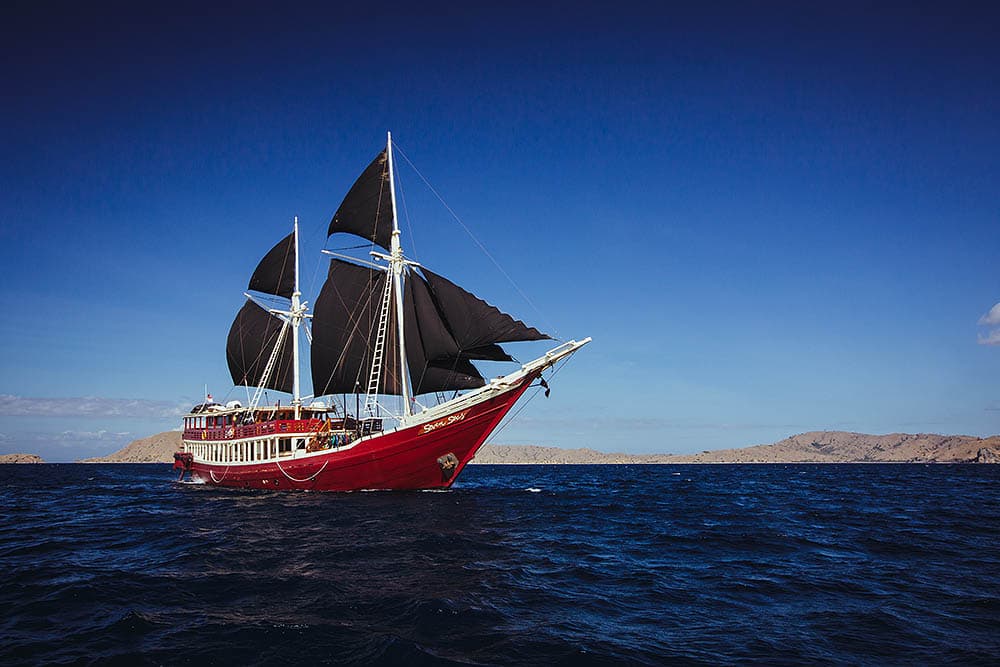
The Seven Seas
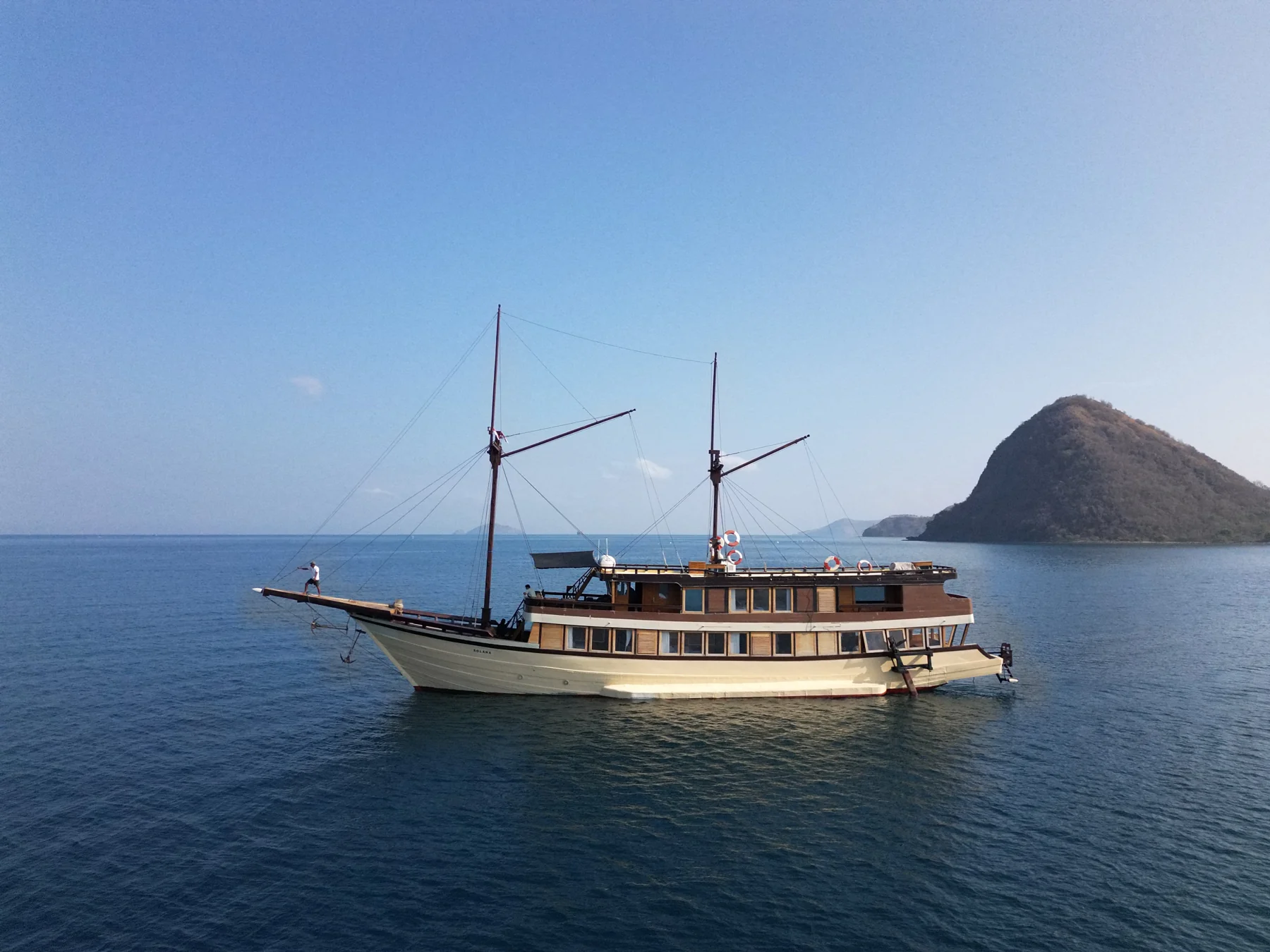
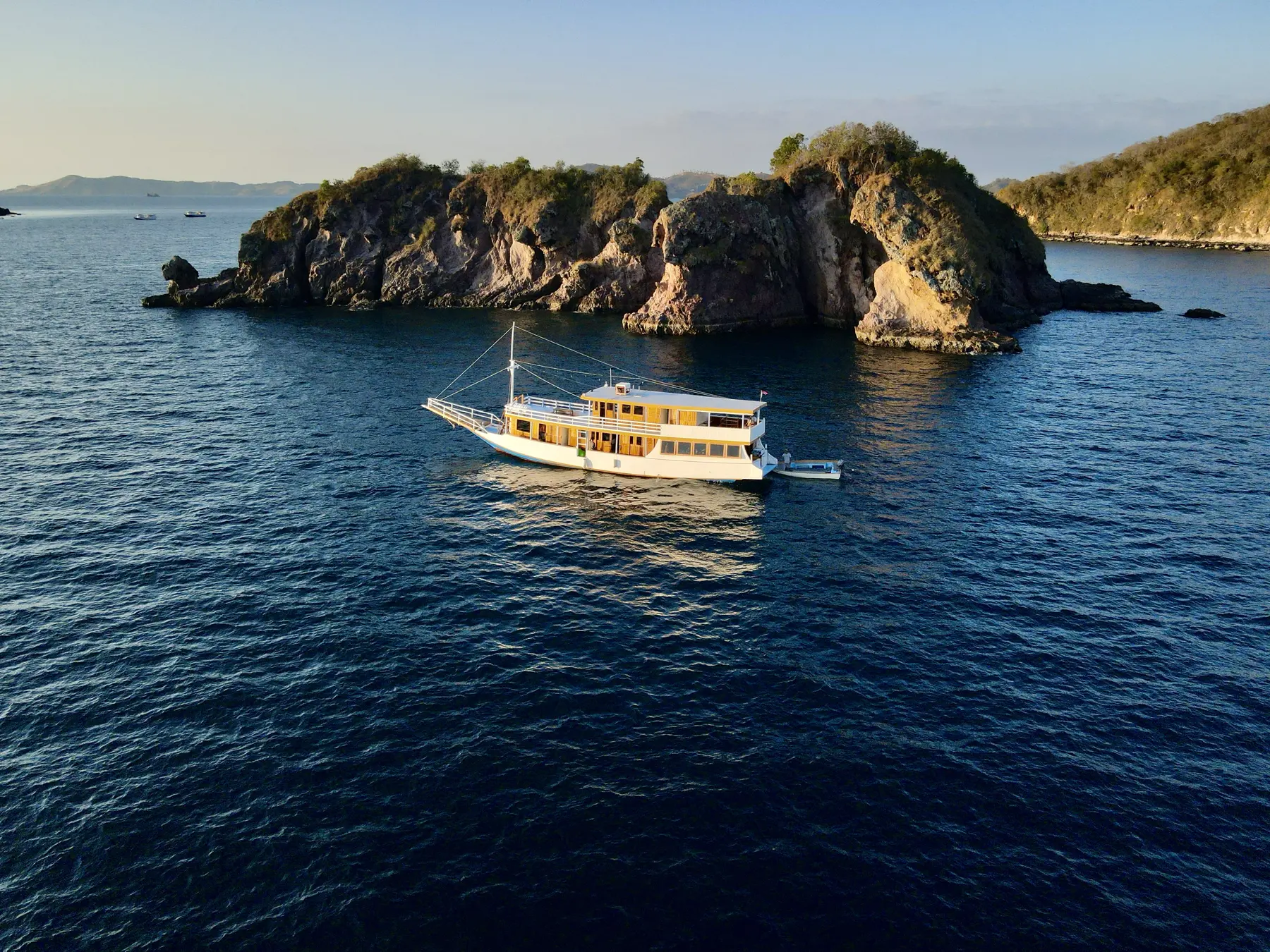
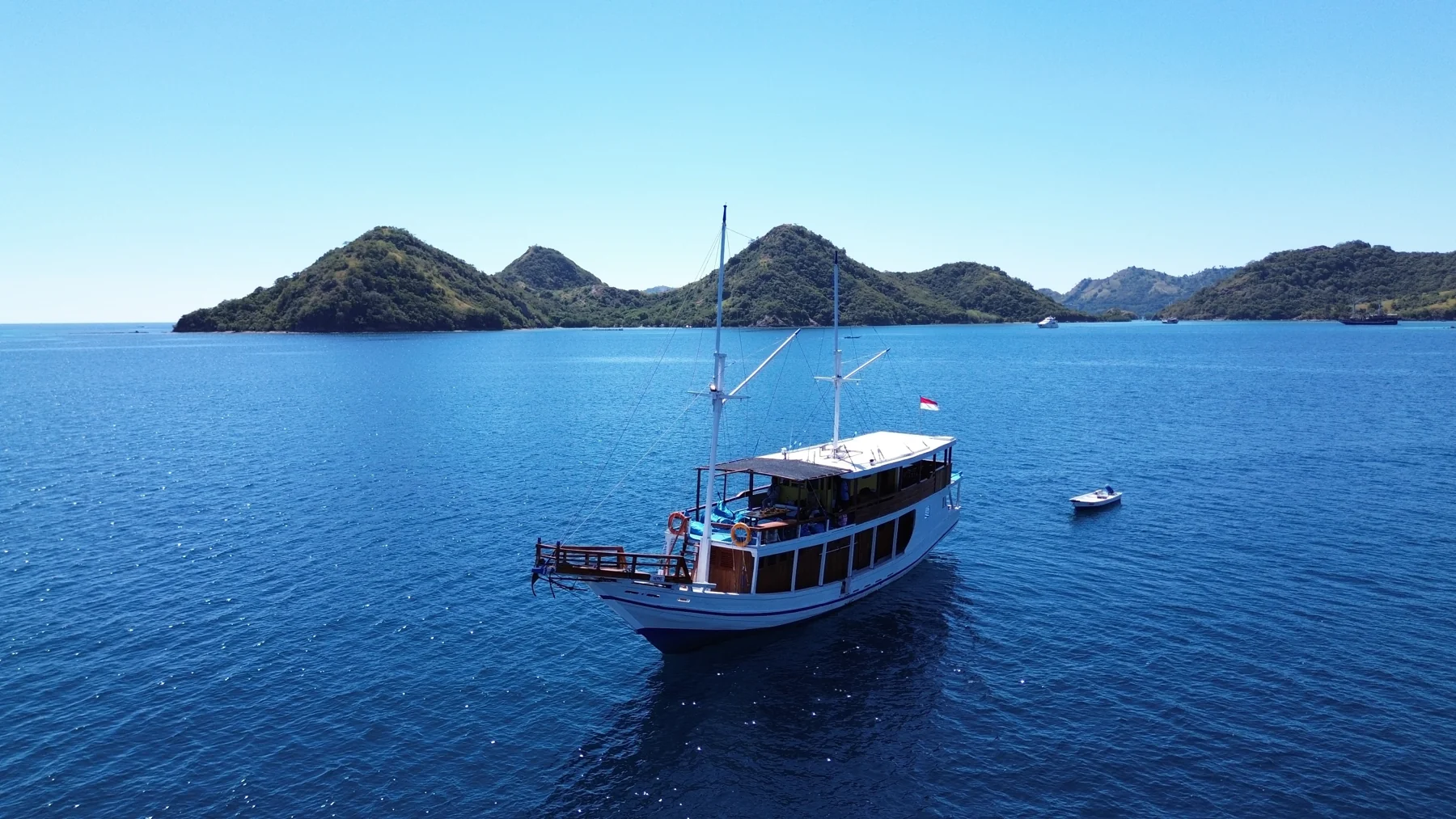
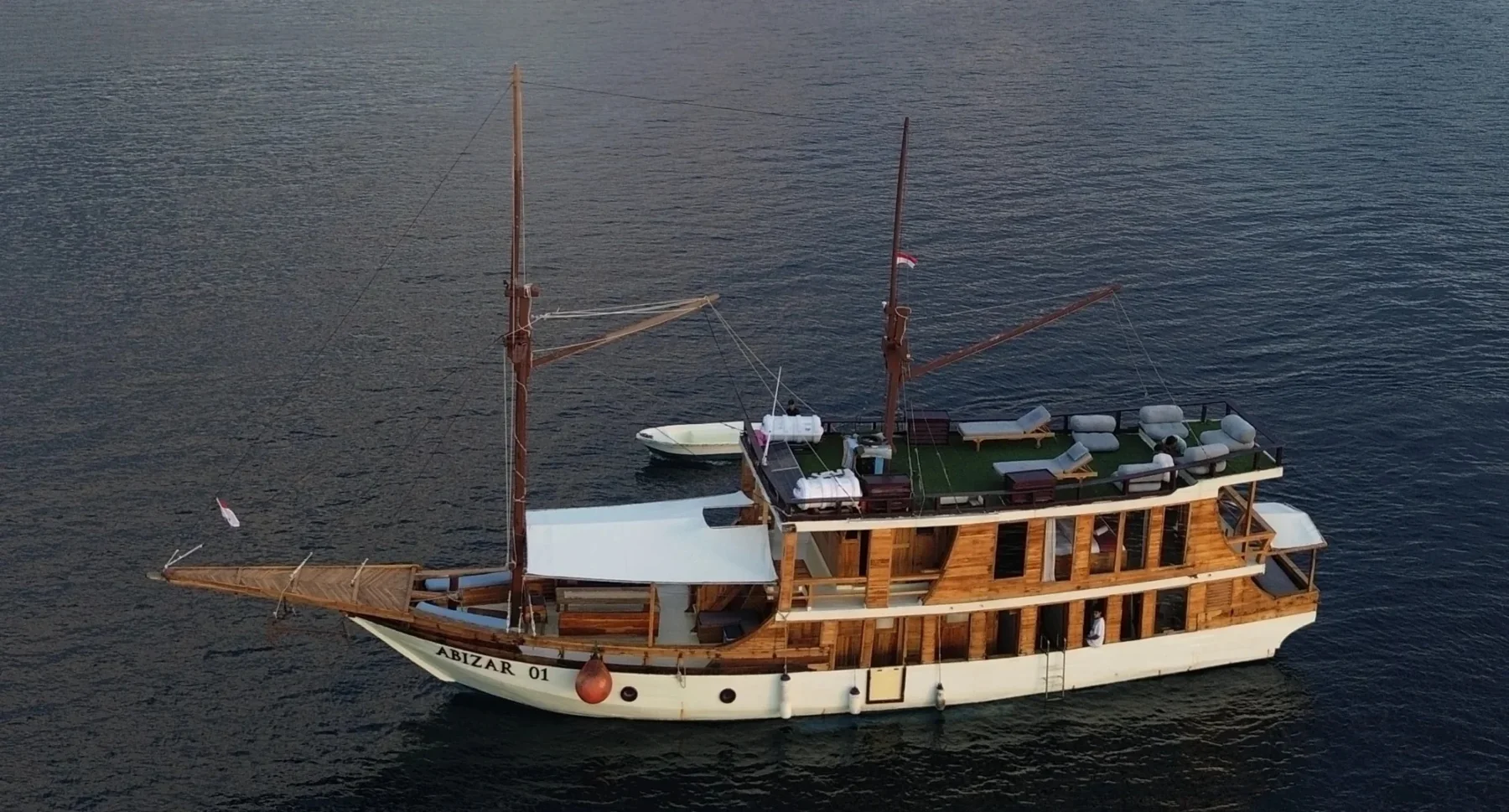
The Seven Seas is a 40m Buginese schooner that has set new standards in Indonesian luxury liveaboards. Custom-designed to accommodate up to 16 guests over three decks, the Seven Seas is perfect for a comfortable scuba diving trip in the Indonesian waters. The boat sails in Komodo, the Banda Sea and also hosts some special trips around Sumbawa and Flores.
There are four double and four twin rooms, all air conditioned, with king-size beds in the doubles and large single beds in the twins. Two of the double cabins sit on the upper deck with ocean views.
The en-suite bathrooms have powerful hot and cold water showers, hot and cold water wash basins, a full-sized WC, and a hairdryer.
The main lounge and inside dining areas is fully air-conditioned, but all windows can be fully opened to let the breeze through, which is usually the nicest experience. A shaded lounging area aft on the upper deck, as well as shaded lounge beds in front of the wheelhouse are great areas for sunsets and cocktails.
The galley serves buffet meals with a selection of wines.
The spacious dive deck, multiple compressors, fully equipped dive shops, comfortable speed boats and experienced dive guides promise you a World Class diving experience. 6 double sea kayaks are available for further adventures.
Seven Seas Deck Plan
Upper Deck
- Large sun deck with lounge chairs and day beds. Also used for outdoor dining
- Sun deck at the rear with comfortable day beds
- 2 double state rooms (1 can be connected to adjoining bunk bed cabin)
- Wheel house where the captain welcomes you to have a turn at the helm

Middle Deck
- Air conditioned lounge and dining area
- Working table for camera preparations and editing
- DVD, radio, books, toys
- Galley with state-of-the-art facilities
- Shaded dive deck with deck showers and dive gear storage
- Crew’s quarters and day heads

Lower Deck
- 6 state rooms, 2 double & 4 twin
- Emergency escape hatch
- Dry storage
- Engine room divided by insulated isolation wall

Itineraries
- Komdo | 7 days / 6 nights | From USD 2,400 per person
- Komodo and Sumbawa Whalesharks | 11 days / 10 nights | From USD 4,000 per person
- Komodo Deep South | 7 days / 6 nights and 11 days / 10 nights | From USD 2,335 per person
- East Flores and Alor | 8 days / 7 nights | From USD 2,720 per person
- Banda Sea – Forgotten Islands | 15 days / 14 nights | Fron USD 9,310 per person
The Seven Seas is available for shared trips and private charter. Contact us now to check the schedule and availability.
Where you’ll sleep
The Cabins
Cabins aboard The Seven Seas liveaboard
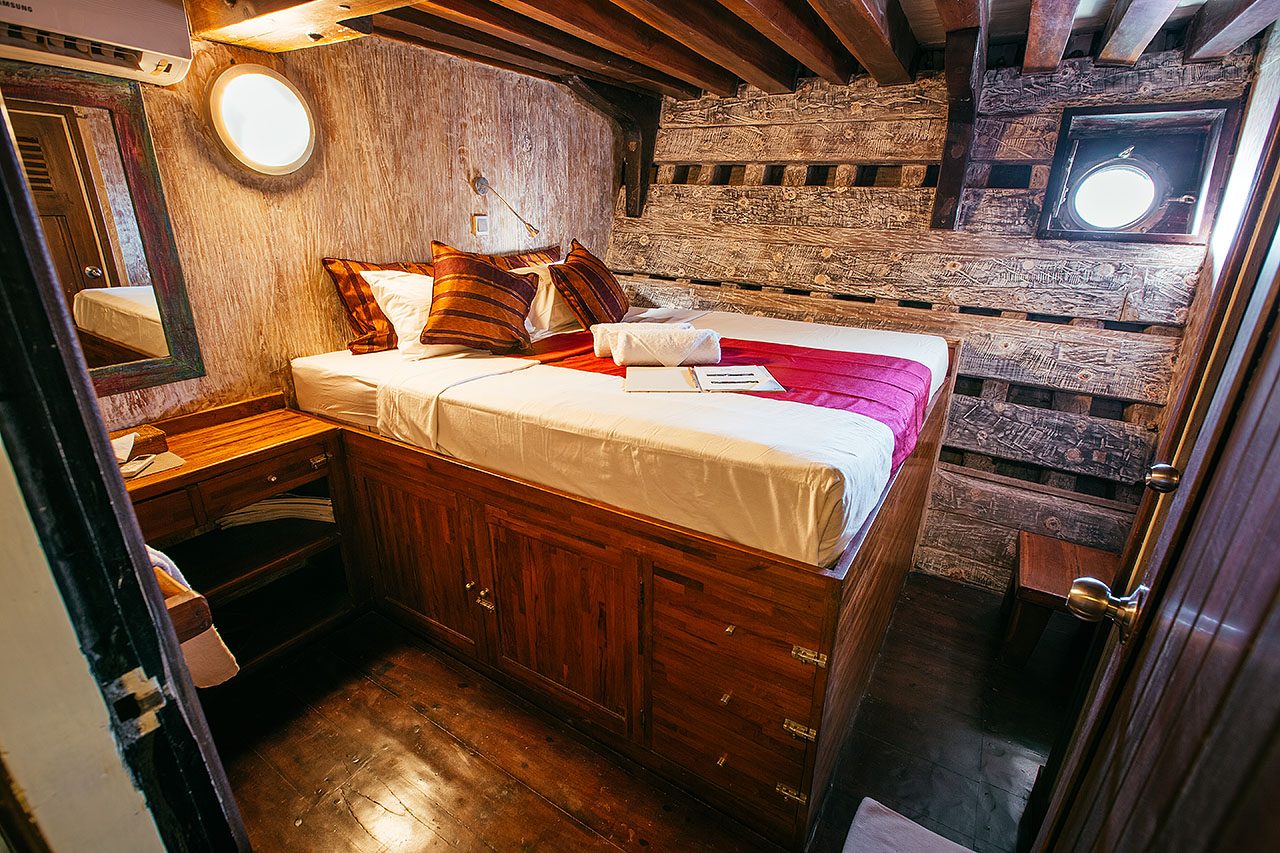
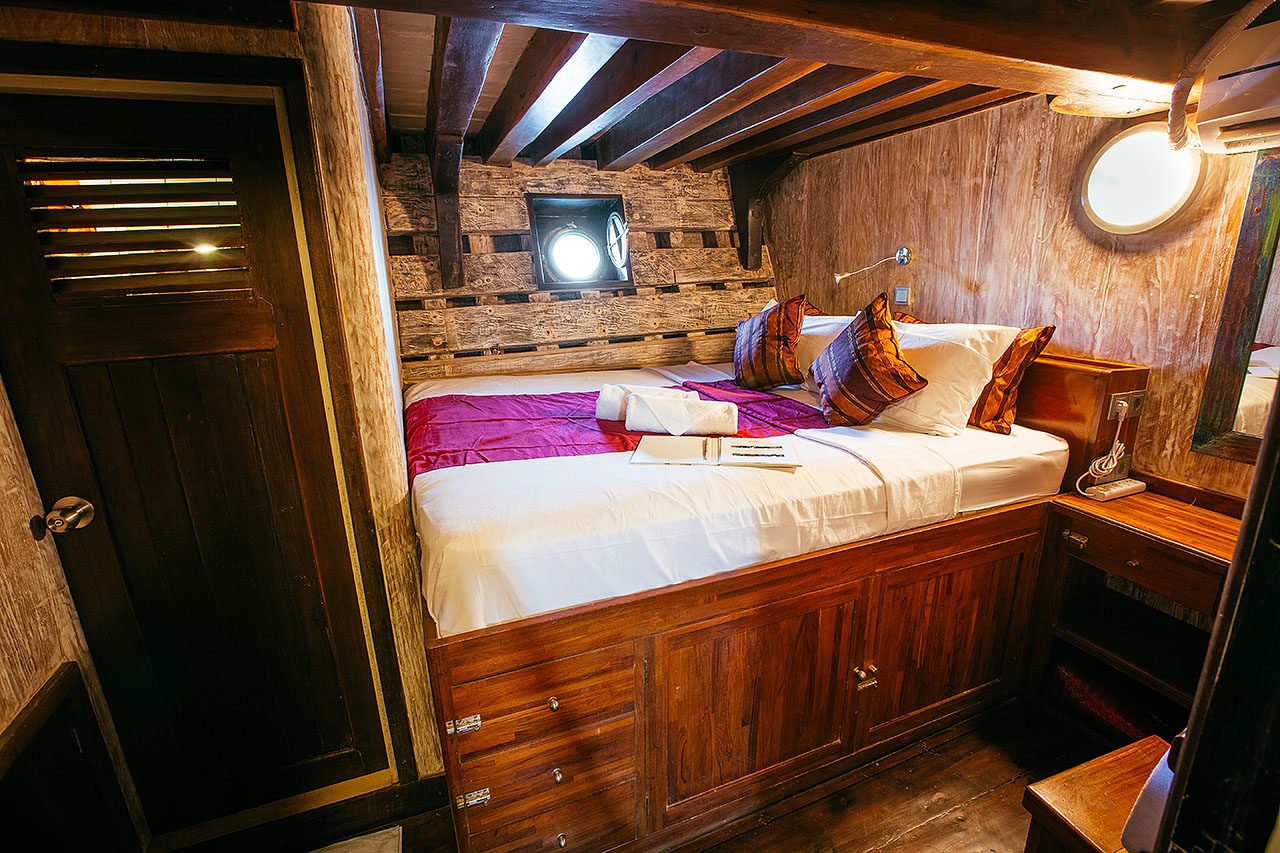
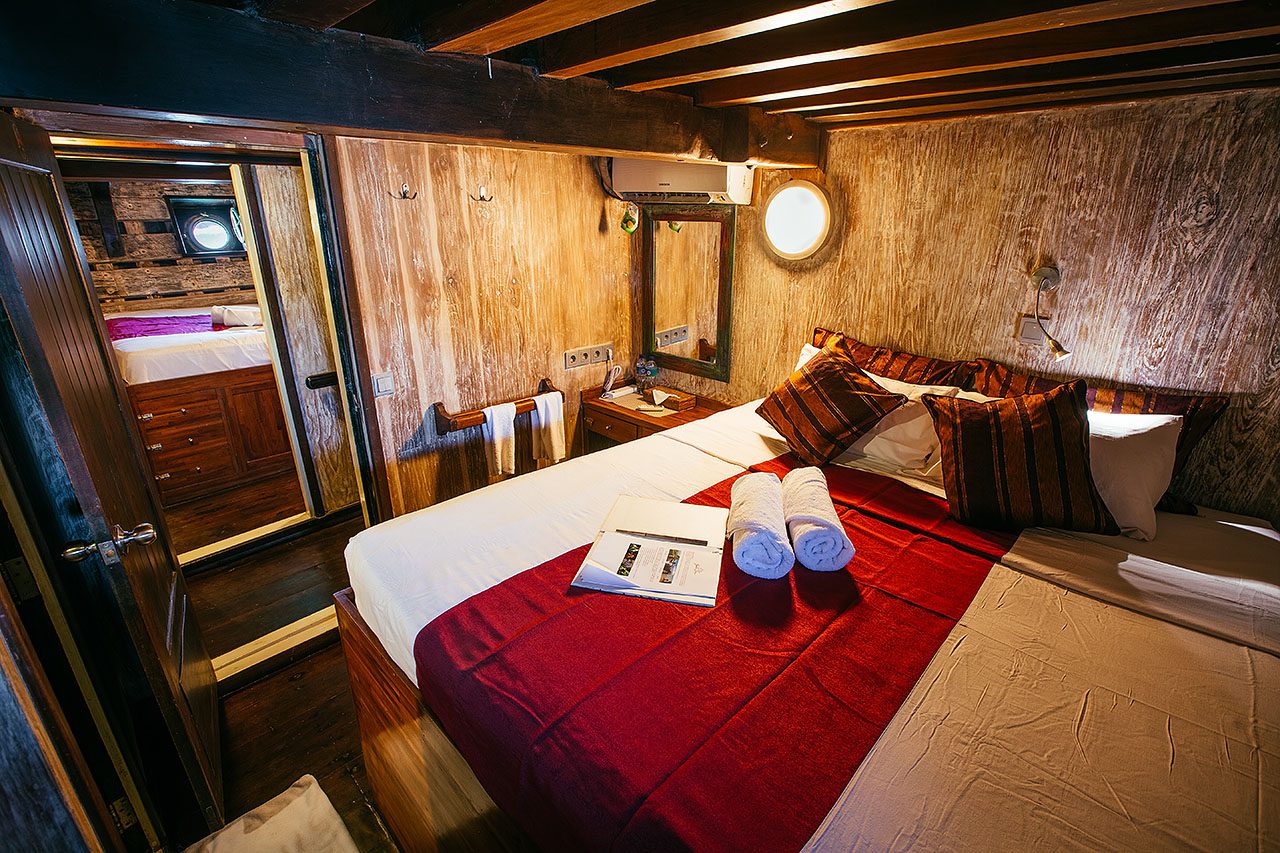
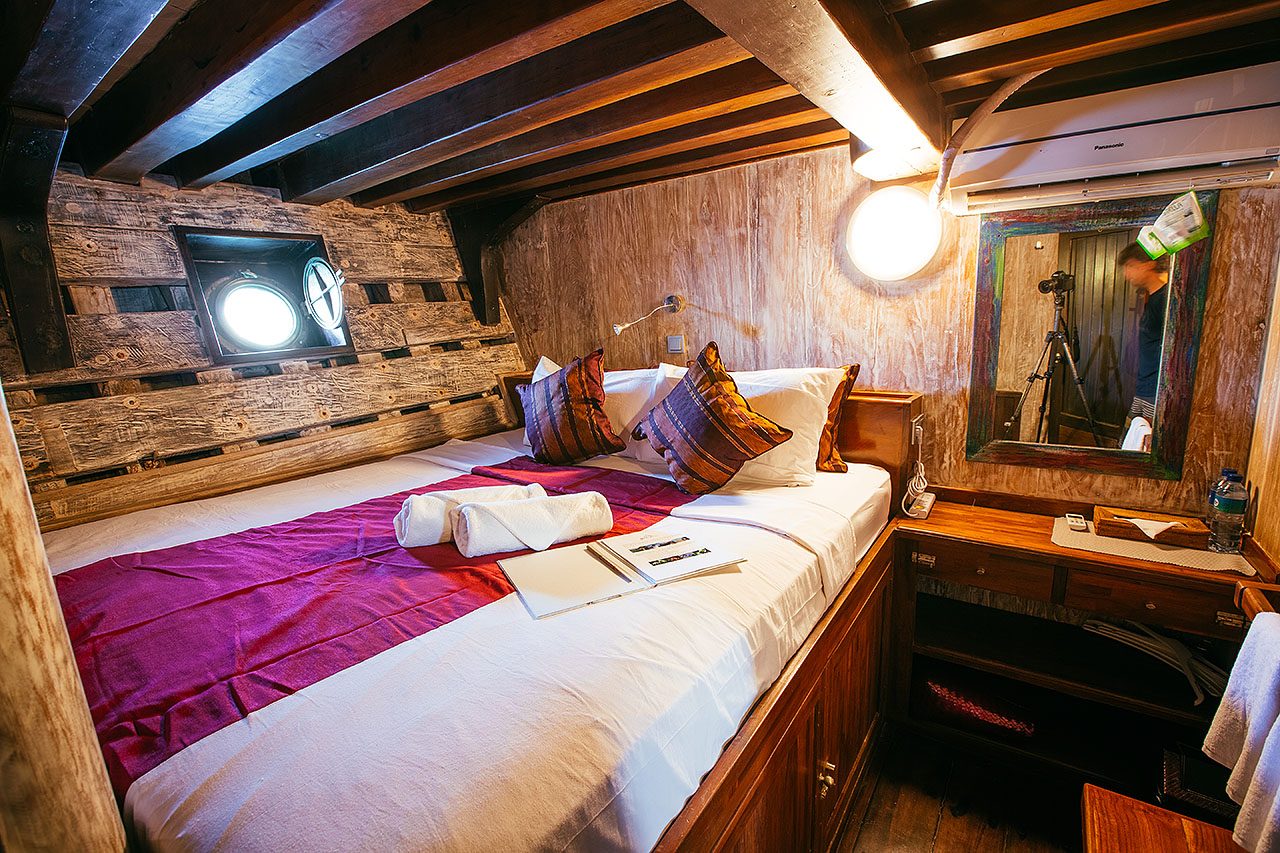
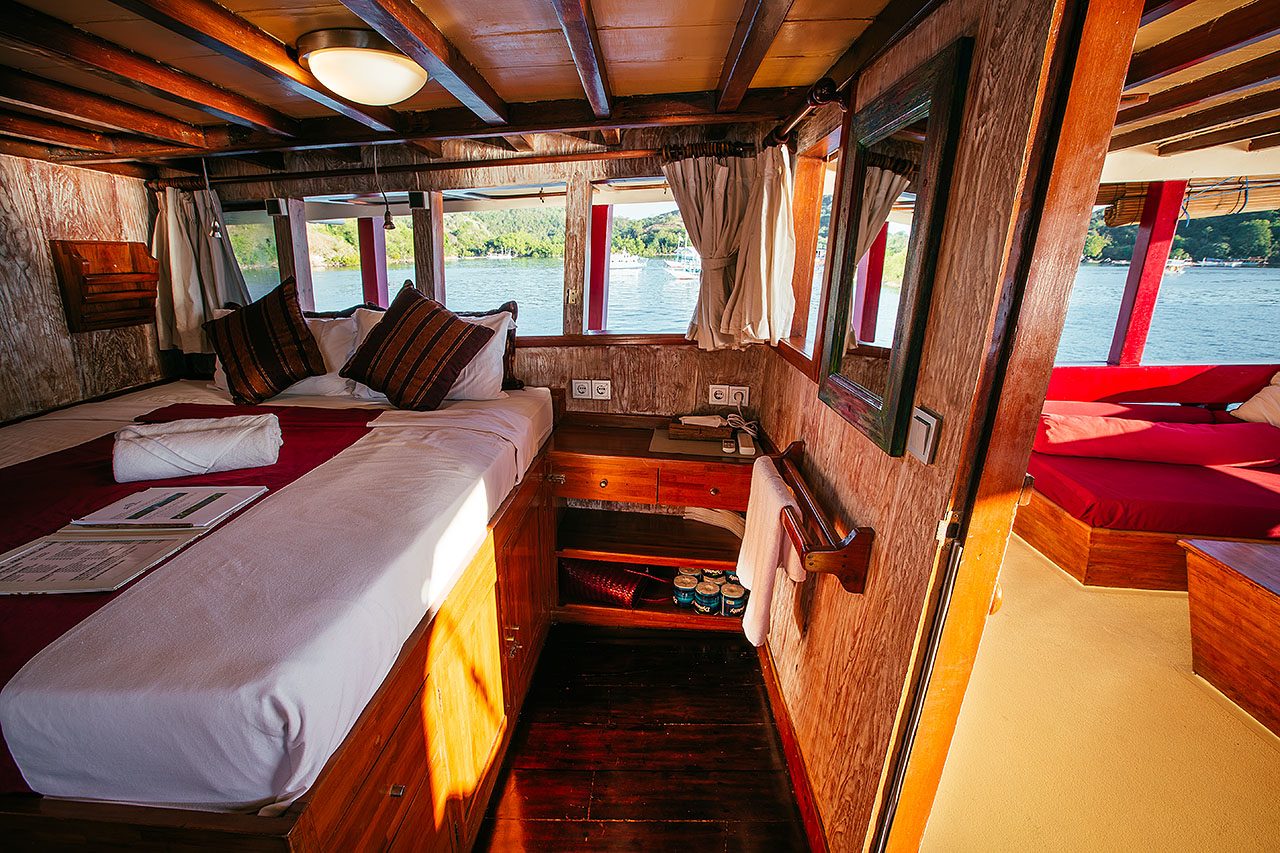
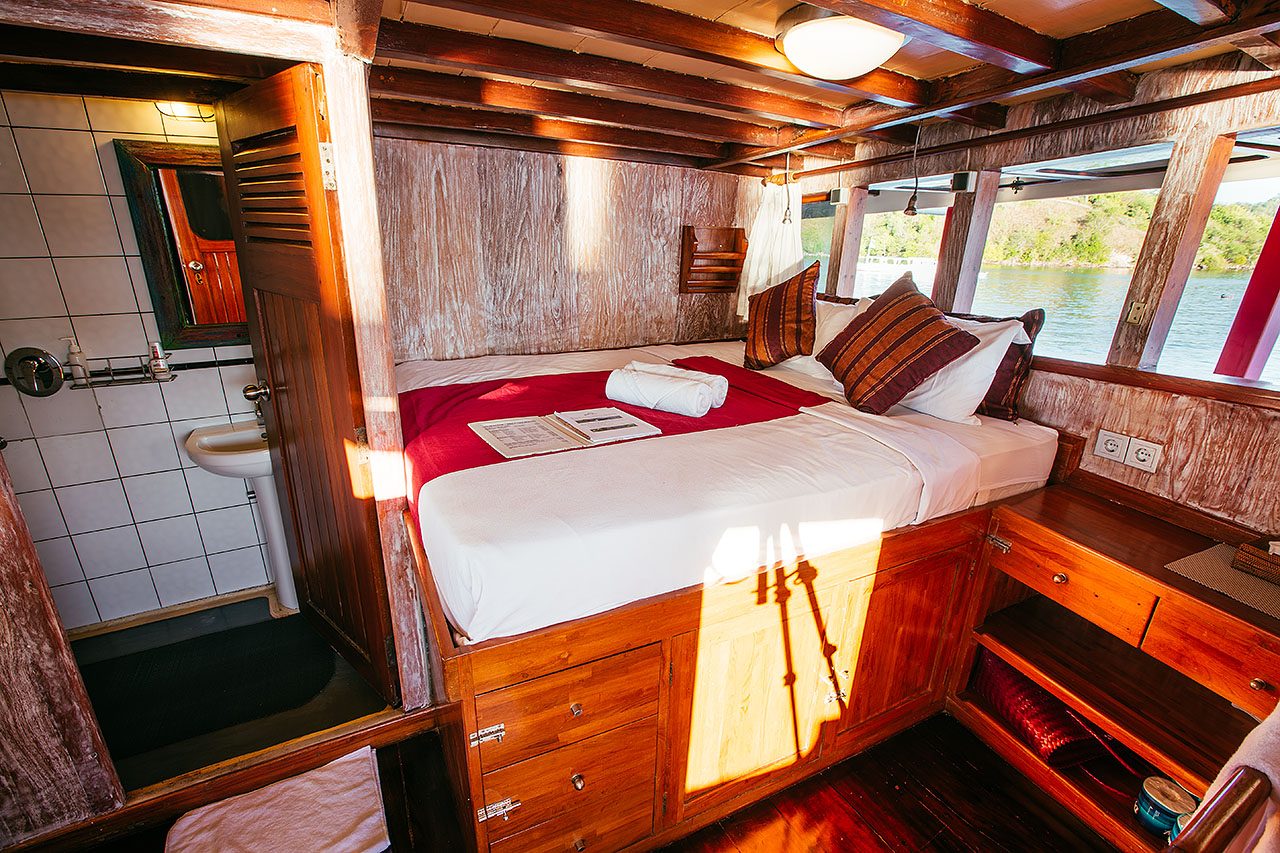
Double State Room (Lower Deck)
2 guests · double · 2 cabins of this type
Comfortable double cabin on the lower deck with a king-size bed, finished to a high standard. Includes air conditioning and a private en-suite bathroom with hot and cold water shower, wash basin, WC, and hairdryer.
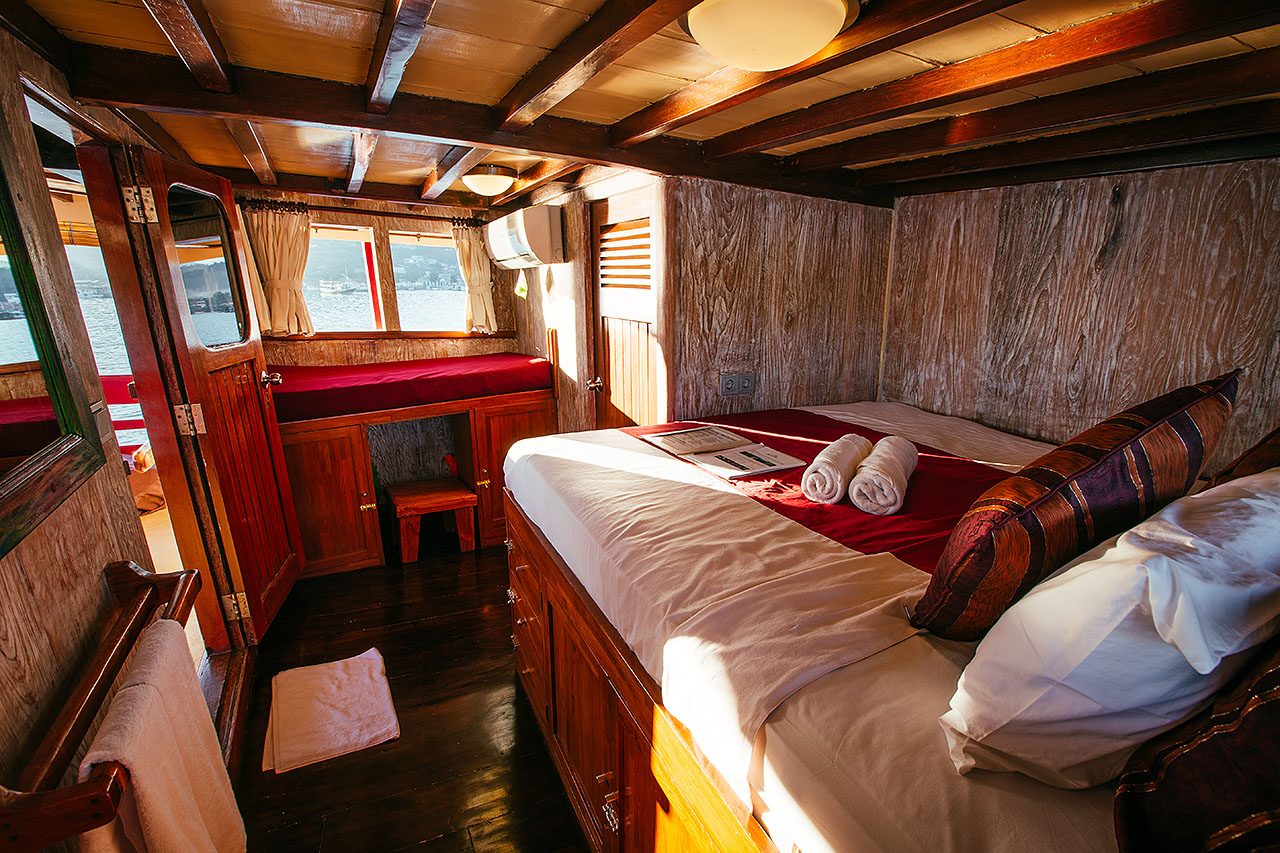
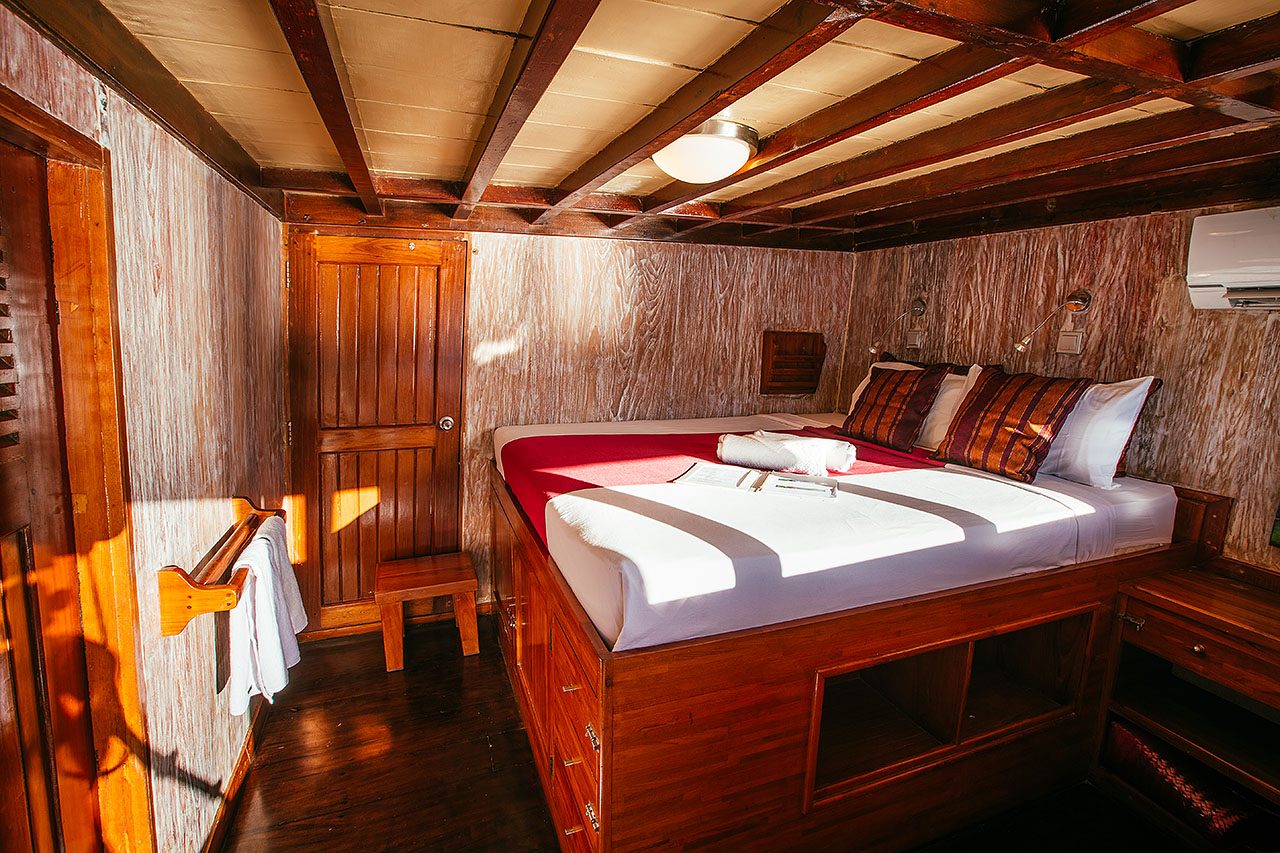
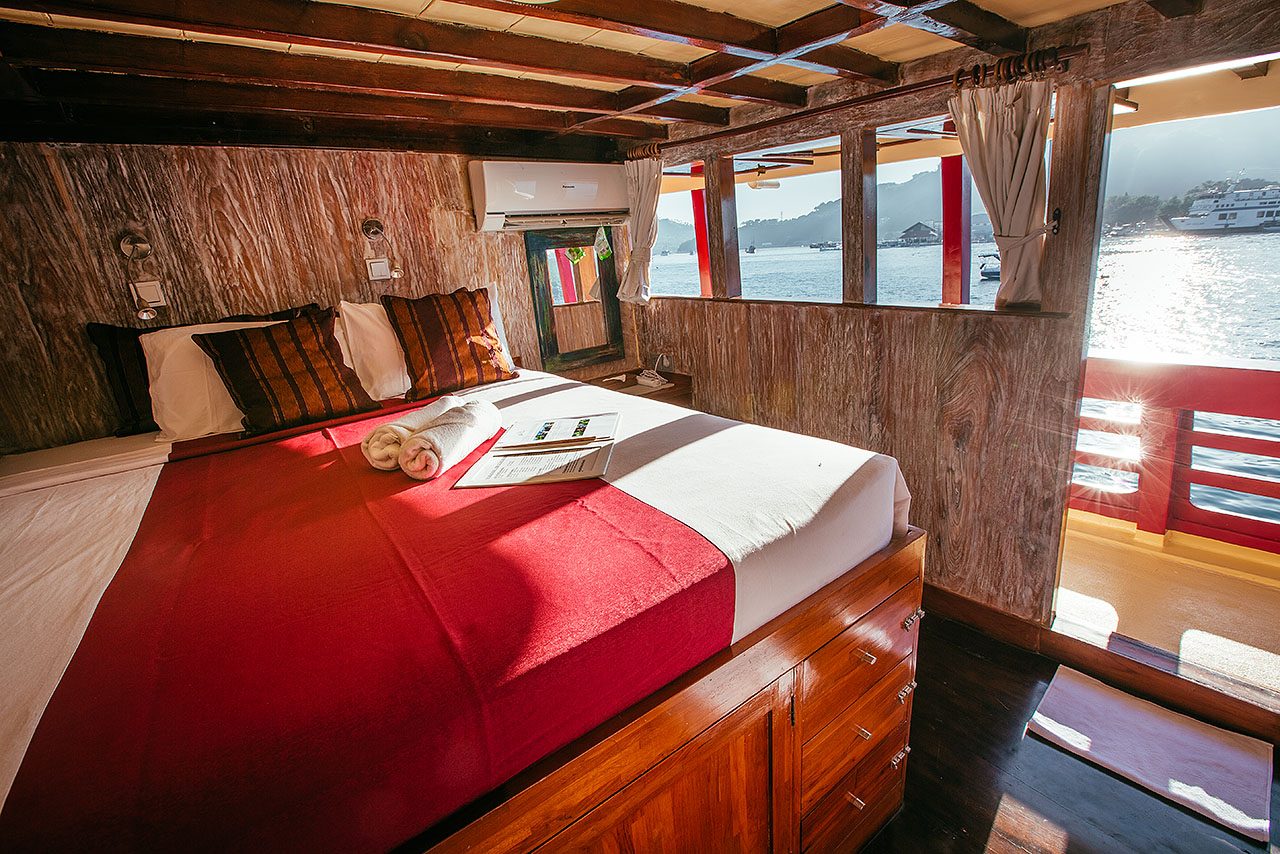
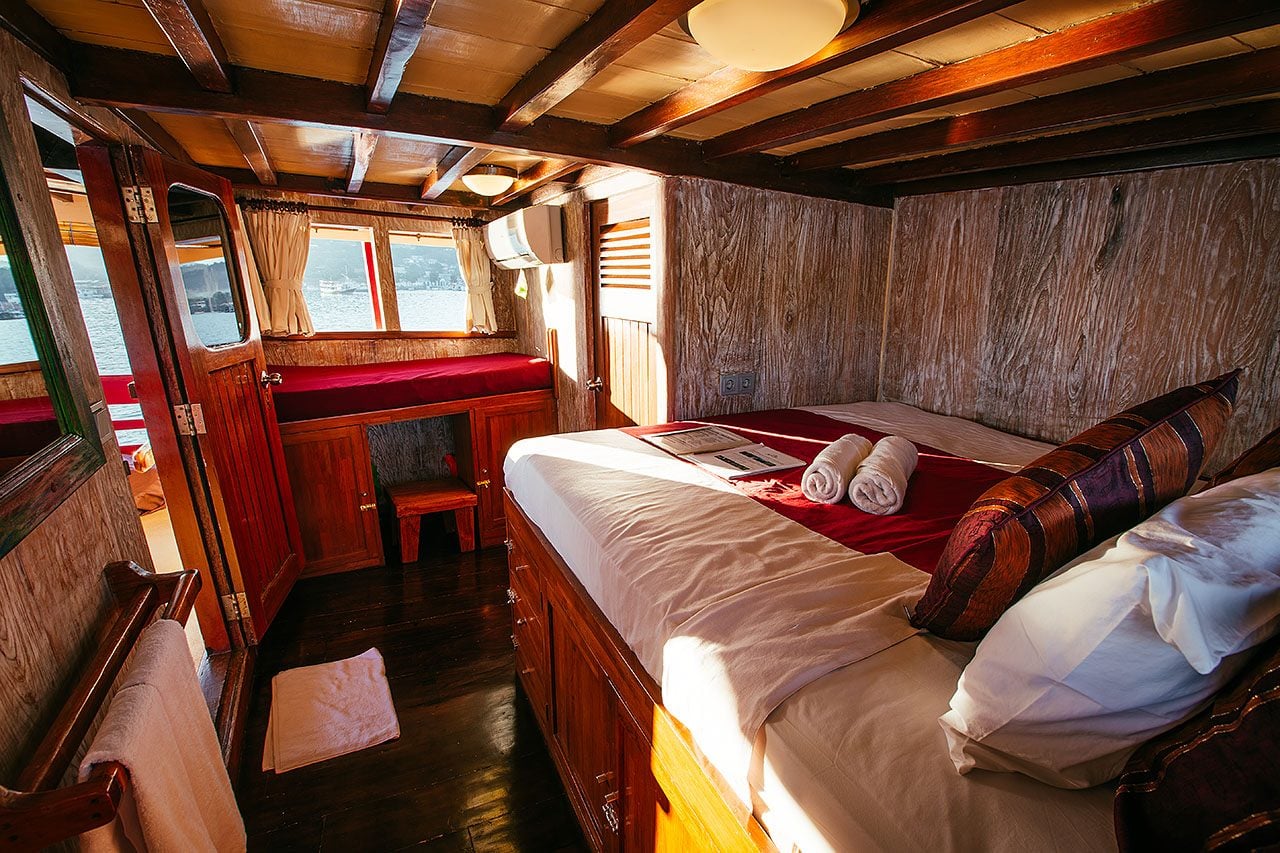
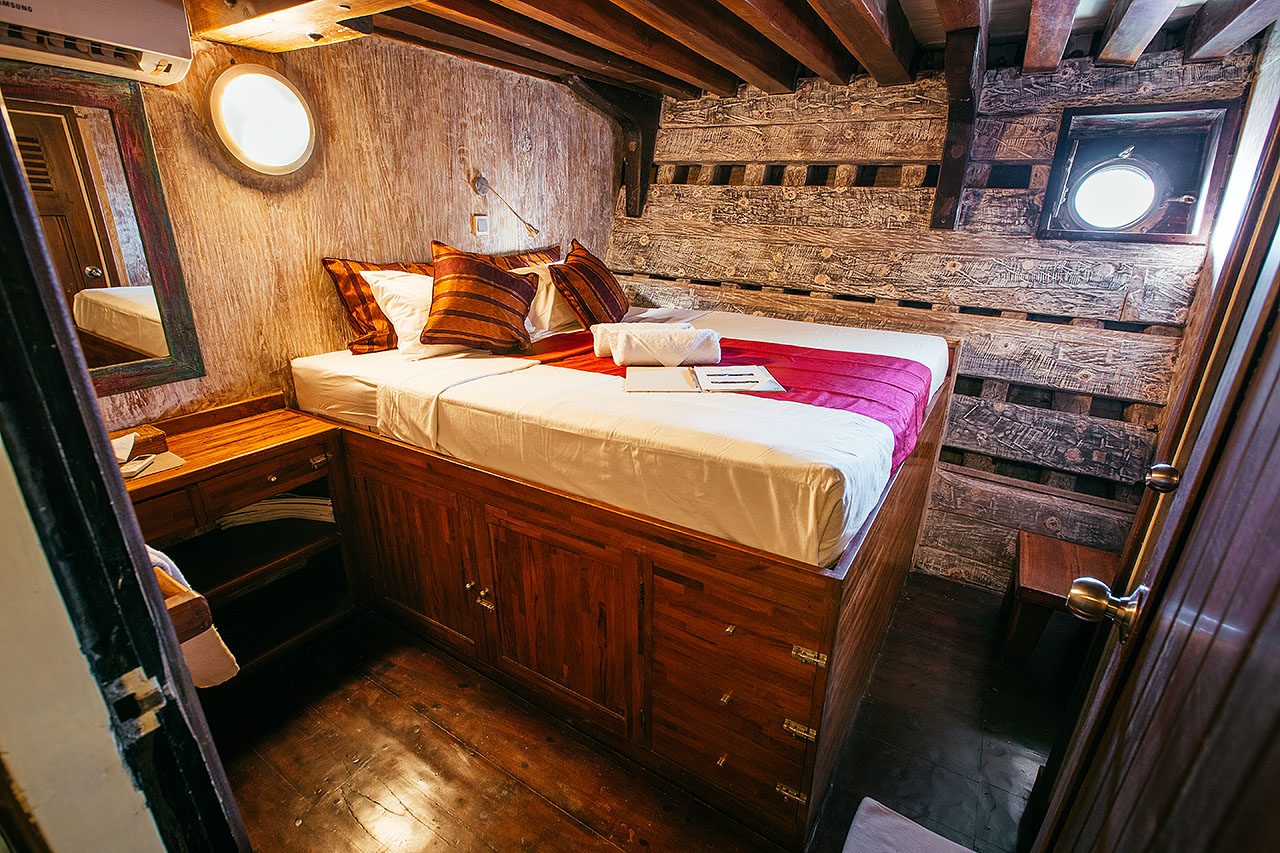
Double State Room (Upper Deck)
2 guests · double · 2 cabins of this type
Spacious double cabin on the upper deck with a king-size bed and breathtaking ocean views. Features air conditioning and a private en-suite bathroom with hot and cold water shower, wash basin, WC, and hairdryer.
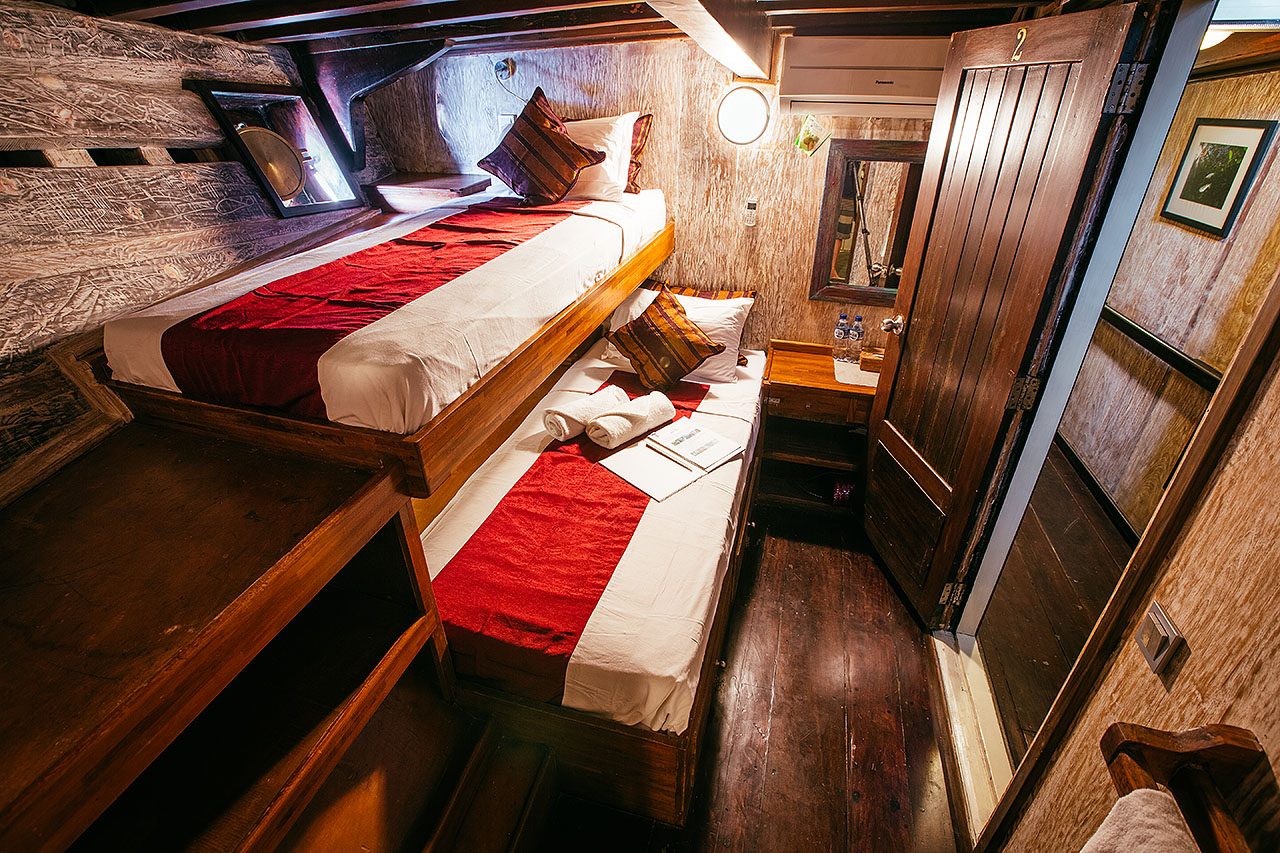
Shared cabin (per person)
1 guest · dorm
The Seven Seas sells places per person and assigns the cabin. A guest travelling alone may share with a guest of the same gender. All cabins are en-suite with air conditioning.
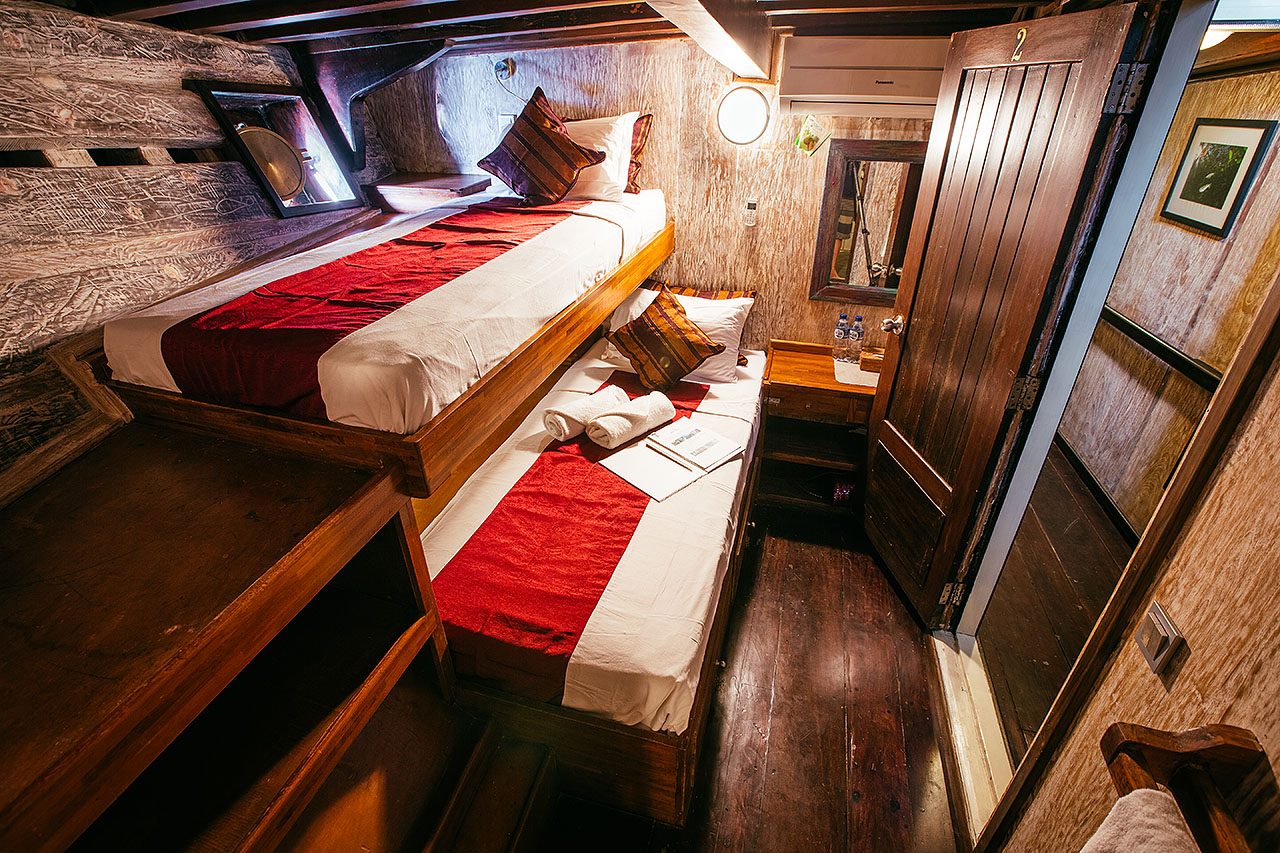
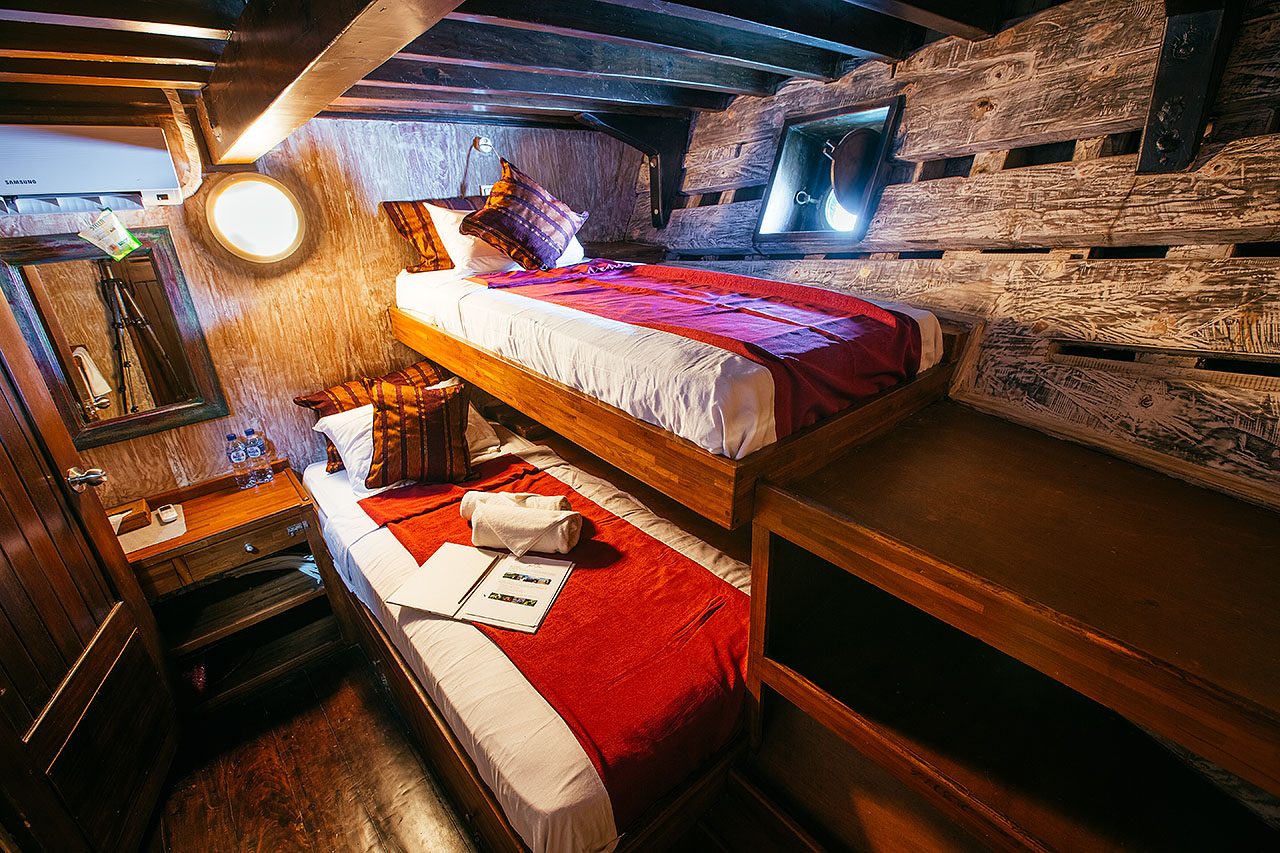
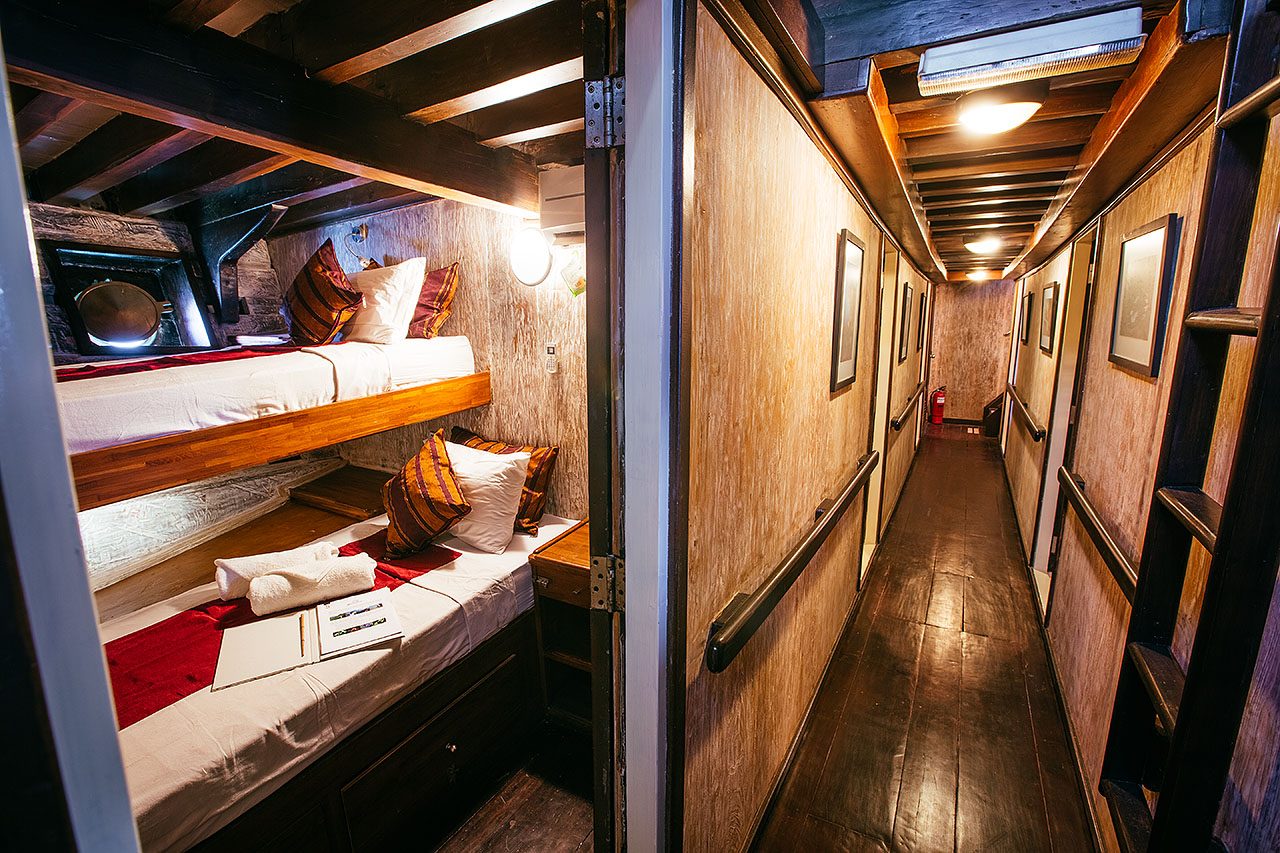
Twin State Room
2 guests · twin · 2 cabins of this type
Lower deck cabin with two large single beds, finished to a high standard. Includes air conditioning and a private en-suite bathroom with hot and cold water shower, wash basin, WC, and hairdryer.
Destination
Itineraries
Itineraries aboard The Seven Seas liveaboard
Komodo National Park
Embark: Labuan Bajo · Disembark: Labuan Bajo
Included
- Port Clearance
- Entrance/Park Conservation Fees
- Onboard accommodation
- Welcome cocktails
- Tea, Indonesian coffee and drinking water
- 4 meals a day
- Snacks
- Beach barbecue when conditions allow
- WIFI (Starlink) in all cabins and common areas with no restriction
- Return transfers from/to designated airport to/from the boat on embarkation/disembarkation days
- Beach visits
- Unguided tours (viewpoints, village visits, etc.)
- Speedboat tours
- Kayaks
- Stand up paddleboard
- Dive master
- Full dive tanks, weights, weight belts
- Nitrox
- 15L tank (upon availability)
- One laundry bag per trip per person (Max 10 pieces)
- Beach, deck and cabin towels
- Complimentary toiletries
Not included
- Flights (and related admin fee in case of rescheduling)
- Accommodation and meals pre and post cruise
- Soft drinks and alcoholic beverages (you can bring your own)
- Merchandise
- Gear and wetsuits rental
- Use of satellite phone
- Personal and medical insurance
- Visa and related fees
- Additional laundry beyond the one complimentary laundry bag
- Guided tours
- Crew gratuities (10% of the cruise rate suggested)
- Fuel surcharge of up to US$20 per guest per day, only if fuel prices rise sharply (announced up to 30 days before departure)
Sumbawa - Komodo Exploration
Embark: Sumbawa Besar · Disembark: Labuan Bajo
Day 1 | PULAU MOYO - West Nusa Tenggara
Flight to Sumbawa Besar. Transfer to the Seven Seas, setting up gear meanwhile we are steaming out and afterwards we'll do a general briefing, after some refreshments and lunch and we'll do our check out dive. We gear up for our first dive at Angel Reef.
Descending into crystal-clear waters, you'll find yourself drifting over a spectacular coral garden bursting with color and life. Hard and soft corals cover the slope, teeming with schools of fusiliers, snappers, trevallies, and bannerfish. Look closer, and you'll discover a world of smaller treasures, from nudibranchs and leaf scorpionfish to graceful ribbon eels weaving through the reef.
The highlight here is the sheer abundance of life. Large table corals host clouds of anthias, turtles glide effortlessly in the blue, and white-tip reef sharks can sometimes be spotted cruising along the slope. With its excellent visibility and healthy coral cover, Angel Reef is a diver's paradise for both wide-angle photographers and macro lovers.
As the day winds down, we will enjoy a golden sunset over Moyo's coastline, with stories of the day's dives shared over a delicious dinner on boar.
Day 2 | TELUK SALEH - Sumbawa
Teluk Saleh is one of the best places in Indonesia to encounter whale sharks. These gentle giants are attracted by the anchovies caught by fishermen near bagans, large traditional fishing platforms. The fishermen's catch draws whale sharks to feed and linger around the platforms, offering a rare chance to swim or snorkel alongside them in calm waters.
This allows for safe and respectful encounters. While sightings are not guaranteed, they are frequent, especially during the dry season. It's an unforgettable experience and one of the highlights of any trip through Sumbawa.
After spending a whole morning with the whale sharks we will move for a dive in Tanjung Berhenti
Day 3 | SANGEANG - Flores Sea
Sangeang Island is an active volcano situated northeast of Sumbawa, easily recognized by its twin volcanic peaks and frequent plumes of smoke. Its raw, rugged beauty and remote setting make it a fascinating destination, both above water and beneath the surface.
The volcanic nature of the island has shaped a unique underwater environment, with black sand slopes, warm water vents, and nutrient-rich conditions that support an impressive variety of marine life. The combination of volcanic terrain, colorful soft corals, and vivid sponges makes this area particularly appealing to divers.
Bubbles from the seabed rise in certain areas, creating an otherworldly atmosphere beneath the surface. The reefs are alive with reef fish, soft corals, and macro creatures like ribbon eels, ghost pipefish, and sand-dwelling critters.
Sangeang offers a refreshing contrast to the surrounding regions, thanks to its volcanic origin, vibrant marine habitats, and the cultural presence of Bontoh Village where traditional boat building is still part of daily life. The villagers craft wooden phinisi boats by hand, a time- honored skill passed down through generations. You'll be able to see the boat frames in various stages of construction and learn how these impressive vessels are built using simple tools, local wood, and deep knowledge of the sea.
After the visit, we'll prepare for a night dive in the surrounding waters.
Day 4 | GILI LAWA - Komodo National Park
Located in the northeast of Komodo Island, Gili Lawa is one of the most iconic dive destinations in the national park, offering some of the region's top underwater adventures. Known for its warm, clear waters and rich marine life. Above water, the hills of Gili Lawa provide stunning panoramic views, making it a favorite for both divers and snorkelers.
Castle Rock: An underwater seamount attracting action-packed marine life thanks to steady currents. Divers can expect to encounter dense schools of predatory fish like giant trevallies, Napoleon wrasse and big groups of surgeonfish , along with reef sharks patrolling the area. The top of the site is shallower and covered in healthy coral, perfect for a slower finish to the dive.
Crystal Rock: A vibrant reef that rises close to the surface, offering excellent visibility and lots of fish traffic. This site is full of movement, snapper, sweetlips, and jacks are common, often swirling in the current. The sheltered side is ideal for exploring colorful hard coral formations and spotting smaller reef species.
The Cauldron (Shotgun): A thrilling drift through a narrow channel between two islands.Timing is key here, so dives are usually planned around tidal flow. Watching the sunset from a secluded beach or hiking to a scenic viewpoint are also popular activities in the area, offering a perfect way to end the day after diving.
Day 5 | BATU MONCO - Komodo National Park
Batu Monco is a quiet bay located on the northwestern side of Komodo Island. With its calm, clear waters and protection from strong currents, it's well-suited for laid-back and comfortable dives. The site features sloping reefs, small drop-offs, and untouched shallow coral zones that are full of marine life.
You'll find a variety of vibrant hard and soft corals, along with commonly seen reef species like angelfish, butterflyfish, and parrotfish. Octopus, cuttlefish, and moray eels can also be encountered. Juvenile manta rays are known to pass through the area from time to time. On the surface, the bay is great for kayaking and paddleboarding, offering a peaceful way to enjoy the natural setting.
After a couple if dives we'll do our afternoon dive in Laju Pamale where we will enjoy close by after the dive some delicious snacks and drinks at the beach.
Day 6 | N'DOKO - Sumbawa
N'doko, located on the eastern side of Sumbawa Island, is a great destination for diving and snorkeling. The area features healthy reefs with soft corals, sponges, and crinoids, and offers excellent underwater visibility.
Marine life is diverse, including schools of surgeonfish, leaf scorpionfish, turtles, white-tip reef sharks, and the occasional warty frogfish. Dive sites range from sandy slopes with coral bommies to drift dives, offering something for different skill levels.
After diving, you can relax on a quiet beach with a fantastic view of Sangeang Island, especially at sunset. The snorkeling is also very good, with plenty of life near the shore.
The beaches along our route are simply breathtaking, untouched stretches of white sand, and even a secluded pink beach reminiscent of what Komodo's famous Pink Beach used to be, before the crowds. Hidden far from any tourist routes, this secret paradise is reserved just for us, ensuring a completely private and intimate experience.
At noon, we set up an unforgettable beach barbeque: the turquoise sea on one side, majestic mountains on the other, and later, a sky full of stars above us. The setting is pure magic, the kind of moment that stays with you forever.
Day 7 | MANTA ALLEY & NUSA KODE - South Komodo National Park
Manta Alley, located at the southern tip of Komodo Island, is renowned as one of the top places in the world to encounter manta rays. During the dry season, cooler waters rich in plankton attract large numbers of reef mantas, and occasionally even oceanic mantas.
This dive site is far more than a standard cleaning station. It features narrow channels, rocky formations, and coral slopes that support a diverse range of marine life. Mantas are often seen cruising through the area, hovering over cleaning spots or feeding in the current.
The reef itself is full of life, dense fields of soft corals, crinoids, and sponges cover the substrate. Schools of fusiliers and trevallies sweep through the water, while white-tip reef sharks and turtles are also commonly sighted.
Manta Alley is an exposed site, open to oceanic conditions, which can bring strong currents, surge, and rough surface weather. At times, diving here may not be possible due to unfavourable sea conditions.
After a couple of dives in Manta Alley, we'll cross into the dramatic setting of Nusa Kode, where our midday dive takes place at the legendary Cannibal Rock. Rising to just 3 meters below the surface and dropping down to around 30 meters, this seamount is considered one of Komodo's richest dive sites. Its slopes are carpeted with sponges, soft corals, and featherstars, creating a vibrant backdrop for some of the best macro life in the park: frogfish, nudibranchs, pygmy seahorses, and the rare Coleman shrimps hiding in fire urchins. Larger reef fish also patrol the area, and depending on the currents, schools of pelagics add to the action. While the bay offers some protection, the water can be cooler here, bringing in nutrients that fuel this explosion of life.
After surfacing, don't forget to glance toward the beach, this is one of the rare places where Komodo dragons can often be seen walking along the shore, a truly surreal sight.
As the sun sets, the adventure continues with a fourth dive at Torpedo Alley, one of Komodo's most famous night dives. On the black sandy slopes between 5 and 25 meters, the reef transforms into a stage for nocturnal creatures. Here you may encounter electric torpedo rays, stargazers, bobtail squid, cuttlefish, frogfish, and bizarre critters like the Bobbitt worm. It's a classic muck dive, where the thrill comes from finding camouflaged and rare species that only reveal themselves under the cover of darkness.
From the dazzling colors of Cannibal Rock to the mysterious nightlife of Torpedo Alley, this day combines two of Komodo's most iconic and contrasting experiences, both above and below the surface.
Day 8 | CENTRAL KOMODO - Komodo National Park
Central Komodo stands out as one of Indonesia's premier diving locations, offering a diverse underwater environment with excellent coral health, a wide range of marine species. The region features everything from easygoing reef dives to more advanced sites with strong currents and larger marine creatures. Dive locations in Central Komodo include coral slopes, reef walls, sandy bottoms, and pinnacles. From macro subjects like nudibranchs and frogfish to large marine animals such as manta rays and reef sharks.
Some of the dives sites that we might do are:
Karang Makassar (Manta Point): A broad, shallow reef known for frequent manta ray encounters, especially during rising tides when they come to cleaning stations. A relaxed drift dive with sandy patches and scattered coral bommies.
Tatawa Besar: An easygoing drift dive with vibrant soft corals, large schools of fish, and regular sightings of turtles.
Tatawa Kecil: A site for more advanced divers, featuring complex coral topography, swim-throughs, and stronger currents. It's a good place to see larger fish like trevallies and the occasional shark.
Siaba Besar: A sheltered bay with minimal current and shallow depths. Expect encounters with turtles, cuttlefish, and large groups of reef fish.
Batu Bolong: One of the most iconic dive sites in Central Komodo. It's a steep coral pinnacle that rises from deep water to just below the surface. The reef is densely packed with hard and soft corals and attracts a huge variety of marine life. Expect to see large schools of anthias, snappers, fusiliers, and surgeonfish. Turtles are common, and reef sharks often cruise the deeper sections. Napoleon wrasse, giant trevallies, and the occasional barracuda also pass through.
Seven Seas Secret: Another of our signature dives, this hidden gem reveals an outstanding hard coral garden that gently slopes into a pristine stretch of white sand. The reef is alive with action: majestic manta rays gliding through the blue, turtles resting gracefully on the corals, and reef sharks patrolling the edge of the slope. With a touch of luck, you may even encounter one of the ocean's rarest and most enchanting visitors, the elusive dugong.
After finishing our day, we make our way to the eastern part of Komodo to wrap up the day doing a night dive in Pulau Lassa.
Day 9 | LOH LIANG & CENTRAL KOMODO - Komodo National Park
The experience begins upon arrival at Loh Liang on Komodo Island, where you are welcomed by official park rangerswho lead a guided walk through the natural trails of the national park. During this walk, you explore areas of open savanna, dry forest, and gentle hills while observing Komodo dragons in their natural habitat, along with other wildlife such as deer, birds, and monkeys. The rangers provide insights into the behavior, biology, and conservation of these unique reptiles, making the visit both safe and educational.
After completing the trek, you continue by boat to Pink Beach, one of the most iconic locations in the park, known for its distinctive pink-hued sand and clear turquoise waters. You continue diving in the waters around Pink Beach, where the shallow reefs and vibrant marine life create an ideal setting for an immersive underwater experience. After the dive, you can swim in the clear turquoise water, relax on the distinctive pink-hued sand, or snorkel along the shoreline to observe colorful corals and tropical fish in the calm, shallow areas, and enjoy a simple lunch either on board or as a picnic by the shore.
The journey then continues to the waters of Central Komodo, an area renowned for its rich marine biodiversity and excellent diving conditions. Guided by our experienced instructors, you take part in one or more dives over vibrant coral reefs where you may encounter schools of fish, sea turtles, reef sharks, and, in certain areas, manta rays.
Day 10 | Labuan Bajo
Disembarkation. Fly to Bali or Jakarta and transfer to flights home or resorts.
Included
- Port Clearance
- Entrance/Park Conservation Fees
- Onboard accommodation
- Welcome cocktails
- Tea, Indonesian coffee and drinking water
- 4 meals a day
- Snacks
- Beach barbecue when conditions allow
- WIFI (Starlink) in all cabins and common areas with no restriction
- Return transfers from/to designated airport to/from the boat on embarkation/disembarkation days
- Beach visits
- Unguided tours (viewpoints, village visits, etc.)
- Speedboat tours
- Kayaks
- Stand up paddleboard
- Dive master
- Full dive tanks, weights, weight belts
- Nitrox
- 15L tank (upon availability)
- One laundry bag per trip per person (Max 10 pieces)
- Beach, deck and cabin towels
- Complimentary toiletries
Not included
- Flights (and related admin fee in case of rescheduling)
- Accommodation and meals pre and post cruise
- Soft drinks and alcoholic beverages (you can bring your own)
- Merchandise
- Gear and wetsuits rental
- Use of satellite phone
- Personal and medical insurance
- Visa and related fees
- Additional laundry beyond the one complimentary laundry bag
- Guided tours
- Crew gratuities (10% of the cruise rate suggested)
- Fuel surcharge of up to US$20 per guest per day, only if fuel prices rise sharply (announced up to 30 days before departure)
Raja Ampat Exploration
Embark: Sorong · Disembark: Sorong
Day 1 | Pulau Matan (Check Dive)
Arrival in Sorong. The crew will pick up guests at the airport and hotels, assist with transfers to the vessel, prepare dive equipment, conduct the boat briefing, and serve lunch on board. In the afternoon, the first dive of the trip will take place at Pulau Matan.
Roughly an hour from Sorong, this first dive site offers a great introduction to the underwater world of Raja Ampat. It's an easy and relaxed dive, making it ideal as a check dive before the longer crossings and more challenging sites ahead. Despite its simplicity, the site packs in a little bit of everything you'll encounter in the days to come: a mix of hard and soft corals, macro life, and schools of reef fish. If you're lucky, you might spot your first wobbegong shark of the trip. This dive is a solid warm-up before you set off on a full night's sail south to Misool.
Day 2 | Daram Islands
The Daram Islands lie in a remote corner of southeast Misool, known for towering limestone formations and exceptional water clarity. This area is prized for its untouched reefs, dramatic underwater topography, and extraordinary colour. Sites like Andiamo, Candy Store, and Warna Berwarna are among the most vibrant reefs in Raja Ampat, boasting carpets of soft corals, huge sea fans, and bright chromatic contrasts that photographers adore.
This region feels wild and isolated, offering guests a true sense of "end-of-the-world diving."
Day 3 & 4 | Fiabacet & Boo (Misool)
The Fiabacet and Boo area represents the beating heart of Misool's marine biodiversity, widely considered one of the richest marine ecosystems on Earth.
The Fiabacet chain, with sites such as Nudi Rock, Tank Rock, and Whale Rock, features a thrilling mix of steep ridges, coral-draped pinnacles, shallow gardens, and pelagic activity. Boo Island is home to the iconic Boo Windows, a natural rock formation carved with large swim-through holes that create one of the most photographed underwater scenes in the world.
The crown jewel of the area is Shadow Reef (Magic Mountain), one of the most sought-after dive sites globally. Guests can expect:• Oceanic manta rays• Grey reef sharks• Schools of jacks and snappers• Giant trevallies• Batfish clouds• Incredible reef health
Fiabacet & Boo deliver many guests' favourite dives of the entire trip.
Day 5 | Wayilbatan (Misool)
Wayilbatan is where the scenery of Raja Ampat becomes almost surreal. Above the water, limestone cliffs rise sharply from emerald lagoons, forming one of the most visually striking landscapes in the entire archipelago.
Underwater, Wayilbatan offers a collection of world-class sites, each with its own personality:
Wedding Cake
A gentle sloping reef with tiered coral "steps," giving the site its name. Bright hard corals dominate the shallow terraces, creating a peaceful and photogenic dive.
Gorgonian Passage
A narrow channel framed by huge sea fans and dramatic walls. Light filters beautifully through the passage, making it a perfect site for photographers and macro lovers, especially those seeking pygmy seahorses.
Barracuda Rock
Often dived late in the day, this site reveals a "night shift" of crustaceans, cephalopods, nudibranchs, and possibly the charismatic epaulette shark, known for walking across the seabed.
Four Kings
One of Misool's signature sites. Four massive underwater pinnacles tower from the sea floor, covered entirely in hard and soft corals. The swim-throughs between them fill with fusiliers, snappers, and batfish, creating a swirling underwater spectacle.
Love Lagoon (Heart Lake)
A stunning heart-shaped lagoon reached by a short but rewarding climb. It is one of the most iconic viewpoints in Raja Ampat and a highlight for guests between dives.
Wayilbatan often becomes the day guests remember as "this is the Raja Ampat I dreamed of."
Day 6 | South Batanta
South Batanta is a paradise for macro lovers, loved by underwater photographers and critter hunters. The area's sandy slopes, rubble habitats, and mangrove-fringed reefs create ideal conditions for rare species such as:
• Blue-ringed octopus• Ghost pipefish• Flamboyant cuttlefish• Mantis shrimp• Nudibranchs of every colour• Pygmy seahorses
It is a day of small treasures and slow exploration, balancing the big scenery of Misool with delicate macro detail.
Day 7 | Penemu
Above water, Penemu offers a hike to a spectacular limestone scenery and a hike to the famous viewpoint. Famous for its iconic limestone lagoons and one of the most stunning viewpoints in Raja Ampat, Penemu blends breathtaking landscapes with spectacular reefs.
Underwater highlights include:My Reef, Keruo Channel, Fantastic Reef, Galaxy, Batu Rufus, and the legendary Melissa's Garden, often described as one of the best shallow reefs in the world, filled with enormous displays of living hard corals and clouds of reef fish.
Day 8 | Arborek
Arborek combines manta encounters with vibrant community-led conservation. The famous Arborek Jetty is known for easy conditions, colourful coral growth, and photogenic scenes.
Nearby, Lalosi, Manta Sandy, and Manta Ridge provide a mix of schooling fish, cleaning stations, and thrilling manta activity.
Day 9 | Mansuar - Kri - Mioskon (Dampier Strait)
One of the most biodiverse diving regions in Raja Ampat. Expect dense fish populations, healthy coral gardens, and regular encounters with reef sharks, barracudas, jacks, and manta rays.Popular sites include Sawandarek Jetty, Cape Kri, Sardine Reef, Blue Magic, Chicken Reef, Mike's Point, and Saporkren (great for night diving).
Day 10 | Sorong (Disembarkation)
Breakfast on board, assisted disembarkation, luggage handling, and transfers to Sorong Airport or guests respective resorts or hotels.
Included
- Port Clearance
- Entrance/Park Conservation Fees
- Onboard accommodation
- Welcome cocktails
- Tea, Indonesian coffee and drinking water
- 4 meals a day
- Snacks
- Beach barbecue when conditions allow
- WIFI (Starlink) in all cabins and common areas with no restriction
- Return transfers from/to designated airport to/from the boat on embarkation/disembarkation days
- Beach visits
- Unguided tours (viewpoints, village visits, etc.)
- Speedboat tours
- Kayaks
- Stand up paddleboard
- Dive master
- Full dive tanks, weights, weight belts
- Nitrox
- 15L tank (upon availability)
- One laundry bag per trip per person (Max 10 pieces)
- Beach, deck and cabin towels
- Complimentary toiletries
Not included
- Flights (and related admin fee in case of rescheduling)
- Accommodation and meals pre and post cruise
- Soft drinks and alcoholic beverages (you can bring your own)
- Merchandise
- Gear and wetsuits rental
- Use of satellite phone
- Personal and medical insurance
- Visa and related fees
- Additional laundry beyond the one complimentary laundry bag
- Guided tours
- Crew gratuities (10% of the cruise rate suggested)
- Fuel surcharge of up to US$20 per guest per day, only if fuel prices rise sharply (announced up to 30 days before departure)
East of Flores, Maumere - Alor
Embark: Maumere · Disembark: Alor
Included
- Port Clearance
- Entrance/Park Conservation Fees
- Onboard accommodation
- Welcome cocktails
- Tea, Indonesian coffee and drinking water
- 4 meals a day
- Snacks
- Beach barbecue when conditions allow
- WIFI (Starlink) in all cabins and common areas with no restriction
- Return transfers from/to designated airport to/from the boat on embarkation/disembarkation days
- Beach visits
- Unguided tours (viewpoints, village visits, etc.)
- Speedboat tours
- Kayaks
- Stand up paddleboard
- Dive master
- Full dive tanks, weights, weight belts
- Nitrox
- 15L tank (upon availability)
- One laundry bag per trip per person (Max 10 pieces)
- Beach, deck and cabin towels
- Complimentary toiletries
Not included
- Flights (and related admin fee in case of rescheduling)
- Accommodation and meals pre and post cruise
- Soft drinks and alcoholic beverages (you can bring your own)
- Merchandise
- Gear and wetsuits rental
- Use of satellite phone
- Personal and medical insurance
- Visa and related fees
- Additional laundry beyond the one complimentary laundry bag
- Guided tours
- Crew gratuities (10% of the cruise rate suggested)
- Fuel surcharge of up to US$20 per guest per day, only if fuel prices rise sharply (announced up to 30 days before departure)
Sumbawa - Komodo Exploration
Embark: Sumbawa Besar · Disembark: Labuan Bajo
Day 1 | PULAU MOYO - West Nusa Tenggara
Flight to Sumbawa Besar. Transfer to the Seven Seas, setting up gear meanwhile we are steaming out and afterwards we'll do a general briefing, after some refreshments and lunch and we'll do our check out dive. We gear up for our first dive at Angel Reef.
Descending into crystal-clear waters, you'll find yourself drifting over a spectacular coral garden bursting with color and life. Hard and soft corals cover the slope, teeming with schools of fusiliers, snappers, trevallies, and bannerfish. Look closer, and you'll discover a world of smaller treasures, from nudibranchs and leaf scorpionfish to graceful ribbon eels weaving through the reef.
The highlight here is the sheer abundance of life. Large table corals host clouds of anthias, turtles glide effortlessly in the blue, and white-tip reef sharks can sometimes be spotted cruising along the slope. With its excellent visibility and healthy coral cover, Angel Reef is a diver's paradise for both wide-angle photographers and macro lovers.
As the day winds down, we will enjoy a golden sunset over Moyo's coastline, with stories of the day's dives shared over a delicious dinner on boar.
Day 2 | TELUK SALEH - Sumbawa
Teluk Saleh is one of the best places in Indonesia to encounter whale sharks. These gentle giants are attracted by the anchovies caught by fishermen near bagans, large traditional fishing platforms. The fishermen's catch draws whale sharks to feed and linger around the platforms, offering a rare chance to swim or snorkel alongside them in calm waters.
This allows for safe and respectful encounters. While sightings are not guaranteed, they are frequent, especially during the dry season. It's an unforgettable experience and one of the highlights of any trip through Sumbawa.
After spending a whole morning with the whale sharks we will move for a dive in Tanjung Berhenti
Day 3 | SANGEANG - Flores Sea
Sangeang Island is an active volcano situated northeast of Sumbawa, easily recognized by its twin volcanic peaks and frequent plumes of smoke. Its raw, rugged beauty and remote setting make it a fascinating destination, both above water and beneath the surface.
The volcanic nature of the island has shaped a unique underwater environment, with black sand slopes, warm water vents, and nutrient-rich conditions that support an impressive variety of marine life. The combination of volcanic terrain, colorful soft corals, and vivid sponges makes this area particularly appealing to divers.
Bubbles from the seabed rise in certain areas, creating an otherworldly atmosphere beneath the surface. The reefs are alive with reef fish, soft corals, and macro creatures like ribbon eels, ghost pipefish, and sand-dwelling critters.
Sangeang offers a refreshing contrast to the surrounding regions, thanks to its volcanic origin, vibrant marine habitats, and the cultural presence of Bontoh Village where traditional boat building is still part of daily life. The villagers craft wooden phinisi boats by hand, a time- honored skill passed down through generations. You'll be able to see the boat frames in various stages of construction and learn how these impressive vessels are built using simple tools, local wood, and deep knowledge of the sea.
After the visit, we'll prepare for a night dive in the surrounding waters.
Day 4 | GILI LAWA - Komodo National Park
Located in the northeast of Komodo Island, Gili Lawa is one of the most iconic dive destinations in the national park, offering some of the region's top underwater adventures. Known for its warm, clear waters and rich marine life. Above water, the hills of Gili Lawa provide stunning panoramic views, making it a favorite for both divers and snorkelers.
Castle Rock: An underwater seamount attracting action-packed marine life thanks to steady currents. Divers can expect to encounter dense schools of predatory fish like giant trevallies, Napoleon wrasse and big groups of surgeonfish , along with reef sharks patrolling the area. The top of the site is shallower and covered in healthy coral, perfect for a slower finish to the dive.
Crystal Rock: A vibrant reef that rises close to the surface, offering excellent visibility and lots of fish traffic. This site is full of movement, snapper, sweetlips, and jacks are common, often swirling in the current. The sheltered side is ideal for exploring colorful hard coral formations and spotting smaller reef species.
The Cauldron (Shotgun): A thrilling drift through a narrow channel between two islands.Timing is key here, so dives are usually planned around tidal flow. Watching the sunset from a secluded beach or hiking to a scenic viewpoint are also popular activities in the area, offering a perfect way to end the day after diving.
Day 5 | BATU MONCO - Komodo National Park
Batu Monco is a quiet bay located on the northwestern side of Komodo Island. With its calm, clear waters and protection from strong currents, it's well-suited for laid-back and comfortable dives. The site features sloping reefs, small drop-offs, and untouched shallow coral zones that are full of marine life.
You'll find a variety of vibrant hard and soft corals, along with commonly seen reef species like angelfish, butterflyfish, and parrotfish. Octopus, cuttlefish, and moray eels can also be encountered. Juvenile manta rays are known to pass through the area from time to time. On the surface, the bay is great for kayaking and paddleboarding, offering a peaceful way to enjoy the natural setting.
After a couple if dives we'll do our afternoon dive in Laju Pamale where we will enjoy close by after the dive some delicious snacks and drinks at the beach.
Day 6 | N'DOKO - Sumbawa
N'doko, located on the eastern side of Sumbawa Island, is a great destination for diving and snorkeling. The area features healthy reefs with soft corals, sponges, and crinoids, and offers excellent underwater visibility.
Marine life is diverse, including schools of surgeonfish, leaf scorpionfish, turtles, white-tip reef sharks, and the occasional warty frogfish. Dive sites range from sandy slopes with coral bommies to drift dives, offering something for different skill levels.
After diving, you can relax on a quiet beach with a fantastic view of Sangeang Island, especially at sunset. The snorkeling is also very good, with plenty of life near the shore.
The beaches along our route are simply breathtaking, untouched stretches of white sand, and even a secluded pink beach reminiscent of what Komodo's famous Pink Beach used to be, before the crowds. Hidden far from any tourist routes, this secret paradise is reserved just for us, ensuring a completely private and intimate experience.
At noon, we set up an unforgettable beach barbeque: the turquoise sea on one side, majestic mountains on the other, and later, a sky full of stars above us. The setting is pure magic, the kind of moment that stays with you forever.
Day 7 | MANTA ALLEY & NUSA KODE - South Komodo National Park
Manta Alley, located at the southern tip of Komodo Island, is renowned as one of the top places in the world to encounter manta rays. During the dry season, cooler waters rich in plankton attract large numbers of reef mantas, and occasionally even oceanic mantas.
This dive site is far more than a standard cleaning station. It features narrow channels, rocky formations, and coral slopes that support a diverse range of marine life. Mantas are often seen cruising through the area, hovering over cleaning spots or feeding in the current.
The reef itself is full of life, dense fields of soft corals, crinoids, and sponges cover the substrate. Schools of fusiliers and trevallies sweep through the water, while white-tip reef sharks and turtles are also commonly sighted.
Manta Alley is an exposed site, open to oceanic conditions, which can bring strong currents, surge, and rough surface weather. At times, diving here may not be possible due to unfavourable sea conditions.
After a couple of dives in Manta Alley, we'll cross into the dramatic setting of Nusa Kode, where our midday dive takes place at the legendary Cannibal Rock. Rising to just 3 meters below the surface and dropping down to around 30 meters, this seamount is considered one of Komodo's richest dive sites. Its slopes are carpeted with sponges, soft corals, and featherstars, creating a vibrant backdrop for some of the best macro life in the park: frogfish, nudibranchs, pygmy seahorses, and the rare Coleman shrimps hiding in fire urchins. Larger reef fish also patrol the area, and depending on the currents, schools of pelagics add to the action. While the bay offers some protection, the water can be cooler here, bringing in nutrients that fuel this explosion of life.
After surfacing, don't forget to glance toward the beach, this is one of the rare places where Komodo dragons can often be seen walking along the shore, a truly surreal sight.
As the sun sets, the adventure continues with a fourth dive at Torpedo Alley, one of Komodo's most famous night dives. On the black sandy slopes between 5 and 25 meters, the reef transforms into a stage for nocturnal creatures. Here you may encounter electric torpedo rays, stargazers, bobtail squid, cuttlefish, frogfish, and bizarre critters like the Bobbitt worm. It's a classic muck dive, where the thrill comes from finding camouflaged and rare species that only reveal themselves under the cover of darkness.
From the dazzling colors of Cannibal Rock to the mysterious nightlife of Torpedo Alley, this day combines two of Komodo's most iconic and contrasting experiences, both above and below the surface.
Day 8 & 9 | CENTRAL KOMODO - Komodo National Park
Central Komodo stands out as one of Indonesia's premier diving locations, offering a diverse underwater environment with excellent coral health, a wide range of marine species. The region features everything from easygoing reef dives to more advanced sites with strong currents and larger marine creatures. Dive locations in Central Komodo include coral slopes, reef walls, sandy bottoms, and pinnacles. From macro subjects like nudibranchs and frogfish to large marine animals such as manta rays and reef sharks.
Some of the dives sites that we might do are:
Karang Makassar (Manta Point): A broad, shallow reef known for frequent manta ray encounters, especially during rising tides when they come to cleaning stations. A relaxed drift dive with sandy patches and scattered coral bommies.
Tatawa Besar: An easygoing drift dive with vibrant soft corals, large schools of fish, and regular sightings of turtles.
Tatawa Kecil: A site for more advanced divers, featuring complex coral topography, swim-throughs, and stronger currents. It's a good place to see larger fish like trevallies and the occasional shark.
Siaba Besar: A sheltered bay with minimal current and shallow depths. Expect encounters with turtles, cuttlefish, and large groups of reef fish.
Batu Bolong: One of the most iconic dive sites in Central Komodo. It's a steep coral pinnacle that rises from deep water to just below the surface. The reef is densely packed with hard and soft corals and attracts a huge variety of marine life. Expect to see large schools of anthias, snappers, fusiliers, and surgeonfish. Turtles are common, and reef sharks often cruise the deeper sections. Napoleon wrasse, giant trevallies, and the occasional barracuda also pass through.
Seven Seas Secret: Another of our signature dives, this hidden gem reveals an outstanding hard coral garden that gently slopes into a pristine stretch of white sand. The reef is alive with action: majestic manta rays gliding through the blue, turtles resting gracefully on the corals, and reef sharks patrolling the edge of the slope. With a touch of luck, you may even encounter one of the ocean's rarest and most enchanting visitors, the elusive dugong.
After finishing our day, we make our way to the eastern part of Komodo to wrap up the day doing a night dive in Pulau Lassa.
Day 10 | LOH LIANG & CENTRAL KOMODO - Komodo National Park
The experience begins upon arrival at Loh Liang on Komodo Island, where you are welcomed by official park rangerswho lead a guided walk through the natural trails of the national park. During this walk, you explore areas of open savanna, dry forest, and gentle hills while observing Komodo dragons in their natural habitat, along with other wildlife such as deer, birds, and monkeys. The rangers provide insights into the behavior, biology, and conservation of these unique reptiles, making the visit both safe and educational.
After completing the trek, you continue by boat to Pink Beach, one of the most iconic locations in the park, known for its distinctive pink-hued sand and clear turquoise waters. You continue diving in the waters around Pink Beach, where the shallow reefs and vibrant marine life create an ideal setting for an immersive underwater experience. After the dive, you can swim in the clear turquoise water, relax on the distinctive pink-hued sand, or snorkel along the shoreline to observe colorful corals and tropical fish in the calm, shallow areas, and enjoy a simple lunch either on board or as a picnic by the shore.
The journey then continues to the waters of Central Komodo, an area renowned for its rich marine biodiversity and excellent diving conditions. Guided by our experienced instructors, you take part in one or more dives over vibrant coral reefs where you may encounter schools of fish, sea turtles, reef sharks, and, in certain areas, manta rays.
Day 11 | Labuan Bajo
Disembarkation. Fly to Bali and transfer to flights home or resorts.
Included
- Port Clearance
- Entrance/Park Conservation Fees
- Onboard accommodation
- Welcome cocktails
- Tea, Indonesian coffee and drinking water
- 4 meals a day
- Snacks
- Beach barbecue when conditions allow
- WIFI (Starlink) in all cabins and common areas with no restriction
- Return transfers from/to designated airport to/from the boat on embarkation/disembarkation days
- Beach visits
- Unguided tours (viewpoints, village visits, etc.)
- Speedboat tours
- Kayaks
- Stand up paddleboard
- Dive master
- Full dive tanks, weights, weight belts
- Nitrox
- 15L tank (upon availability)
- One laundry bag per trip per person (Max 10 pieces)
- Beach, deck and cabin towels
- Complimentary toiletries
Not included
- Flights (and related admin fee in case of rescheduling)
- Accommodation and meals pre and post cruise
- Soft drinks and alcoholic beverages (you can bring your own)
- Merchandise
- Gear and wetsuits rental
- Use of satellite phone
- Personal and medical insurance
- Visa and related fees
- Additional laundry beyond the one complimentary laundry bag
- Guided tours
- Crew gratuities (10% of the cruise rate suggested)
- Fuel surcharge of up to US$20 per guest per day, only if fuel prices rise sharply (announced up to 30 days before departure)
Banda Sea, Ambon - Maumere
Embark: Ambon · Disembark: Maumere
Included
- Port Clearance
- Entrance/Park Conservation Fees
- Onboard accommodation
- Welcome cocktails
- Tea, Indonesian coffee and drinking water
- 4 meals a day
- Snacks
- Beach barbecue when conditions allow
- WIFI (Starlink) in all cabins and common areas with no restriction
- Return transfers from/to designated airport to/from the boat on embarkation/disembarkation days
- Beach visits
- Unguided tours (viewpoints, village visits, etc.)
- Speedboat tours
- Kayaks
- Stand up paddleboard
- Dive master
- Full dive tanks, weights, weight belts
- Nitrox
- 15L tank (upon availability)
- One laundry bag per trip per person (Max 10 pieces)
- Beach, deck and cabin towels
- Complimentary toiletries
Not included
- Flights (and related admin fee in case of rescheduling)
- Accommodation and meals pre and post cruise
- Soft drinks and alcoholic beverages (you can bring your own)
- Merchandise
- Gear and wetsuits rental
- Use of satellite phone
- Personal and medical insurance
- Visa and related fees
- Additional laundry beyond the one complimentary laundry bag
- Guided tours
- Crew gratuities (10% of the cruise rate suggested)
- Fuel surcharge of up to US$20 per guest per day, only if fuel prices rise sharply (announced up to 30 days before departure)
Komodo - Sumbawa Exploration
Embark: Labuan Bajo · Disembark: Sumbawa Besar
Day 1 | Labuan Bajo
Arrival in Labuan Bajo. Transfer to the Seven Seas and check-in. After settling into your cabin and a welcome briefing, we prepare for the adventure ahead as we set sail into Komodo National Park for a check dive.
Day 2 | LOH LIANG & CENTRAL KOMODO, Komodo National Park
The experience begins upon arrival at Loh Liang on Komodo Island, where you are welcomed by official park rangerswho lead a guided walk through the natural trails of the national park. During this walk, you explore areas of open savanna, dry forest, and gentle hills while observing Komodo dragons in their natural habitat, along with other wildlife such as deer, birds, and monkeys. The rangers provide insights into the behavior, biology, and conservation of these unique reptiles, making the visit both safe and educational.
After completing the trek, you continue by boat to Pink Beach, one of the most iconic locations in the park, known for its distinctive pink-hued sand and clear turquoise waters. You continue diving in the waters around Pink Beach, where the shallow reefs and vibrant marine life create an ideal setting for an immersive underwater experience. After the dive, you can swim in the clear turquoise water, relax on the pink-hued sand, or snorkel along the shoreline to observe colorful corals and tropical fish in the calm, shallow areas, and enjoy a simple lunch either on board or as a picnic by the shore.
The journey then continues to the waters of Central Komodo, an area renowned for its rich marine biodiversity and excellent diving conditions. Guided by our experienced instructors, you take part in one or more dives over vibrant coral reefs where you may encounter schools of fish, sea turtles, reef sharks, and, in certain areas, manta rays.
Day 3 | CENTRAL KOMODO, Komodo National Park
Central Komodo stands out as one of Indonesia's premier diving locations, offering a diverse underwater environment with excellent coral health and a wide range of marine species. The region features everything from easygoing reef dives to more advanced sites with stronger currents and larger marine creatures. Dive locations in Central Komodo include coral slopes, reef walls, sandy bottoms, and pinnacles.
Some of the dive sites we may explore include:
Karang Makassar (Manta Point):A broad, shallow reef known for frequent manta ray encounters, especially during rising tides when they visit cleaning stations. A relaxed drift dive with sandy patches and scattered coral bommies.
Tatawa Besar:An easygoing drift dive with vibrant soft corals, large schools of fish, and regular sightings of turtles.
Tatawa Kecil:A site for more advanced divers, featuring complex coral topography, swim-throughs, and stronger currents. It's a good place to see larger fish like trevallies and the occasional shark.
Siaba Besar:A sheltered bay with minimal current and shallow depths. Expect encounters with turtles, cuttlefish, and large groups of reef fish.
Batu Bolong:One of the most iconic dive sites in Central Komodo. A steep coral pinnacle that rises from deep water to just below the surface. The reef is densely packed with hard and soft corals and attracts a huge variety of marine life, including large schools of anthias, snappers, fusiliers, and surgeonfish. Turtles are common, and reef sharks often cruise the deeper sections. Napoleon wrasse, giant trevallies, and occasional barracuda also pass through.
Seven Seas Secret:A signature dive revealing an outstanding hard coral garden that gently slopes into a pristine stretch of white sand. Expect manta rays gliding through the blue, turtles resting gracefully on the corals, and reef sharks patrolling the edge of the slope. With a bit of luck, you may even encounter the elusive dugong.
After finishing our day, we make our way to the eastern part of Komodo to wrap up with a night dive in Pulau Lassa.
Day 4 | MANTA ALLEY & NUSA KODE, South Komodo National Park
Manta Alley, located at the southern tip of Komodo Island, is renowned as one of the top places in the world to encounter manta rays. During the dry season, cooler waters rich in plankton attract large numbers of reef mantasand, on occasion, even oceanic mantas.
This dive site features narrow channels, rocky formations, and coral slopes that support a diverse range of marine life. Mantas are often seen cruising through the area, hovering over cleaning stations, or feeding in the current. The reef is full of life, with dense fields of soft corals, crinoids, and sponges. Schools of fusiliers and trevallies sweep through the water, while whitetip reef sharks and turtles are also commonly sighted.
Manta Alley is an exposed site, open to oceanic conditions, which can bring strong currents and surge. At times, diving here may not be possible due to unfavorable sea conditions.
After a couple of dives in Manta Alley, we cross into the dramatic setting of Nusa Kode, where our midday dive takes place at the legendary Cannibal Rock. Rising to just three meters below the surface and dropping down to around 30 meters, this seamount is considered one of Komodo's richest dive sites. Its slopes are carpeted with sponges, soft corals, and featherstars, creating a vibrant backdrop for some of the park's best macro life, including frogfish, nudibranchs, pygmy seahorses, and rare Coleman shrimp hiding in fire urchins. Larger reef fish and schools of pelagics also patrol the area, depending on the currents.
After surfacing, don't forget to glance toward the beach, this is one of the rare places where Komodo dragons can often be seen walking along the shore.
As the sun sets, the adventure continues with a fourth dive at Torpedo Alley, one of Komodo's most famous night dives. On the black sandy slopes between 5 and 25 meters, the reef transforms into a stage for nocturnal creatures, including electric torpedo rays, stargazers, bobtail squid, cuttlefish, frogfish, and bizarre critters like the bobbit worm. This classic muck dive is a thrilling contrast to the day's colorful reefs.
Day 5 | BATU MONCO - Komodo National Park
Batu Monco is a quiet bay on the northwestern side of Komodo Island. With its calm, clear waters and protection from strong currents, it's ideal for laid-back and comfortable dives. The site features sloping reefs, small drop-offs, and untouched shallow coral zones that are teeming with marine life.
You'll find a variety of vibrant hard and soft corals, along with commonly seen reef species such as angelfish, butterflyfish, and parrotfish. Octopus, cuttlefish, and moray eels are also frequently encountered, and juvenile manta rays are known to pass through the area from time to time. On the surface, the bay is perfect for kayaking and paddleboarding, offering a peaceful way to enjoy the natural setting.
After a couple of dives, we head to Laju Pamale for our afternoon dive, followed by delicious snacks and refreshing drinks on the beach, the perfect way to unwind after a day in the water.
Day 6 | N'DOKO - Sumbawa
N'doko, located on the eastern side of Sumbawa Island, is a fantastic destination for diving and snorkeling. The area features healthy reefs adorned with soft corals, sponges, and crinoids, and offers excellent underwater visibility.
Marine life is diverse and abundant, including schools of surgeonfish, leaf scorpionfish, turtles, whitetip reef sharks, and the occasional warty frogfish. Dive sites range from sandy slopes with coral bommies to gentle drift dives, providing options for different experience levels.
After diving, you can relax on a quiet, pristine beach with a spectacular view of Sangeang Island, especially at sunset. Snorkeling is excellent, with plenty of marine life close to shore.
The beaches along our route are simply breathtaking, featuring untouched stretches of white sand and even a secluded pink beach, reminiscent of what Komodo's famous Pink Beach used to be before the crowds. Hidden far from tourist routes, this secret paradise is reserved just for us, ensuring a completely private and intimate experience.
At noon, we set up an unforgettable beach barbecue, the turquoise sea on one side, majestic mountains on the other, and later a sky full of stars above. The setting is pure magic, the kind of moment that stays with you forever.
Day 7 | SANGEANG, Flores Sea
Sangeang Island is an active volcano situated northeast of Sumbawa, easily recognized by its twin volcanic peaks and frequent plumes of smoke. Its raw, rugged beauty and remote setting make it a fascinating destination both above and beneath the surface.
The island's volcanic nature has shaped a unique underwater environment, with black sand slopes, warm water vents, and nutrient-rich conditions that support an impressive variety of marine life. The combination of volcanic terrain, colorful soft corals, and vivid sponges makes this area particularly appealing to divers.
In certain areas, bubbles rise from the seabed, creating an otherworldly atmosphere beneath the surface. The reefs are alive with reef fish, soft corals, and macro creatures such as ribbon eels, ghost pipefish, and sand-dwelling critters.
Sangeang also offers a cultural contrast with the presence of Bontoh Village, where traditional boat building is still part of daily life. You'll have the chance to see the construction of wooden phinisi boats at various stages and learn how these impressive vessels are built using simple tools, local wood, and generations of maritime knowledge.
After the visit, we prepare for a night dive in the surrounding waters.
Day 8 | TELUK SALEH, Sumbawa
Teluk Saleh is one of the best places in Indonesia to encounter whale sharks. These gentle giants are attracted by the anchovies caught by fishermen near bagans, large traditional fishing platforms. The fishermen's catch draws whale sharks to feed and linger around the platforms, offering a rare opportunity to swim or snorkel alongside them in calm waters.
This allows for safe and respectful encounters. While sightings are not guaranteed, they are frequent, especially during the dry season. It's an unforgettable experience and one of the highlights of any journey through Sumbawa.
After spending the morning with the whale sharks, we move on for a dive at Tanjung Berhenti.
Day 9 | PULAU MOYO, West Nusa Tenggara (Sumbawa))
Morning dive at Angel Reef
Descending into crystal-clear waters, you'll drift over a spectacular coral garden bursting with color and life. Hard and soft corals cover the slope, teeming with schools of fusiliers, snappers, trevallies, and bannerfish. Look closer and you'll discover nudibranchs, leaf scorpionfish, and graceful ribbon eels weaving through the reef.
The highlight here is the sheer abundance of life. Large table corals host clouds of anthias, turtles glide effortlessly in the blue, and whitetip reef sharks can sometimes be spotted cruising along the slope. With its excellent visibility and healthy coral cover, Angel Reef is a paradise for both wide-angle photographers and macro lovers.
As the day winds down, we enjoy a golden sunset over Moyo's coastline, sharing stories of the day's dives over a delicious dinner on board.
Day 11 | Sumbawa Besar
Disembarkation. Fly to Bali and transfer to flights home or resorts.
Included
- Port Clearance
- Entrance/Park Conservation Fees
- Onboard accommodation
- Welcome cocktails
- Tea, Indonesian coffee and drinking water
- 4 meals a day
- Snacks
- Beach barbecue when conditions allow
- WIFI (Starlink) in all cabins and common areas with no restriction
- Return transfers from/to designated airport to/from the boat on embarkation/disembarkation days
- Beach visits
- Unguided tours (viewpoints, village visits, etc.)
- Speedboat tours
- Kayaks
- Stand up paddleboard
- Dive master
- Full dive tanks, weights, weight belts
- Nitrox
- 15L tank (upon availability)
- One laundry bag per trip per person (Max 10 pieces)
- Beach, deck and cabin towels
- Complimentary toiletries
Not included
- Flights (and related admin fee in case of rescheduling)
- Accommodation and meals pre and post cruise
- Soft drinks and alcoholic beverages (you can bring your own)
- Merchandise
- Gear and wetsuits rental
- Use of satellite phone
- Personal and medical insurance
- Visa and related fees
- Additional laundry beyond the one complimentary laundry bag
- Guided tours
- Crew gratuities (10% of the cruise rate suggested)
- Fuel surcharge of up to US$20 per guest per day, only if fuel prices rise sharply (announced up to 30 days before departure)
Alor Conservation Diving & Exploration
Embark: Alor (Kalabahi) · Disembark: Alor (Kalabahi)
Day 1 | Alor - Kalebahi Bay
Flight to Alor from Kupang. Transfer to the Seven Seas, setting up gear meanwhile we are steaming out and afterwards we'll do a general briefing, after some refreshments and lunch and we'll do our check out dive.
Day 2 | Ternate & North Alor Area
Volcanic Walls, Coral Gardens and Underwater Architecture
Today we explore the spectacular reefs surrounding Ternate Island and nearby Ula, where dramatic volcanic topography, crystal-clear water and thriving coral ecosystems combine to create some of the finest diving in the Pantar Strait.
From towering walls and natural swim-throughs to pristine coral gardens and white sand slopes, every dive reveals another side of this remarkable archipelago.
Babylon Wall: Our day begins at the legendary Babylon Wall, one of the signature dive sites of the Alor Archipelago.
This spectacular vertical wall begins among shallow coral gardens before descending into the deep blue. Covered in vibrant soft corals, giant sea fans and colourful sponges, the reef supports large schools of fusiliers, anthias and snappers, while giant trevallies, Napoleon wrasse and occasional pelagic visitors patrol the open water. With visibility often exceeding 30 metres, Babylon offers one of the finest wide-angle dives in the region.
The Arch: Our second dive explores The Arch, one of Ternate's most iconic underwater landmarks.
A magnificent natural volcanic archway has been carved into the reef, forming an impressive swim-through surrounded by healthy coral growth. The steep walls are decorated with large sea fans, whip corals and colourful soft corals, providing shelter for countless reef fish and macro species.
Outside the arch, trevallies, reef sharks and eagle rays frequently cruise through the blue, creating an unforgettable combination of dramatic scenery and abundant marine life.
Ula: Our final dive takes us to Ula, one of the Pantar Strait's most beautiful sloping reefs.
The reef gently descends towards a pristine white sand beach, where colourful coral bommies are scattered across the seabed like an underwater garden. Magnificent hard corals, vibrant soft corals and expansive coral gardens create one of the most spectacular reefscapes in the region.
The reef teems with schools of fusiliers, butterflyfish, angelfish, sweetlips and parrotfish, while green turtles are frequent visitors and larger predators occasionally appear in the blue.
The contrast between brilliant coral colours, crystal-clear water and white sand makes Ula a favourite among underwater photographers and one of the most visually stunning dives of the expedition.
Evening On Board
As Seven Seas anchors between the volcanic islands of Ternate and Pura, guests reflect on another unforgettable day exploring some of the Pantar Strait's most celebrated reefs.
From towering walls and dramatic underwater arches to vibrant coral gardens and pristine white sand, today's dives perfectly showcase the extraordinary beauty and diversity that have made the Pantar Strait one of Indonesia's premier diving destinations.
Day 3 | Pulau Komba
Komba Island. Where the Flores Sea Meets the Banda Sea
Rising dramatically from the open ocean, Pulau Komba is one of the most extraordinary and remote destinations of the expedition. Located off the northern coast of Lembata, the island is dominated by Mount Batutara, an active volcano that regularly releases smoke and ash, creating a spectacular backdrop during navigation, surface intervals and dives.
Beneath the surface, Komba reveals an equally dramatic underwater world. Rocky volcanic slopes, black sand, colourful coral gardens and steep reef walls combine to create a unique seascape shaped by centuries of volcanic activity. Healthy hard and soft corals, giant sponges and lava-formed rock formations provide habitat for a rich diversity of marine life.
The surrounding waters are alive with schools of fusiliers, surgeonfish, snappers and giant trevallies, while moray eels, leaf scorpionfish and other cryptic reef species hide among the volcanic reef. Depending on the season and conditions, divers may also encounter dogtooth tuna, white-tip reef sharks and other pelagic visitors cruising through the deep blue.
With its excellent visibility, pristine reefs and the constant presence of one of Indonesia's most active volcanoes, Pulau Komba offers a truly unforgettable diving experience where the raw forces of nature continue to shape both the landscape above and the vibrant marine ecosystem below.
Day 4 | Kawula
LewalingBay at North Kawula: Pristine Walls Beneath an Active Volcano
Nestled along the northern coast of Kawula Island, Lewaling Bay is one of the hidden gems of the Alor region, offering a spectacular combination of healthy sloping reefs, dramatic walls and crystal-clear visibility. Towering above the bay, the active Mount Lewotolok volcano provides a breathtaking backdrop, making this one of the most scenic diving locations of the expedition.
The reefs begin in shallow water before plunging into the deep, their walls adorned with colourful soft corals, giant sea fans and vibrant sponges. Depending on the tides, gentle to moderate currents create beautiful drift dives along the reef face.
The bay supports an abundance of marine life. Schools of fusiliers, snappers, anthias and triggerfish fill the water column, while green turtles, reef sharks and leaf scorpionfish are frequent sightings among the corals.
One of the area's highlights is Cardinals, a shallow dive site perfect for extended bottom times. Named after its extraordinary concentration of cardinalfish, the reef is home to several different species living side by side among coral heads, rocky outcrops and sheltered crevices. The combination of vibrant reef life, exceptional visibility and the dramatic volcanic landscape above the surface makes Lewaling Bay one of the most memorable diving destinations of the expedition.
Day 5 | Ipet
Ipet Island, diving, beach and flying foxes.
Ipet and Watu Peni coastal zone is located on the northeastern coast of Adonara Island, next to the deep channel that separates Adonara from Lembata. The coastline features steep slopes and rocky outcrops, with the seafloor dropping rapidly into deep water. The area is shaped by volcanic activity.
A pearl farm operates near Ipet. It produces Akoya or South Sea pearls using suspended lines and baskets in protected reef zones. The farm supports the local economy and helps limit boat traffic and fishing activity in the surrounding area. The strait is part of a migration route for blue whales, which pass through the area seasonally, mainly between September and December, and March to May, as they move between feeding and breeding areas in the Banda and Savu Seas. Dolphins are also sometimes seen.
Ipet area on the northeastern coast of Adonara has steep underwater terrain, including drop- offs, vertical walls, and a coral ridge called Ipet Ridge. The reef is in good condition with hard and soft corals, sea fans, and sponges. Common marine life includes white-tip and blacktip reef sharks, fusiliers, trevallies, and turtles. Ipet Drop Off is a deep wall dive with current, while Ipet Ridge offers a gentler slope with good opportunities for spotting small marine species.
Watu Peni, located close to shore, is primarily dived at night. It features a sloping reef with coral bommies and sandy areas. The site is known for calm conditions and high macro biodiversity. Typical night-time sightings include decorator crabs, bobtail squid, cuttlefish, octopus, sleeping parrotfish, moray eels, frogfish, and bluespotted stingrays.Bioluminescent plankton may also appear. The site is more protected than Ipet and suitable for less experienced divers.
After a full day of diving, we'll have some snacks and drinks at the beach and also have the chance to see flying foxes emerge from the coastal forest near Ipet. As the sun begins to set, these large fruit bats take flight, moving silently overhead as they head out across the strait to forage for the night. It's a peaceful and memorable way to end the day by the sea.
Day 6 | Serbete
Tanjung Gedong and Serbete, crossing to Adonara.
Tanjung Gedong, located on the northeastern coast of Flores Island near Maumere, offers a diverse underwater landscape with a gentle reef slope that leads into sandy bottoms dotted with large coral bommies. Deeper areas are covered in soft corals and wide table corals, creating a vibrant reef environment. Marine life includes stingrays and ghost pipefish in the sand, while the reef wall is home to lionfish, moray eels, and angelfish. The shallower reef top features healthy staghorn coral formations. With generally mild currents and good conditions for both macro and wide-angle photography, Tanjung Gedong provides a rich and varied dive experience.
Pulau Serbete Ridge, just off the northeastern coastline of Flores near Maumere, offers a dynamic dive along a wide, elongated reef structure that supports abundant coral growth and marine life. The ridge is made up of gradual slopes and drop-offs, covered in vibrant hard and soft corals, along with barrel sponges. Divers frequently spot schools of fusiliers, butterflyfish, angelfish, and larger animals like blacktip and whitetip reef sharks, as well as turtles that often cruise along the reef.
We'll head south between Flores and Adonara, passing through a narrow strait that is used by blue whales during their migration at this time of year. This stretch of water offers a good chance to spot them from the boat as we make our way through.
To end the day, we'll do a night dive at Anatuka, a beach entry site known for excellent macro life. After sunset, the shallow sandy bottom comes alive with nocturnal activity. Divers can expect to find frogfish, octopus, squat lobsters, and a variety of crustaceans moving across the reef and sand. It's a productive site for critter hunting and macro photography.
Day 7 | Solor Archipelago
Remote Reefs Between Flores and Alor.
As our expedition continues westward, we enter the remote waters of the Solor Archipelago, a little-explored region where the Flores Sea meets the Savu Sea. Far from the better-known dive destinations of Indonesia, these isolated islands offer a spectacular combination of current-swept channels, pristine coral reefs, volcanic slopes and dramatic underwater topography.
Strong tidal exchanges bring cool, nutrient-rich water, attracting schools of fusiliers, snappers, giant trevallies, dogtooth tuna and barracuda, while reef sharks, eagle rays and other pelagic visitors are frequent encounters along exposed reefs and submerged pinnacles.
Between the currents, divers discover healthy hard coral gardens, colourful soft corals, giant sea fans and volcanic reef formations, creating a striking contrast between dramatic scenery and thriving marine life.
With very few liveaboards spending significant time in this region, the Solor Archipelago remains one of eastern Indonesia's least explored diving frontiers, offering a true sense of discovery both above and below the surface.
Day 8 | Pulau Rusa
Pulau Rusa. Untouched reefs and rare encounters
Today we explore the remote waters surrounding Pulau Rusa, where pristine reefs, and nutrient-rich currents allow us to witness incredible healthy reefs. From exhilarating reef dives alive with pelagic action to beautiful healthy reefs.
Watu Balu: Just off the southwest coast of Pulau Rusa, Watu Balu is surrounded by some of Indonesia's healthiest and least disturbed coral reefs. Exposed to the open Indian Ocean, nutrient-rich currents support an exceptional abundance of marine life.
The reef is covered with vibrant hard corals, enormous table corals and colourful sponge formations, attracting yellow snappers, fusiliers, surgeonfish, rainbow runners and red snappers. Beneath the coral ledges, bamboo sharksare frequently encountered, while lucky divers may even spot the elusive wobbegong shark.
During the cooler months, there is also the exciting possibility of encountering Mola Mola (ocean sunfish).
A spectacular sponge-covered wall gradually transitions into coral terraces, creating an unforgettable dive for both wide-angle photographers and marine life enthusiasts.
Rainbow Ridge: Our second dive explores Rainbow Ridge, an underwater ridge extending into deeper waters southeast of Pulau Rusa.
Influenced by nutrient-rich oceanic currents, the ridge attracts large schools of fusiliers, surgeonfish and reef fish, while Napoleon wrasse and occasional pelagic visitors patrol the deeper sections.
Beautiful patches of hard and soft corals cover the ridge, providing habitat for colourful reef fish, invertebrates and countless macro subjects, making every dive a rewarding combination of reef scenery and fish life.
Day 9 | Alcatraz & Beangabang Bay
We begin the day at Alcatraz, one of Alor's most spectacular and visually unique dive sites.
Descending onto the reef, divers are welcomed by an extraordinary underwater forest of giant pink soft coral treesrising gracefully from the sandy seabed. These impressive coral formations, some reaching several metres in height, create an almost surreal landscape unlike anywhere else in the Alor Archipelago.
The dive gradually follows a dramatic near-vertical wall adorned with massive gorgonian sea fans, black coral bushes, colourful sponges and delicate sea whips, all flourishing in the nutrient-rich waters of the Pantar region. Visibility often exceeds 20 to 30 metres, allowing divers to fully appreciate the scale and beauty of this remarkable reef.
The reef is alive with schools of anthias, fusiliers, damselfish and reef fish, while giant trevallies, jacks and barracuda occasionally patrol the blue beyond the wall. Careful observation also reveals a fascinating collection of macro life hidden among the corals, making Alcatraz equally rewarding for wide-angle photographers and macro enthusiasts alike.
With its spectacular coral formations, dramatic topography and exceptional biodiversity, Alcatraz stands as one of the true highlights of any expedition through the Alor Archipelago.
Beangabang: This afternoon we arrive at Beangabang, one of Alor's premier muck diving destinations and a favourite among underwater photographers.
Its black volcanic sand, coral rubble and calm conditions create the perfect habitat for an extraordinary variety of macro life. Divers may encounter frogfish, pygmy and thorny seahorses, mimic octopus, wonderpus, ghost pipefish, dragonets, snake eels and countless nudibranchs, together with fascinating crustaceans including the distinctive hairy orangutan crab.
Nearby, a beautiful shallow reef and sloping wall covered in healthy soft corals and colourful reef life provides a striking contrast to the volcanic seabed, offering a relaxed and colourful conclusion to the day's diving.
Beangabang Village
Beyond its remarkable diving, Beangabang offers a rare opportunity to experience the authentic culture of coastal Pantar.
A walk through the village provides a glimpse into everyday island life, where visitors may see fishermen drying their catch, families preparing food, coconuts being harvested and children greeting arriving boats with warm smiles and genuine curiosity.
It is a reminder that Alor's greatest treasures are found not only beneath the surface, but also within the communities that have lived alongside these waters for generations.
Evening On Board
As Seven Seas anchors off the quiet coastline of Pantar, guests reflect on a day that perfectly captures the essence of an expedition through Alor.
From spectacular coral reefs and pelagic encounters to rare macro subjects and authentic cultural experiences, today's journey reveals the extraordinary diversity that makes this remote corner of Indonesia so truly unforgettable.
Day 10 | North Pura Island
Alor's Hidden Macro Treasures
Today we leave the current-swept reefs behind to discover another extraordinary side of Alor. Sheltered bays, black volcanic sand and thriving muck habitats reveal a world where patience is rewarded with some of the rarest and most fascinating marine life in the Indo-Pacific.
This is a day dedicated to macro photography, unusual critters and the remarkable biodiversity hidden beneath seemingly simple volcanic landscapes.
Our day begins in Limaharing Bay: One of Alor's premier macro destinations and a favourite among underwater photographers.
The gently sloping black volcanic sand provides the perfect habitat for an astonishing variety of cryptic marine life. With a careful eye, divers may discover Rhinopias scorpionfish, frogfish, ghost pipefish, flamboyant cuttlefish, mimic octopus, blue-ring octopus, dragonets, nudibranchs and countless species of shrimps and crabs.
Every dive is a treasure hunt, where the smallest details often reveal the greatest surprises.
Abila: Our second dive takes us to Abila, a beautiful volcanic slope where black sand gradually gives way to coral bommies and patches of healthy reef.
This unique combination of habitats attracts an impressive diversity of marine life. Leaf scorpionfish, frogfish, juvenile sweetlips, crocodile fish, octopus and ornate ghost pipefish are regularly encountered, while colourful reef fish occupy the scattered coral heads.
Abila perfectly combines Alor's celebrated muck diving with vibrant reef scenery, offering exceptional opportunities for both macro and wide-angle photography.
Mucky Mosque: We conclude the day at the legendary Mucky Mosque, widely regarded as one of the finest muck dives in the Alor Archipelago.
Its dark volcanic substrate and coral rubble provide an ideal environment for some of the Indo-Pacific's most sought-after macro subjects. Rhinopias, frogfish, ghost pipefish, pygmy pipehorses, seamoths, nudibranchs, mantis shrimps and countless cryptic species reward patient observation and slow exploration.
No two dives at Mucky Mosque are ever the same, making every descent an exciting opportunity to discover something new.
Evening On Board
As Seven Seas settles quietly at anchor in the calm waters of Kalabahi Bay, guests gather to review the day's extraordinary photographs and compare the remarkable creatures discovered beneath Alor's volcanic seabed.
Today's dives are a reminder that some of the archipelago's greatest treasures are not found in the blue, but hidden in the sand, waiting to be discovered by those willing to slow down and look closely.
Day 11 | Alor Area
Pulau Pura & Takpala Village Visit
Pasir Merah (Red Sand): Located north of Pura, Pasir Merah is one of Alor's most distinctive dive sites, featuring volcanic red sandy slopes with natural bubbling gas vents, a unique hallmark of Pura's volcanic seabed.
The site is teeming with exceptional macro life, including mandarin fish, hairy shrimp, and, in deeper sections, the possibility of encountering bamboo sharks and nurse sharks.
Bakalang Jetty: Dive beneath the weathered pillars of Bakalang Jetty, where soft corals transform the structure into a vibrant underwater tapestry and frogfish blend perfectly into their surroundings.
Beyond the jetty, rays and schools of batfish may drift through the blue, while the reef itself hides an extraordinary variety of macro life. With clear water, gentle conditions and exceptional critter hunting, Bakalang Jetty is a favourite among underwater photographers and a perfect introduction to Alor's renowned muck diving.
Cultural Visit, Takpala Village
After our final dive, we leave the ocean behind to visit Takpala, a traditional Abui village nestled in the hills above Kalabahi.
The village has preserved centuries-old traditions, with houses built entirely from natural materials surrounding a central ceremonial area. Here, we are welcomed by the local community with traditional dances, including the famous Lego-Lego, and have the opportunity to learn about their culture, rituals and way of life.
On our return to the harbour, those still full of energy may enjoy a short visit to Kalabahi's local market, offering a final glimpse into everyday island life before returning to Seven Seas.
Day 12 | Kalebahi Bay
Disembarkation in Kalebahi, Alor. Flight to Bali via Kupang.
Included
- Port Clearance
- Entrance/Park Conservation Fees
- Onboard accommodation
- Welcome cocktails
- Tea, Indonesian coffee and drinking water
- 4 meals a day
- Snacks
- Beach barbecue when conditions allow
- WIFI (Starlink) in all cabins and common areas with no restriction
- Return transfers from/to designated airport to/from the boat on embarkation/disembarkation days
- Beach visits
- Unguided tours (viewpoints, village visits, etc.)
- Speedboat tours
- Kayaks
- Stand up paddleboard
- Dive master
- Full dive tanks, weights, weight belts
- Nitrox
- 15L tank (upon availability)
- One laundry bag per trip per person (Max 10 pieces)
- Beach, deck and cabin towels
- Complimentary toiletries
Not included
- Flights (and related admin fee in case of rescheduling)
- Accommodation and meals pre and post cruise
- Soft drinks and alcoholic beverages (you can bring your own)
- Merchandise
- Gear and wetsuits rental
- Use of satellite phone
- Personal and medical insurance
- Visa and related fees
- Additional laundry beyond the one complimentary laundry bag
- Guided tours
- Crew gratuities (10% of the cruise rate suggested)
- Fuel surcharge of up to US$20 per guest per day, only if fuel prices rise sharply (announced up to 30 days before departure)
Raja Ampat Exploration
Embark: Sorong · Disembark: Sorong
Day 1 | Pulau Matan (Check Dive)
Arrival in Sorong. The crew will pick up guests at the airport and hotels, assist with transfers to the vessel, prepare dive equipment, conduct the boat briefing, and serve lunch on board. In the afternoon, the first dive of the trip will take place at Pulau Matan.
Roughly an hour from Sorong, this first dive site offers a great introduction to the underwater world of Raja Ampat. It's an easy and relaxed dive, making it ideal as a check dive before the longer crossings and more challenging sites ahead. Despite its simplicity, the site packs in a little bit of everything you'll encounter in the days to come: a mix of hard and soft corals, macro life, and schools of reef fish. If you're lucky, you might spot your first wobbegong shark of the trip. This dive is a solid warm-up before you set off on a full night's sail south to Misool.
Day 2 | Daram Islands
The Daram Islands lie in a remote corner of southeast Misool, known for towering limestone formations and exceptional water clarity. This area is prized for its untouched reefs, dramatic underwater topography, and extraordinary colour. Sites like Andiamo, Candy Store, and Warna Berwarna are among the most vibrant reefs in Raja Ampat, boasting carpets of soft corals, huge sea fans, and bright chromatic contrasts that photographers adore.
This region feels wild and isolated, offering guests a true sense of "end-of-the-world diving."
Day 3 & 4 | Fiabacet & Boo (Misool)
The Fiabacet and Boo area represents the beating heart of Misool's marine biodiversity, widely considered one of the richest marine ecosystems on Earth.
The Fiabacet chain, with sites such as Nudi Rock, Tank Rock, and Whale Rock, features a thrilling mix of steep ridges, coral-draped pinnacles, shallow gardens, and pelagic activity. Boo Island is home to the iconic Boo Windows, a natural rock formation carved with large swim-through holes that create one of the most photographed underwater scenes in the world.
The crown jewel of the area is Shadow Reef (Magic Mountain), one of the most sought-after dive sites globally. Guests can expect:• Oceanic manta rays• Grey reef sharks• Schools of jacks and snappers• Giant trevallies• Batfish clouds• Incredible reef health
Fiabacet & Boo deliver many guests' favourite dives of the entire trip.
Day 5 | Wayilbatan (Misool)
Wayilbatan is where the scenery of Raja Ampat becomes almost surreal. Above the water, limestone cliffs rise sharply from emerald lagoons, forming one of the most visually striking landscapes in the entire archipelago.
Underwater, Wayilbatan offers a collection of world-class sites, each with its own personality:
Wedding Cake
A gentle sloping reef with tiered coral "steps," giving the site its name. Bright hard corals dominate the shallow terraces, creating a peaceful and photogenic dive.
Gorgonian Passage
A narrow channel framed by huge sea fans and dramatic walls. Light filters beautifully through the passage, making it a perfect site for photographers and macro lovers, especially those seeking pygmy seahorses.
Barracuda Rock
Often dived late in the day, this site reveals a "night shift" of crustaceans, cephalopods, nudibranchs, and possibly the charismatic epaulette shark, known for walking across the seabed.
Four Kings
One of Misool's signature sites. Four massive underwater pinnacles tower from the sea floor, covered entirely in hard and soft corals. The swim-throughs between them fill with fusiliers, snappers, and batfish, creating a swirling underwater spectacle.
Love Lagoon (Heart Lake)
A stunning heart-shaped lagoon reached by a short but rewarding climb. It is one of the most iconic viewpoints in Raja Ampat and a highlight for guests between dives.
Wayilbatan often becomes the day guests remember as "this is the Raja Ampat I dreamed of."
Day 6 | Puri Pinnacle & Sagof
Puri Pinnacle
A true Misool classic, Puri Pinnacle rises from deep blue water and is swept by nutrient-rich currents. It is an energetic, big-fish dive known for:
• Large schools of jacks, fusiliers, trevallies, and batfish• Napoleon wrasse and giant trevally• Occasional encounters with oceanic mantas and mobulas• Beautiful sea fans, soft corals, and sponge growth• Excellent visibility
Puri Pinnacle gives guests the exhilarating feeling of being immersed in a high-traffic underwater highway full of life and motion.
Sagof
Sagof offers a calmer contrast to Puri Pinnacle's intensity. Its coral slopes and bright shallow reefs provide excellent conditions for snorkelers and photographers. Sagof is often described as a relaxed, colourful farewell to southern Misool before the boat turns north toward Batanta.
Day 7 | South Batanta
South Batanta is a paradise for macro lovers, loved by underwater photographers and critter hunters. The area's sandy slopes, rubble habitats, and mangrove-fringed reefs create ideal conditions for rare species such as:
• Blue-ringed octopus• Ghost pipefish• Flamboyant cuttlefish• Mantis shrimp• Nudibranchs of every colour• Pygmy seahorses
It is a day of small treasures and slow exploration, balancing the big scenery of Misool with delicate macro detail.
Day 8 | Penemu
Above water, Penemu offers a hike to a spectacular limestone scenery and a hike to the famous viewpoint. Famous for its iconic limestone lagoons and one of the most stunning viewpoints in Raja Ampat, Penemu blends breathtaking landscapes with spectacular reefs.
Underwater highlights include:My Reef, Keruo Channel, Fantastic Reef, Galaxy, Batu Rufus, and the legendary Melissa's Garden, often described as one of the best shallow reefs in the world, filled with enormous displays of living hard corals and clouds of reef fish.
Day 9 | Yangeffo
Yangeffo offers a rare mix of mangrove habitats, reefs, and seamounts. The contrast of dark mangrove roots merging with coral gardens makes this one of the most unique environments in Raja Ampat. Key sites include:
• Citrus Ridge, bright yellow-orange soft corals and relaxed drift• Mangrove Edge, shallow macro-rich area where mangroves meet reef• Mayhem, thrilling high-current seamount with huge fish schools, sharks, tunas, and trevallies swirling in all directions
It is one of the most dynamic areas for marine life encounters.
Day 10 | Arborek
Arborek combines manta encounters with vibrant community-led conservation. The famous Arborek Jetty is known for easy conditions, colourful coral growth, and photogenic scenes.
Nearby, Lalosi, Manta Sandy, and Manta Ridge provide a mix of schooling fish, cleaning stations, and thrilling manta activity.
Day 11 | Mansuar - Kri - Mioskon (Dampier Strait)
One of the most biodiverse diving regions in Raja Ampat. Expect dense fish populations, healthy coral gardens, and regular encounters with reef sharks, barracudas, jacks, and manta rays.Popular sites include Sawandarek Jetty, Cape Kri, Sardine Reef, Blue Magic, Chicken Reef, Mike's Point, and Saporkren (great for night diving).
Day 12 | Sorong (Disembarkation)
Breakfast on board, assisted disembarkation, luggage handling, and transfers to Sorong Airport or guests respective resorts or hotels.
Included
- Port Clearance
- Entrance/Park Conservation Fees
- Onboard accommodation
- Welcome cocktails
- Tea, Indonesian coffee and drinking water
- 4 meals a day
- Snacks
- Beach barbecue when conditions allow
- WIFI (Starlink) in all cabins and common areas with no restriction
- Return transfers from/to designated airport to/from the boat on embarkation/disembarkation days
- Beach visits
- Unguided tours (viewpoints, village visits, etc.)
- Speedboat tours
- Kayaks
- Stand up paddleboard
- Dive master
- Full dive tanks, weights, weight belts
- Nitrox
- 15L tank (upon availability)
- One laundry bag per trip per person (Max 10 pieces)
- Beach, deck and cabin towels
- Complimentary toiletries
Not included
- Flights (and related admin fee in case of rescheduling)
- Accommodation and meals pre and post cruise
- Soft drinks and alcoholic beverages (you can bring your own)
- Merchandise
- Gear and wetsuits rental
- Use of satellite phone
- Personal and medical insurance
- Visa and related fees
- Additional laundry beyond the one complimentary laundry bag
- Guided tours
- Crew gratuities (10% of the cruise rate suggested)
- Fuel surcharge of up to US$20 per guest per day, only if fuel prices rise sharply (announced up to 30 days before departure)
Komodo - Sumbawa Exploration
Embark: Labuan Bajo · Disembark: Sumbawa Besar
Day 1 | Labuan Bajo
Arrival in Labuan Bajo. Transfer to the Seven Seas and check-in. After settling into your cabin and a welcome briefing, we prepare for the adventure ahead as we set sail into Komodo National Park for a check dive.
Day 2 | LOH LIANG & CENTRAL KOMODO, Komodo National Park
The experience begins upon arrival at Loh Liang on Komodo Island, where you are welcomed by official park rangerswho lead a guided walk through the natural trails of the national park. During this walk, you explore areas of open savanna, dry forest, and gentle hills while observing Komodo dragons in their natural habitat, along with other wildlife such as deer, birds, and monkeys. The rangers provide insights into the behavior, biology, and conservation of these unique reptiles, making the visit both safe and educational.
After completing the trek, you continue by boat to Pink Beach, one of the most iconic locations in the park, known for its distinctive pink-hued sand and clear turquoise waters. You continue diving in the waters around Pink Beach, where the shallow reefs and vibrant marine life create an ideal setting for an immersive underwater experience. After the dive, you can swim in the clear turquoise water, relax on the pink-hued sand, or snorkel along the shoreline to observe colorful corals and tropical fish in the calm, shallow areas, and enjoy a simple lunch either on board or as a picnic by the shore.
The journey then continues to the waters of Central Komodo, an area renowned for its rich marine biodiversity and excellent diving conditions. Guided by our experienced instructors, you take part in one or more dives over vibrant coral reefs where you may encounter schools of fish, sea turtles, reef sharks, and, in certain areas, manta rays.
Day 3 & 4 | CENTRAL KOMODO, Komodo National Park
Central Komodo stands out as one of Indonesia's premier diving locations, offering a diverse underwater environment with excellent coral health and a wide range of marine species. The region features everything from easygoing reef dives to more advanced sites with stronger currents and larger marine creatures. Dive locations in Central Komodo include coral slopes, reef walls, sandy bottoms, and pinnacles.
Some of the dive sites we may explore include:
Karang Makassar (Manta Point):A broad, shallow reef known for frequent manta ray encounters, especially during rising tides when they visit cleaning stations. A relaxed drift dive with sandy patches and scattered coral bommies.
Tatawa Besar:An easygoing drift dive with vibrant soft corals, large schools of fish, and regular sightings of turtles.
Tatawa Kecil:A site for more advanced divers, featuring complex coral topography, swim-throughs, and stronger currents. It's a good place to see larger fish like trevallies and the occasional shark.
Siaba Besar:A sheltered bay with minimal current and shallow depths. Expect encounters with turtles, cuttlefish, and large groups of reef fish.
Batu Bolong:One of the most iconic dive sites in Central Komodo. A steep coral pinnacle that rises from deep water to just below the surface. The reef is densely packed with hard and soft corals and attracts a huge variety of marine life, including large schools of anthias, snappers, fusiliers, and surgeonfish. Turtles are common, and reef sharks often cruise the deeper sections. Napoleon wrasse, giant trevallies, and occasional barracuda also pass through.
Seven Seas Secret:A signature dive revealing an outstanding hard coral garden that gently slopes into a pristine stretch of white sand. Expect manta rays gliding through the blue, turtles resting gracefully on the corals, and reef sharks patrolling the edge of the slope. With a bit of luck, you may even encounter the elusive dugong.
After finishing our day, we make our way to the eastern part of Komodo to wrap up with a night dive in Pulau Lassa.
Day 5 & 6 | MANTA ALLEY & NUSA KODE, South Komodo National Park
Manta Alley, located at the southern tip of Komodo Island, is renowned as one of the top places in the world to encounter manta rays. During the dry season, cooler waters rich in plankton attract large numbers of reef mantasand, on occasion, even oceanic mantas.
This dive site features narrow channels, rocky formations, and coral slopes that support a diverse range of marine life. Mantas are often seen cruising through the area, hovering over cleaning stations, or feeding in the current. The reef is full of life, with dense fields of soft corals, crinoids, and sponges. Schools of fusiliers and trevallies sweep through the water, while whitetip reef sharks and turtles are also commonly sighted.
Manta Alley is an exposed site, open to oceanic conditions, which can bring strong currents and surge. At times, diving here may not be possible due to unfavorable sea conditions.
After a couple of dives in Manta Alley, we cross into the dramatic setting of Nusa Kode, where our midday dive takes place at the legendary Cannibal Rock. Rising to just three meters below the surface and dropping down to around 30 meters, this seamount is considered one of Komodo's richest dive sites. Its slopes are carpeted with sponges, soft corals, and featherstars, creating a vibrant backdrop for some of the park's best macro life, including frogfish, nudibranchs, pygmy seahorses, and rare Coleman shrimp hiding in fire urchins. Larger reef fish and schools of pelagics also patrol the area, depending on the currents.
After surfacing, don't forget to glance toward the beach, this is one of the rare places where Komodo dragons can often be seen walking along the shore.
As the sun sets, the adventure continues with a fourth dive at Torpedo Alley, one of Komodo's most famous night dives. On the black sandy slopes between 5 and 25 meters, the reef transforms into a stage for nocturnal creatures, including electric torpedo rays, stargazers, bobtail squid, cuttlefish, frogfish, and bizarre critters like the bobbit worm. This classic muck dive is a thrilling contrast to the day's colorful reefs.
Day 7 | BATU MONCO - Komodo National Park
Batu Monco is a quiet bay on the northwestern side of Komodo Island. With its calm, clear waters and protection from strong currents, it's ideal for laid-back and comfortable dives. The site features sloping reefs, small drop-offs, and untouched shallow coral zones that are teeming with marine life.
You'll find a variety of vibrant hard and soft corals, along with commonly seen reef species such as angelfish, butterflyfish, and parrotfish. Octopus, cuttlefish, and moray eels are also frequently encountered, and juvenile manta rays are known to pass through the area from time to time. On the surface, the bay is perfect for kayaking and paddleboarding, offering a peaceful way to enjoy the natural setting.
After a couple of dives, we head to Laju Pamale for our afternoon dive, followed by delicious snacks and refreshing drinks on the beach, the perfect way to unwind after a day in the water.
Day 8 | N'DOKO - Sumbawa
N'doko, located on the eastern side of Sumbawa Island, is a fantastic destination for diving and snorkeling. The area features healthy reefs adorned with soft corals, sponges, and crinoids, and offers excellent underwater visibility.
Marine life is diverse and abundant, including schools of surgeonfish, leaf scorpionfish, turtles, whitetip reef sharks, and the occasional warty frogfish. Dive sites range from sandy slopes with coral bommies to gentle drift dives, providing options for different experience levels.
After diving, you can relax on a quiet, pristine beach with a spectacular view of Sangeang Island, especially at sunset. Snorkeling is excellent, with plenty of marine life close to shore.
The beaches along our route are simply breathtaking, featuring untouched stretches of white sand and even a secluded pink beach, reminiscent of what Komodo's famous Pink Beach used to be before the crowds. Hidden far from tourist routes, this secret paradise is reserved just for us, ensuring a completely private and intimate experience.
At noon, we set up an unforgettable beach barbecue, the turquoise sea on one side, majestic mountains on the other, and later a sky full of stars above. The setting is pure magic, the kind of moment that stays with you forever.
Day 9 | SANGEANG, Flores Sea
Sangeang Island is an active volcano situated northeast of Sumbawa, easily recognized by its twin volcanic peaks and frequent plumes of smoke. Its raw, rugged beauty and remote setting make it a fascinating destination both above and beneath the surface.
The island's volcanic nature has shaped a unique underwater environment, with black sand slopes, warm water vents, and nutrient-rich conditions that support an impressive variety of marine life. The combination of volcanic terrain, colorful soft corals, and vivid sponges makes this area particularly appealing to divers.
In certain areas, bubbles rise from the seabed, creating an otherworldly atmosphere beneath the surface. The reefs are alive with reef fish, soft corals, and macro creatures such as ribbon eels, ghost pipefish, and sand-dwelling critters.
Sangeang also offers a cultural contrast with the presence of Bontoh Village, where traditional boat building is still part of daily life. You'll have the chance to see the construction of wooden phinisi boats at various stages and learn how these impressive vessels are built using simple tools, local wood, and generations of maritime knowledge.
After the visit, we prepare for a night dive in the surrounding waters.
Day 10 | TELUK SALEH, Sumbawa
Teluk Saleh is one of the best places in Indonesia to encounter whale sharks. These gentle giants are attracted by the anchovies caught by fishermen near bagans, large traditional fishing platforms. The fishermen's catch draws whale sharks to feed and linger around the platforms, offering a rare opportunity to swim or snorkel alongside them in calm waters.
This allows for safe and respectful encounters. While sightings are not guaranteed, they are frequent, especially during the dry season. It's an unforgettable experience and one of the highlights of any journey through Sumbawa.
After spending the morning with the whale sharks, we move on for a dive at Tanjung Berhenti.
Day 11 | PULAU MOYO, West Nusa Tenggara (Sumbawa))
Morning dive at Angel Reef
Descending into crystal-clear waters, you'll drift over a spectacular coral garden bursting with color and life. Hard and soft corals cover the slope, teeming with schools of fusiliers, snappers, trevallies, and bannerfish. Look closer and you'll discover nudibranchs, leaf scorpionfish, and graceful ribbon eels weaving through the reef.
The highlight here is the sheer abundance of life. Large table corals host clouds of anthias, turtles glide effortlessly in the blue, and whitetip reef sharks can sometimes be spotted cruising along the slope. With its excellent visibility and healthy coral cover, Angel Reef is a paradise for both wide-angle photographers and macro lovers.
As the day winds down, we enjoy a golden sunset over Moyo's coastline, sharing stories of the day's dives over a delicious dinner on board.
Day 12 | Sumbawa Besar
Disembarkation. Fly to Bali and transfer to flights home or resorts.
Included
- Port Clearance
- Entrance/Park Conservation Fees
- Onboard accommodation
- Welcome cocktails
- Tea, Indonesian coffee and drinking water
- 4 meals a day
- Snacks
- Beach barbecue when conditions allow
- WIFI (Starlink) in all cabins and common areas with no restriction
- Return transfers from/to designated airport to/from the boat on embarkation/disembarkation days
- Beach visits
- Unguided tours (viewpoints, village visits, etc.)
- Speedboat tours
- Kayaks
- Stand up paddleboard
- Dive master
- Full dive tanks, weights, weight belts
- Nitrox
- 15L tank (upon availability)
- One laundry bag per trip per person (Max 10 pieces)
- Beach, deck and cabin towels
- Complimentary toiletries
Not included
- Flights (and related admin fee in case of rescheduling)
- Accommodation and meals pre and post cruise
- Soft drinks and alcoholic beverages (you can bring your own)
- Merchandise
- Gear and wetsuits rental
- Use of satellite phone
- Personal and medical insurance
- Visa and related fees
- Additional laundry beyond the one complimentary laundry bag
- Guided tours
- Crew gratuities (10% of the cruise rate suggested)
- Fuel surcharge of up to US$20 per guest per day, only if fuel prices rise sharply (announced up to 30 days before departure)
Alor Exploration
Embark: Alor (Kalabahi) · Disembark: Alor (Kalabahi)
Included
- Port Clearance
- Entrance/Park Conservation Fees
- Onboard accommodation
- Welcome cocktails
- Tea, Indonesian coffee and drinking water
- 4 meals a day
- Snacks
- Beach barbecue when conditions allow
- WIFI (Starlink) in all cabins and common areas with no restriction
- Return transfers from/to designated airport to/from the boat on embarkation/disembarkation days
- Beach visits
- Unguided tours (viewpoints, village visits, etc.)
- Speedboat tours
- Kayaks
- Stand up paddleboard
- Dive master
- Full dive tanks, weights, weight belts
- Nitrox
- 15L tank (upon availability)
- One laundry bag per trip per person (Max 10 pieces)
- Beach, deck and cabin towels
- Complimentary toiletries
Not included
- Flights (and related admin fee in case of rescheduling)
- Accommodation and meals pre and post cruise
- Soft drinks and alcoholic beverages (you can bring your own)
- Merchandise
- Gear and wetsuits rental
- Use of satellite phone
- Personal and medical insurance
- Visa and related fees
- Additional laundry beyond the one complimentary laundry bag
- Guided tours
- Crew gratuities (10% of the cruise rate suggested)
- Fuel surcharge of up to US$20 per guest per day, only if fuel prices rise sharply (announced up to 30 days before departure)
Komodo Exploration
Embark: Labuan Bajo · Disembark: Labuan Bajo
Included
- Port Clearance
- Entrance/Park Conservation Fees
- Onboard accommodation
- Welcome cocktails
- Tea, Indonesian coffee and drinking water
- 4 meals a day
- Snacks
- Beach barbecue when conditions allow
- WIFI (Starlink) in all cabins and common areas with no restriction
- Return transfers from/to designated airport to/from the boat on embarkation/disembarkation days
- Beach visits
- Unguided tours (viewpoints, village visits, etc.)
- Speedboat tours
- Kayaks
- Stand up paddleboard
- Dive master
- Full dive tanks, weights, weight belts
- Nitrox
- 15L tank (upon availability)
- One laundry bag per trip per person (Max 10 pieces)
- Beach, deck and cabin towels
- Complimentary toiletries
Not included
- Flights (and related admin fee in case of rescheduling)
- Accommodation and meals pre and post cruise
- Soft drinks and alcoholic beverages (you can bring your own)
- Merchandise
- Gear and wetsuits rental
- Use of satellite phone
- Personal and medical insurance
- Visa and related fees
- Additional laundry beyond the one complimentary laundry bag
- Guided tours
- Crew gratuities (10% of the cruise rate suggested)
- Fuel surcharge of up to US$20 per guest per day, only if fuel prices rise sharply (announced up to 30 days before departure)
Triton Bay Exploration
Embark: Kaimana · Disembark: Kaimana
Day 1 | Kaimana - Namatota Island
Flight to Kaimana from Sorong. Transfer to the Seven Seas, setting up gear meanwhile we are steaming out and afterwards we'll do a general briefing, after some refreshments and lunch and we'll do our check out dive. We gear up for our first dive at At the southern flank of Namatote Island,
Namatote Wall drops into a deep cobalt stage where color and texture never let up, its vertical face draped in soft corals, giant sea fans, and thickets of black coral that turn the dive into a slow, hypnotic glide along ledges and fissures; even on milky days the relief seems to glow, inviting you to hover close and let the reef reveal itself one balcony at a time, a rare blend of grand wall drama and intimate detail where fan forests buzz with life, black-coral bushes shelter tiny residents, and every overhang hints at a surprise as gentle pulses of current ignite the colors and pull schools of anthias and fusiliers from the blue, while keen eyes find nudibranchs, watchful gobies, cryptic shrimp, and the occasional pipefish or leaf scorpionfish tucked among branches, with hawkfish and groupers patrolling the ledges and, if you're lucky, a turtle drifting past to silhouette the wall before it fades into the open sea.
After the dive we will go to a beach for some refreshments and snacks.
Day 2 | Pulau Aiduma - Triton Bay Area
The day begins under soft morning light, the sea a perfect mirror reflecting the jungle-clad hills of Triton Bay. The air is still cool as the crew gears up, three dives ahead, each promising a different face of this underwater paradise.
True to its name, Aquarium feels like diving into a natural fish tank. Gentle currents, and an explosion of color wherever you look. This site showcases Triton Bay's coral diversity at its best, with fields of soft corals, hard coral bommies, and sponges shaped like sculptures. Anthias, butterflyfish, and angelfish dance through the light, while turtles glide serenely above the reef. Ideal for both beginners and photographers, Aquarium is a calm, immersive dive that reveals the gentler, more poetic side of this marine paradise.
Andy's Point greets us with moving water and a touch of adrenaline. The current sweeps along steep coral-covered ridges, carrying clouds of fusiliers, barracudas, and trevallies. Massive black coral bushes sway in the flow, and every crevice hides life, wobbegongs resting motionless, pygmy seahorses clinging to gorgonians, nudibranchs glowing like jewels. This is Triton Bay at its wildest: raw, unpredictable, and absolutely thrilling. Each drift reveals a new surprise, each pause a tiny world waiting to be discovered.
As the afternoon sun softens, we descend on White Rock, a gleaming limestone pinnacle rising from the sea. Below the surface, the reef glows in the fading light, a masterpiece of coral and color. Flasher wrasses dance in bursts of neon, while ghost pipefish hover delicately between sea fans. Pelagic visitors sometimes glide past, mobulas, tunas, or sleek reef sharks, reminders that even in stillness, the ocean is never truly quiet. It's a serene, almost poetic finale to a day of contrasts, from calm to current, from frenzy to peace.
Day 3 | Pintu Arus - Triton Bay Area
Dawn breaks softly over Triton Bay, painting the water in hues of silver and gold. The sea is calm, the air charged with quiet anticipation, today's dives promise both power and grace, a journey through the living pulse of the currents.
We begin the day at Pintu Arus, a site that lives up to its name, the "Gate of Currents." Here, two water masses collide, stirring up a rich blend of nutrients that fuels an explosion of life. The current carries us through a corridor of color: soft corals and sea fans swaying like underwater gardens, tiny crustaceans tucked among branches, reef fish flashing past in every direction. Trevallies and jacks cut through the blue in sharp, synchronized bursts. It's an exhilarating drift, the kind that makes you surrender to the rhythm of the ocean.
A short ride from Pintu Arus brings us to Little Komodo, one of Triton Bay's most iconic sites. Named after its wild namesake in Komodo, it captures the same untamed spirit, a place where everything moves, glows, and breathes in unison. Descending into the blue, you're greeted by a riot of color: orange and purple soft corals, swirling anthias and fusiliers, sweetlips hovering motionless above the reef. Along the edges, trevallies and mackerel hunt in formation, while wobbegong sharks rest camouflaged on the sandy bottom. When the current runs just right, the dive becomes pure poetry, a flowing ride through a storm of life and color that defines Triton Bay's raw beauty.
As the sun lowers toward the horizon, we return to Pintu Arus to dive it from the other side. for a final dive. The light has softened, and the reef feels transformed. Shadows stretch across the coral, and schools of fish move in lazy synchrony, as if winding down for the day. The current, still present but gentler now, carries us in a calm, meditative drift, a perfect ending to a day defined by motion and light.
Back on the boat, golden reflections ripple across the bay. The crew is quiet, content, watching the last rays disappear behind the headlands. Three dives, one ocean, and a day that captures the untamed heartbeat of Triton Bay.
Day 4 | Teluk Bitsyari - Kaimama Area
We'll spend the morning diving and snorkeling beneath the bagans, traditional Indonesian wooden fishing platformsanchored offshore. Bagans lower large nets at night to catch baitfish (anchovies and sardines). At first light, the crew hauls the nets and rinses fish scraps over the water, this creates a natural feeding station that often attracts whale sharks, the "gentle giants" of Triton Bay.
We approach quietly by tender and enter the water in small groups to keep the scene calm. You'll float beside the platform and let the sharks come to you, no chasing, no touching, always giving way. Visibility can be milky from plankton (that's why the sharks are here!), but the close, unhurried encounters are unforgettable. Photographers should bring wide-angle setups; snorkelers enjoy eye-level moments as the sharks glide up from the blue.
After a full morning with these gentle giants, we'll return to Namatota for a final dive in the area, an easy, scenic immersion along coral-draped slopes and boulder gardens
Day 5 | Momon Seamount - Arafura Sea
After a night crossing, we arrive to Momon seamount where we will do two dives Located in the Arafura Sea, Momon Seamount is an isolated underwater mountain known for its healthy coral formations, consistent currents, and high marine biodiversity. The top of the seamount rises to about 8, 10 meters, creating a broad plateau surrounded by deeper slopes that descend into open water.
The site is recognized as a cleaning station for oceanic manta rays, which are frequently observed gliding over the plateau. In addition to mantas, divers may encounter Bigeye Trevally, Batfish, Napoleon Wrasse, and Giant Trevally. The coral growth includes large hard coral structures, sponges, and sea fans that thrive in the nutrient-rich flow.
Currents can vary from mild to strong depending on the tide, bringing excellent water movement and visibility but sometimes requiring good drift-diving experience. The combination of pelagic activity and coral health makes Momon Seamount one of the most notable dive sites in the region.
Near the dive site lies a Waterfall, a rare natural feature where freshwater from the jungle flows directly into the sea. The waterfall is accessible by tender and offers an opportunity for a short swim or freshwater rinse after diving. The contrast between the cool fresh water and the warm saltwater creates a unique and refreshing experience, often enjoyed as part of a liveaboard itinerary.
Day 6 | Pulau Aiduma - Triton Bay Area
A new day begins as the vessel returns to the Triton Bay area. Today's dives will take place around Aiduma Island, one of the region's best-known diving zones. The island's coastline features a mix of steep rocky walls, coral slopes, and sheltered bays that host an exceptional variety of marine life.
Three daytime dives are planned around the island, each highlighting a different aspect of Aiduma's underwater landscape, from vibrant coral gardens and macro-rich reefs to dramatic rock formations. The day will end with a night dive near the resort, offering a chance to search for one of Triton Bay's most remarkable endemic species.
Bo's Rainbow is one of Triton Bay's most colorful and photogenic reefs. The site features a shallow profile, with depths averaging around 12, 18 meters, making it suitable for both macro and wide-angle photography. Large coral bommies are covered in black coral bushes and soft coral gardens that attract a wide variety of reef life. Divers may encounter pygmy seahorses, nudibranchs, pipefish, and hawk groupers among the corals. The site also includes a small shallow swim-through that cuts through part of the island, adding variety to the dive. With mild conditions and rich coral growth, Bo's Rainbow showcases the healthy, vibrant reef ecosystems typical of Triton Bay.
Named after the Indonesian term for "Falling Rock," Batu Jatuh is characterized by large boulders that slope into deeper water, forming a terrain of canyons, ledges, and crevices. The rocks are densely covered with soft corals, sponges, and sea fans, creating a colorful and textured environment. Marine life commonly observed includes schools of snapper, moray eels, octopuses, and a variety of reef fish species. On clear days, sunlight filters through the formations, illuminating the coral walls and giving the site excellent photographic appeal. Batu Jatuh offers both scenic topography and rich marine biodiversity, suitable for slow exploration and observation.
Tangga is a versatile dive site combining sea fans, sandy areas, and scattered coral bommies. The variety of habitats supports an abundance of small marine life, making it a preferred site for macro enthusiasts. Typical sightings include pygmy seahorse, ornate ghost pipefish, and numerous species of nudibranchs. The site generally features gentle currents and good visibility, allowing for relaxed, detailed diving. With its mix of coral structures and open patches, Tanga provides an excellent opportunity to observe Triton Bay's characteristic diversity in a compact, easily navigable setting.
The day concludes with a night dive in front of the resort at Aiduma Bay, a shallow area of sand and coral rubble ideal for observing nocturnal marine life. This site is known as a potential location to encounter the Triton Bay Walking Shark (Hemiscyllium sp.), an endemic species found only in this region. During the dive, divers may also observe crustaceans, cephalopods, benthic fish, and a range of invertebrates that become active after dark. The calm conditions and moderate depth make this an accessible and rewarding site for night exploration.
Day 7 | Pulau Dramai & Pulau Aiduma - Triton Bay Area
A new day begins as we continue exploring the outer islands of Triton Bay, an area known for its rich coral ecosystems and dramatic underwater scenery. Today's dives focus on the region's western side, visiting Dramai, Batu Jeruk, and Christmas Rock, three sites that highlight the diversity of habitats and marine life found in this part of the bay.
Named after one of Triton Bay's outer island, Dramai offers a mix of shallow coral gardens and steep slopes covered in soft corals. The site is often the first dive of the day, with excellent morning light illuminating the reef. Orange and pink soft corals dominate the upper sections, while deeper areas feature gorgonians and sponges that attract a wide range of reef fish. Common sightings include fusiliers, sweetlips, wobbegongs, honeycomb more eels, and during periods of stronger current, blue fin and giant trevallies may pass through the area. The combination of vibrant coral cover and pelagic activity makes Dramai a representative dive site for Triton Bay's outer reef systems, colorful, healthy, and full of movement.
Meaning "Orange Rock" in Indonesian, Batu Jeruk is named for its bright orange and gold soft corals that dominate the landscape. The site features large coral formations and bommies surrounded by sandy patches and scattered sea fans. Typical marine life includes glassfish, trevallies, and barracudas in the open water, while closer to the reef, divers may find shrimp, pipefish, and ornate ghost pipefish hidden among the coral. The vivid coral colors are especially striking in sunlight, giving Batu Jeruk a warm, glowing appearance that makes it one of the most visually distinctive reefs in the area.
Christmas Rock is a colorful and lively reef system characterized by large coral bommies and dense schools of reef fish. Sweetlips, surgeonfish, and yellow snapper are commonly found here, often gathered around the coral heads in large numbers. The steady current brings nutrient-rich water that supports the reef's health and color. Divers may also encounter rays resting on the sand, and a wide variety of nudibranchs. With its strong coral growth, high fish density, and bright natural light, Christmas Rock captures the abundance and vibrancy that define diving in Triton Bay.
These three sites, Dramai, Batu Jeruk, and Christmas Rock, offer an excellent overview of the outer reef environments of Triton Bay. From steep coral slopes and pelagic visitors to dense reef fish populations and colorful soft corals, each dive showcases a different facet of this remote and biologically rich region
Day 8 | Pulau Dramai & Pulau Irianjaya - Triton Bay Area
Today's dives include Tanjung Nambimia, the opposite side of Dramai Island, and Wet Dream, three sites that combine strong currents, coral-rich formations, and excellent fish activity. Together, they showcase the powerful and dynamic underwater environments typical of this region.
Located at a prominent headland, Tanjung Nambimia is a drift dive known for its strong currents and impressive underwater landscape. The site is made up of a series of large boulders and ridges covered in both soft and hard corals, forming natural channels that funnel water movement and attract marine life. Divers are often surrounded by large schools of fusiliers, jacks, and giant trevallies moving through the current. Napoleon wrasse are occasionally seen cruising along the reef, while pelagic species may pass through the open blue, drawn by the rich flow of nutrients. The combination of structure, current, and active fish life makes Tanjung Nambimia an exciting and energetic first dive of the day, ideal for experienced divers comfortable with drift conditions.
The opposite side of Dramai Island offers a different exposure to current and a contrasting topography from the main reef explored previously. The area consists of sloping coral ridges and walls decorated with sponges, gorgonians, and dense soft coral growth. Marine life includes sweetlips, batfish, surgeonfish, jacks, giant trevallies and fusiliers, along with occasional wobbiegongs. Depending on current direction, this site can alternate between calm observation and steady drift, offering a balanced and varied dive experience.
Situated off the coast of Dramai Island, Wet Dream is among Triton Bay's most spectacular and densely populated dive sites. The underwater terrain consists of a chain of submerged ridges separated by sandy channels that extend outward toward open water. The ridges are covered in vibrant soft corals, sponges, and sea fans, and are surrounded by exceptional fish activity. Large schools of fusiliers, trevallies, and groupers are commonly observed, while honeycomb moray eels often inhabit crevices and overhangs. With strong currents and high nutrient flow, Wet Dream offers intense color, movement, and biodiversity, a true highlight of Triton Bay diving.
After the final dive, the vessel anchors near La Playa, a small sandy beach where the day ends with snacks and drinks at sunset. Divers and crew gather to relax, share impressions of the day, and enjoy the view as the light fades over the bay.
It's a calm and fitting close to a day defined by movement, color, and the unmistakable energy of Triton Bay's southern reefs.
Day 9 | Pulau Aiduma - Triton Bay Area
Today's dives take place in the Iris Strait, an area exposed to open ocean flow and known for its striking underwater topography. The sites here combine large rock formations, channel systems, and sheltered coral gardens, offering a balance of scenic wide-angle terrain and delicate macro environments.
The plan includes two morning dives at Boulders and 3 Rocks, followed by an afternoon dive at Flasher Beach, one of Triton Bay's most renowned macro sites. Together, these dives showcase the diversity of habitats and marine life that define the region's eastern passages.
As its name suggests, Boulders consists of massive rock formations scattered across the seabed, covered with gorgonians, sponges, and soft corals. The rocks form natural swim-throughs, overhangs, and caverns that create both scenic and habitat complexity. Common marine life includes lionfish, moray eels, and pufferfish sheltering in crevices. Shrimp, crabs, and other invertebrates can often be found among the rubble and coral bases. When sunlight filters through the gaps, the site takes on a dramatic atmosphere, a play of light and color that makes Boulders one of the most visually engaging sites in the Iris Strait.
3 Rocks, located in the heart of the Iris Strait, consists of three prominent pinnacles that form a natural mini-pass. This structure channels water, nutrients, and fish life between the rocks, creating a dynamic environment ideal for drift-style diving. The dive begins over soft coral slopes (5, 18 m / 15, 60 ft) and continues between the pinnacles, where sea fans and whip corals line the walls. The current here can range from mild to strong, making each dive slightly different depending on the tide. Marine life typically includes clouds of anthias and fusiliers, snappers around the bommies, and during stronger flow, jacks or trevallies sweeping through the pass. In calmer areas, divers can focus on smaller species such as nudibranchs, crustaceans, and tiny perching fish among the fans.
Also known as Secret Beach, Flasher Beach is one of Triton Bay's signature macro dive sites, located along a sheltered cove not far away form the dive resort. The dive features shallow coral gardens and sand-and-rubble patches, perfect for spotting small, cryptic species. Typical finds include nudibranchs, pygmy seahorses, shrimp, and other reef invertebrates. The site is most famous for its flasher wrasses, which perform their vibrant mating displays in the late afternoon, flashing brilliant blues and reds as they court above the coral. With gentle conditions, good visibility, and consistent subject diversity, Flasher Beach is ideal for macro and behavior photography, offering an intimate look at Triton Bay's smaller marine life.
After surfacing from the final dive, the vessel anchors in a calm bay for snacks and drinks at sunset. The day's sequence, from the rugged formations of Boulders and 3 Rocks to the intricate details of Flasher Beach, captures the full spectrum of what Triton Bay offers: powerful structure, rich flow, and delicate life.
Day 10 | Pulau Aiduma - Triton Bay Area
Our final full day of diving takes us back to three of Triton Bay's highlights, Little Komodo, Pintu Arus, and The Aquarium, a perfect way to revisit the sites that best capture the region's diversity and energy.
Each dive offers a different rhythm: the vibrant coral gardens and swirling fish of Little Komodo, the dynamic currents of Pintu Arus, and the calm, colorful reefs of The Aquarium. Together, they form a complete portrait of Triton Bay's underwater world, wild, rich, and full of life.
As the sun sets, we gather on deck with snacks and drinks, reflecting on the week's dives and the unforgettable beauty of this remote corner of Indonesia, a fitting end to our journey beneath the waves.
Day 11 | Namatota Island - Kaimana Area
We cap the voyage with a graceful descent at Open Sky, a favorite near Namatota Island. A natural vertical "skylight" in the limestone drops into a pocket cave carpeted with glassfish, often patrolled by scorpionfish weaving through the silver shimmer. Around the opening, soft corals glow and schools of batfish cruise the blue; on the sandy patches between the boulders, you might be lucky enough to find a leopard shark resting in perfect stillness. It's a serene, cinematic farewell dive unhurried, luminous, and unforgettable.
The rest of the day is all about easing back to shore in style: kayaking along the limestone coastline, a speedboat run to admire the region's ancient rock art, and a beach stop for drinks and snacks as the afternoon softens. As dusk draws in, we set sail for Kaimana, carrying the colors of Triton Bay with us.
Day 12 | Kaimana
Disembarkation. Fly to Jakarta with a stop over in Sorong and transfer to flights home or resorts.
Included
- Port Clearance
- Entrance/Park Conservation Fees
- Onboard accommodation
- Welcome cocktails
- Tea, Indonesian coffee and drinking water
- 4 meals a day
- Snacks
- Beach barbecue when conditions allow
- WIFI (Starlink) in all cabins and common areas with no restriction
- Return transfers from/to designated airport to/from the boat on embarkation/disembarkation days
- Beach visits
- Unguided tours (viewpoints, village visits, etc.)
- Speedboat tours
- Kayaks
- Stand up paddleboard
- Dive master
- Full dive tanks, weights, weight belts
- Nitrox
- 15L tank (upon availability)
- One laundry bag per trip per person (Max 10 pieces)
- Beach, deck and cabin towels
- Complimentary toiletries
Not included
- Flights (and related admin fee in case of rescheduling)
- Accommodation and meals pre and post cruise
- Soft drinks and alcoholic beverages (you can bring your own)
- Merchandise
- Gear and wetsuits rental
- Use of satellite phone
- Personal and medical insurance
- Visa and related fees
- Additional laundry beyond the one complimentary laundry bag
- Guided tours
- Crew gratuities (10% of the cruise rate suggested)
- Fuel surcharge of up to US$20 per guest per day, only if fuel prices rise sharply (announced up to 30 days before departure)
Sumbawa - Komodo Exploration
Embark: Sumbawa Besar · Disembark: Labuan Bajo
Day 1 | PULAU MOYO - West Nusa Tenggara
Flight to Sumbawa Besar. Transfer to the Seven Seas, setting up gear meanwhile we are steaming out and afterwards we'll do a general briefing, after some refreshments and lunch and we'll do our check out dive. We gear up for our first dive at Angel Reef.
Descending into crystal-clear waters, you'll find yourself drifting over a spectacular coral garden bursting with color and life. Hard and soft corals cover the slope, teeming with schools of fusiliers, snappers, trevallies, and bannerfish. Look closer, and you'll discover a world of smaller treasures, from nudibranchs and leaf scorpionfish to graceful ribbon eels weaving through the reef.
The highlight here is the sheer abundance of life. Large table corals host clouds of anthias, turtles glide effortlessly in the blue, and white-tip reef sharks can sometimes be spotted cruising along the slope. With its excellent visibility and healthy coral cover, Angel Reef is a diver's paradise for both wide-angle photographers and macro lovers.
As the day winds down, we will enjoy a golden sunset over Moyo's coastline, with stories of the day's dives shared over a delicious dinner on boar.
Day 2 | TELUK SALEH - Sumbawa
Teluk Saleh is one of the best places in Indonesia to encounter whale sharks. These gentle giants are attracted by the anchovies caught by fishermen near bagans, large traditional fishing platforms. The fishermen's catch draws whale sharks to feed and linger around the platforms, offering a rare chance to swim or snorkel alongside them in calm waters.
This allows for safe and respectful encounters. While sightings are not guaranteed, they are frequent, especially during the dry season. It's an unforgettable experience and one of the highlights of any trip through Sumbawa.
After spending a whole morning with the whale sharks we will move for a dive in Tanjung Berhenti
Day 3 | SANGEANG - Flores Sea
Sangeang Island is an active volcano situated northeast of Sumbawa, easily recognized by its twin volcanic peaks and frequent plumes of smoke. Its raw, rugged beauty and remote setting make it a fascinating destination, both above water and beneath the surface.
The volcanic nature of the island has shaped a unique underwater environment, with black sand slopes, warm water vents, and nutrient-rich conditions that support an impressive variety of marine life. The combination of volcanic terrain, colorful soft corals, and vivid sponges makes this area particularly appealing to divers.
Bubbles from the seabed rise in certain areas, creating an otherworldly atmosphere beneath the surface. The reefs are alive with reef fish, soft corals, and macro creatures like ribbon eels, ghost pipefish, and sand-dwelling critters.
Sangeang offers a refreshing contrast to the surrounding regions, thanks to its volcanic origin, vibrant marine habitats, and the cultural presence of Bontoh Village where traditional boat building is still part of daily life. The villagers craft wooden phinisi boats by hand, a time- honored skill passed down through generations. You'll be able to see the boat frames in various stages of construction and learn how these impressive vessels are built using simple tools, local wood, and deep knowledge of the sea.
After the visit, we'll prepare for a night dive in the surrounding waters.
Day 4 | GILI LAWA - Komodo National Park
Located in the northeast of Komodo Island, Gili Lawa is one of the most iconic dive destinations in the national park, offering some of the region's top underwater adventures. Known for its warm, clear waters and rich marine life. Above water, the hills of Gili Lawa provide stunning panoramic views, making it a favorite for both divers and snorkelers.
Castle Rock: An underwater seamount attracting action-packed marine life thanks to steady currents. Divers can expect to encounter dense schools of predatory fish like giant trevallies, Napoleon wrasse and big groups of surgeonfish , along with reef sharks patrolling the area. The top of the site is shallower and covered in healthy coral, perfect for a slower finish to the dive.
Crystal Rock: A vibrant reef that rises close to the surface, offering excellent visibility and lots of fish traffic. This site is full of movement, snapper, sweetlips, and jacks are common, often swirling in the current. The sheltered side is ideal for exploring colorful hard coral formations and spotting smaller reef species.
The Cauldron (Shotgun): A thrilling drift through a narrow channel between two islands.Timing is key here, so dives are usually planned around tidal flow. Watching the sunset from a secluded beach or hiking to a scenic viewpoint are also popular activities in the area, offering a perfect way to end the day after diving.
Day 5 | BATU MONCO - Komodo National Park
Batu Monco is a quiet bay located on the northwestern side of Komodo Island. With its calm, clear waters and protection from strong currents, it's well-suited for laid-back and comfortable dives. The site features sloping reefs, small drop-offs, and untouched shallow coral zones that are full of marine life.
You'll find a variety of vibrant hard and soft corals, along with commonly seen reef species like angelfish, butterflyfish, and parrotfish. Octopus, cuttlefish, and moray eels can also be encountered. Juvenile manta rays are known to pass through the area from time to time. On the surface, the bay is great for kayaking and paddleboarding, offering a peaceful way to enjoy the natural setting.
After a couple if dives we'll do our afternoon dive in Laju Pamale where we will enjoy close by after the dive some delicious snacks and drinks at the beach.
Day 6 | N'DOKO - Sumbawa
N'doko, located on the eastern side of Sumbawa Island, is a great destination for diving and snorkeling. The area features healthy reefs with soft corals, sponges, and crinoids, and offers excellent underwater visibility.
Marine life is diverse, including schools of surgeonfish, leaf scorpionfish, turtles, white-tip reef sharks, and the occasional warty frogfish. Dive sites range from sandy slopes with coral bommies to drift dives, offering something for different skill levels.
After diving, you can relax on a quiet beach with a fantastic view of Sangeang Island, especially at sunset. The snorkeling is also very good, with plenty of life near the shore.
The beaches along our route are simply breathtaking, untouched stretches of white sand, and even a secluded pink beach reminiscent of what Komodo's famous Pink Beach used to be, before the crowds. Hidden far from any tourist routes, this secret paradise is reserved just for us, ensuring a completely private and intimate experience.
At noon, we set up an unforgettable beach barbeque: the turquoise sea on one side, majestic mountains on the other, and later, a sky full of stars above us. The setting is pure magic, the kind of moment that stays with you forever.
Day 7 & 8 | MANTA ALLEY & NUSA KODE - South Komodo National Park
Manta Alley, located at the southern tip of Komodo Island, is renowned as one of the top places in the world to encounter manta rays. During the dry season, cooler waters rich in plankton attract large numbers of reef mantas, and occasionally even oceanic mantas.
This dive site is far more than a standard cleaning station. It features narrow channels, rocky formations, and coral slopes that support a diverse range of marine life. Mantas are often seen cruising through the area, hovering over cleaning spots or feeding in the current.
The reef itself is full of life, dense fields of soft corals, crinoids, and sponges cover the substrate. Schools of fusiliers and trevallies sweep through the water, while white-tip reef sharks and turtles are also commonly sighted.
Manta Alley is an exposed site, open to oceanic conditions, which can bring strong currents, surge, and rough surface weather. At times, diving here may not be possible due to unfavourable sea conditions.
After a day diving in Manta Alley and surroundings, we'll cross into the dramatic setting of Nusa Kode, where our midday dive takes place at the legendary Cannibal Rock. Rising to just 3 meters below the surface and dropping down to around 30 meters, this seamount is considered one of Komodo's richest dive sites. Its slopes are carpeted with sponges, soft corals, and featherstars, creating a vibrant backdrop for some of the best macro life in the park: frogfish, nudibranchs, pygmy seahorses, and the rare Coleman shrimps hiding in fire urchins. Larger reef fish also patrol the area, and depending on the currents, schools of pelagics add to the action. While the bay offers some protection, the water can be cooler here, bringing in nutrients that fuel this explosion of life.
After surfacing, don't forget to glance toward the beach, this is one of the rare places where Komodo dragons can often be seen walking along the shore, a truly surreal sight.
As the sun sets, the adventure continues with a fourth dive at Torpedo Alley, one of Komodo's most famous night dives. On the black sandy slopes between 5 and 25 meters, the reef transforms into a stage for nocturnal creatures. Here you may encounter electric torpedo rays, stargazers, bobtail squid, cuttlefish, frogfish, and bizarre critters like the Bobbitt worm. It's a classic muck dive, where the thrill comes from finding camouflaged and rare species that only reveal themselves under the cover of darkness.
From the dazzling colors of Cannibal Rock to the mysterious nightlife of Torpedo Alley, this day combines two of Komodo's most iconic and contrasting experiences, both above and below the surface.
Day 9 & 10 | CENTRAL KOMODO - Komodo National Park
Central Komodo stands out as one of Indonesia's premier diving locations, offering a diverse underwater environment with excellent coral health, a wide range of marine species. The region features everything from easygoing reef dives to more advanced sites with strong currents and larger marine creatures. Dive locations in Central Komodo include coral slopes, reef walls, sandy bottoms, and pinnacles. From macro subjects like nudibranchs and frogfish to large marine animals such as manta rays and reef sharks.
Some of the dives sites that we might do are:
Karang Makassar (Manta Point): A broad, shallow reef known for frequent manta ray encounters, especially during rising tides when they come to cleaning stations. A relaxed drift dive with sandy patches and scattered coral bommies.
Tatawa Besar: An easygoing drift dive with vibrant soft corals, large schools of fish, and regular sightings of turtles.
Tatawa Kecil: A site for more advanced divers, featuring complex coral topography, swim-throughs, and stronger currents. It's a good place to see larger fish like trevallies and the occasional shark.
Siaba Besar: A sheltered bay with minimal current and shallow depths. Expect encounters with turtles, cuttlefish, and large groups of reef fish.
Batu Bolong: One of the most iconic dive sites in Central Komodo. It's a steep coral pinnacle that rises from deep water to just below the surface. The reef is densely packed with hard and soft corals and attracts a huge variety of marine life. Expect to see large schools of anthias, snappers, fusiliers, and surgeonfish. Turtles are common, and reef sharks often cruise the deeper sections. Napoleon wrasse, giant trevallies, and the occasional barracuda also pass through.
Seven Seas Secret: Another of our signature dives, this hidden gem reveals an outstanding hard coral garden that gently slopes into a pristine stretch of white sand. The reef is alive with action: majestic manta rays gliding through the blue, turtles resting gracefully on the corals, and reef sharks patrolling the edge of the slope. With a touch of luck, you may even encounter one of the ocean's rarest and most enchanting visitors, the elusive dugong.
After finishing our day, we make our way to the eastern part of Komodo to wrap up the day doing a night dive in Pulau Lassa.
Day 11 | LOH LIANG & CENTRAL KOMODO - Komodo National Park
The experience begins upon arrival at Loh Liang on Komodo Island, where you are welcomed by official park rangerswho lead a guided walk through the natural trails of the national park. During this walk, you explore areas of open savanna, dry forest, and gentle hills while observing Komodo dragons in their natural habitat, along with other wildlife such as deer, birds, and monkeys. The rangers provide insights into the behavior, biology, and conservation of these unique reptiles, making the visit both safe and educational.
After completing the trek, you continue by boat to Pink Beach, one of the most iconic locations in the park, known for its distinctive pink-hued sand and clear turquoise waters. You continue diving in the waters around Pink Beach, where the shallow reefs and vibrant marine life create an ideal setting for an immersive underwater experience. After the dive, you can swim in the clear turquoise water, relax on the distinctive pink-hued sand, or snorkel along the shoreline to observe colorful corals and tropical fish in the calm, shallow areas, and enjoy a simple lunch either on board or as a picnic by the shore.
The journey then continues to the waters of Central Komodo, an area renowned for its rich marine biodiversity and excellent diving conditions. Guided by our experienced instructors, you take part in one or more dives over vibrant coral reefs where you may encounter schools of fish, sea turtles, reef sharks, and, in certain areas, manta rays.
Day 12 | Labuan Bajo
Disembarkation. Fly to Bali and transfer to flights home or resorts.
Included
- Port Clearance
- Entrance/Park Conservation Fees
- Onboard accommodation
- Welcome cocktails
- Tea, Indonesian coffee and drinking water
- 4 meals a day
- Snacks
- Beach barbecue when conditions allow
- WIFI (Starlink) in all cabins and common areas with no restriction
- Return transfers from/to designated airport to/from the boat on embarkation/disembarkation days
- Beach visits
- Unguided tours (viewpoints, village visits, etc.)
- Speedboat tours
- Kayaks
- Stand up paddleboard
- Dive master
- Full dive tanks, weights, weight belts
- Nitrox
- 15L tank (upon availability)
- One laundry bag per trip per person (Max 10 pieces)
- Beach, deck and cabin towels
- Complimentary toiletries
Not included
- Flights (and related admin fee in case of rescheduling)
- Accommodation and meals pre and post cruise
- Soft drinks and alcoholic beverages (you can bring your own)
- Merchandise
- Gear and wetsuits rental
- Use of satellite phone
- Personal and medical insurance
- Visa and related fees
- Additional laundry beyond the one complimentary laundry bag
- Guided tours
- Crew gratuities (10% of the cruise rate suggested)
- Fuel surcharge of up to US$20 per guest per day, only if fuel prices rise sharply (announced up to 30 days before departure)
Raja Ampat Exploration
Embark: Sorong · Disembark: Sorong
Included
- Port Clearance
- Entrance/Park Conservation Fees
- Onboard accommodation
- Welcome cocktails
- Tea, Indonesian coffee and drinking water
- 4 meals a day
- Snacks
- Beach barbecue when conditions allow
- WIFI (Starlink) in all cabins and common areas with no restriction
- Return transfers from/to designated airport to/from the boat on embarkation/disembarkation days
- Beach visits
- Unguided tours (viewpoints, village visits, etc.)
- Speedboat tours
- Kayaks
- Stand up paddleboard
- Dive master
- Full dive tanks, weights, weight belts
- Nitrox
- 15L tank (upon availability)
- One laundry bag per trip per person (Max 10 pieces)
- Beach, deck and cabin towels
- Complimentary toiletries
Not included
- Flights (and related admin fee in case of rescheduling)
- Accommodation and meals pre and post cruise
- Soft drinks and alcoholic beverages (you can bring your own)
- Merchandise
- Gear and wetsuits rental
- Use of satellite phone
- Personal and medical insurance
- Visa and related fees
- Additional laundry beyond the one complimentary laundry bag
- Guided tours
- Crew gratuities (10% of the cruise rate suggested)
- Fuel surcharge of up to US$20 per guest per day, only if fuel prices rise sharply (announced up to 30 days before departure)
Raja Ampat & Banda Sea, Sorong - Ambon
Embark: Sorong · Disembark: Ambon
Included
- Port Clearance
- Entrance/Park Conservation Fees
- Onboard accommodation
- Welcome cocktails
- Tea, Indonesian coffee and drinking water
- 4 meals a day
- Snacks
- Beach barbecue when conditions allow
- WIFI (Starlink) in all cabins and common areas with no restriction
- Return transfers from/to designated airport to/from the boat on embarkation/disembarkation days
- Beach visits
- Unguided tours (viewpoints, village visits, etc.)
- Speedboat tours
- Kayaks
- Stand up paddleboard
- Dive master
- Full dive tanks, weights, weight belts
- Nitrox
- 15L tank (upon availability)
- One laundry bag per trip per person (Max 10 pieces)
- Beach, deck and cabin towels
- Complimentary toiletries
Not included
- Flights (and related admin fee in case of rescheduling)
- Accommodation and meals pre and post cruise
- Soft drinks and alcoholic beverages (you can bring your own)
- Merchandise
- Gear and wetsuits rental
- Use of satellite phone
- Personal and medical insurance
- Visa and related fees
- Additional laundry beyond the one complimentary laundry bag
- Guided tours
- Crew gratuities (10% of the cruise rate suggested)
- Fuel surcharge of up to US$20 per guest per day, only if fuel prices rise sharply (announced up to 30 days before departure)
Triton Bay Exploration
Embark: Kaimana · Disembark: Kaimana
Day 1 | Kaimana - Namatota Island
Flight to Kaimana from Sorong. Transfer to the Seven Seas, setting up gear meanwhile we are steaming out and afterwards we'll do a general briefing, after some refreshments and lunch and we'll do our check out dive. We gear up for our first dive at At the southern flank of Namatote Island,
Namatote Wall drops into a deep cobalt stage where color and texture never let up, its vertical face draped in soft corals, giant sea fans, and thickets of black coral that turn the dive into a slow, hypnotic glide along ledges and fissures; even on milky days the relief seems to glow, inviting you to hover close and let the reef reveal itself one balcony at a time, a rare blend of grand wall drama and intimate detail where fan forests buzz with life, black-coral bushes shelter tiny residents, and every overhang hints at a surprise as gentle pulses of current ignite the colors and pull schools of anthias and fusiliers from the blue, while keen eyes find nudibranchs, watchful gobies, cryptic shrimp, and the occasional pipefish or leaf scorpionfish tucked among branches, with hawkfish and groupers patrolling the ledges and, if you're lucky, a turtle drifting past to silhouette the wall before it fades into the open sea.
After the dive we will go to a beach for some refreshments and snacks.
Day 2 | Pulau Aiduma - Triton Bay Area
The day begins under soft morning light, the sea a perfect mirror reflecting the jungle-clad hills of Triton Bay. The air is still cool as the crew gears up, three dives ahead, each promising a different face of this underwater paradise.
True to its name, Aquarium feels like diving into a natural fish tank. Gentle currents, and an explosion of color wherever you look. This site showcases Triton Bay's coral diversity at its best, with fields of soft corals, hard coral bommies, and sponges shaped like sculptures. Anthias, butterflyfish, and angelfish dance through the light, while turtles glide serenely above the reef. Ideal for both beginners and photographers, Aquarium is a calm, immersive dive that reveals the gentler, more poetic side of this marine paradise.
Andy's Point greets us with moving water and a touch of adrenaline. The current sweeps along steep coral-covered ridges, carrying clouds of fusiliers, barracudas, and trevallies. Massive black coral bushes sway in the flow, and every crevice hides life, wobbegongs resting motionless, pygmy seahorses clinging to gorgonians, nudibranchs glowing like jewels. This is Triton Bay at its wildest: raw, unpredictable, and absolutely thrilling. Each drift reveals a new surprise, each pause a tiny world waiting to be discovered.
As the afternoon sun softens, we descend on White Rock, a gleaming limestone pinnacle rising from the sea. Below the surface, the reef glows in the fading light, a masterpiece of coral and color. Flasher wrasses dance in bursts of neon, while ghost pipefish hover delicately between sea fans. Pelagic visitors sometimes glide past, mobulas, tunas, or sleek reef sharks, reminders that even in stillness, the ocean is never truly quiet. It's a serene, almost poetic finale to a day of contrasts, from calm to current, from frenzy to peace.
Day 3 | Pintu Arus - Triton Bay Area
Dawn breaks softly over Triton Bay, painting the water in hues of silver and gold. The sea is calm, the air charged with quiet anticipation, today's dives promise both power and grace, a journey through the living pulse of the currents.
We begin the day at Pintu Arus, a site that lives up to its name, the "Gate of Currents." Here, two water masses collide, stirring up a rich blend of nutrients that fuels an explosion of life. The current carries us through a corridor of color: soft corals and sea fans swaying like underwater gardens, tiny crustaceans tucked among branches, reef fish flashing past in every direction. Trevallies and jacks cut through the blue in sharp, synchronized bursts. It's an exhilarating drift, the kind that makes you surrender to the rhythm of the ocean.
A short ride from Pintu Arus brings us to Little Komodo, one of Triton Bay's most iconic sites. Named after its wild namesake in Komodo, it captures the same untamed spirit, a place where everything moves, glows, and breathes in unison. Descending into the blue, you're greeted by a riot of color: orange and purple soft corals, swirling anthias and fusiliers, sweetlips hovering motionless above the reef. Along the edges, trevallies and mackerel hunt in formation, while wobbegong sharks rest camouflaged on the sandy bottom. When the current runs just right, the dive becomes pure poetry, a flowing ride through a storm of life and color that defines Triton Bay's raw beauty.
As the sun lowers toward the horizon, we return to Pintu Arus to dive it from the other side. for a final dive. The light has softened, and the reef feels transformed. Shadows stretch across the coral, and schools of fish move in lazy synchrony, as if winding down for the day. The current, still present but gentler now, carries us in a calm, meditative drift, a perfect ending to a day defined by motion and light.
Back on the boat, golden reflections ripple across the bay. The crew is quiet, content, watching the last rays disappear behind the headlands. Three dives, one ocean, and a day that captures the untamed heartbeat of Triton Bay.
Day 4 | Teluk Bitsyari - Kaimama Area
We'll spend the morning diving and snorkeling beneath the bagans, traditional Indonesian wooden fishing platformsanchored offshore. Bagans lower large nets at night to catch baitfish (anchovies and sardines). At first light, the crew hauls the nets and rinses fish scraps over the water, this creates a natural feeding station that often attracts whale sharks, the "gentle giants" of Triton Bay.
We approach quietly by tender and enter the water in small groups to keep the scene calm. You'll float beside the platform and let the sharks come to you, no chasing, no touching, always giving way. Visibility can be milky from plankton (that's why the sharks are here!), but the close, unhurried encounters are unforgettable. Photographers should bring wide-angle setups; snorkelers enjoy eye-level moments as the sharks glide up from the blue.
After a full morning with these gentle giants, we'll return to Namatota for a final dive in the area, an easy, scenic immersion along coral-draped slopes and boulder gardens
Day 5 | Momon Seamount - Arafura Sea
After a night crossing, we arrive to Momon seamount where we will do two dives Located in the Arafura Sea, Momon Seamount is an isolated underwater mountain known for its healthy coral formations, consistent currents, and high marine biodiversity. The top of the seamount rises to about 8, 10 meters, creating a broad plateau surrounded by deeper slopes that descend into open water.
The site is recognized as a cleaning station for oceanic manta rays, which are frequently observed gliding over the plateau. In addition to mantas, divers may encounter Bigeye Trevally, Batfish, Napoleon Wrasse, and Giant Trevally. The coral growth includes large hard coral structures, sponges, and sea fans that thrive in the nutrient-rich flow.
Currents can vary from mild to strong depending on the tide, bringing excellent water movement and visibility but sometimes requiring good drift-diving experience. The combination of pelagic activity and coral health makes Momon Seamount one of the most notable dive sites in the region.
Near the dive site lies a Waterfall, a rare natural feature where freshwater from the jungle flows directly into the sea. The waterfall is accessible by tender and offers an opportunity for a short swim or freshwater rinse after diving. The contrast between the cool fresh water and the warm saltwater creates a unique and refreshing experience, often enjoyed as part of a liveaboard itinerary.
Day 6 | Pulau Aiduma - Triton Bay Area
A new day begins as the vessel returns to the Triton Bay area. Today's dives will take place around Aiduma Island, one of the region's best-known diving zones. The island's coastline features a mix of steep rocky walls, coral slopes, and sheltered bays that host an exceptional variety of marine life.
Three daytime dives are planned around the island, each highlighting a different aspect of Aiduma's underwater landscape, from vibrant coral gardens and macro-rich reefs to dramatic rock formations. The day will end with a night dive near the resort, offering a chance to search for one of Triton Bay's most remarkable endemic species.
Bo's Rainbow is one of Triton Bay's most colorful and photogenic reefs. The site features a shallow profile, with depths averaging around 12, 18 meters, making it suitable for both macro and wide-angle photography. Large coral bommies are covered in black coral bushes and soft coral gardens that attract a wide variety of reef life. Divers may encounter pygmy seahorses, nudibranchs, pipefish, and hawk groupers among the corals. The site also includes a small shallow swim-through that cuts through part of the island, adding variety to the dive. With mild conditions and rich coral growth, Bo's Rainbow showcases the healthy, vibrant reef ecosystems typical of Triton Bay.
Named after the Indonesian term for "Falling Rock," Batu Jatuh is characterized by large boulders that slope into deeper water, forming a terrain of canyons, ledges, and crevices. The rocks are densely covered with soft corals, sponges, and sea fans, creating a colorful and textured environment. Marine life commonly observed includes schools of snapper, moray eels, octopuses, and a variety of reef fish species. On clear days, sunlight filters through the formations, illuminating the coral walls and giving the site excellent photographic appeal. Batu Jatuh offers both scenic topography and rich marine biodiversity, suitable for slow exploration and observation.
Tangga is a versatile dive site combining sea fans, sandy areas, and scattered coral bommies. The variety of habitats supports an abundance of small marine life, making it a preferred site for macro enthusiasts. Typical sightings include pygmy seahorse, ornate ghost pipefish, and numerous species of nudibranchs. The site generally features gentle currents and good visibility, allowing for relaxed, detailed diving. With its mix of coral structures and open patches, Tanga provides an excellent opportunity to observe Triton Bay's characteristic diversity in a compact, easily navigable setting.
The day concludes with a night dive in front of the resort at Aiduma Bay, a shallow area of sand and coral rubble ideal for observing nocturnal marine life. This site is known as a potential location to encounter the Triton Bay Walking Shark (Hemiscyllium sp.), an endemic species found only in this region. During the dive, divers may also observe crustaceans, cephalopods, benthic fish, and a range of invertebrates that become active after dark. The calm conditions and moderate depth make this an accessible and rewarding site for night exploration.
Day 7 | Pulau Dramai & Pulau Aiduma - Triton Bay Area
A new day begins as we continue exploring the outer islands of Triton Bay, an area known for its rich coral ecosystems and dramatic underwater scenery. Today's dives focus on the region's western side, visiting Dramai, Batu Jeruk, and Christmas Rock, three sites that highlight the diversity of habitats and marine life found in this part of the bay.
Named after one of Triton Bay's outer island, Dramai offers a mix of shallow coral gardens and steep slopes covered in soft corals. The site is often the first dive of the day, with excellent morning light illuminating the reef. Orange and pink soft corals dominate the upper sections, while deeper areas feature gorgonians and sponges that attract a wide range of reef fish. Common sightings include fusiliers, sweetlips, wobbegongs, honeycomb more eels, and during periods of stronger current, blue fin and giant trevallies may pass through the area. The combination of vibrant coral cover and pelagic activity makes Dramai a representative dive site for Triton Bay's outer reef systems, colorful, healthy, and full of movement.
Meaning "Orange Rock" in Indonesian, Batu Jeruk is named for its bright orange and gold soft corals that dominate the landscape. The site features large coral formations and bommies surrounded by sandy patches and scattered sea fans. Typical marine life includes glassfish, trevallies, and barracudas in the open water, while closer to the reef, divers may find shrimp, pipefish, and ornate ghost pipefish hidden among the coral. The vivid coral colors are especially striking in sunlight, giving Batu Jeruk a warm, glowing appearance that makes it one of the most visually distinctive reefs in the area.
Christmas Rock is a colorful and lively reef system characterized by large coral bommies and dense schools of reef fish. Sweetlips, surgeonfish, and yellow snapper are commonly found here, often gathered around the coral heads in large numbers. The steady current brings nutrient-rich water that supports the reef's health and color. Divers may also encounter rays resting on the sand, and a wide variety of nudibranchs. With its strong coral growth, high fish density, and bright natural light, Christmas Rock captures the abundance and vibrancy that define diving in Triton Bay.
These three sites, Dramai, Batu Jeruk, and Christmas Rock, offer an excellent overview of the outer reef environments of Triton Bay. From steep coral slopes and pelagic visitors to dense reef fish populations and colorful soft corals, each dive showcases a different facet of this remote and biologically rich region
Day 8 | Pulau Dramai & Pulau Irianjaya - Triton Bay Area
Today's dives include Tanjung Nambimia, the opposite side of Dramai Island, and Wet Dream, three sites that combine strong currents, coral-rich formations, and excellent fish activity. Together, they showcase the powerful and dynamic underwater environments typical of this region.
Located at a prominent headland, Tanjung Nambimia is a drift dive known for its strong currents and impressive underwater landscape. The site is made up of a series of large boulders and ridges covered in both soft and hard corals, forming natural channels that funnel water movement and attract marine life. Divers are often surrounded by large schools of fusiliers, jacks, and giant trevallies moving through the current. Napoleon wrasse are occasionally seen cruising along the reef, while pelagic species may pass through the open blue, drawn by the rich flow of nutrients. The combination of structure, current, and active fish life makes Tanjung Nambimia an exciting and energetic first dive of the day, ideal for experienced divers comfortable with drift conditions.
The opposite side of Dramai Island offers a different exposure to current and a contrasting topography from the main reef explored previously. The area consists of sloping coral ridges and walls decorated with sponges, gorgonians, and dense soft coral growth. Marine life includes sweetlips, batfish, surgeonfish, jacks, giant trevallies and fusiliers, along with occasional wobbiegongs. Depending on current direction, this site can alternate between calm observation and steady drift, offering a balanced and varied dive experience.
Situated off the coast of Dramai Island, Wet Dream is among Triton Bay's most spectacular and densely populated dive sites. The underwater terrain consists of a chain of submerged ridges separated by sandy channels that extend outward toward open water. The ridges are covered in vibrant soft corals, sponges, and sea fans, and are surrounded by exceptional fish activity. Large schools of fusiliers, trevallies, and groupers are commonly observed, while honeycomb moray eels often inhabit crevices and overhangs. With strong currents and high nutrient flow, Wet Dream offers intense color, movement, and biodiversity, a true highlight of Triton Bay diving.
After the final dive, the vessel anchors near La Playa, a small sandy beach where the day ends with snacks and drinks at sunset. Divers and crew gather to relax, share impressions of the day, and enjoy the view as the light fades over the bay.
It's a calm and fitting close to a day defined by movement, color, and the unmistakable energy of Triton Bay's southern reefs.
Day 9 | Pulau Aiduma - Triton Bay Area
These dive sites are among the most remote of the itinerary, located on the exposed, open-ocean side of Aiduma Island. Here, the currents are stronger, the water clearer, and the reefs more influenced by oceanic flow. Today's plan includes two dives at Larry's Dive Heaven, one of the most iconic sites in Triton Bay, followed by a third dive at Frantic Jack, a high-energy spot known for its schooling fish and pelagic encounters.
Larry's Dive Heaven was named in honor of Larry Smith, one of Indonesia's pioneering dive guides. The site features coral-covered slopes, large boulders, and sections of wall, offering a mix of habitats and excellent visibility when currents run clear. The reef structure supports dense coral growth, black coral bushes, sea fans, and sponges, creating shelter for an abundance of reef species. Schools of fusiliers and jacks frequently pass over the slopes, while smaller reef fish fill the gaps between coral heads. Flasher wrasses and other colorful species are often seen displaying near the bommies.
Currents can vary in strength, and two dives here allow exploration of both the gentler, shallower sections and the steeper outer areas that catch more water movement. The combination of coral diversity, fish activity, and clear water makes Larry's Dive Heaven one of Triton Bay's most representative and rewarding reef dives.
The day continues with a dive at Frantic Jack, a site famous for its intensity and pelagic action. Located in a current-swept channel, this reef attracts large schools of jacks, trevallies, and other fast-moving predators that hunt in synchronized bursts through the blue. The topography includes coral ridges and slopes covered with soft corals and sea fans, all in constant motion under the current. Between the action, divers can spot hidden wobbegongs, and manta rays are occasionally seen gliding past in open water. Conditions here can be demanding, with strong water movement and shifting visibility, but for experienced divers, Frantic Jack offers one of the most exhilarating dives in Triton Bay, a powerful mix of color, current, and marine life.
After surfacing from the final dive, the vessel returns to a sheltered bay where the crew prepares snacks and sunset drinks on deck. The light fades over the open sea, and conversation drifts between the day's dives, the mantas, the jacks, the endless blue.
It's a peaceful ending after a day defined by current, movement, and the wild energy of Triton Bay's outer reefs.
Day 10 | Pulau Aiduma - Triton Bay Area
Today's dives take place in the Iris Strait, an area exposed to open ocean flow and known for its striking underwater topography. The sites here combine large rock formations, channel systems, and sheltered coral gardens, offering a balance of scenic wide-angle terrain and delicate macro environments.
The plan includes two morning dives at Boulders and 3 Rocks, followed by an afternoon dive at Flasher Beach, one of Triton Bay's most renowned macro sites. Together, these dives showcase the diversity of habitats and marine life that define the region's eastern passages.
As its name suggests, Boulders consists of massive rock formations scattered across the seabed, covered with gorgonians, sponges, and soft corals. The rocks form natural swim-throughs, overhangs, and caverns that create both scenic and habitat complexity. Common marine life includes lionfish, moray eels, and pufferfish sheltering in crevices. Shrimp, crabs, and other invertebrates can often be found among the rubble and coral bases. When sunlight filters through the gaps, the site takes on a dramatic atmosphere, a play of light and color that makes Boulders one of the most visually engaging sites in the Iris Strait.
3 Rocks, located in the heart of the Iris Strait, consists of three prominent pinnacles that form a natural mini-pass. This structure channels water, nutrients, and fish life between the rocks, creating a dynamic environment ideal for drift-style diving. The dive begins over soft coral slopes (5, 18 m / 15, 60 ft) and continues between the pinnacles, where sea fans and whip corals line the walls. The current here can range from mild to strong, making each dive slightly different depending on the tide. Marine life typically includes clouds of anthias and fusiliers, snappers around the bommies, and during stronger flow, jacks or trevallies sweeping through the pass. In calmer areas, divers can focus on smaller species such as nudibranchs, crustaceans, and tiny perching fish among the fans.
Also known as Secret Beach, Flasher Beach is one of Triton Bay's signature macro dive sites, located along a sheltered cove not far away form the dive resort. The dive features shallow coral gardens and sand-and-rubble patches, perfect for spotting small, cryptic species. Typical finds include nudibranchs, pygmy seahorses, shrimp, and other reef invertebrates. The site is most famous for its flasher wrasses, which perform their vibrant mating displays in the late afternoon, flashing brilliant blues and reds as they court above the coral. With gentle conditions, good visibility, and consistent subject diversity, Flasher Beach is ideal for macro and behavior photography, offering an intimate look at Triton Bay's smaller marine life.
After surfacing from the final dive, the vessel anchors in a calm bay for snacks and drinks at sunset. The day's sequence, from the rugged formations of Boulders and 3 Rocks to the intricate details of Flasher Beach, captures the full spectrum of what Triton Bay offers: powerful structure, rich flow, and delicate life.
Day 11 | Pulau Aiduma - Triton Bay Area
Our final full day of diving takes us back to three of Triton Bay's highlights, Little Komodo, Pintu Arus, and The Aquarium, a perfect way to revisit the sites that best capture the region's diversity and energy.
Each dive offers a different rhythm: the vibrant coral gardens and swirling fish of Little Komodo, the dynamic currents of Pintu Arus, and the calm, colorful reefs of The Aquarium. Together, they form a complete portrait of Triton Bay's underwater world, wild, rich, and full of life.
As the sun sets, we gather on deck with snacks and drinks, reflecting on the week's dives and the unforgettable beauty of this remote corner of Indonesia, a fitting end to our journey beneath the waves.
Day 12 | Namatota Island - Kaimana Area
We cap the voyage with a graceful descent at Open Sky, a favorite near Namatota Island. A natural vertical "skylight" in the limestone drops into a pocket cave carpeted with glassfish, often patrolled by scorpionfish weaving through the silver shimmer. Around the opening, soft corals glow and schools of batfish cruise the blue; on the sandy patches between the boulders, you might be lucky enough to find a leopard shark resting in perfect stillness. It's a serene, cinematic farewell dive unhurried, luminous, and unforgettable.
The rest of the day is all about easing back to shore in style: kayaking along the limestone coastline, a speedboat run to admire the region's ancient rock art, and a beach stop for drinks and snacks as the afternoon softens. As dusk draws in, we set sail for Kaimana, carrying the colors of Triton Bay with us.
Day 13 | Kaimana
Disembarkation. Fly to Jakarta with a stop over in Sorong and transfer to flights home or resorts.
Included
- Port Clearance
- Entrance/Park Conservation Fees
- Onboard accommodation
- Welcome cocktails
- Tea, Indonesian coffee and drinking water
- 4 meals a day
- Snacks
- Beach barbecue when conditions allow
- WIFI (Starlink) in all cabins and common areas with no restriction
- Return transfers from/to designated airport to/from the boat on embarkation/disembarkation days
- Beach visits
- Unguided tours (viewpoints, village visits, etc.)
- Speedboat tours
- Kayaks
- Stand up paddleboard
- Dive master
- Full dive tanks, weights, weight belts
- Nitrox
- 15L tank (upon availability)
- One laundry bag per trip per person (Max 10 pieces)
- Beach, deck and cabin towels
- Complimentary toiletries
Not included
- Flights (and related admin fee in case of rescheduling)
- Accommodation and meals pre and post cruise
- Soft drinks and alcoholic beverages (you can bring your own)
- Merchandise
- Gear and wetsuits rental
- Use of satellite phone
- Personal and medical insurance
- Visa and related fees
- Additional laundry beyond the one complimentary laundry bag
- Guided tours
- Crew gratuities (10% of the cruise rate suggested)
- Fuel surcharge of up to US$20 per guest per day, only if fuel prices rise sharply (announced up to 30 days before departure)
Banda Sea & Triton Bay, Tual - Kaimana
Embark: Tual · Disembark: Kaimana
Included
- Port Clearance
- Entrance/Park Conservation Fees
- Onboard accommodation
- Welcome cocktails
- Tea, Indonesian coffee and drinking water
- 4 meals a day
- Snacks
- Beach barbecue when conditions allow
- WIFI (Starlink) in all cabins and common areas with no restriction
- Return transfers from/to designated airport to/from the boat on embarkation/disembarkation days
- Beach visits
- Unguided tours (viewpoints, village visits, etc.)
- Speedboat tours
- Kayaks
- Stand up paddleboard
- Dive master
- Full dive tanks, weights, weight belts
- Nitrox
- 15L tank (upon availability)
- One laundry bag per trip per person (Max 10 pieces)
- Beach, deck and cabin towels
- Complimentary toiletries
Not included
- Flights (and related admin fee in case of rescheduling)
- Accommodation and meals pre and post cruise
- Soft drinks and alcoholic beverages (you can bring your own)
- Merchandise
- Gear and wetsuits rental
- Use of satellite phone
- Personal and medical insurance
- Visa and related fees
- Additional laundry beyond the one complimentary laundry bag
- Guided tours
- Crew gratuities (10% of the cruise rate suggested)
- Fuel surcharge of up to US$20 per guest per day, only if fuel prices rise sharply (announced up to 30 days before departure)
Forgotten Islands, Alor - Saumlaki
Embark: Alor · Disembark: Saumlaki
Day 1 | Alor
Flight to Alor. Transfer to the Seven Seas, setting up gear meanwhile we are steaming out and afterwards we'll do a general briefing, after some refreshments and lunch.
Day 2 | Alor Area
Pulau Pura and Ternate
In the heart of the Alor Strait lies Pura, a small volcanic island where every dive pulses with energy and life. Here, the ocean is raw, powerful, and wildly beautiful.
The waters around Pura are renowned for their nutrient-rich currents, which attract an explosion of marine life. Massive schools of jacks, barracudas, and fusiliers swirl in silver tornadoes, while Napoleon wrasses, giant groupers, and reef sharks glide through deep canyons and coral-covered slopes.
During the right season, lucky divers may even encounter Mola mola (sunfish) or hammerhead sharks. But what truly sets Pura apart is its exceptional biodiversity: pristine coral gardens, dramatic drop-offs, and muck diving sitesteeming with rare and fascinating critters such as rhinopias, mimic octopus, pygmy seahorses, and an endless variety of nudibranchs.
Clown Valley (Apuri Bay):Home to one of the largest concentrations of anemones and clownfish on the planet.
The volcanic islands of Ternate, in the Alor Strait, are one of Indonesia's best-kept secrets, a collection of dive sites with thriving reefs where every descent feels like a front-row seat to a marine symphony.
Munaseli (Yellow Corner):One of Alor's most thrilling and dynamic dive sites. Fueled by deep ocean currents and pristine waters, it is a magnet for pelagic life and dramatic underwater action. Divers may spot hammerhead sharks and Mola mola, along with a constant presence of gray reef sharks, blacktip sharks, giant trevallies, bonitos, and schools of fusiliers in every direction.
Babylon:Located on the southern coast of Ternate Island, this is a classic vertical wall dive descending from shallow coral gardens into depths of 25, 30 meters or more, with exceptional visibility (often 25, 30 meters) and a sloping reef covered in soft corals, colorful reef fish, and occasional pelagic visitors.
Day 3 | Alor Area
Pulau Pura and Takpala Village Visit
Pasir Merah (Red Sand):Located north of Pura, this site features volcanic red sandy slopes with bubbling gas vents, a hallmark of Pura's volcanic seabed. It's teeming with macro life, including mandarin fish, hairy shrimp, and, in deeper sections, bamboo sharks and nurse sharks.
Bakalang Jetty:Dive beneath the weathered pillars of Bakalang Jetty, where soft corals cling like marine tapestries and frogfish hide among them. Rays and schooling batfish may glide through the blue beyond, but it's the bold textures and vibrant colors of macro life that truly steal the show. With clear water and gentle conditions, this site is a macro photographer's dream and a perfect introduction to Alor's muck diving scene.
After our final dive, we'll head inland to visit Takpala, a traditional Abui village nestled in the hills above Kalabahi. The village preserves ancestral customs, with houses built from natural materials and arranged around a central ceremonial area. We'll be welcomed by the locals with traditional dances and have the chance to learn about their culture, rituals, and way of life.
On the way back to the boat, we can stop at the local market in Kalabahi (if energy allows) to soak in the atmosphereand experience a bit more of authentic island life before returning onboard.
Day 4 | Pulau Wetar & Pulau Reong
Tanjung Nunukae is a captivating dive site located off the west coast of Wetar Island. As part of the Forgotten Islands region.
The dive begins on a shallow plateau that gradually tapers off before plunging into a steep, vertical wall adorned with massive sea fans, vibrant cup corals, and colorful sponges. The nutrient-rich waters attract an impressive array of marine life. Divers can expect frequent sightings of mobula rays, manta rays, dogtooth tuna, bigeye trevally, reef sharks, and swirling schools of fusiliers and barracuda, creating a vibrant and action-filled underwater environment.
Pulau Reong, located northwest of Wetar Island in Indonesia's Banda Sea, offers spectacular diving in one of the country's most remote and pristine marine environments. The site features steep walls, terraced reefs, and vibrant coral coverage, including soft corals, sea fans, and sponges. Its dramatic underwater landscape supports a wide variety of marine life.
Divers can expect regular sightings of dogtooth tuna, bigeye trevally, giant trevally, barracuda, and reef sharks. The reef is alive with schools of fusiliers, anthias, redtooth triggerfish, and other reef fish. Moray eels are commonly seen along the wall.
Currents are moderate to strong, making it ideal for drift diving. Visibility is often excellent, typically ranging from 25 to 30 meters, with dive depths extending from shallow reef flats to deep vertical walls.
The closest village to Pulau Reong is Nabar, located on the northwest coast of Wetar Island. Pulau Reong sits just offshore from Nabar, making it the nearest inhabited point to the dive site. We'll go for a walk near the coastline to try to spot the saltwater crocodiles that are known to live in the area.
Day 5 | Pulau Nyata & Pulau Romang
Pulau Nyata & Waterfall Ridge
Pulau Nyata is a remote and rarely visited island, located about 4 miles east of Pulau Romang, offering exceptional liveaboard diving in a truly isolated region. The underwater terrain features dramatic slopes, deep drop-offs, overhangs, and swim-throughs, creating an exciting and varied dive landscape.
Dives typically begin along the western edge of the island, where reefs slope gently before plunging into deeper waters. As you drift along the reef, the structure becomes more complex, with natural tunnels and swim-throughs that attract marine life and provide thrilling passages to explore.
Divers can expect encounters with reef sharks, dogtooth tuna, and barracuda, as well as black snappers and midnight snappers patrolling the reef edge. The area is also home to massive barrel sponges, colorful soft corals, and large sea fans, making it a spectacular site for wide-angle photography. In the shallows, you'll often find schools of fusiliers, anthias, and redtooth triggerfish, along with occasional sightings of turtles and Napoleon wrasse.
Currents can be moderate to strong, creating exciting drift diving conditions for experienced divers.
Waterfall Ridge (Pulau Romang):A fantastic and truly unique dive site off the west coast of Pulau Romang.
The dive begins along a narrow coral-covered ridge that drops into deeper water, adorned with hard and soft corals, whip corals, and large sea fans. The reef is alive with activity, and divers commonly encounter Napoleon wrasse, reef sharks, and cruising schools of fusiliers.
After exploring the ridge, we cross a short channel to the main island, where you'll witness volcanic gas bubbles rising from the black sand seabed, a rare and unforgettable underwater spectacle.
The dive concludes with a truly memorable finale as we surface beneath a freshwater waterfall that cascades directly into the sea. This area is also perfect for snorkelers, with clear, shallow water and plenty of marine life visible just below the surface.
Day 6 | Pulau Telang & Pulau Kital
Pulau Telang and Pulau Kital are two remote gems , offering divers and snorkelers the chance to explore pristine reefs. Diving around these islands reveals gently sloping reefs covered in hard coral bommies, with vibrant, healthy top reefs that teem with life. The underwater landscape is perfect for relaxed yet exciting dives, with excellent visibility and calm conditions.
Marine life is diverse and rewarding. Large nurse sharks are often seen cruising slowly along the reef, while lucky divers may encounter the curious and majestic silvertip shark, which occasionally appears in the blue. The area also attracts snappers, turtles, and other reef fish throughout the dive.
Beyond diving, the experience is enhanced by the setting itself. These isolated islands are stunning above the surface, with the opportunity to land on an idyllic beach for sunset, a peaceful and scenic end to the day. On the way to and from the sites, dolphins are often seen riding the bow wave of the speedboats, adding a memorable touch to the journey.
Day 7 | Pulau Kelapa
Pulau Kelapa
Pulau Kelapa is a small, remote island in the Tanimbar Archipelago in eastern Indonesia's Maluku Province, nestled between Pulau Moa and Pulau Sermata. Though modest in size, it is known for its lush tropical vegetation and is dominated by coconut palms, which give the island its name. The island's natural landscape features sandy beaches and dense greenery, creating a serene and untouched environment typical of the remote Tanimbar Islands.
The diving around Pulau Kelapa is exceptional, offering a variety of underwater environments. Divers can explore exposed corners with strong currents that attract abundant marine life, as well as protected walls and reef cracksteeming with species such as red snappers, longfin snappers, bigeye trevally, fusiliers, dogtooth tuna, and the occasional hammerhead shark. The walls are decorated with beautiful sea fans and colorful sponges, and you may also spot electric clams nestled in the crevices. Dolphins are often seen in the area, adding an extra thrill to the experience.
We end the day with a truly unique night dive to encounter the remarkable flashlight fish, creating an unforgettable underwater experience. These fascinating creatures use their natural glowing light organs beneath their eyes to communicate, attract prey, and confuse predators. At night, their soft bioluminescent glow illuminates the reef as they move in small schools or hide within reef cracks, offering divers a rare and magical sight.
Day 8 | Terbang
Damar Islands
The Damar Islands are part of the Banda Sea and remain peaceful, remote, and largely untouched by development. Because they are far from busy areas, these islands offer a pristine and natural environment both above and below the surface.
These islands are especially known for their exceptional diving. The surrounding waters are crystal clear, providing stunning visibility and making it easy to take in the breathtaking underwater scenery. They are ideal for wall diving and drift diving, where divers can glide effortlessly along the reef, carried by the gentle to moderate currents.
Beneath the surface, you'll find steep underwater walls and dramatic overhangs that create striking shapes and shadowed formations. The reefs are vibrant and full of life, adorned with colorful sea fans and sponges that add movement and brilliance to this spectacular underwater landscape.
Day 9 | Pulau Teun
Pulau Teun, dominated by an active volcano, offers a remarkable underwater landscape shaped by powerful geological forces. Above the surface, you can often see smoke rising from the crater and notice a distinct sulfur scent in the air, a constant reminder of the island's volcanic nature. Below the surface, divers explore steep walls, ancient lava ridges, and cavernous overhangs, all adorned with vibrant hard and soft corals. Thanks to its remote location, the reefs remain in exceptional condition.
The nutrient-rich waters attract open-ocean predators and migratory species. Regular encounters include dogtooth tuna patrolling the reef edges, curious Napoleon wrasse along the ridges, schools of jacks and barracudas, bumphead parrotfish, mobula and eagle rays gliding through open water, and reef sharks such as blacktip, whitetip, and grey reef sharks. On occasion, divers may even spot hammerhead sharks passing through the area.
Pulau Teun is also home to Mesa, a small traditional village where locals preserve time-honored ways of life, adding a layer of cultural richness to this remote and wild island.
Day 10 | Pulau Serua
Pulau Serua & Pulau Keka
About 70 nautical miles northeast of Pulau Teun lies Pulau Serua, a small volcanic island home to a charming village and a scenic hilltop church overlooking the sea. While Serua is known for this picturesque landmark, the main dive sites are found nearby around Pulau Keka.
Pulau Keka offers steep underwater walls covered in vibrant hard and soft corals and impressive barrel sponges. Thanks to its remote location, the reefs remain in excellent condition.
The nutrient-rich waters attract a wide range of open-ocean predators and migratory species. Divers commonly encounter dogtooth tuna, Napoleon wrasse, schools of jacks and fusiliers, great barracuda, and turtles. Olive sea snakes are also frequently seen, and Pulau Keka is a well-known hotspot for hammerhead sharks, often spotted during early mornings and late afternoons.
Beyond diving, Pulau Keka offers excellent snorkeling, along with opportunities for kayaking and paddle surfing, allowing visitors to explore the beautiful coastline and enjoy the calm, crystal-clear waters.
Day 11 | Manuk
That will be our northernmost point on this route, the remote and captivating island of Manuk.
Situated in the heart of the Banda Sea, Manuk Island is a hidden gem known for its raw, untouched beauty both above and below the surface. Surrounded by deep waters and volcanic geology, it offers a truly unique diving experience featuring black sand slopes, coral-covered ridges, and vertical walls that host a wide range of marine life.
Above the surface, the island is equally fascinating. Manuk is an active volcano, and it's not uncommon to see a thin column of smoke rising from a vent on the southern side. The island also supports a vibrant population of seabirds, including frigatebirds and boobies, often seen soaring overhead or nesting along the rocky shoreline.
Marine biodiversity here is rich and varied. Divers can expect to see schools of fusiliers, snappers, moray eels, the occasional passing pelagic, turtles, and sometimes hammerhead sharks. The great barracudas are often seen in large numbers and are surprisingly curious on this island. However, what truly sets Manuk apart is its thriving population of olive sea snakes. These elegant creatures are often encountered in impressive numbers, sometimes dozens swimming throughout the site.
One of the most extraordinary spectacles at Manuk is the rare chance to witness cooperative hunting behavior between the olive sea snakes and bluespotted trevally. In a coordinated effort, the trevally herd small fish into tight spaces while the snakes probe the crevices, flushing out prey. This dynamic interaction has attracted significant interest from scientists, who have been keen to study and understand this remarkable behavior. For divers, it's a once-in-a-lifetime experience to witness nature's intelligence and adaptability in action.
Day 12 | Nildisperandum
Nil Desperandum Atoll
Nil Desperandum is a remote, untouched atoll far to the south, completely unspoiled by development. Its name means "Never despair" in Latin, and it carries a powerful story of survival and hope. In the early 1800s, a British ship ran aground on the reef, leaving its crew stranded for weeks. They survived on fish, coconuts, and rainwater, and when they were finally rescued, the captain's log ended with the words: "All is not lost. Nil desperandum." The name has remained ever since.
The atoll forms a ring of coral surrounding a calm, hidden lagoon, with steep outer reef walls that drop dramatically into the deep blue ocean. The reefs here remain wild, pristine, and rarely visited.
Diving along the outer wall, you'll encounter massive barrel sponges, schools of fusiliers and snappers, barracudas, dogtooth tuna, and turtles. It is also considered one of the best places to spot hammerhead sharks when conditions align, making every dive a truly thrilling and unforgettable experience.
Day 13 | Dawera
Dawera Island
Dawera Island, located in Indonesia's Maluku Province within the Tanimbar Islands, is renowned for its abundant marine biodiversity and pristine coral ecosystems.
The island offers exceptional diving opportunities, especially along its dramatic vertical walls, where divers can encounter a diverse array of marine life. From vibrant reef fish to larger species such as barracudas and reef sharks, the underwater world here is both rich and varied. Adding to the experience are fascinating macro creatures like pygmy seahorses, colorful nudibranchs, and elusive mantis shrimps. The hard and soft coral formations create stunning underwater landscapes that captivate every visitor.
During our visit, we will explore the local village, where the community welcomes guests with heartfelt traditional ceremonies. These cultural moments offer a meaningful connection to the island's heritage and highlight the villagers' deep commitment to preserving their natural environment.
Day 14 | Karang Barasadi & Nustabun
Located approximately 40 nautical miles from Saumlaki, this remote reef formation offers a pristine underwater environment that remains largely untouched by mass tourism. The site features a diverse and vibrant seascape, including healthy coral gardens, dramatic reef walls dropping into the deep blue, and expansive sandy patches that beautifully contrast with the colorful reef. These elements make it an exceptional location for wide-angle underwater photography, with endless opportunities to capture the interplay of light, texture, and marine life.
The biodiversity here is impressive. Divers can expect to encounter a wide range of reef-associated species, including gobies, parrotfish, and damselfish. The sandy areas are ideal for spotting smaller creatures that prefer open habitats. From time to time, pelagic species such as tuna pass through, adding an exciting element of surprise. On lucky days, divers may also encounter schools of bumphead parrotfish.
Near Saumlaki, we complete our final dive at Pulau Nustabun, a small, uninhabited island featuring a gentle sandy slope, scattered coral heads, and rubble fields, a perfect setting for macro exploration.
This environment provides shelter for a wide variety of small marine life, including anemones, leaf scorpionfish, and colorful nudibranchs. The site is also known for sightings of mantis shrimp and the occasional frogfish.
Pulau Nustabun is a fitting and memorable place to wrap up our diving near Saumlaki. After the final dives, we'll relax on the white sandy beach, enjoy fresh cocktails, and swim in the turquoise shallows, a perfect ending to a day of adventure and serenity in one of Indonesia's most remote corners.
Day 15 | Saumlaki
Disembarkation. Fly to Bali/Jakarta and transfer to flights home or resorts.
Included
- Port Clearance
- Entrance/Park Conservation Fees
- Onboard accommodation
- Welcome cocktails
- Tea, Indonesian coffee and drinking water
- 4 meals a day
- Snacks
- Beach barbecue when conditions allow
- WIFI (Starlink) in all cabins and common areas with no restriction
- Return transfers from/to designated airport to/from the boat on embarkation/disembarkation days
- Beach visits
- Unguided tours (viewpoints, village visits, etc.)
- Speedboat tours
- Kayaks
- Stand up paddleboard
- Dive master
- Full dive tanks, weights, weight belts
- Nitrox
- 15L tank (upon availability)
- One laundry bag per trip per person (Max 10 pieces)
- Beach, deck and cabin towels
- Complimentary toiletries
Not included
- Flights (and related admin fee in case of rescheduling)
- Accommodation and meals pre and post cruise
- Soft drinks and alcoholic beverages (you can bring your own)
- Merchandise
- Gear and wetsuits rental
- Use of satellite phone
- Personal and medical insurance
- Visa and related fees
- Additional laundry beyond the one complimentary laundry bag
- Guided tours
- Crew gratuities (10% of the cruise rate suggested)
- Fuel surcharge of up to US$20 per guest per day, only if fuel prices rise sharply (announced up to 30 days before departure)
Forgotten Islands, Saumlaki - Tual
Embark: Saumlaki · Disembark: Tual
Day 1 | Saumlaki
Flight to Saumlaki. Transfer to the Seven Seas, setting up gear meanwhile we are steaming out and afterwards we'll do a general briefing, after some refreshments and lunch.
Our Forgotten Islands expedition begins in Saumlaki, the remote gateway to one of Indonesia's last true frontiers. After boarding the vessel, settling into your cabin, assembling your dive equipment and attending the safety briefing, we set course towards our first dive.
Karang Barasadi is the perfect introduction to the expedition. Its gentle sandy slope, healthy shallow coral gardens, excellent visibility and calm conditions make it an ideal check dive. Reef fish thrive throughout the site, providing a relaxed start before entering progressively deeper and more remote waters.
From here, we begin following the legendary Forgotten Islands route, renowned for its volcanic islands, powerful currents, untouched reefs and extraordinary marine biodiversity.
Day 2 | Pulau Dawera
Dawera Island
Dawera Island, located in Indonesia's Maluku Province within the Tanimbar Islands, is renowned for its abundant marine biodiversity and pristine coral ecosystems.
The island offers exceptional diving opportunities, especially along its dramatic vertical walls, where divers can encounter a diverse array of marine life. From vibrant reef fish to larger species such as barracudas and reef sharks, the underwater world here is both rich and varied. Adding to the experience are fascinating macro creatures like pygmy seahorses, colorful nudibranchs, and elusive mantis shrimps. The hard and soft coral formations create stunning underwater landscapes that captivate every visitor.
During our visit, we will explore the local village, where the community welcomes guests with heartfelt traditional ceremonies. These cultural moments offer a meaningful connection to the island's heritage and highlight the villagers' deep commitment to preserving their natural environment.
Day 3 | Pulau Kelapa
Pulau Kelapa
Pulau Kelapa is a small, remote island in the Tanimbar Archipelago in eastern Indonesia's Maluku Province, nestled between Pulau Moa and Pulau Sermata. Though modest in size, it is known for its lush tropical vegetation and is dominated by coconut palms, which give the island its name. The island's natural landscape features sandy beaches and dense greenery, creating a serene and untouched environment typical of the remote Tanimbar Islands.
The diving around Pulau Kelapa is exceptional, offering a variety of underwater environments. Divers can explore exposed corners with strong currents that attract abundant marine life, as well as protected walls and reef cracksteeming with species such as red snappers, longfin snappers, bigeye trevally, fusiliers, dogtooth tuna, and the occasional hammerhead shark. The walls are decorated with beautiful sea fans and colorful sponges, and you may also spot electric clams nestled in the crevices. Dolphins are often seen in the area, adding an extra thrill to the experience.
We end the day with a truly unique night dive to encounter the remarkable flashlight fish, creating an unforgettable underwater experience. These fascinating creatures use their natural glowing light organs beneath their eyes to communicate, attract prey, and confuse predators. At night, their soft bioluminescent glow illuminates the reef as they move in small schools or hide within reef cracks, offering divers a rare and magical sight.
Day 4 | Luang
Luang
The remote volcanic island of Luang marks the transition into one of the most untouched sections of the Forgotten Islands. Rising abruptly from the deep Banda Sea, its rugged coastline continues underwater as a series of dramatic walls, volcanic drop-offs, overhangs and current-swept ridges, creating spectacular underwater scenery and consistently excellent visibility.
The nutrient-rich oceanic currents that flow through this region support healthy hard and soft coral reefs, enormous sea fans, colourful sponges and an exceptional diversity of reef life. Clouds of fusiliers, surgeonfish, anthias and snappershover above the reef, while giant trevallies, dogtooth tunas and Spanish mackerel often patrol the blue water beyond the wall.
The reefs surrounding Luang are remarkably pristine, having remained largely untouched thanks to the area's extreme remoteness and the very limited number of liveaboards that visit each season. Depending on currents and conditions, divers may also encounter grey reef sharks, white tip reef sharks, Napoleon wrasse, green turtles and large schools of pelagic fish moving along the reef edge.
The Luang and neighbouring Kelapa reef system is also renowned for its impressive coral diversity, with expansive coral gardens giving way to steep walls that disappear into the deep blue. Every dive offers a different perspective, combining spectacular topography, crystal-clear water and the feeling of exploring one of Indonesia's last truly wild diving frontiers.
Day 5 | Terbang
Damar Islands
The Damar Islands are part of the Banda Sea and remain peaceful, remote, and largely untouched by development. Because they are far from busy areas, these islands offer a pristine and natural environment both above and below the surface.
These islands are especially known for their exceptional diving. The surrounding waters are crystal clear, providing stunning visibility and making it easy to take in the breathtaking underwater scenery. They are ideal for wall diving and drift diving, where divers can glide effortlessly along the reef, carried by the gentle to moderate currents.
Beneath the surface, you'll find steep underwater walls and dramatic overhangs that create striking shapes and shadowed formations. The reefs are vibrant and full of life, adorned with colorful sea fans and sponges that add movement and brilliance to this spectacular underwater landscape.
Day 6 | Pulau Teun
Pulau Teun, dominated by an active volcano, offers a remarkable underwater landscape shaped by powerful geological forces. Above the surface, you can often see smoke rising from the crater and notice a distinct sulfur scent in the air, a constant reminder of the island's volcanic nature. Below the surface, divers explore steep walls, ancient lava ridges, and cavernous overhangs, all adorned with vibrant hard and soft corals. Thanks to its remote location, the reefs remain in exceptional condition.
The nutrient-rich waters attract open-ocean predators and migratory species. Regular encounters include dogtooth tuna patrolling the reef edges, curious Napoleon wrassealong the ridges, schools of jacks and barracudas, bumphead parrotfish, mobula and eagle rays gliding through open water, and reef sharks such as blacktip, whitetip, and grey reef sharks. On occasion, divers may even spot hammerhead sharks passing through the area.
Pulau Teun is also home to Mesa, a small traditional village where locals preserve time-honored ways of life, adding a layer of cultural richness to this remote and wild island.
Day 7 | Nildisperandum
Nil Desperandum Atoll
Nil Desperandum is a remote, untouched atoll far to the south, completely unspoiled by development. Its name means "Never despair" in Latin, and it carries a powerful story of survival and hope. In the early 1800s, a British ship ran aground on the reef, leaving its crew stranded for weeks. They survived on fish, coconuts, and rainwater, and when they were finally rescued, the captain's log ended with the words: "All is not lost. Nil desperandum." The name has remained ever since.
The atoll forms a ring of coral surrounding a calm, hidden lagoon, with steep outer reef walls that drop dramatically into the deep blue ocean. The reefs here remain wild, pristine, and rarely visited.
Diving along the outer wall, you'll encounter massive barrel sponges, schools of fusiliers and snappers, barracudas, dogtooth tuna, and turtles. It is also considered one of the best places to spot hammerhead sharks when conditions align, making every dive a truly thrilling and unforgettable experience.
Day 8 | Serua
Pulau Serua & Pulau Keka
About 70 nautical miles northeast of Pulau Teun lies Pulau Serua, a small volcanic islandhome to a charming village and a scenic hilltop church overlooking the sea. While Serua is known for this picturesque landmark, the main dive sites are found nearby around Pulau Keka.
Pulau Keka offers steep underwater walls covered in vibrant hard and soft corals and impressive barrel sponges. Thanks to its remote location, the reefs remain in excellent condition.
The nutrient-rich waters attract a wide range of open-ocean predators and migratory species. Divers commonly encounter dogtooth tuna, Napoleon wrasse, schools of jacks and fusiliers, great barracuda, and turtles. Olive sea snakes are also frequently seen, and Pulau Keka is a well-known hotspot for hammerhead sharks, often spotted during early mornings and late afternoons.
Beyond diving, Pulau Keka offers excellent snorkeling, along with opportunities for kayaking and paddle surfing, allowing visitors to explore the beautiful coastline and enjoy the calm, crystal-clear waters.
Day 9 | Manuk
That will be our northernmost point on this route, the remote and captivating island of Manuk.
Situated in the heart of the Banda Sea, Manuk Island is a hidden gem known for its raw, untouched beauty both above and below the surface. Surrounded by deep waters and volcanic geology, it offers a truly unique diving experience featuring black sand slopes, coral-covered ridges, and vertical walls that host a wide range of marine life.
Above the surface, the island is equally fascinating. Manuk is an active volcano, and it's not uncommon to see a thin column of smoke rising from a vent on the southern side. The island also supports a vibrant population of seabirds, including frigatebirds and boobies, often seen soaring overhead or nesting along the rocky shoreline.
Marine biodiversity here is rich and varied. Divers can expect to see schools of fusiliers, snappers, moray eels, the occasional passing pelagic, turtles, and sometimes hammerhead sharks. The great barracudas are often seen in large numbers and are surprisingly curious on this island. However, what truly sets Manuk apart is its thriving population of olive sea snakes. These elegant creatures are often encountered in impressive numbers, sometimes dozens swimming throughout the site.
One of the most extraordinary spectacles at Manuk is the rare chance to witness cooperative hunting behavior between the olive sea snakes and bluespotted trevally. In a coordinated effort, the trevally herd small fish into tight spaces while the snakes probe the crevices, flushing out prey. This dynamic interaction has attracted significant interest from scientists, who have been keen to study and understand this remarkable behavior. For divers, it's a once-in-a-lifetime experience to witness nature's intelligence and adaptability in action.
Day 10 | Five Meter Patch Seamount
This beautiful submerged seamount is crowned by a shallow coral plateau bathed in sunlight only a few metres below the surface. Deeper sections attract tunas, jacks and reef sharks, making this an excellent site for both wide-angle photography and pelagic encounters.
Day 11 | Ultima Frontera
True to its name, Ultima Frontera represents one of the most remote dive sites of the expedition. Outstanding visibility, pristine coral cover and powerful currents attract reef sharks, dogtooth tunas, giant trevallies and impressive schools of barracudas.
During the afternoon we begin our navigation towards the peaceful Tayandu Islands, where conditions become noticeably calmer. Here we may visit a spectacular white sand spit sheltered inside the lagoon of a traditional pearl farm.
Day 12 | Karagng Huisman
The vertical walls of Karang Huisman are covered in flourishing coral growth and surrounded by large schools of fusiliers, trevallies and reef sharks. Excellent visibility makes this another outstanding wide-angle dive.
Day 13 | Karang Rembrang
A remote seamount with excellent visibility, sharks, trevallies, dogtooth tunas and schooling barracudas. Coral is in superb condition.
Navigation to Tayandu Islands.
Conditions become calmer as the route approaches the Tayandu group. Includes a visit to a white sand tongue beach protected inside a pearl farm lagoon.
Day 14 | Little Manuk
Our final dives take place around Little Manuk, where volcanic slopes meet healthy coral reefs. Reef sharks, sea snakes, turtles and countless reef fish accompany us during the last underwater adventure before returning towards Tual.
Day 15 | Tual
Disembarkation. Fly to Bali/Jakarta and transfer to flights home or resorts.
Included
- Port Clearance
- Entrance/Park Conservation Fees
- Onboard accommodation
- Welcome cocktails
- Tea, Indonesian coffee and drinking water
- 4 meals a day
- Snacks
- Beach barbecue when conditions allow
- WIFI (Starlink) in all cabins and common areas with no restriction
- Return transfers from/to designated airport to/from the boat on embarkation/disembarkation days
- Beach visits
- Unguided tours (viewpoints, village visits, etc.)
- Speedboat tours
- Kayaks
- Stand up paddleboard
- Dive master
- Full dive tanks, weights, weight belts
- Nitrox
- 15L tank (upon availability)
- One laundry bag per trip per person (Max 10 pieces)
- Beach, deck and cabin towels
- Complimentary toiletries
Not included
- Flights (and related admin fee in case of rescheduling)
- Accommodation and meals pre and post cruise
- Soft drinks and alcoholic beverages (you can bring your own)
- Merchandise
- Gear and wetsuits rental
- Use of satellite phone
- Personal and medical insurance
- Visa and related fees
- Additional laundry beyond the one complimentary laundry bag
- Guided tours
- Crew gratuities (10% of the cruise rate suggested)
- Fuel surcharge of up to US$20 per guest per day, only if fuel prices rise sharply (announced up to 30 days before departure)
Availability
Upcoming departures
· 15 days, 14 nights
Forgotten Islands, Alor - Saumlaki
Dive requirement: Open Water
Rp 166,550,000 / person
· 15 days, 14 nights
Forgotten Islands, Saumlaki - Tual
Dive requirement: Open Water
Rp 166,550,000 / person
· 15 days, 14 nights
Banda Sea & Triton Bay, Tual - Kaimana
Dive requirement: Open Water
Rp 166,550,000 / person
· 13 days, 12 nights
Triton Bay Exploration
Dive requirement: Open Water
Rp 127,750,000 / person
· 13 days, 12 nights
Raja Ampat Exploration
Dive requirement: Open Water
Rp 127,750,000 / person
Showing 5 of 30 departures
More Komodo dive trips: compare dates and prices on every boat
Information and Booking Request
Any question, special request or custom itinerary, we reply within 24hrs.
Explore more